The Book of Esther Blu-ray Movie
HomeThe Book of Esther Blu-ray Movie 
Pure Flix Entertainment | 2013 | 89 min | Not rated | Jun 04, 2013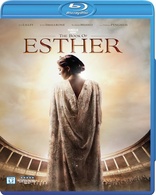

Movie rating
6.8 | / 10 |
Blu-ray rating
| Users |  | 3.5 |
| Reviewer |  | 3.0 |
| Overall | | 3.1 |
Overview
The Book of Esther (2013)
Good battles evil in this timeless story of Biblical heroism. The righteous Jew Mordecai and the despicable Haman square off for control of the young Persian King Xerxes. But Haman's plans include something horrible for Mordecai and his people. It is up to Mordecai's niece Esther to win the affection of the King, unmask Haman's treachery and save the Jewish people. Based upon the Book of Esther, this delightful retelling emphasizes the values of courage, faith and obedience.
Starring: Jen Lilley, Robert Miano, Thaao Penghlis, Mark Irvingsen, Jennifer LyonsDirector: David A.R. White
| Drama | 100% |
Specifications
Video
Video codec: MPEG-4 AVC
Video resolution: 1080p
Aspect ratio: 1.78:1
Original aspect ratio: 1.78:1
Audio
English: Dolby Digital 5.1 (448 kbps)
Subtitles
English, Spanish
Discs
25GB Blu-ray Disc
Single disc (1 BD)
Playback
Region free
Review
Rating summary
| Movie |  | 2.0 |
| Video |  | 4.5 |
| Audio | | 3.5 |
| Extras | | 2.0 |
| Overall | | 3.0 |
The Book of Esther Blu-ray Movie Review
Featuring a cast of tens.
Reviewed by Jeffrey Kauffman June 8, 2013There’s an old ad campaign that some of you might remember that begins “You don’t have to be Jewish to love. . .” (Bonus points for those who can finish that statement.) But perhaps you do need to be Jewish to, say, appreciate the big laugh Billy Crystal got when he hosted Saturday Night Live years ago and began his monologue with an over ecstatic “It’s Purim, everybody!” Similarly, it might at least help to be Jewish to fully appreciate the Biblical Book of Esther, which is in fact the basis for the “Jewish Hallowe’en” (as some have termed it) celebration of Purim. Now the funny thing about this is for the real Hallowe’en, people tend to adopt alter egos, dressing up as their favorite characters. For Purim, Jews typically (though not always) dress up as only one of the three main characters in the Esther story—Esther herself (it's not at all unusual to see hirsute men cross-dressing in this costume), her cousin Mordecai, and at least occasionally even as the villain of the piece, the despicable Haman (please begin shaking your noisemakers now). It’s an oft-repeated joke for Jews that the bulk of their festivals boil down to, “Hey, they haven’t killed us yet, let’s eat”, which in the case of Purim might be slightly amended to “Let’s also drink”. But buried beneath this unusually upbeat celebration is a rather serious story, and it’s from that basis that The Book of Esther mines its content.

Pure Flix Entertainment is a relatively small company which has been putting out Christian themed material for the past few years, including such Blu-ray titles as Brother White, Me Again, Marriage Retreat, Christmas with a Capital C , Escape, Jerusalem Countdown, The Encounter: Paradise Lost and Apostle Peter and the Last Supper, some of which were also written by The Book of Esther’s screenwriter Timothy Ratajczak.
In fact even a cursory review of many Pure Flix films’ credits shows that these films are often “family affairs” with many of the same people multitasking in various capacities. That element has both benefits and detriments. On the plus side, there's a palpable feeling of sincerity and even missionary work that comes through quite clearly in the label's offerings. On the other hand, Pure Flix obviously produces its films on what most Hollywood studios would probably not even consider a shoestring budget, but more of an aglet. For Pure Flix’s contemporary set films, that tends not to matter so much. But for its historical dramas, the paltry budgets mean that what should really be an epic comes off as more of a community theater production, with production designs that simply can’t capture the scope of the story and some performances which at times at least don’t seem quite ready for prime time (to bring Saturday Night Live into the mix again).
My sense is Pure Flix knows it’s creating product for a niche audience (albeit a rather large niche) of church groups and the like (as evidenced by a title card promoting movie ministries), people who are more than likely to overlook any niggling qualms like a lack of “finery” in sets and costumes, but the fact that Pure Flix is attempting to establish itself in the home video market probably also indicates at least a modicum of ambition, and for the company’s films to really reach out and touch the general populace, more needs to be done to support the storytelling, especially with regard to films set in the dim mists of history. As the entity becomes more successful, hopefully they'll have the capital to pour more into the look of their films, something that will help establish a sense of place. In the case of Apostle Peter and the Last Supper, the issue wasn’t quite as detrimental, since a lot of the film took place in the shabby confines of a prison, but in The Book of Esther we’re supposed to feel the terror of an entire people whose existence is threatened when at most we’re shown a gaggle of folks who would hardly constitute a Minyan.
The film starts with a disclaimer stating that it will be fictionalizing certain elements of the Esther story and that anyone interested in the tale should probably open up their Bibles and read the “original” version (though anyone who’s taken a course in Bible history will know that Esther had one of the more interesting sets of aggregations in the Old Testament, having had various additions and redactions through the centuries). We meet a young Esther and her Uncle Mordecai (a family relationship slightly changed from the Biblical version, where they're cousins). Mordecai has just had some sort of apocalyptic dream which has convinced him he needs to hide both his relationship to Esther as well as their Jewish identity. (Cynics may question why Mordecai’s dream, which is presented on screen, contains not one but several crosses as symbols of "the holy"—including some on the tops of churches—when the film is set hundreds of years before the birth of Christ. But I digress.) Years later, when Esther is a grown woman and Mordecai is obviously also quite a bit older, it turns out Mordecai's dream was in fact a warning, and that the fate of Persian Jews may rest with the evil machinations of a courtly counselor named Haman as well as a young and inexperienced King Xerxes.
The Book of Esther features lead performances by two veterans of soap operas. Jen Lilley (General Hospital) portrays the adult Esther, while Days of our Lives mainstay Thaao Penghlis takes on the role of arch-villain Haman. Lilley manages to do a creditable job balancing Esther’s wide eyed innocence, though she is perhaps a bit too contemporary for the role, something that screenwriter Timothy Ratajczak obviously wanted for the film, as he also introduces little modern day comedic touches like a sort of Rhoda Morgenstern-esque friend for Esther. Penghlis seems to be relishing the chance to sink his teeth into this really nasty bad guy, and if he’s a bit hyperbolic at times, that falls well within the purview of how Haman is typically depicted in Purim plays around the globe. Robert Miano brings some underplayed gravitas to the role of Mordecai, making for a nice balance against the larger, slightly cartoonish, Haman.
The biggest problem confronting The Book of Esther in the marketplace if not inherently may well be that a much better financed production of this same story has just debuted on Blu-ray. One Night with the King right off the bat is a film which admittedly managed to bungle the reteaming of Peter O’Toole and Omar Sharif decades after their iconic pairing in Lawrence of Arabia, but the fact that it was able to recruit two such high profile stars is some indication of the bucks it was able to throw around. Now make no mistake about it: One Night With the King is a largely tedious experience that (like The Book of Esther itself) tweaks the original Biblical story, not always to good effect. But One Night With the King at the very least has spectacle, something that if nothing else can distract the impatient viewer from risible dialogue and clunky acting. The Book of Esther may in fact be the more simple and heartfelt retelling of this story, but it’s confined in a way that tends to detract, rather than distract.
There are a couple of famous adages, one of them even Biblical, that might be applicable to these films. The first of these is "money can't buy everything", let along cinematic quality, and that's certainly the case, as One Night With the King ably proves. The other is "the love of money is the root of all evil", which perhaps is keeping Pure Flix from really investing in their product. I'd simply caution them that you don't have to love money, but you certainly have to have a healthy respect for what a little more attention to things like production design can mean for a historically set film. Verisimilitude doesn't come cheap.
The Book of Esther Blu-ray Movie, Video Quality
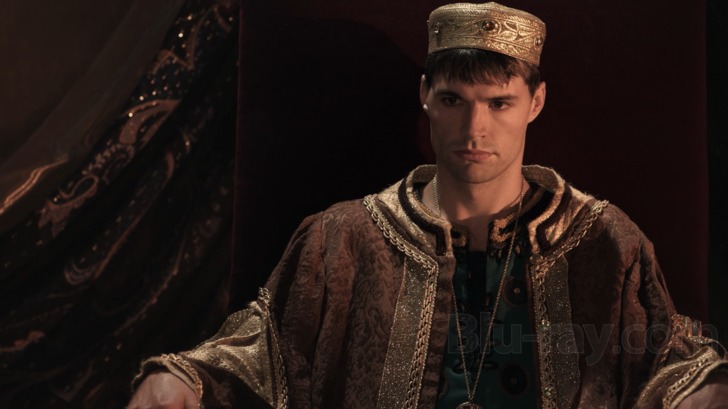
Pure Flix is upping its game in the Blu-ray market by finally adopting the more contemporary AVC codec for video compression after releasing many of its first Blu-rays with the older MPEG-2 regimen (with sometimes pretty anemic bitrates attached). The Book of Esther benefits from this AVC encoded 1080p transfer in 1.78:1 by offering a really nicely sharp and well detailed image. Even what is probably stock establishing footage (used repeatedly, unfortunately) looks really nice. The bulk of the film takes place on minimally dressed sets that look quite small, but the film offers nice fine detail that pops quite admirably in close-ups. Colors are decently robust and well saturated.
The Book of Esther Blu-ray Movie, Audio Quality
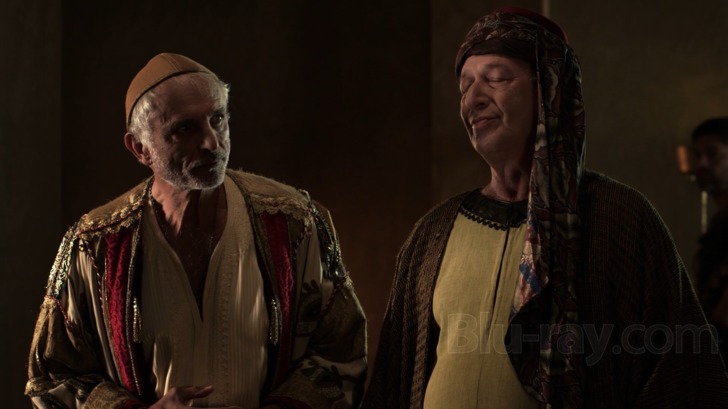
Unfortunately, Pure Flix hasn't quite figured out that high definition consumers also want lossless audio along with their well compressed video, and so The Book of Esther continues this label's tradition of offering only a Dolby Digital soundtrack, in this case a fairly well done 5.1 surround mix. The lack of a lossless track is especially unfortunate for one of this film's best elements is the really rather well done score by Will Musser, who offers a battery of percussion in his main theme that would have benefited from a lossless rendering. Otherwise, things are pretty unambitious from a sound design perspective. The bulk of the film plays out in relatively modest dialogue scenes. Occasionally when there are larger groups of people (larger being a decidedly relative term in this film), there are inklings of immersion with some good use of side channel activity. Fidelity is fine, if unremarkable.
The Book of Esther Blu-ray Movie, Special Features and Extras

- Esther Video Blogs (720p; 9:21) offers cast and crew members discussing the film and the Esther story, as well as some behind the scenes footage.
- A Tribute to Darren Rydstrom (720p; 2:45) profiles the film's Director of Photography, who sadly passed away at a very young age earlier this year.
- Director's Commentary. David A.R. White, who has starred in several Pure Flix films, as well as having written, produced and served as director for others (see what I mean by multitasking?), directed The Book of Esther. Though she isn't credited, Jen Lilley is also on hand here. This is a fairly conversational outing, but White and Lilley go into some detail about how the screenplay was constructed and the shoot. There is a lot of anecdotal information imparted about several of the cast members.
The Book of Esther Blu-ray Movie, Overall Score and Recommendation

There's an undeniable earnestness to The Book of Esther which may make it the more preferable rendition of this story for devout filmgoers who might otherwise be "wowed" by One Night With the King's physical opulence, but less convinced by its message. There is also some light comedy here, despite the serious subtext, that may make The Book of Esther enjoyable for kids. But Esther's story requires context, and unfortunately part of that context is some sense of its historical epoch. In this regard, Pure Flix shortchanges itself and its potential audience. The result is a sweet and sincere film that nonetheless never quite has the grand and glorious impact it might have.
Similar titles
Similar titles you might also like
(Still not reliable for this title)

Titanic
ITV Series
2012

Sons of Liberty
2015

Paul, Apostle of Christ
2018

The Hawaiians
1970

Brubaker
1980

The Bible: In the Beginning...
1966

To Kill a King
2003

A.D. The Bible Continues
2015

Same Kind of Different as Me
2017

Parkland
2013

The Newsroom: The Complete Series
2012-2014

Killing Kennedy
2013

The Bible: The Epic Miniseries
2013

I, Claudius
1976

Zorba the Greek
1964

Day of the Falcon
Black Gold
2011

Nuremberg
2025

Origin
2023

The Last Duel 4K
2021

Gunpowder
2017