That Evening Sun Blu-ray Movie
HomeThat Evening Sun Blu-ray Movie 
Image Entertainment | 2009 | 109 min | Rated PG-13 | Sep 07, 2010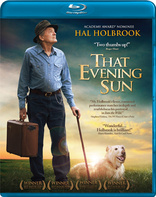
Price
List price:Listed on Amazon marketplace

Movie rating
7 | / 10 |
Blu-ray rating
| Users |  | 4.0 |
| Reviewer | | 4.0 |
| Overall | | 4.0 |
Overview
That Evening Sun (2009)
An 80-year-old Tennessee farmer, Abner Meecham, leaves the retirement home where he's been living and returns to his farm–only to find it's been leased by his son to Lonzo Choat and his family. When Abner sets out to reclaim his house and land, tensions escalate between him and Lonzo to the point of violence, and Lonzo's wife and teenage daughter are caught in the middle.
Starring: Hal Holbrook, Ray McKinnon, Walton Goggins, Mia Wasikowska, Carrie PrestonDirector: Scott Teems
| Drama | 100% |
Specifications
Video
Video codec: MPEG-4 AVC
Video resolution: 1080p
Aspect ratio: 2.35:1
Original aspect ratio: 2.39:1
Audio
English: DTS-HD Master Audio 5.1 (48kHz, 16-bit)
Subtitles
English SDH, Spanish
Discs
25GB Blu-ray Disc
Single disc (1 BD)
Playback
Region A (C untested)
Review
Rating summary
| Movie |  | 4.5 |
| Video | | 4.5 |
| Audio | | 4.0 |
| Extras |  | 3.5 |
| Overall | | 4.0 |
That Evening Sun Blu-ray Movie Review
The Dying of the Light in Tennessee
Reviewed by Michael Reuben July 10, 2013When a venerable actor known for decades of celebrated work takes a leading part in a film about an aging man in his waning days, it's natural to assume that the character will be sympathetic and appealing. One imagines someone like Christopher Plummer's Hal Fields in Beginners, who is being reborn at the same time as he is dying. (The role won Plummer an Oscar.) How striking it is, then, when a performer of Hal Holbrook's caliber goes in the opposite direction. Best known for his reincarnation of literary icon Mark Twain, with which he's toured the country for years, and more recently as part of the noble ensemble in Lincoln and as the kindly man who tried to save the doomed Chris McCandless in Into the Wild, in 2009 Holbrook took on the role of an 80-year-old farmer named Abner Meecham who emphasized the element of rage in the poet Dylan Thomas' famous command to "rage against the dying of the light". Written and directed by Scott Teems, from a short story by William Gay, That Evening Sun tells the stark, spare story of a man whose only clear virtue is his determination in the face of physical decline. The rest is for the viewer to decide. Among its many notable features, That Evening Sun is distinctively—almost defiantly—a film of the South. William Gay, a native of Tennessee, is a noted Southern writer, and Teems, a native of Georgia, was immediately attracted to his story "I Hate to See That Evening Sun Go Down". Teems' spec script received a boost when it won the 2006 Independent Film Project "Emerging Narrative" Award, but it was the screenplay's Southern flavor that spoke to actor/producers Walton Goggins (The Shield) and Ray McKinnon (Deadwood), natives of Alabama and Georgia, respectively. Together, they assembled the crazy quilt of producing and financing partners that so many independent projects seem to require. Both the director and his producers also insisted—and, in the interviews and commentary included on the Blu-ray, are clearly proud of—absolute authenticity in locations and casting. A story about a Tennessee farmer was filmed on location in and around Knoxville. The cast was composed of authentic Southerners, with two notable exceptions: Holbrook himself was born in Cleveland, Ohio, but he was considered an honorary Tennessee resident after living there for twenty-five years as the husband of actress Dixie Carter, who appears in the film in flashbacks as Ellen Meecham, Abner's late wife. (It was her final film.) The pivotal role of Pamela Choat, greatly expanded by Teems from the short story to be the film's voice of reason, went to then 19-year-old Australian actress Mia Wasikowska, who had not yet made any of the films in which she would soon be widely seen (The Kids Are All Right , Alice in Wonderland, Jane Eyre), but whose talent was already undeniable.
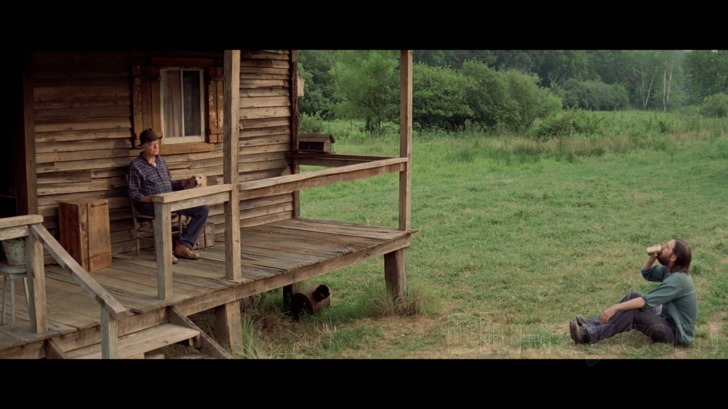
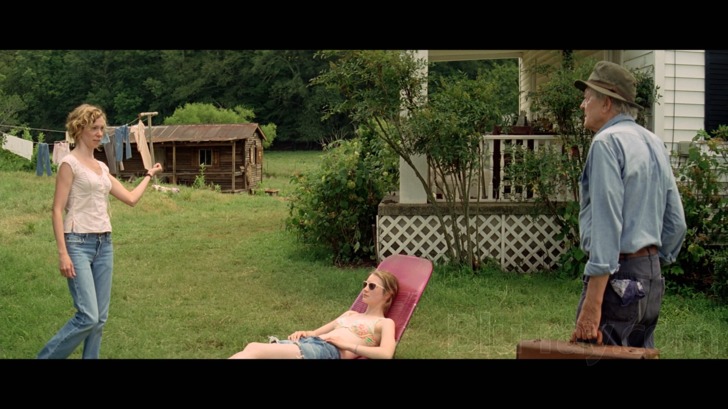
Teems opens the film with a five-minute sequence of purely visual storytelling that says much about Abner Meecham. We find him in a retirement home, sullen, silent and unhappy. He will later say that he felt more alone there than when he was on his farm with no one around. One day Abner packs his bag, walks out the door and departs on foot under a bright sun. When he reaches a bridge over a stream, he looks around, considers the additional effort, then deposits his bag by the roadside and carefully climbs down for a drink. That's when the taxi hired by the retirement home pulls up and the cabby (Barlow Jacobs) gets out. The short exchange that follows tells you everything else you need to know about Abner. He's direct, to the point, fully in possession of his faculties and determined to return to his farm. He offers the cabby more to take him there than the retirement home is paying to fetch Abner, and the cabby readily agrees. Arriving home, Abner finds young Pamela Choat (Wasikowska) sunbathing outside his house and her mother, Ludie (Carrie Preston, True Blood), inside the house. They are shortly joined by husband and father, Lonzo Choat (McKinnon), who has rented the property for 90 days, with an option to buy, from Abner's son, Paul Meecham (Goggins), who has been appointed as guardian for his father. Abner knows nothing of these arrangements and tells the Choat family to clear off his land. Quite understandably, they refuse. Abner spends the night in the nearby "tenant shack", a barely habitable structure where his personal property has been stored. Then he decides to take up permanent residence there, and a war of nerves begins between Abner and Lonzo Choat, of whom Abner has always held a low opinion (and never hesitates to express it anew). Because the telephone in Abner's house has been disconnected (which gives a clue about the state of the Choat family finances), Paul Meecham doesn't learn of his father's whereabouts until Abner walks to the home of his neighbor and friend, Thurl Chessor (the fine Texas-born character actor, Barry Corbin), who has a working phone. Paul is an attorney in the city, and as Abner's medical history emerges, it becomes clear that Paul has been trying to make the best arrangements he can for his father. The problem is simply that the two men cannot communicate across the massive gulf that separates them and has probably always been there, even before Paul's mother died. There's more to Lonzo Choat than the drunken, lazy good-for-nothing that Abner sees. Among other things, Lonzo has a wife and child depending on him, and Abner seems indifferent to the impact that his battle with Lonzo will have on Ludie and Pamela, even when he's presented with graphic evidence in the form of Choat's rage, stoked by Abner, boiling over at Pamela. (Abner just uses the occasion as an opportunity to one-up Lonzo by reporting him to the police.) Lonzo may not have amounted to much so far, but with Ludie's encouragement, he is trying, perhaps for the first time in his life, to make something of himself by farming Abner's land. He just doesn't have much experience with success, and Paul Meecham's 90-day lease has him on a short leash. Abner's arrival was an additional burden he didn't need. Teems is the kind of storyteller who deliberately does not tag characters as "good" or "bad". The closest he comes is with the character of Pamela, from whose youthful perspective the battle between her father and this odd (but interesting) elderly man makes no sense. That's a necessary perspective in a film that ultimately doesn't choose sides but simply gets you in close, sometimes uncomfortably so, to people at critical junctures in their lives, motivated by primal forces from deep inside. They are who they are, and they cannot be otherwise. The end of the film, which extends William Gay's short story beyond its original stopping point but in a manner wholly consistent with the story's resolution, is a logical outcome of the conflict that has intensified throughout the film, but it is also not a predictable result. Indeed, Teems and his marvelous cast have pulled off the delicate trick of creating a conclusion that is both satisfying and ambiguous. You can't say for sure what happened, but it feels right anyway.
That Evening Sun Blu-ray Movie, Video Quality
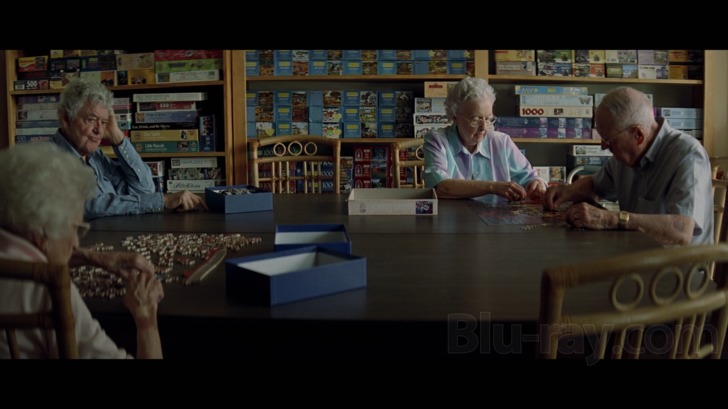
As described in the commentary, cinematographer Rodney Taylor shot That Evening Sun on film using older lenses that softened the image for a "period" look, even though the film isn't a period drama. The goal was to capture a sense of an older style of living in a less developed part of the country. Contrary to standard modern practice, all color correction was performed photochemically, without the aid of such tools as a digital intermediate. Teems believes these resources have made filmmakers lazy, because they defer too many decisions until post-production, instead of making firm decisions about what they want on the set with the actors present. Image Entertainment's 1080p, AVC-encoded Blu-ray represents a first-rate scan from pristine source material. The only telltale sign that the source was not a digital file is a slight tremor on some of the opening credits (probably caused by shifting of the film element as it travels across the scanner) and almost imperceptible amounts of video noise from time to time (probably resulting from the same cause). Otherwise, the image is finely detailed, though without the hard edges that Taylor's lens selection was intended to avoid. Every crease and crag in Holbrook's time-worn face is visible and expressive, as are the minute details of the detritus in the tenant shack, the household items used by the Choats and the fine lines of Dixie Carter's face and hands in Abner's flashbacks to his life with Ellen. Grass, trees, fields and the road that Abner walks are equally finely detailed. The blacks of night are deep, and shadow detail (e.g., inside the tenant shack) are well-delineated. The film's grain pattern appears natural and undisturbed by filtering, artificial sharpening or other digital manipulation. The average bitrate of 11.01 Mbps came as a surprise to me when I checked it, because it seemed far too low for the quality of the image I had viewed. But then I considered the film's style, which favors long and medium shots situating a character in a frame with relatively little motion. An efficient codec like AVC can take advantage of such scenes to conserve bits, which are then available for more demanding scenes with fast motion and multiple edits. The Evening Sun has very little of the latter.
That Evening Sun Blu-ray Movie, Audio Quality
The film's original 5.1 track is presented in lossless DTS-HD MA 5.1. It's a spare but effective mix that places gentle sounds of nature in the surrounds, primarily wind, rustling of leaves and grass, and the buzzing of insects. With the exception of a barking dog, a few loud pistol shots, and a big effect near the film's end that cannot be described without spoilers, there is no major demand on the track's dynamic range or bass extension. The dialogue has to be clearly rendered, and it is. The original soundtrack score was written by Michael Penn (currently married to Aimee Mann and the composer for HBO's Girls ), but there are several songs on the track written by Jimmy Rodgers, whose "Blue Yodel #3" contains the line that provided author William Gay with the title of his original short story. Both the songs and Penn's score have a haunting presence on the Blu-ray's track.
That Evening Sun Blu-ray Movie, Special Features and Extras
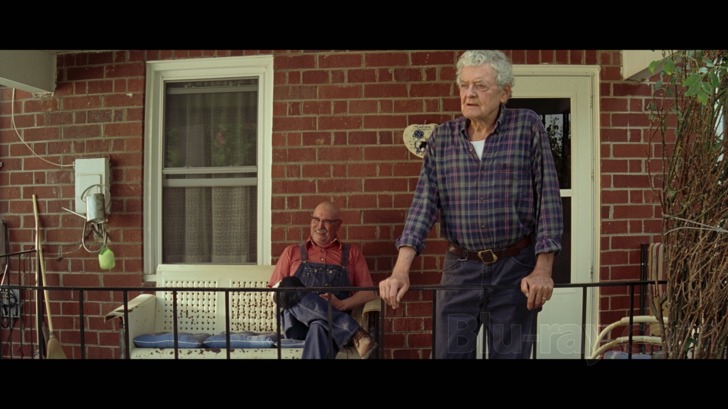
- Director's "Anti-Commentary" with Writer-Director Scott Teems, Director of Photography Rodney Taylor, ASC and Editor Travis Sittard: Teems explains at the outset what he doesn't like about many DVD and Blu-ray commentaries and extras (hence the label "anti-commentary"). He objects to filmmakers showing all the parts they cut out, whether as deleted scenes or in director's cuts, and he doesn't like commentaries that are trips down memory lane ("Remember that day when . . . ?"). In keeping with that philosophy, his discussion with his DP and editor is not "scene-specific", but focuses on their shared philosophy of movie-making and their general approach to the design and realization of That Evening Sun. Much of the discussion is well worth pondering, e.g., Teems's thoughts on how digital cinema has caused young filmmakers to become undisciplined in their storytelling.
- "That Tennessee Sun . . . " The Making of That Evening Sun, in Music and Image (720p; 1.78:1; 9:12): A montage of behind-the-scenes footage, set to music from the soundtrack.
- The Art and Craft of That Evening Sun (720p; 1.78:1; 34:01): "The Art and Craft" was a podcast series hosted by Michael Dunaway of Paste magazine that focused on independent film. The installment studies a critical scene between Lonzo and Ludie Choat, with contributions assembled and edited together by Dunaway from all of the creative talent (interviewed by telephone). The compilation has been illustrated with a combination of photographs and low-resolution excerpts from the film.
- Cast Interviews (720p; 1.78:1; 7:06): Frank and informative.
- Hal Holbrook (7:06)
- Raymond McKinnon (5:44)
- Walton Goggins (4:57)
- Mia Wasikowska (3:46)
- Carrie Preston (3:39)
- Dixie Carter (4:53)
- Crew Interviews (720p; 1.78:1; 46:19): Somewhat less focused and more broadly ranging than the actors' comments, but still informative.
- Scott Teems, Writer-Director (9:48)
- William Gay, Author (6:52)
- Rodney Taylor, ASC, Director of Photography (6:15)
- Mara LaPere-Schloop, Production Designer (5:36)
- Alexis Scott, Costume Designer (5:40)
- Terence Berry & Laura Smith, Producers (5:47)
- Raul Cellaya & Larsen Jay, Executive Producers (6:18)
- Trailer (480i; 2:20:1; 2:24): As much as a trailer can, it fairly represents the film.
- Additional Trailers: At startup, the disc plays trailers (in 480i, enhanced for 16:9) for Blood Done Sign My Name, Multiple Sarcasms and $5 a Day. These can be skipped with the chapter forward button and are not otherwise available once the disc loads.
That Evening Sun Blu-ray Movie, Overall Score and Recommendation
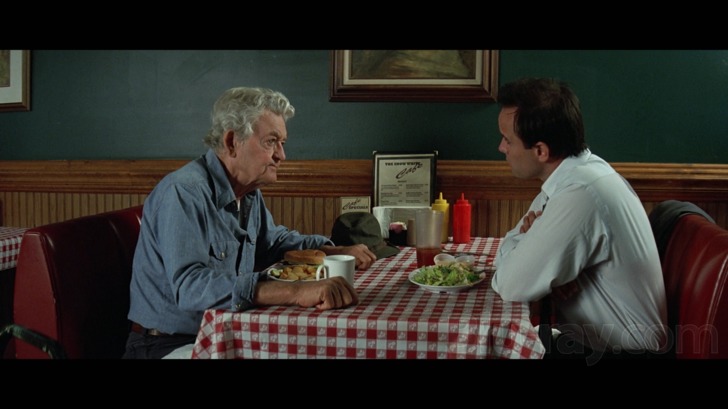
Hal Holbrook's portrayal of Abner Meecham represents the distillation of a lifetime's performing experience, and it's screen acting in its purest perform. Holbrook doesn't "play" Abner; he simply is Abner, and for just under two hours we watch how Abner behaves and others react to him. Lonzo is angered; Ludie is frightened; Pamela is intrigued; Paul Meecham is frustrated; Thurl Chessor is alternately bemused and concerned. For a few days, all eyes are focused on Abner, and everyone waits to see what he does next. There are those who would say that this was Abner's goal all along, and that all he wanted was attention. But one of the many strengths of Teems's film is that he shows us, in Abner's private moments, away from everyone else, how ill-equipped they all are to give Abner whatever it is he yearns for—and it isn't anything as simple as the wife who is no longer there with him. Abner himself barely knows what he wants, but he knows that he can only find it on his own, alone with his thoughts, watching the evening sun go down. Highly recommended.

Similar titles
Similar titles you might also like
(Still not reliable for this title)

Yellowstone: The Complete Series
2018-2024
Destination Moon
1950

Tender Mercies
1983

Blood and Sand
1922

Hounddog
2007

The Candidate
1972

El Paso
1949

That Man Bolt
1973

The Wild Angels
1966

The Court-Martial of Billy Mitchell
One Man Mutiny | Special Edition
1955

Brimstone
2016

Escape from Zahrain
4K Restoration
1962

The Wilby Conspiracy
1975

The Indian Runner
1991

Before and After
1996

Return to Macon County
1975

Great Expectations
2012

Starsky and Hutch: Complete Series - Seasons 1 - 4
1975-1979

Knights of the Round Table
Warner Archive Collection
1953

Commando Cody: Sky Marshal of the Universe
1953