Swimming to Cambodia Blu-ray Movie
HomeSwimming to Cambodia Blu-ray Movie 
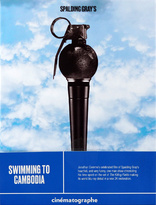
Spalding Gray's Swimming to Cambodia | Limited EditionCinématographe | 1987 | 84 min | Not rated | Jun 03, 2025
Price
Movie rating
7 | / 10 |
Blu-ray rating
| Users |  | 0.0 |
| Reviewer |  | 4.5 |
| Overall | | 4.5 |
Overview
Swimming to Cambodia (1987)
Spalding Gray discusses his participation in the film The Killing Fields (1984) and the background story about the troubles of Cambodia.
Starring: Spalding GrayDirector: Jonathan Demme
| Drama | Uncertain |
| Dark humor | Uncertain |
| Other | Uncertain |
| Comedy | Uncertain |
| Biography | Uncertain |
Specifications
Video
Video codec: MPEG-4 AVC
Video resolution: 1080p
Aspect ratio: 1.85:1
Original aspect ratio: 1.85:1
Audio
English: DTS-HD Master Audio 2.0 (48kHz, 24-bit)
Subtitles
English SDH
Discs
Blu-ray Disc
Single disc (1 BD)
Playback
Region A (C untested)
Review
Rating summary
| Movie | | 4.5 |
| Video | | 4.5 |
| Audio |  | 4.0 |
| Extras | | 4.5 |
| Overall | | 4.5 |
Swimming to Cambodia Blu-ray Movie Review
Reviewed by Brian Orndorf July 3, 2025Spalding Gray wanted to be an actor. Jobs weren’t exactly plentiful, but he received an opportunity to be part of a prestige movie when he scored a small part in 1984’s “The Killing Fields,” a picture that detailed the grim experience of the Khmer Rouge regime in Cambodia during the 1970s. The feature would go on to become a minor hit at the box office and win several awards at the 1985 Oscars. However, to Gray, it was a job, and one that took him across the world to Thailand for filming, placing the New Yorker in the middle of an alien environment that carried heavenly qualities, especially for those interested in hedonistic pursuits. Using the experience to fuel a stage event, Gray turned his time on “The Killing Fields” into a monologue, using “Swimming to Cambodia” to dramatically share pieces of his life and the depths of his brain, sold in a furious, colorful manner by director Jonathan Demme as stories and reflections pour out of the monologist for 80 minutes.
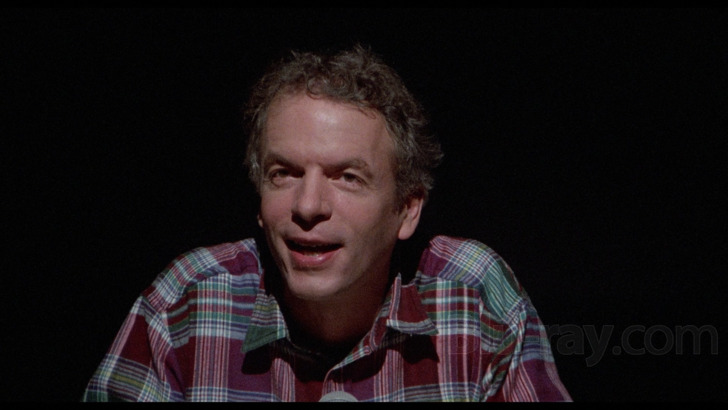
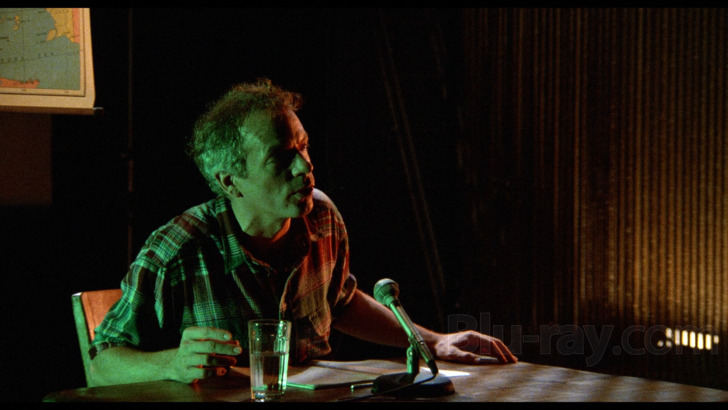
A brief glimpse of the outside world is presented at the beginning of “Swimming to Cambodia.” We watch Gray make his way through New York City, on a mission to reach The Performing Garage where a crowd is awaiting his arrival. Gray sits at a table onstage, armed with a microphone, a glass of water, and a Ronald McDonald notebook containing his thoughts. Soon enough, “Swimming to Cambodia” takes off, following Gray’s lead as he pulls viewers back to 1983, where he meets director Roland Joffe (a mix of “Zorro, Jesus, and Rasputin”), encountering a filmmaker looking to turn the troubling tale of the Khmer Rouge experience into a feature with depth and emotion.
Gray examines all of his feelings in “Swimming to Cambodia,” going into depth about his Thailand days, finding himself in a tight position as his New York City responsibilities failed to match Thai possibilities, spending down time with interesting people and compelling drugs, also exploring the country’s reputation for prostitution and other forms of companionship. Gray is also committed to providing a sense of history to the region and the birth of the Khmer Rouge, introducing maps to help make regional position perfectly clear as he tries to get educational in “Swimming to Cambodia.” Demme’s job is to bring something made for the stage to the screen, working with cinematographer John Bailey and editor Carol Littleton to add a mild sense of visual ferocity to the endeavor, keeping up with Gray’s fits of emotion and reaction, also selling his one-man-show forms of communication with absolute clarity.
Swimming to Cambodia Blu-ray Movie, Video Quality
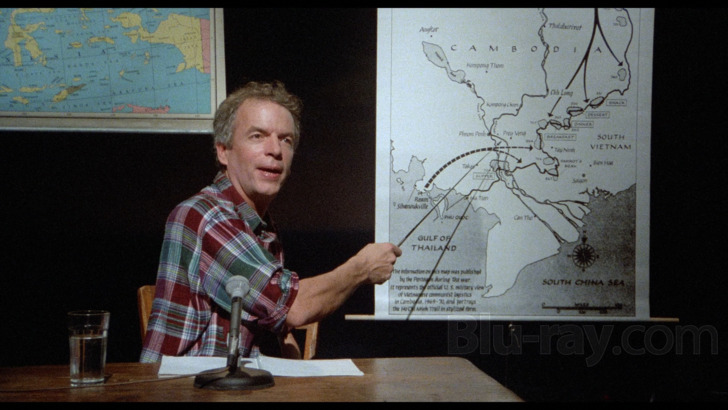
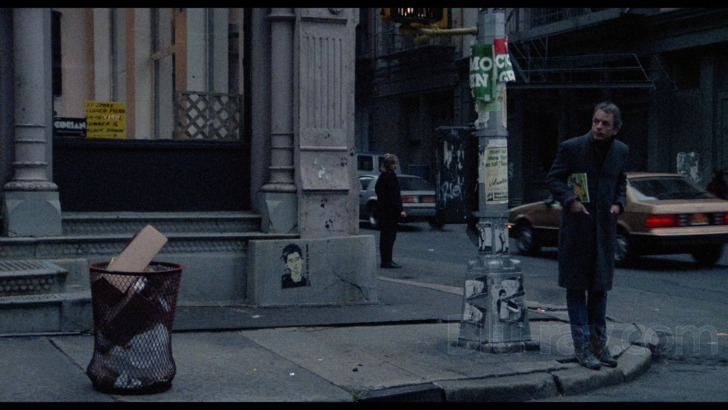
The AVC encoded image (1.85:1 aspect ratio) presentation for "Swimming to Cambodia" is listed as a "new 2K restoration from the 35mm original camera negative." Of course, this feature isn't built to wow visually, but there's a defined cinematic look to the endeavor that's nicely delivered on this release. Detail is strong, exploring Spalding Gray's appearance, from his wiry hair to the fibrousness of his flannel shirt. Skin particulars are also appreciable as intensity gets the monologist sweatier, and white spittle begins to form on his mouth. Map displays are clear, and stage position is dimensional. Very brief opening moments on the streets of New York City maintain depth. Color is exact, maintaining natural skin tones and grey hair. Clothing choices deliver rich reds and subtle greens, and visual displays offer vivid hues. Cooler moods of the city are noted in the opening, touring the concrete world. Delineation is satisfactory. Grain is nicely resolved. Source is in good condition.
Swimming to Cambodia Blu-ray Movie, Audio Quality
The 2.0 DTS-HD MA mix for "Swimming to Cambodia" encounters some elements of age and mild damage, but nothing prolonged. Gray's performance remains intelligible and dramatic, offering a balanced sense of his dramatic emphasis and periodic yelling fits. Scoring is sparse but understood, with acceptable instrumentation.
Swimming to Cambodia Blu-ray Movie, Special Features and Extras
- Booklet contains essays by Marya E. Gates, Chris Shields, Keith Uhlich, and David M. Stewart.
- Commentary features film critic Scout Tafoya.
- "Lifting up the Carpet" (20:36, HD) is an interview with filmmaker Roland Joffe, who originally cast Spalding Gray in his 1984 film, "The Killing Fields." The interviewee examines his experience on the feature, drawn to its themes, emotions, and politics, also responding to the professional opportunity, as the picture was Joffe's helming debut. The conversation eventually gets around to Gray and his performance in "The Killing Fields," noting the actor was around for the length of production. Joffe was happy to have Gray nearby to help brighten the mood, also dealing with the man's unusual ways, including his reluctance to return home after completing his part.
- "A Good Story is a Good Story" (12:29, HD) is an interview with executive producer Ira Deutchman, who was an employee at the company Cinecom, describing the loose definition his "producer" role, playing more of a part in financing "Swimming to Cambodia." Delighted with "Stop Making Sense," Deutchman was committed to working with director Jonathan Demme, winning a chance to make the Spalding Gray movie, satisfied with the cinematic potential of the endeavor. Marketing "Swimming to Cambodia" proved to be a challenge, requiring careful handling to hide the feature's content in hopes to surprise ticket-buyers. The interviewee also recalls his time with Demme and shares his appreciation of the film.
- "The Great Sensorium of the World" (13:21, HD) is an interview with producer Edward Saxon, who created a relationship with director Jonathan Demme during his time as an intern on one of his productions. Joining the filmmaker on many of his creative endeavors, Saxon followed Demme into "Swimming to Cambodia," ready for the technical and creative challenges of the movie. The interviewee shares his memories of Demme and Spalding Gray and their days together, also highlighted the special nature of Gray's material and performance skills.
- Interview (16:44, SD) is an undated discussion of "Swimming to Cambodia" with director Jonathan Demme, who connected to the picture through a relationship with a producer. Viewing time on the feature as a "tonic," Demme was eager to make another "performance film," teaming up with star Spalding Gray to work on the material, transforming it into a cinematic experience without sacrificing its stage presentation. The interviewee examines technical challenges and use of "The Killing Fields," thrilled to employ clips in "Swimming to Cambodia" to help provide context for viewers. Editorial achievements are celebrated, as Carol Littleton's labor on the offering required "no notes," and she was married to cinematographer John Bailey, who also contributed memorable work. Demme is thrilled with the "perfect film," also tracking Gray's special gifts and troubled life.
- "Jonathan Demme's Real Life Characters" (64:20) is an episode of the Pure Nonfiction Podcast.
- "Jonathan Demme and Renee Shafransky on Spalding Gray" (29:08) is an episode of the Pure Nonfiction Podcast.
- And a Theatrical Trailer (:50, SD) is included.
Swimming to Cambodia Blu-ray Movie, Overall Score and Recommendation
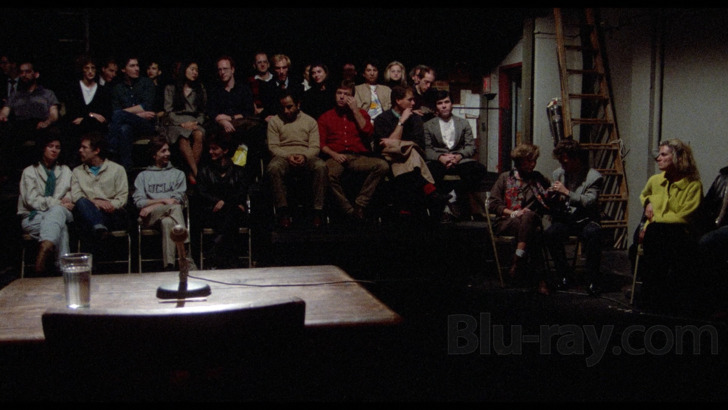
"Swimming to Cambodia" heads in multiple directions, keeping up with Gray as he reflects on his OCD, confessional train rides with strangers, the Thai prostitute experience, physical and dramatic commitments to "The Killing Fields," New York City neighbors, and his encounter with death in the Indian Ocean. It's a spare picture, rarely stepping away from Gray's presence, allowing him to feverishly articulate memories and moments from a colorful time in his life. It's somewhat miraculous that "Swimming to Cambodia" never slips into dullness, watching Gray and Demme work to transform a man at a table sharing stories into riveting cinema at times, giving viewers a front row seat for the monologist's unique perspectives and sometimes volcanic performance.
Other editions
Swimming to Cambodia: Other Editions

Similar titles
Similar titles you might also like

Jo Jo Dancer, Your Life Is Calling
1986

Querelle
1982

Gray's Anatomy
1996

Chameleon Street
1989

The Boys in the Band
1970

I Used to Be Funny
Slipcover in Original Pressing
2023

Wiener-Dog
2016

Listen Up Philip
2014

Underground
Подземље / Podzemlje
1995

Cyrano de Bergerac
1990

Kinds of Kindness
2024

Ugly, Dirty and Bad
Brutti, sporchi e cattivi
1976

Trust
1990

Hi, Mom!
1970

Chained for Life
2018

Women on the Verge of a Nervous Breakdown
Mujeres al borde de un ataque de nervios
1988

Happiness 4K
1998

Entertaining Mr Sloane
1970

Storytelling
2001

In the Soup
Slipcover in Original Pressing
1992