Stella Maris Blu-ray Movie
HomeStella Maris Blu-ray Movie 
Blu-ray + DVDVCI | 1918 | 84 min | Not rated | Dec 12, 2023


Price
List price:Amazon: $17.12 (Save 43%)
Third party: $17.12 (Save 43%)
Only 16 left in stock (more on the way).

Movie rating
7.4 | / 10 |
Blu-ray rating
| Users |  | 0.0 |
| Reviewer |  | 4.0 |
| Overall | | 4.0 |
Overview
Stella Maris (1918)
Two young women - a paraplegic girl sheltered by her wealthy guardians and a more experienced orphan - fall in love with a man separated from his violent wife.
Starring: Mary Pickford, Ida Waterman, Herbert Standing, Conway Tearle, Marcia ManonDirector: Marshall Neilan
| Drama | 100% |
Specifications
Video
Video codec: MPEG-4 AVC
Video resolution: 1080p
Aspect ratio: 1.35:1
Original aspect ratio: 1.33:1
Audio
English: Dolby Digital 2.0 (320 kbps)
Subtitles
None
Discs
Blu-ray Disc
Two-disc set (1 BD, 1 DVD)
DVD copy
Playback
Region free
Review
Rating summary
| Movie |  | 3.5 |
| Video |  | 4.5 |
| Audio | | 4.0 |
| Extras |  | 3.0 |
| Overall | | 4.0 |
Stella Maris Blu-ray Movie Review
Reviewed by Kenneth Brown December 14, 2023It's always a pleasure and a privilege to discover or rediscover a piece of filmmaking history, often times in a film that's been long forgotten or overlooked by even the most knowledgeable moviegoer. In 2023 it's so easy to take things for granted -- color on screen, a single actor playing two roles yet sharing scenes with "one another", double exposure photography, complex editing, shots of beautiful clarity free of distortion -- and yet we do it, and do it again, and do it again. But there's decades of films that brought us to a place we could shrug our shoulders and munch or our popcorn, unimpressed with the magic we're watching unfold before our eyes. Stella Maris is one of those early pictures that moved the chains. Audiences were awed and it helped pave the way for new, wondrous developments in moviemaking that would inspire generation after generation of filmmaker to push boundaries and what is possible in cinema. No, Stella Maris and its team (Mary Pickford, Frances Marion, Marshall "Mickey" Neilan and others) were simply a part of the growing legions of visionaries who could see the potential of film, dreamed all they could dream, and found a way to make it happen on screen.
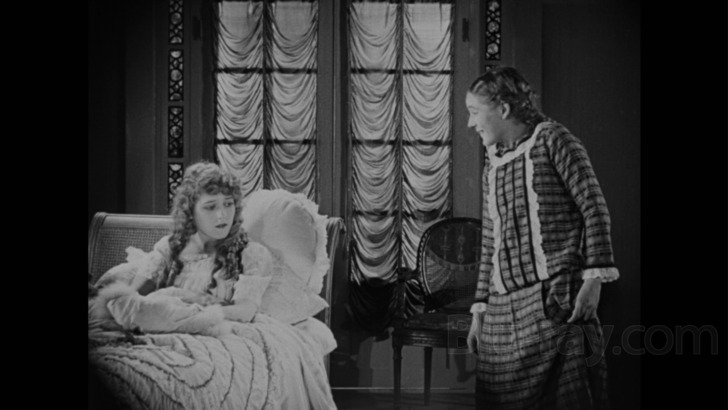
Stella Maris (Mary Pickford), an invalid, is brought up by a circle of adoring relatives and servants in the comfortable home of her uncle and aunt, the kindly Sir Oliver (Herbert Standing) and Lady Blount (Ida Waterman). Blissfully unaware of the strife and hardship of the outside world, Stella looks forward to the day when she will be able to call on her favorite visitor, John Risca (Conway Tearle). Unknown to her, however, John is trapped in an unhappy marriage to Louise (Marcia Manon), an alcoholic. In another part of town lives Unity Blake (also played by Mary Pickford), an orphan who has been treated cruelly all of her life. Louise offers to adopt Unity in the hope of securing a permanent maid, but one day, she beats the girl senseless in a drunken tirade. When Louise is imprisoned for her crime, John adopts Unity, who soon comes to adore him. Meanwhile, Stella's paralysis is cured by an operation, but with her first ventures into the world, she becomes aware of life's struggle and cruelty. The film is directed by Marshall Neilan, written by Frances Marion and based on a novel by William J. Locke.
The silent film's story is succinct, quaint melodrama by today's measure but the actors, born on the stage and embracing the screen, use their expressions and gracefully overexaggerated movements to great effect. It's difficult to judge performances because so much of silent filmmaking relied on an audience -- typically untrained in any language of cinema and unacquainted with watching an array of movies -- understanding precisely what was going on. Cards appear on screen with dialogue and key plot points, sure. But it's those faces... the swoons, the thought, the yearning, the grasping, the rejection, the love, the hate; it's the emotions and dance between characters, particularly when Pickford shares the screen with Pickford, and her ability to forge two very different women (Stella and Unity) in a fire that hadn't burned before. Placed properly in its context and era, Stella Maris is a fine little film -- too long for its own good -- but effortless in its storytelling and actually surprising in the lengths and into the darkness that the story takes its characters.
Stella Maris Blu-ray Movie, Video Quality
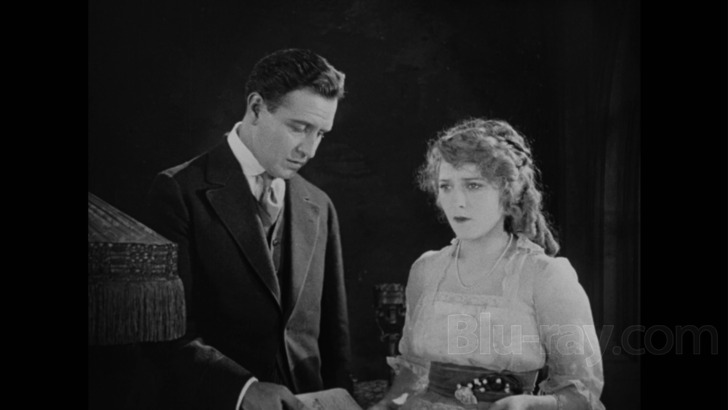
From the Pickford Foundation and the producers of the 1080p/AVC-encoded video transfer of Stella Maris featured on this VCI release,
written by Jeff McCarty of the Paramount Film Archive: The
Mary Pickford Foundation and the Paramount Film Archive partnered to access all elements available in the Pickford collections, both at the UCLA Film
&
Television Archive and at The Library of Congress. Even though the archives were shut down during the Covid-19 pandemic, all parties cooperated to
send the film elements to Paramount so they could be scanned in 4K resolution and commence work on the restoration.
The two primary elements used in this restoration were a 1967 35mm B&W Dupe Negative and an incomplete 1925 35mm Tinted Print. Scans from
the
Dupe Negative were used for the majority of the feature, and all surviving material from the print was inserted wherever possible. New inter-titles
were
digitally recreated for the Dupe Negative to match the feel and length of the Print, as the cards in the Negative were static and much longer than
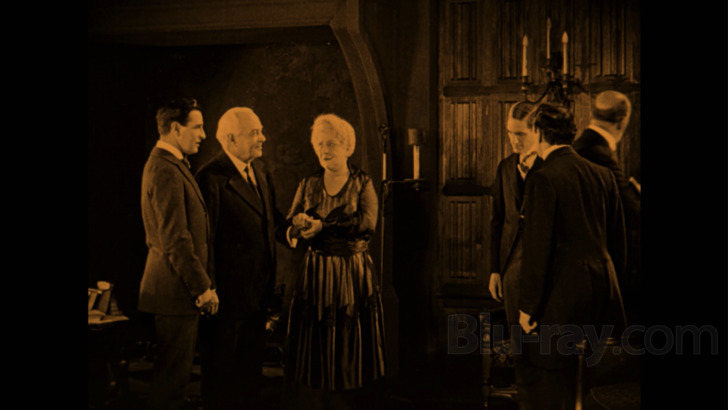
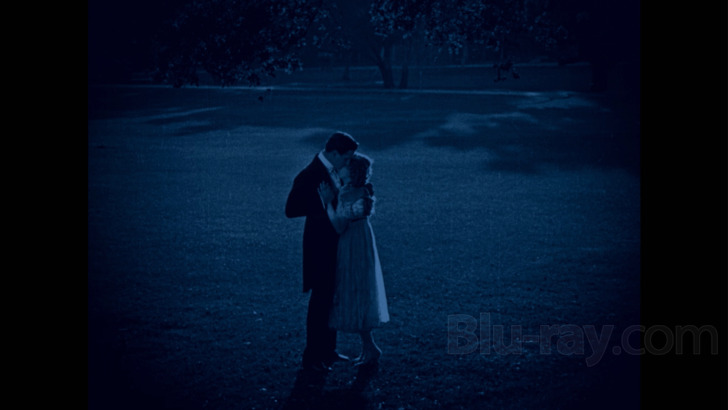
originally intended. The tinting scheme of the Print was used for all evening sequences: amber for night interiors and blue for night exteriors, with the
rest of the feature presented in black and white for daytime sequences. Lastly, all the most egregious damage was digitally repaired, the film's
printed-in jitter was stabilized, and the film's framerate was digitally varisped to 19fps, mirroring a more natural, hand-cranked projection speed
suitable for 1918, the year of the film's release.
Side note: what is "varisped" or "varispeed"? It's a feature of audio recorders (typically tape-based, although emulated digitally) that allows for both
the time and pitch of a recording to be raised and lowered by a percentage, through the use of a pitch or speed control on the recorder. Many current
digital audio programs allow for both time and pitch elements to be altered independently of each other, which allows for powerful time and pitch
correction editing features. The term varispeed also gets used occasionally in reference to synchronization, because in order for one machine to stay
synced to another it must be able to vary its speed according to the master machine.
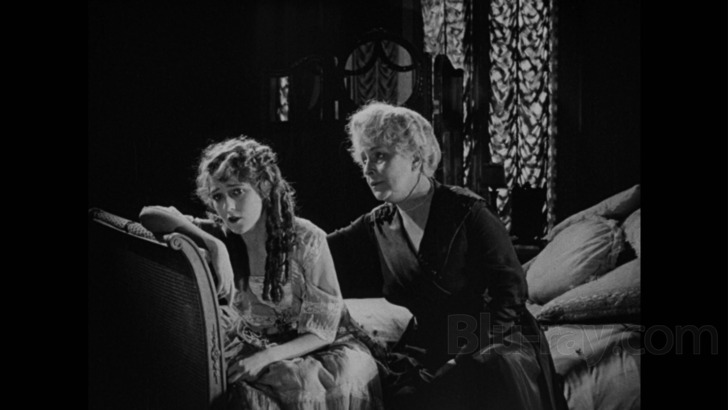
With all that said -- whew -- on to the 1080p presentation itself. Despite all the challenges, all the obstacles, all the damage and missing bits of film,
Stella Maris looks terrific. A few scratches, lines and other bits and pieces of film wear and tear are still present but they're rare. The
restoration team did a good job digitally removing them, as well as adjusting everything that was adjusted; there's virtually no hiccups or oddities to
report. The film not only looks great, its stabilization nor the removal of all of its problematic traits have left us with a lesser image. Gray gradients
are smooth, black levels are nice and inky, and white areas of the screen are balanced well, without having pushed contrast or the brightness of the
picture too high. Its pleasing appearance isn't affected by the occasional shifts to amber or blue-tinted sequences either, although it takes a little
getting used to when you first encounter a change-over. (I would've preferred the entire film to be restored to black and white but I also appreciate
the thought that went into the use of the B&W, amber and blue.) Detail is relatively strong throughout, grain is present and natural (despite no doubt
being digitally reinserted) and edge definition is notable. Softness presses in and retreats often, but it's clear it's a product of the original
photography. Likewise, lens edges sometimes invade the outer perimeter of the image. If you've never encountered this before, take a breath. It's
par for the course.
All told, the Blu-ray presentation of Mary Pickford isn't perfect, but based on the producers' notes, it won't ever be
perfect. Other than a 4K release, which would be a pixel-by-pixel superior way to present a 4K scan and restoration -- it isn't going to get better than
this. Kudos to all involved.
Stella Maris Blu-ray Movie, Audio Quality
'Stella Maris' was the perfect silent vehicle for us, as composers, to showcase our style of delivering simple, yet highly emotional thematic cues. The
process was about clearing the clutter, paring back whenever necessary to elevate the film with music, rather than to drown it out. The story itself
demanded a "less is more" approach in the musical arena, succumbing to its thought-provoking and captivating story from the very beginning. We
sought simplification in the approach to our orchestration, allowing the film to translate the proper emotions. We created the musical template at
Sterling Silver studios in Van Nuys, California. This is where we wrote the score and performed many of the instruments such as guitar and celeste. It is
also where we fine-tuned our themes, adding texture to enhance the action on the screen. We then arranged for some incredibly talented musicians to
add layers of instrumentation to accentuate the score at Savannah Studios in Boyle Heights. The Graves Brothers had the honor of working with Ginny
Luke on Violin, Viola and vocals, and Sean Sonderegger on clarinet and bass clarinet. Ian Roller captivated us with his layering of flute and with
harmonious solo performances. Quenton Blache delivered a mesmerizing cello performance that glued the score together. We recorded all these gifted
musicians at Savannah Studios with the guidance of Ignacio Gonzalez, who recorded the instruments and mixed the score for the final outcome.
The Blu-ray release of Mary Pickford doesn't offer any lossless audio option, which is a surprise, but if you didn't check the specs or the back
cover-art, you probably wouldn't notice the difference when listening to the film's lossy 320kbps Dolby Digital stereo AC3 mix. (If that comment sends
you scurrying to the forum, please don't. I already know what you'll say.) There isn't any dialogue to speak of (har har, puns) but the new music sounds
quite good. It evokes the tone and tenor of a 1918 silent film without the warble and tinniness that litter early cinematic productions, and all of the
instrumentation lifts, dips and soars accordingly. It would have been interesting to hear a more spatially engaging orchestral presentation. Imagine a
5.1 mix that places the listener in the music studio. Or better yet, give the illusion that you're sitting inside an early 20th century
theater, listening to a live orchestra play along with Stella Maris as the sound echoes along the walls of a cramped auditorium. Ah well, it's a
tiny nitpick anyway. There's not much else you could ask for here.
Stella Maris Blu-ray Movie, Special Features and Extras
- Audio Commentary - Author and film historian Marc Wanamaker offers a comprehensive overview of the film's genesis, its production, casting and actors, groundbreaking film techniques, its legacy and more.
- The Mountaineer's Honor (HD, 15 minutes) - This 1909 American Biograph short film was newly remastered in high definition and a new original score from the Graves Brothers.
- Extensive Photo Gallery (HD, 4 minutes)
Stella Maris Blu-ray Movie, Overall Score and Recommendation
The Blu-ray release of Stella Maris is far more successful than I expected thanks to an excellent restoration and video presentation, a solid little stereo mix and a decent selection of special features. Amateur film historians will get a lot out of this one, although I suspect the average moviegoer will walk on by, allowing this groundbreaking piece of cinematic history to be forgotten once again.
Similar titles
Similar titles you might also like
(Still not reliable for this title)

The Children's Hour
1961

Sparrows
1926

Two Weeks in Another Town
2 Weeks in Another Town
1962

Driftwood
1947

Manpower
Warner Archive Collection
1941

Manhandled
1924

No Down Payment
Limited Edition to 3000
1957

Arrowsmith
Warner Archive Collection
1931

You Never Know Women
1926

The Cobweb
Warner Archive Collection
1955

A Letter to Three Wives
Fox Studio Classics
1949

Hilda Crane
Limited Edition to 3000
1956

Sherlock Holmes
1922

All I Desire
1953

The Mortal Storm
Warner Archive Collection
1940

There's Always Tomorrow
1955

The Silver Horde
1930

St. Martin's Lane
The Vivien Leigh Anniversary Collection
1938

Hold Back the Dawn
Arrow Academy
1941

The Lost Moment
1947