Moses and Aaron Blu-ray Movie
HomeMoses and Aaron Blu-ray Movie 
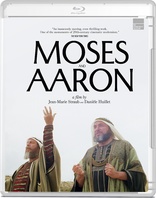
Moses und AronGrasshopper Film | 1975 | 107 min | Not rated | Nov 28, 2017
Price
List price:Listed on Amazon marketplace

Movie rating
7 | / 10 |
Blu-ray rating
| Users |  | 0.0 |
| Reviewer |  | 4.0 |
| Overall | | 4.0 |
Overview
Moses and Aaron (1975)
In expressive, melodic tones, the fraternal pair debate God's true message and intent for His creations, a conflict that leads their followers - in extravagantly choreographed song and dance - towards chaos and sin.
Starring: Günter Reich, Louis Devos, Eva CsapoDirector: Danièle Huillet, Jean-Marie Straub
| Foreign | 100% |
| Drama | 80% |
| Music | 5% |
Specifications
Video
Video codec: MPEG-4 AVC
Video resolution: 1080p
Aspect ratio: 1.37:1
Original aspect ratio: 1.37:1
Audio
German: DTS-HD Master Audio Mono
Subtitles
English
Discs
Blu-ray Disc
Single disc (1 BD)
Playback
Region free
Review
Rating summary
| Movie | | 4.0 |
| Video | | 4.0 |
| Audio | | 4.0 |
| Extras |  | 3.0 |
| Overall | | 4.0 |
Moses and Aaron Blu-ray Movie Review
Still stubborn, splendid and adorable.
Reviewed by Jeffrey Kauffman June 2, 2019Though there are obvious and manifest differences between them, the lives and careers of Gustav Mahler and Arnold Schoenberg share some interesting similarities. While Schoenberg lived a good deal longer than Mahler did, both were born within just a little over a decade of each other (Mahler in 1860 and Schoenberg in 1874), and both were raised in an artistic climate that saw composers attempting to push at the “boundaries” of so-called “tonal” music. The two men took radically different paths in addressing this almost zeitgeist like quest to develop a new musical language, with an emphasis on “radical”. Mahler tended to introduce what are almost musical non sequiturs into his often gargantuan orchestral pieces, though as amorphous as some of his works could be, he tended to never stray all that far from a largely “classical” tonal underpinning. Schoenberg, as students of music and/or music theory will know, helped develop if not popularize the so-called “twelve tone” method of composition, whereby a composer utilized a “tone row”, a collection of all twelve half steps housed within an octave, each used once and never repeated, to form the structural foundation for any given piece. Aside from their careers in music, however, Mahler and Schoenberg shared one other salient thing in common — they were both born Jews, but both, for various reasons, converted to various Christian denominations. Both the circumstances of their birth “ethnicity” (if you accept Judaism as being such a designation) and/or religion, and their subsequent decision to “move on” to something else colored their psyches in profound ways, and both offered now fairly famous and surprisingly comparable quotes about what it was like to be a “wandering Jew” (if I may purloin another famous quote), albeit one with a supposed Christian veneer. Mahler’s wife Alma reprinted a letter from Gustav in her memoir where Mahler stated “I am thrice homeless: as a Bohemian among Austrians, as an Austrian among the Germans, and as a Jew throughout the entire world. I am an intruder everywhere, welcome nowhere.” Schoenberg seemed to echo these sentiments some time later in a letter he wrote to Wassily Kandinsky (there’s more Kandinsky related content on this disc which is addressed below), where Schoenberg stated, “I am not a German, not a European, indeed scarcely even a human being. . .but that I am a Jew.”
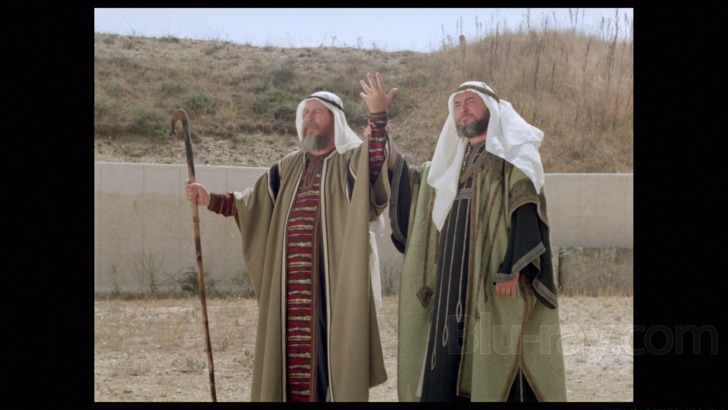
One major way in which Mahler and Schoenberg differed is in the fact that Mahler never wrote an “official” opera. There are many huge choral pieces in Mahler’s oeuvre (and some critics have averred that Mahler’s huge symphonies are in essence “operatic”, even if they have no singing), but no outright “music dramas”, to borrow a term of Art from another composer of that general era who also pushed the tonal envelope (Richard Wagner). Schoenberg also has a number of smaller scale vocal works to his credit, but he does have some “real” operas, albeit in the case of Moses and Aaron, unfinished (kind of like Mahler’s tenth symphony, in fact). As such, Moses and the assembled multitude may never get to “the Promised Land” (figuratively and literally), but the opera is a fascinating combination of styles and it contains an almost Talmudic dialectic at its heart whereby Moses (Günter Reich) and Aron* (Louis Devos) debate a number of weighty issues involving Man’s relationship with his Creator.
Actual film versions of operas are a rather rare commodity even in this day and age, with the more standard norm being actual theatrical presentations which are either filmed or videotaped (as tends to be the case with a lot of Naxos distributed offerings that I’ve reviewed over the years). This 1975 feature helmed by the husband and wife team of Danièle Huillet and Jean-Marie Straub both is and is not “cinematic”, in the way most people think of that term. The film utilizes a number of fascinating desert locations (something that may remind some fans of a “rock opera” film, Jesus Christ Superstar , which came out a couple of years before this particular film), but it’s a curiously static presentation from a number of angles. The film exploits long, unedited takes, frequently with little to no actual “action” in them, and as such there’s a feeling that the viewer is being presented with a series of tableaux, something that may arguably rob the story of some of its inherent drama.
That said, there's an almost monolithic quality to the film that does tie in remarkably well with the metaphysical issues at the core of the story. Even in its unfinished state, Moses and Aaron is an arresting piece, one which can assault unwary ears with its frequently astringent dissonances, but one whose libretto isn't afraid to address how different people can "discern" the reality of a Deity in vastly different ways. As such, the imagery actually can tend to work on a subliminal level at times, slowly but surely elucidating some of the concepts without overtly depicting them.
*Not to be too cheeky about it, but Schoenberg evidently presaged one Dionne Warwick, whom some fans may recall spelled her surname with an “e” appended to it for a few years because she had been told by some kind of psychic it would improve her karma (it didn’t — those were the years she was selling relatively few albums and/or singles). Schoenberg was reportedly on the superstitious side and decided to spell Aron with only one “A” in order to keep his title from having thirteen letters.
Moses and Aaron Blu-ray Movie, Video Quality
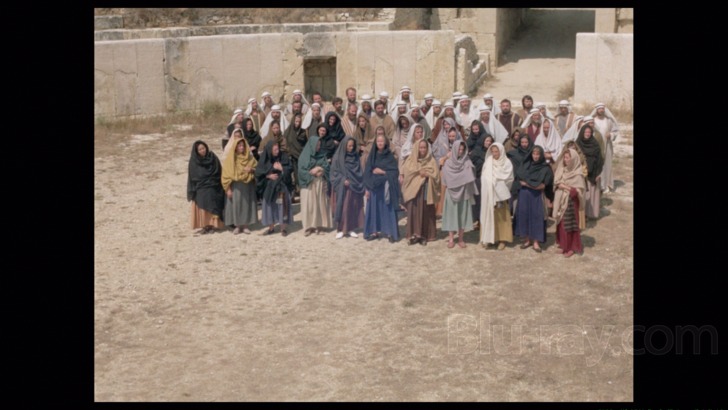
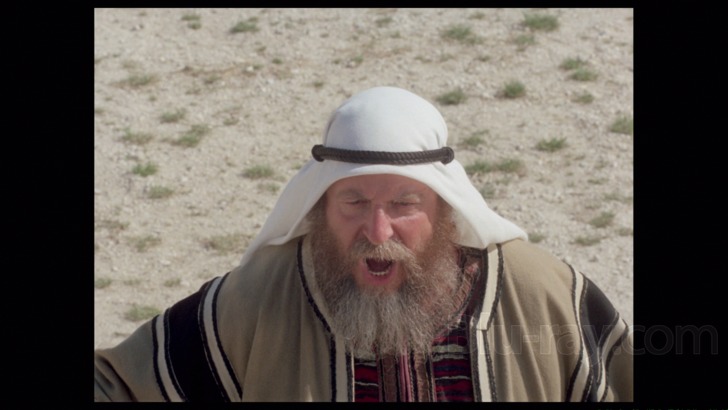
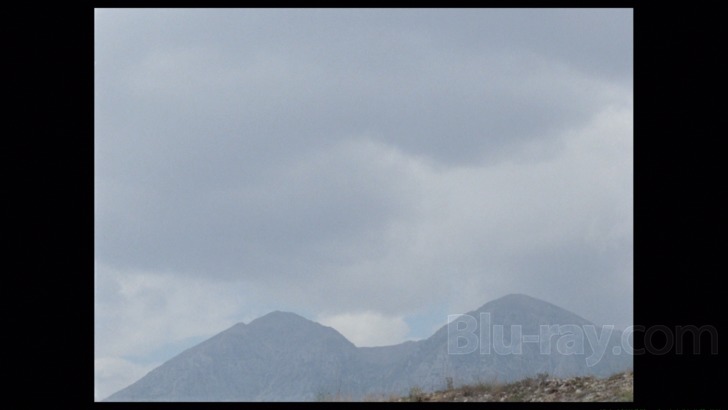
Moses and Aaron is presented on Blu-ray courtesy of Grasshopper Films with an AVC encoded 1080p transfer in 1.37:1. The trailer included on this disc touts a "new 2K restoration", and with an understanding that the film doesn't really provide a ton of visual "pop", the results here are largely commendable. There are a couple of oddities to note, including the fact (discernable by looking at the screenshots accompanying this review) that the presentation is windowboxed in order to attain a 1.37:1 aspect ratio, which may strike some as a little unusual. There's also a manifest difference in visibility of grain between the brightly lit outdoor scenes (the bulk of the film) and some of the rather long black interstitial moments where only sounds from the score play (see screenshot 19 for an example). While the transfer boasts a nicely organic appearance, grain is relatively minimal looking in the bright scenes, but tends to look fairly clumpy and blocky in the black moments. Other than these two niggling qualms, the transfer offers nice detail levels, though framings tend to be in the midrange territory a lot of the time, something that may work against fine detail levels. There's not a ton of color to the proceedings, and the palette may be a trifle faded (I frankly never saw this theatrically, and so am presuming based solely on the appearance of the feature), with flesh tones hovering in a kind pink-purple territory at times.
Moses and Aaron Blu-ray Movie, Audio Quality

While some audiophiles may lament the inclusion of at least a stereo track, the disc's DTS-HD Master Audio Mono audio (in the original German) boasts excellent fidelity, rendering the rather dry and even abrasive sounds of Schoenberg's score quite winningly. Interestingly, Moses doesn't sing here, he only speaks in a kind of Sprechgesang which kind of humorously may strike some listeners as being more "melodic" than the bulk of the actual score. Schoenberg's exploitation of reeds and winds in the orchestration perhaps lends itself more winningly to this mono presentation, though a track with greater width and separation may have provided a better accounting of simultaneously unfolding lines. There's some rather odd verbiage on the setup menu about the subtitles, mentioning how they're literal and intermittent by design, though the "reasons" for this given in the text struck me as completely illogical.
Moses and Aaron Blu-ray Movie, Special Features and Extras
- Theatrical Trailer (1080p; 1:14)
- Additional Films by Straub-Huillet
- Machorka-Muff (1080p; 18:04) is a 1962 short about a former Nazi in post-World War II Germany.
- Not Reconciled (1080p; 52:31) is from 1964 and was the feature directorial debut of the pair. This follows the history of a prominent Germany family over several decades of political turmoil and kind of reminded me obliquely of films like The Garden of the Finzi Contini and/or 1900.
- Introduction to Arnold Schoenberg's "Accompaniment to a Cinematographic Scene" (1080p; 16:54) hails from 1972 and was inspired by Schoenberg's letter to Kandinsky referenced above in the main body of the review.
Moses and Aaron Blu-ray Movie, Overall Score and Recommendation
This is one of those rare releases where I'm going to give a "Recommended", but where I heartily advise those without an interest or knowledge in Schoenberg to perhaps consider that recommendation with a built in caveat. Schoenberg's music is about the polar opposite of whatever "accessible" is supposed to mean, and so there can be an almost built in distancing factor, at least for listeners not accustomed to his provocative musical vocabulary. The ideas in this piece, though, are absolutely bracing and would make a fantastic "sidebar" for a weekly Torah Study built around the various Parshahs being enacted here. Technical merits are solid, and (again, with caveats noted), Moses and Aaron comes Recommended.
Similar titles
Similar titles you might also like
(Still not reliable for this title)

Autumn Sonata
Höstsonaten
1978

Baxter, Vera Baxter
1977

Ema
2019

The Music Room
জলসাঘর / Jalsaghar
1958
Dancing in the Dust
Raghs dar ghobar
2003

Vortex
Splitcase in Original Pressing
2021

Compartment No. 6
Hytti nro 6
2021

An Elephant Sitting Still
大象席地而坐 / Da xiang xi di er zuo
2018

Anna Boleyn
1920

Happy End
2017

Un film comme les autres
A Film Like Any Other
1968

Les rendez-vous d'Anna
The Meetings of Anna
1978

La Strada
1954

Stray Dogs
郊游 / Jiao you
2013

Winter Light
Nattvardsgästerna
1963

The Passion of Anna
En passion
1969
The Insect Woman
にっぽん昆虫記 / Nippon konchûki
1963
Lemmings: Part 2 - Injuries
1979

Signs of Life
1968

Downpour
رگبار / Ragbar
1972