Manufactured Landscapes Blu-ray Movie
HomeManufactured Landscapes Blu-ray Movie 
Zeitgeist Films | 2006 | 80 min | Not rated | Dec 11, 2012

Movie rating
7 | / 10 |
Blu-ray rating
| Users |  | 0.0 |
| Reviewer |  | 4.0 |
| Overall | | 4.0 |
Overview
Manufactured Landscapes (2006)
Documentary about the photography of Edward Burtynsky, who transforms such unlikely sights as slag heaps, e-waste dumps, huge factories and ship recycling plants into aesthetic objects.
Starring: Edward BurtynskyDirector: Jennifer Baichwal
| Documentary | 100% |
Specifications
Video
Video codec: MPEG-4 AVC
Video resolution: 1080p
Aspect ratio: 1.78:1
Original aspect ratio: 1.85:1
Audio
English: DTS-HD Master Audio 5.1
Subtitles
French
Discs
25GB Blu-ray Disc
Single disc (1 BD)
Playback
Region A (B, C untested)
Review
Rating summary
| Movie | | 4.0 |
| Video | | 4.0 |
| Audio |  | 3.5 |
| Extras |  | 3.0 |
| Overall | | 4.0 |
Manufactured Landscapes Blu-ray Movie Review
Pictures at an Exhibition; You're on Display
Reviewed by Michael Reuben December 23, 2012The photographer Edward Burtynsky takes high-resolution photographs, usually on negatives that are four inches wide by five inches tall, then prints them for art installations at giant size, typically fifty by sixty inches. The results are rich with visual detail and reflect Burtynsky's eye for striking compositions and juxtapositions of color. It may take a few moments to recognize that Burtynsky's photographs depict garbage, factories, industrial waste and other sights not normally associated with artistic pursuits. Burtynsky's gift is the ability to transform such subject matter into objects of aesthetic contemplation (and possibly more). China has proved fertile ground for Burtynsky because of the rapid pace of industrial development and the sheer scale on which the country has been modernized. Documentary filmmaker Jennifer Baichwal accompanied Burtynsky on a working trip to China, and much of the footage found its way into Manufactured Landscapes, which is Baichwal's attempt to provide a cinematic accompaniment to Burtynsky's photographs. The film doesn't offer an analysis of the photographer's work, and it certainly doesn't present his life and times. Indeed, the viewer of Manufactured Landscapes learns almost nothing about Edward Burtynsky the individual. What Baichwal has attempted (and largely accomplished) is what documentaries about visual artists usually fail to do, which is to focus on the work and allow it to be seen more widely, and perhaps better, than any gallery exhibition or coffee table book would allow.
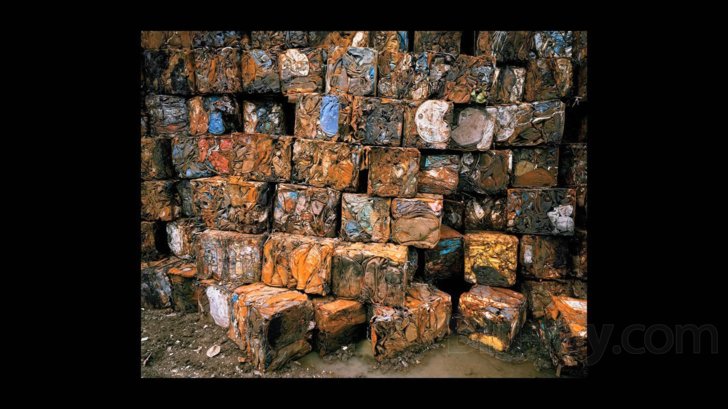
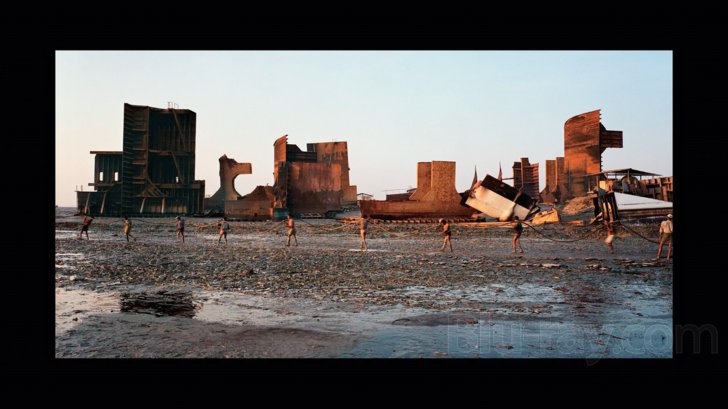
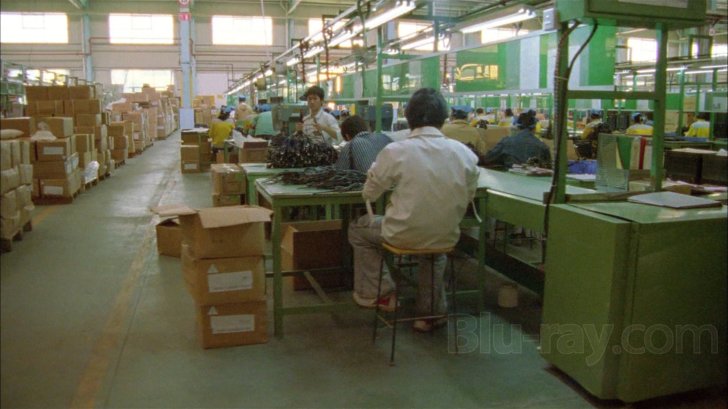
Baichwal has described Burtynsky's technique as an "aesthetic seduction", because a viewer of his photographs is often lured into staring at them by their formal beauty and thereby "tricked" into contemplating a wasteland of scrap metal, discarded microchips, worn-out tires, repetitive labor or the like. Burtynsky disclaims any social or ecological "message", but there is a brute force in the scale of his images that cannot help but raise questions. Baichwal opens Manufactured Landscapes with her own form of "aesthetic seduction" by a simple device. Her camera tracks across the floor of a Chinese factory as if it were showing us the surroundings before settling on a subject. But then Baichwal does something wholly unexpected, which is to keep tracking—for eight minutes. As aisle succeeds aisle, each one occupied by still more workers, machines and supplies, the camera never does come to rest. The vast expanse is the subject. The factory makes most of the world's irons, and Burtynsky is there to stage the huge outdoor assembly of workers of which his photo has been used for the cover of the U.S. Blu-ray release. Baichwal includes a few snippets of Burtynsky framing the shot, but his working methods are not what interest her. She's trying to convey the feel of what captures the photographer's eye and motivates his work. To that end, Manufactured Landscapes contains very little narration. What's there is primarily taken from a presentation given by Burtynsky in his native Toronto introducing his work at a gallery showing. The soundtrack is dominated by an abstract, almost industrial score by composer Dan Driscoll and, in select scenes, by production sound. Baichwal's attention remains fixed on Burtynsky's massive photographs, which she will frequently swap editorially with the real subject, zooming in so that the viewer doesn't spot the switch until the camera slowly zooms out to reveal the frame and the gallery setting. It's a different form of "aesthetic seduction", luring the viewer from reality into Burtynsky's carefully composed tableaux. Much of Burtynsky's trip involved exploration of the area affected by the Three Gorges Dam, the largest such project in the world, which had been under construction since 1994. Over a million people were relocated during the course of the project, and Baichwal interviews a few of those affected to add a human dimension to Burtynsky's photographs of the areas being transformed (mostly by submersion under the water being dammed up). One senses that there are massive histories to be written here—assuming, of course, that the Chinese government would allow it and that people would speak freely—but Baichwal is not interested in filming an exposé. It's as if she is zooming in on Burtynsky's images and, for a few moments, letting an area of detail come alive and speak, before the larger canvas freezes under the illusion of finality that Burtynsky seems to cast over all his work. An additional sequence is included from Burtynsky's 2001 expedition to a ships' graveyard in Bangladesh. The black-and-white footage was apparently not shot by Baichwal, but Burtynsky's photographs from the trip are of a piece with his works from China. As workers toil at stripping down discarded vessels for their scrap value, often under perilous conditions, the beach is transformed into an alien landscape of metal and petroleum products, dotted by human forms. The sheer scale of the ships and the steadiness of the supply ensures that this new landscape will remain vast. Not all of Burtynsky's photographs are of unusual places. His work includes such predictable subjects as cityscapes, complex freeway interchanges seen from the air, parking lots filled with cars and employees gathered in massive numbers in lunch rooms and on factory floors. Still, his most striking and memorable images are those where you'd least expect to find anything beautiful. Baichwal captures a classic and amusing exchange between Burtynsky's facilitator and a Chinese government official who is clearly concerned that the photographer wants to take pictures of the garbage at a product distribution center. Excuses are made, permissions denied, and Burtynsky's people literally haul out a book of his work to show the concerned official that this is a photographer who can make garbage look beautiful. Eventually the worried official is persuaded to let the group inspect the site to check the lighting conditions, and Burtynsky gets his photographs.
Manufactured Landscapes Blu-ray Movie, Video Quality
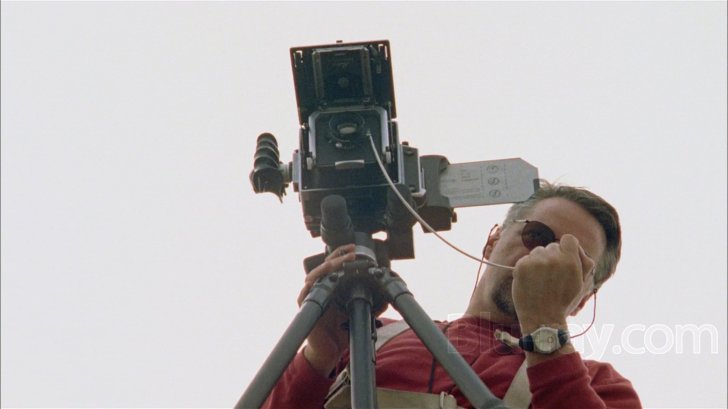
Manufactured Landscapes was shot on film in Super16. The cinematographer, Peter Mettler, discusses his visual strategies in a brief interview in the disc's extras. As Mettler notes, a still photographer like Burtynsky can achieve a degree of precision in the delineation of light and color that is impossible in moving pictures. The single toughest demand for Mettler was the accurate reproduction of Burtynsky's photography in a manner that would both show it to advantage but also allow it to be blended with other images in the film. The image on Zeitgeist Films's 1080p, AVC-encoded Blu-ray ably captures the film's tonal shifts, which is central to Baichwal's odd balance between documenting and partnering in Burtynsky's work. Lengthy passages, such as the much-commented-upon tracking shot that opens the film, have a solidly "documentary" feel, with the detailed but softer look of Super16 photography and the naturalism that comes from photographing real people and places using available light. Burtynsky's work, however, has been carefully lit and shot to utilize the full range of the Super16 negative's resolution and color capacity. As much as a copy can be accurate, Baichwal and Mettler have tried to make their filmed reproduction of Burtynsky's work identical to the real thing. When they cut to a Burtynsky photograph from their own footage, they have generally chosen a sharp, colorful take so that the switch is invisible. The only flaw in the image that sometimes gives away the copying aspect of Baichwal's strategy is a distinctive "noise" when she zooms in too close on one of Burtynsky's photos and a portion of the image doesn't have sufficient detail to withstand such close scrutiny. It's a minor problem, but it recurs at regular intervals, and it might be mistaken for a flaw in the Blu-ray, which it isn't. This "noise" recedes as Baichwal zooms back from Burtynsky's photo, and his image snaps back into its original clarity. Except for limitations of the original documentary footage (as in, for example, the Bangladesh section), the Blu-ray is as sharp, detailed and colorful as the source materials will allow. I did observe occasional instances of banding, but it was light and will probably go unnoticed by most viewers. Compression errors were nowhere to be seen.
Manufactured Landscapes Blu-ray Movie, Audio Quality
Manufactured Landscapes features a 5.1 soundtrack supplied in lossless DTS-HD MA, but there isn't a lot for it to do. With limited narration and almost nothing in the way of dialogue, the film is primarily visual. As noted above, the score by Dan Driscoll is abstract rather than tuneful, an apt accompaniment to Burtynsky's images. It's well-reproduced but nothing to delight the ear. The documentary footage does not provide opportunities for use of the surround field, with one significant exception: During the eight-minute tracking shot through the Chinese factory that opens the film, the sounds of the factory floor appear to echo in the distance, reinforcing the sense of the giant space through which the camera is moving. Whether the production actually recorded discrete stems at the time (which is unlikely) or created the mix after the fact in a studio, it's an effective adjunct to the visuals.
Manufactured Landscapes Blu-ray Movie, Special Features and Extras
- Extended Scenes (480i; 1.78:1, non-enhanced; 39:03): It's not hard to understand why these six long scenes failed to make the final cut. The bulk of them are concerned with social and economic changes in China as a result of the rapid transformation documented in the scenes that Burtynsky is photographing. But as Burtynsky stresses elsewhere, the whole purpose of his photography is to leave such concerns for the viewer to discover on their own. Similarly, since Baichwal's film takes its cue from Burtynsky's method, this footage would have felt as if the film were turning into a polemic.
- Discussion with Director Jennifer Baichwal and Photographer Edward Burtynsky (480i; 1.78:1, non-enhanced; 19:05): This almost qualifies as a documentary short. The director and the photographer are interviewed in Burtynsky's studio by Richard Goddard. They discuss their collaboration, Burtynsky's artistic approach and the aims of the documentary.
- Interview with Cinematographer Peter Mettler (480i; 1.78:1, non-enhanced; 5:16): Interviewed by Richard Goddard, Mettler describes how he became involved in the project and his approach to the photography.
- Trailer (480i; 1.33:1; 2:02): An accurate overview.
- Additional Trailer (720p; 1.78:1; 1:53): At startup the disc plays a trailer for Payback, which can be skipped with the chapter forward button and is not available once the disc loads.
Manufactured Landscapes Blu-ray Movie, Overall Score and Recommendation
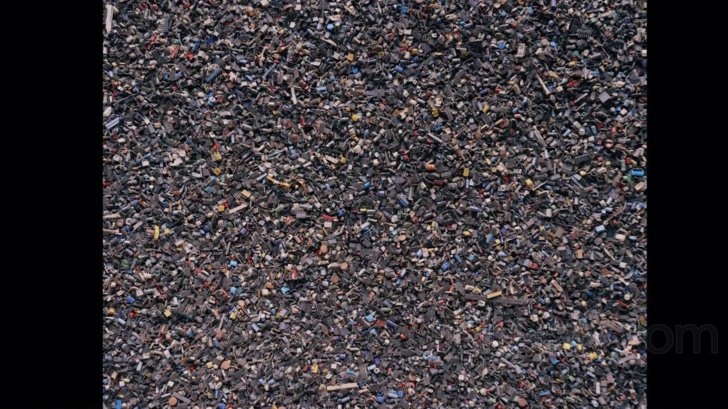
Burtynsky has repeatedly stated his desire to produce images that have no agenda, even though he himself harbors concerns about the pace and scale at which human endeavors are transforming the face of the planet. His goal is to find unique, unexpected and aesthetically surprising sights created by such endeavors and capture them at a particular moment. The viewer decides what to make of them. It is entirely possible (and not inappropriate) to look at one of Burtynsky's works and be filled with pride at the magnitude of what humanity has been able to accomplish. Then again, photographs like Burtynsky's portrait of endless fields of discarded microchips and other forms of Western "e-waste" shipped to China recall a slogan that hangs above the computer on my desk: "No Single Raindrop Believes It Is to Blame for the Flood". Recommended.
Similar titles
Similar titles you might also like
(Still not reliable for this title)

Dream Big: Engineering Our World 4K + 3D
IMAX
2017

The Late Great Planet Earth
1979

Pandas 4K
2018

Magician: The Astonishing Life and Work of Orson Welles
2014

More Than Honey
2012

Why We Fight
20th Anniversary Edition
2005

Forks Over Knives
2010
The Story of Film: An Odyssey
2011

An Inconvenient Truth
2006

In Search of the Last Action Heroes
2019

Samsara
2011
Le monde du silence
The Silent World
1956

Icons Unearthed: Star Wars
2022

A Disturbance in the Force: How the Star Wars Holiday Special Happened
2023

Ken Burns: The U.S. and the Holocaust
2022

Never Surrender: A Galaxy Quest Documentary
Slipcover in Original Pressing
2019

Turtle Odyssey 4K
IMAX Enhanced
2018

Looking for Lennon
2018

Armstrong
2019

NOVA: The Planets
2019