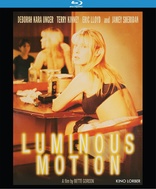
Luminous Motion Blu-ray Movie
HomeLuminous Motion Blu-ray Movie 
Kino Lorber | 1998 | 95 min | Not rated | Jul 23, 2019

Movie rating
7.2 | / 10 |
Blu-ray rating
| Users |  | 0.0 |
| Reviewer |  | 2.5 |
| Overall | | 2.5 |
Overview
Luminous Motion (1998)
Fugitives from the American Dream, 10 year old Phillip and his mom live the outlaw life on the road. The precocious Phillip has no need for school: the neon glow of motel signs is light enough by which to read his textbooks on biology and physics -- two subjects about which his Mom teaches him a thing or two, as she seduces men out of their credit cards to fuel their crazy flight. Mom begins to feel the gravitational pull of home life and the need to settle down.
Starring: Deborah Kara Unger, Terry Kinney, Eric Lloyd, Jamey Sheridan, Patrick FitzgeraldDirector: Bette Gordon
| Dark humor | Insignificant |
| Surreal | Insignificant |
| Drama | Insignificant |
Specifications
Video
Video codec: MPEG-4 AVC
Video resolution: 1080p
Aspect ratio: 1.85:1
Original aspect ratio: 1.85:1
Audio
English: DTS-HD Master Audio 5.1
English: DTS-HD Master Audio 2.0
Subtitles
English SDH
Discs
Blu-ray Disc
Single disc (1 BD)
Playback
Region A (B, C untested)
Review
Rating summary
| Movie |  | 2.0 |
| Video |  | 4.0 |
| Audio |  | 4.5 |
| Extras |  | 3.0 |
| Overall | | 2.5 |
Luminous Motion Blu-ray Movie Review
Reviewed by Dr. Svet Atanasov March 19, 2023Bette Gordon's "Luminous Motion" (1998) arrives on Blu-ray courtesy of Kino Lorber. The supplemental features on the release include audio commentary by Bette Gordon and cinematographer Teodoro Maniaci; production stills; vintage trailer; and more. In English, with optional English SDH subtitles for the main feature. Region-A "locked".

“If you really want to help yourself, you need to love yourself”. It is difficult to discard the logic that is attached to this very popular statement, isn’t it? Think about it. What do you do if a person that you truly, deeply love needs help? You do everything you can to help this person. What you do may not be enough, but it gives this person a chance to recover and do better. What if this person is you? You do the same and give yourself a chance. What you do with this chance is very important too, but you cannot help yourself without it. It is your crucial first step, and once you make it, you can begin pondering the best strategy to succeed. If you do not love yourself, it is highly unlikely that you will do what it takes to give yourself a chance, which means that sooner or later you will find the perfect excuse to give up on life. It is how a drug addict would overdose. His love for the temporary pleasure he gets from his fix is more powerful than his love for himself.
In Bette Gordon’s Luminous Motion, Deborah Kara Unger plays a single mother who takes care of her ten-year-old son (Eric Lloyd) with money she steals from strangers across the country. Their beat-up car, probably stolen too, is their only valuable possession. She picks up her clients at roadside cafes and diners, they end up in a motel, and while her son is waiting, she goes to work. Occasionally, she mixes business with pleasure, too. She spends the night with her client in the motel, while the boy sleeps in the car. Then they have breakfast and hit the road again, looking for drunkards and suckers who would fall for her tricks.
In her own way, she makes her son feel special. She buys him cheap food and cheaper gifts and shows him warmth that the boy instantly detects. The boy is not naïve or stupid. He understands exactly what his mother does and why she does it, and how quickly their relationship could end if she is busted by the police. She does too and often appears to be thinking about it, but instead of making a change to avoid the risk continues to roll the dice because there are too many suckers waiting to be conned.
When eventually the mother screws up one of her dates, a decision is made to temporarily stop stealing so that she and the boy can recharge their batteries. They rent a house and shortly after the boy reunites with his father, a working man with drastically different views on how to make ends meet and pursue happiness. However, the encounter unleashes a sea of memories and fantasizes that unexpectedly complicate the boy’s relationship with his mother and ultimately his perception of the life the two have been living.
Gordon apparently worked with a screenplay that was handed to her by Robert Roth, who had adapted Scott Bradfield’s novel “The History of Luminous Motion”, but the film she shot very much looks like an original project. Unfortunately, it is not a good original project.
The entire film is structured as a mosaic of uneven episodes that overemphasize style over substance in such random ways that it becomes virtually impossible to care about its two characters and their ordeals. On top of this, the boy is forced to narrate many complex observations about the unpredictability of life that he very clearly has a difficult time grasping, so the complete mosaic becomes an oddly surreal creation too.
It appears that Gordon wanted to deliver some meaningful message about the relationship between loving, caring, and helping, and how its strength impacts the decisions we make and the paths we choose in life. Or at least most of the first half of her film seems to suggest so. It is very difficult to tell exactly what happens in the second half and why. Here the boy undergoes a dramatic transformation and his involvement with a serious crime unceremoniously pushes the film into a dark abyss where fantasies and reality become one. What about his mother? She remains isolated in a shadow cast by his misery, but not because she has abandoned him, or because he has started moving away from her. Their brittle relationship is just paused until something or someone resumes it again. A genuinely confusing film, indeed.
Luminous Motion Blu-ray Movie, Video Quality

Presented in its original aspect ratio of 1.85:1, encoded with MPEG-4 AVC and granted a 1080p transfer, Luminous Motion arrives on Blu-ray courtesy of Kino Lorber.
On my system, the film looked very good. Some of the stylization produces minor fluctuations but the overall quality of the visuals is usually lovely. Color balance is convincing, too. If there is any room for improvement it would be in terms of saturation, but I like how the film looks a lot. There are no traces of problematic digital corrections. Image stability is very good. I noticed a few blemishes but there are no large cuts, debris, marks, warped or torn frame to report. The encoding could have been a tad better. However, even on a very large screen, you will not notice any distracting anomalies. My score is 4.25/5.00. (Note: This is a Region-A "locked" Blu-ray release. Therefore, you must have a native Region-A or Region-Free player in order to access its content).
Luminous Motion Blu-ray Movie, Audio Quality

There are two standard audio tracks on this Blu-ray release: English DTS-HD Master Audio 5.1 and English DTS-HD Master Audio 2.0. Optional English SDH subtitles are provided for the main feature.
I viewed the entire film with the 5.1 track. I did not encounter any anomalies to report in our review. Clarity, sharpness, and stability were very good. Depth was nice as well, but the film's soundtrack has pretty obvious limitations. The music sounded very good, but it has to be said that its role is secondary even though it could have been more exciting.
Luminous Motion Blu-ray Movie, Special Features and Extras

- Trailer - presented here is a vintage trailer for Luminous Motion. In English, not subtitled. (2 min).
- Storyboards - presented with music. (2 min).
- Illustrated Script Pages - presented with music. (5 min).
- Production Stills by Nan Goldin - presented with music. (2 min).
- Commentary - this audio commentary was recorded by director Bette Gordon and cinematographer Teodoro Maniaci.
Luminous Motion Blu-ray Movie, Overall Score and Recommendation
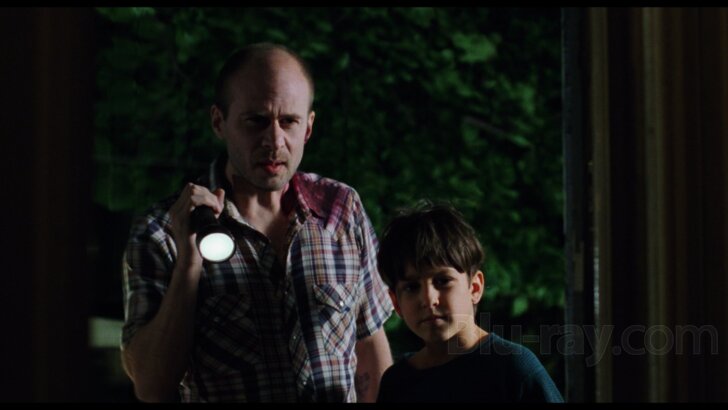
A good portion of the first half of Luminous Motion looked promising to me because of Deborah Kara Unger's performance. But the boy's narration was very distracting, and by the time he and his mother agreed to head south, the film was already falling apart. Too bad. I wanted to like it, but a lot of material is badly mismanaged and the end product feels quite pretentious. Kino Lorber's technical presentation of Luminous Motion is solid.
Similar titles
Similar titles you might also like
(Still not reliable for this title)

Querelle
1982

Moebius
2013

Female Perversions
Standard Edition
1996

Viva la muerte
Long Live Death | Limited Edition
1971

Visitor Q
Bizhitā Kyū | ビジターQ | Limited Edition
2001

Force Majeure
Turist
2014

Viridiana 4K
1961

Hail Mary
Je vous salue, Marie
1985

Dillinger Is Dead
Dillinger è morto
1969

The Celebration
Festen
1998

La Chinoise
1967

The Swimmer
Deluxe Edition
1968

The Other Side of the Underneath
1972

Naked Lunch
1991

Sweetie
1989

If....
1968

Dogtooth 4K
Kynodontas / Κυνόδοντας
2009

The Trip
1967

Naked
1993

Little White Lies
Les petits mouchoirs
2010