Visitor Q Blu-ray Movie
HomeVisitor Q Blu-ray Movie 
Bizhitā Kyū | ビジターQ | Limited EditionRadiance Films | 2001 | 84 min | Not rated | Oct 20, 2026



Movie rating
6.5 | / 10 |
Blu-ray rating
| Users |  | 0.0 |
| Reviewer |  | 3.0 |
| Overall | | 3.0 |
Overview
Visitor Q (2001)
A troubled and perverted family find their lives intruded by a mysterious stranger who seems to help find a balance in their disturbing natures. Shot in SD 480i60
Starring: Ken'ichi Endô, Shôko Nakahara, Shungiku Uchida, Kazushi Watanabe, FujikoDirector: Takashi Miike
| Foreign | Uncertain |
| Drama | Uncertain |
| Dark humor | Uncertain |
Specifications
Video
Video codec: MPEG-4 AVC
Video resolution: 1080i (upconverted)
Aspect ratio: 1.33:1
Original aspect ratio: 1.33:1
Audio
Japanese: LPCM 2.0
Subtitles
English
Discs
Blu-ray Disc
Single disc (1 BD)
Playback
Region A (B, C untested)
Review
Rating summary
| Movie |  | 2.5 |
| Video |  | 4.0 |
| Audio | | 4.0 |
| Extras | | 3.0 |
| Overall | | 3.0 |
Visitor Q Blu-ray Movie Review
Reviewed by Jeffrey Kauffman October 18, 2026Commentator Tom Mes chuckles slightly throughout several provocative sequences in Takashi Miike's notorious Visitor Q, as if to subliminally suggest to listeners (and viewers) that it's "okay", the transgressive content being almost thrust into the audience's veritable faces is supposed to be squirm worthy, and can maybe (maybe) be accepted as darkly humorous. Finding comedy in everything from incest (which opens the film) to rape to bodily immolation to drug abuse to elder abuse to necrophilia to "lactation lessons" may be a tall order for some, and that very aspect may account for how widely disparate both audience and critical reaction to the film has been through the years. That reaction might be compared, as many other things about the film can be, to Pier Paolo Pasolini's Teorema, an outing which is expressly mentioned in some of the supplements on this disc. If Visitor Q is, as video essayist Kat Ellinger suggests, a kinda sorta remake of Teorema, it also echoes or presages any number of arguably better remembered films where at least one interloper arrives to upset an already perilous family dynamic, a foundational premise underlying any number of films including the relatively recent Academy Award winning sensation Parasite. What sets Visitor Q apart from its perceived kin, though, is Miike's "up close and personal" minicam style and the film's emphasis on a seemingly endless array of taboo busting as alluded to in the aforementioned list of the film's "comedic" content.
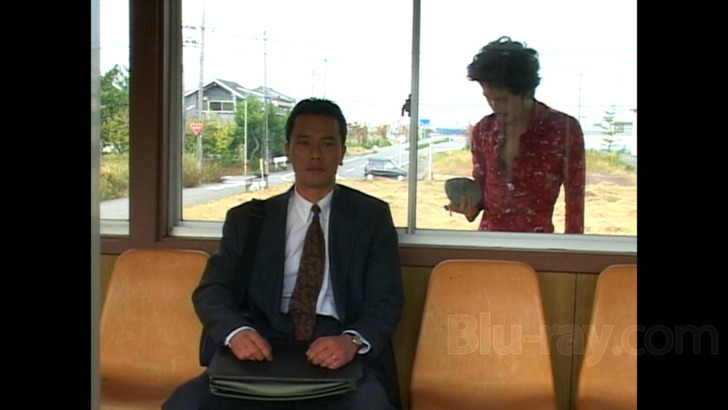
Some of the supplements on this disc also address a perceived "surrealist" approach to the film, something that may in fact be true but which almost inherently clashes with Miike's use of a Sony VX-1000 MiniDV camera to capture the story, something that gives the narrative an intentionally lo fi "home movie" feeling, something that probably only ups the angst levels as that above list of transgressive plot points plays out. The whole "home movie" aspect is only heightened and reinforced by the fact that the focal paterfamilias in the story, Kiyoshi Yamazaki (Kenichi Endo), does in fact videotape his life (and the lives of his extremely dysfunctional family) for a supposed exposé about troubled Japanese youth. Kiyoshi certainly doesn't have to travel very far to find examples of that group, since his daughter Miki (Fujiko) works as a prostitute and in fact is introduced in the film's opening scene having sex with Kiyoshi. Things aren't much better with son Takuya (Jun Mutō) who like many bullied kids responds by bullying others, notably his mother and Kiyoshi's wife Keiko (Shungicu Uchida), an unstable woman who bears the physical scars of her abuse and who has retreated into drug addiction. Just one big happy family, right?
The mysterious title character (Kazushi Watanabe) enters the fray for unexplained reasons, literally assaulting Kiyoshi as if to awaken him from his almost zombie like ambience and then basically just moving in with the family and causing even more chaos. Suffice it to say the chaos soon includes at least a couple of those aforementioned taboo subjects, notably necrophilia and some unabashedly disturbing content where the visitor instructs Keiko how to lactate, as if to "reawaken" her in some way. There's both a lot (arguably too much) and maybe not quite enough (in terms of contextualizing characters) going on here, and I couldn't help but think of intentionally provocative pieces like A Serbian Film which have their adherents, but which I unapologetically admit absolutely repulsed me. Visitor Q probably due to Miike's inherent genius and its implied "meta" aspects may not have the same effect on people that outings like A Serbian Film have had for some (including me), but still may require a pretty high tolerance level to make it through the maelstrom without some stomach churning reactions.
Visitor Q Blu-ray Movie, Video Quality
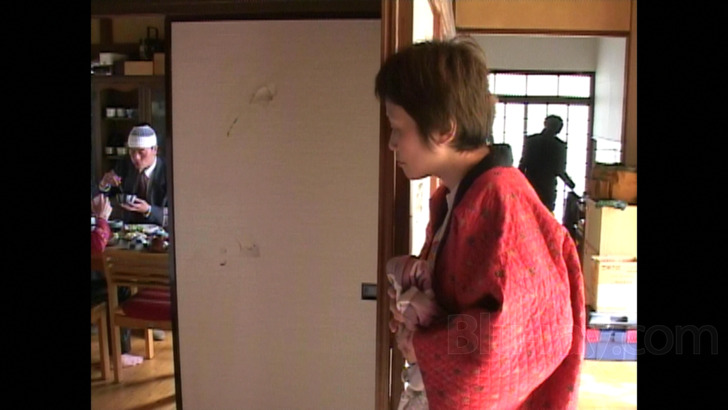
Visitor Q is presented on Blu-ray courtesy of Radiance Films with an AVC encoded 1080i transfer in 1.33:1. Radiance's insert booklet contains the following information on the presentation:
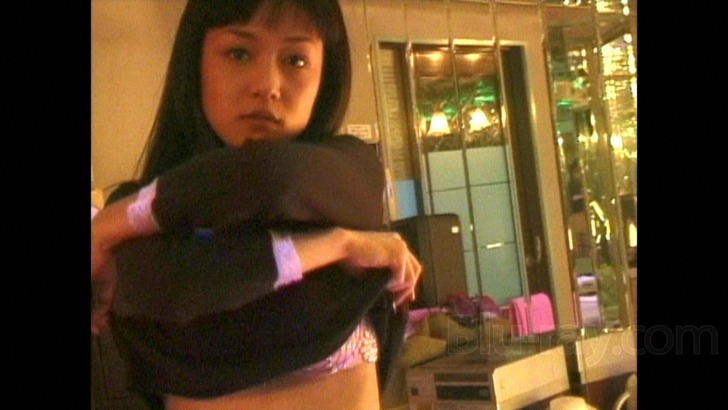
Visitor Q is presented here in its original aspect ratio of 1.33:1, with original stereo audio. The film was shot on a Sony VX-1000 MiniDV digital camera. For this release, the original MiniDV master tape was transferred in 2025 by Trustech Japan Co., Ltd. This new scan presents the film in the highest possible quality, while preserving the inherent limitations of the original source format.This is another presentation where the "accuracy" of the transfer may conflict with its actual "appearance". There's probably little doubt this accurately recreates the original video look of the piece, but the upscale offered here just frankly looks like one. Upscaling artifacts abound throughout, starting with some of the production mastheads, and there's an undeniable if understandable "video" look to the entire enterprise. Perhaps surprisingly, some extreme close-ups in relatively secure lighting conditions actually offer something approximating "real" high definition, but as can probably be easily made out in the screenshots accompanying this review, there are "inherent limitations" that simply can't be avoided. As with many upscales, the palette may be one of the more consistently satisfying elements, and some of the bright reds in particular really resonate quite well. Some low light moments can look pretty noisy at times.
Visitor Q Blu-ray Movie, Audio Quality
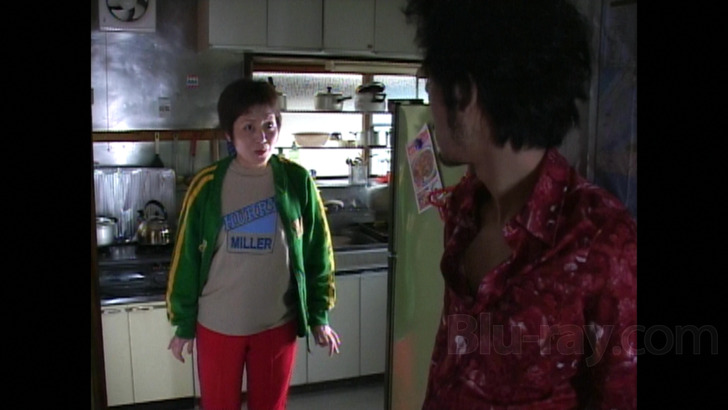
Visitor Q doesn't have an overly complex sound design, and the LPCM 2.0 track in the original Japanese provided here supports the frequent use of sometimes slightly bizarre ambient environmental effects. There's also a sparingly utilized score by Kōji Endō that sounds fine. Dialogue is rendered cleanly and clearly throughout. Optional English subtitles are available.
Visitor Q Blu-ray Movie, Special Features and Extras
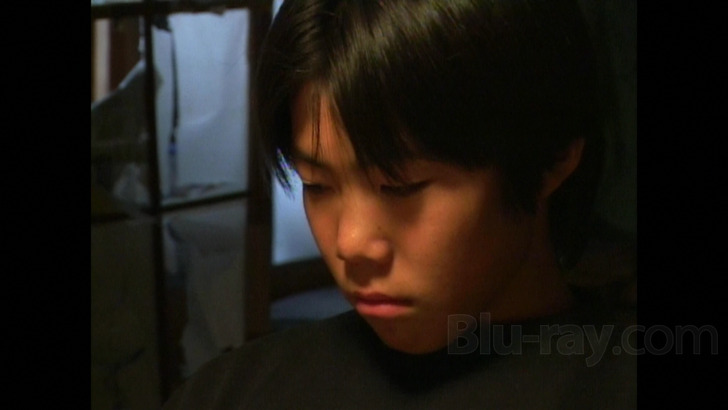
- Audio Commentary by Tom Mes
- Takashi Miike (HD; 21:46) is featured in this 2026 interview discussing things like the low budget and minicam use. Subtitled in English.
- Kenichi Endo (HD; 18:38) is featured in this 2026 interview discussing his long relationship with Miike. Subtitled in English.
- Showko Nakahara (HD; 20:49) is featured in this 2026 interview discussing how profoundly the film impacted her career. Subtitled in English.
- Mother's Milk: Visitor Q and the Feminine Principle (HD; 16:04) is a 2026 visual essay by Kat Ellinger.
- Trailer (HD; 1:33) was made by Kazushi Watanabe.
Visitor Q Blu-ray Movie, Overall Score and Recommendation
Tom Mes begins his commentary by mentioning how protean Miike was during this period and how he churned out an almost insane number of "classics" relatively quickly, although Mes immediately hedges that statement by admitting there were several clunkers by Miike released during this same general timeframe. Reactions to this film will probably continue to be highly disparate, and my hunch is things will probably be more or less evenly split between those thinking it is in fact a classic, and those who despise it. I'm not as unavoidably disgusted by this film as I was with regard to that aforementioned Serbian enterprise, mostly because it's obvious Miike does have a point here (something I found troublingly lacking in A Serbian Film, despite that film's fanbase who insists it's a masterpiece), but that said, this is not an easy watch one way or the other, even granting some pitch black comedic elements. Technical merits are indicative of the lo fi source. The included supplements are all excellent, for anyone who may be considering making a purchase.
Similar titles
Similar titles you might also like
The Disenchanted
La désenchantée
1990

Elles
2011

Diary of a Lost Girl
Tagebuch einer Verlorenen
1929

Happy End
2017

Young & Beautiful
Jeune et jolie / Slipcover in Original Pressing
2013

Goodbye to Language 3D
Adieu au langage
2014

The Life of Oharu
西鶴一代女 / Saikaku ichidai onna
1952

The Marriage of Maria Braun
Die Ehe der Maria Braun
1978

Jeanne Dielman, 23, quai du Commerce, 1080 Bruxelles
1975

Beyond the Hills
După dealuri
2012

Anita: Swedish Nymphet
Anita / Slipcover in Original Pressing
1973

Double Suicide
心中天網島 / Shinjû: Ten no Amijima
1969

The Painted Bird
Nabarvené ptáce / Slipcover in Original Pressing
2019
Green Fish
초록 물고기 | 4K Restoration
1997

Hail Mary
Je vous salue, Marie
1985

The Celebration
Festen
1998

Force Majeure
Turist
2014

Moebius
2013

Dogtooth 4K
Kynodontas / Κυνόδοντας
2009

Custody
Jusqu'à la garde
2017