Blue Like Jazz Blu-ray Movie
HomeBlue Like Jazz Blu-ray Movie 
Lionsgate Films | 2012 | 106 min | Rated PG-13 | Aug 07, 2012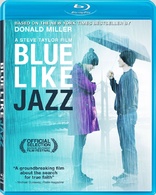
Price
List price:Listed on Amazon marketplace

Movie rating
6.2 | / 10 |
Blu-ray rating
| Users |  | 0.0 |
| Reviewer |  | 3.0 |
| Overall | | 3.0 |
Overview
Blue Like Jazz (2012)
Don, a nineteen-year-old sophomore at a Texas junior college, tries to escape his Bible Belt upbringing for life in the Pacific Northwest at the most godless campus in America.
Starring: Marshall Allman, Claire Holt, Tania Raymonde, Justin Welborn, Eric LangeDirector: Steve Taylor (VII)
| Drama | Uncertain |
| Comedy | Uncertain |
Specifications
Video
Video codec: MPEG-4 AVC
Video resolution: 1080p
Aspect ratio: 1.78:1
Original aspect ratio: 1.85:1
Audio
English: DTS-HD Master Audio 5.1
Subtitles
English, English SDH, Spanish
Discs
25GB Blu-ray Disc
Single disc (1 BD)
Playback
Region A (locked)
Review
Rating summary
| Movie |  | 2.5 |
| Video |  | 3.5 |
| Audio |  | 4.0 |
| Extras | | 3.0 |
| Overall | | 3.0 |
Blue Like Jazz Blu-ray Movie Review
The flip side of Portlandia.
Reviewed by Jeffrey Kauffman July 31, 2012There are a rather disturbingly high number of synchronicities between the film version of Donald Miller’s semi-autobiographical tome Blue Like Jazz and myself. Like Miller, I grew up in an insular environment where one religion was incredibly dominant. In Miller’s case, it was the Southern Baptists, in mine, Mormonism. Like Miller, I “escaped” the confines of my upbringing by moving to the Pacific Northwest, and rather incredibly like Miller, I ended up at Reed College, the tony private liberal arts school in Portland’s inner east side that has been dubbed the “Harvard of the West”. Unlike Miller, however, I had already completed my undergraduate work, and so was at Reed for my Masters, where I was able to forge my own incredibly multidisciplinary program that saw me doing everything from analyzing the poetry of William Butler Yeats with an internationally renowned Yeats scholar to studying Classical Greek with an elderly and very formal British professor to working in the theater department and scoring a production of William Inge’s Picnic. That last foray may point out another salient synchronicity shared by Miller and myself, namely a love of jazz, a love that I personally have been fortunate to have blossom into a career. Portland’s jazz community is among the most creative and varied in the United States, with all manner of world class musicians calling the city home, and I am proud and privileged to have performed and recorded with several of them over the years. Finally, I also make part of my musical living by Music Directing for one of Portland’s large churches, and so Blue Like Jazz’s underpinning of a spiritual quest also hits rather close to home for me. Obviously with so many connections preexisting between me and this property, I was primed to really enjoy what many have called (at least in its book form) a proto-revolutionary look at what being a Christian in the modern world amounts to. What I found, however, was a kind of anemic film experience that has a certain indie cachet (it was funded through Kickstarter, for example), but which fundamentally misses the Portland “vibe” in a number of important ways, something at least a little odd in that Miller himself not only of course wrote the source material but also contributed to the screenplay of the film version.
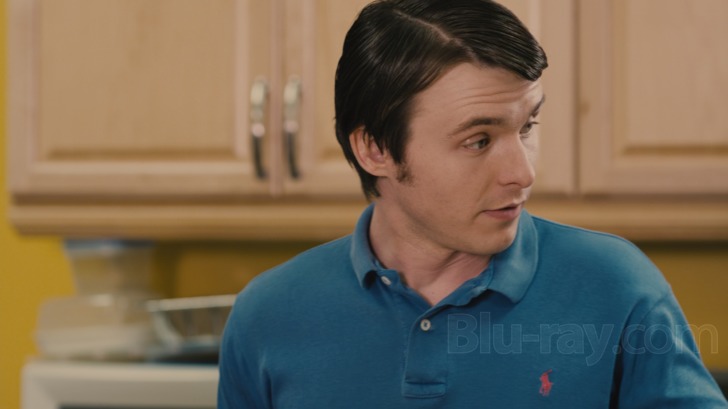
“Contemporary Christianity” has become a branding device in everything from music to literature and film, to widely variant results. Church bound religion, as opposed to the more general practice of “spirituality”, has had an especially hard time in the Pacific Northwest, whether or not its “contemporary” or “traditional”, as fewer and fewer people identify themselves as belonging to any formalized religion, even if an equally large number of people profess to believe in something, even if that something can’t be easily summed up in a phrase or even an all-knowing word like God. That’s one of the major errors this film version of Blue Like Jazz makes about the Portland ethos, even in the rarified and often acerbically academic world of Reed College, because it’s really more than likely that a “recovering” Southern Baptist like Don (Marshall Allman) wouldn’t be confronted by anyone about his beliefs, and instead would be greeted by a big, fat yawn and laissez faire questions like, “Who cares?” Let me put it another way in terms of my personal experience: I am a half-Jew, half-Christian guy who grew up in Salt Lake City surrounded by Mormons and who was put in an Episcopalian parochial school for much of my early childhood in a valiant if ultimately unsuccessful attempt by my parents to keep me from overweening LDS influence. And nine times out of ten when I've relayed that history to my Portland friends, their reaction has basically been nonplussed, to say the least.
Though it probably won’t strike many non-Oregonians as odd as it did me, but large swaths of this picture were not in fact filmed at Reed or in Portland. While a couple of quick establishing shots (and later some other brief moments) do capture the red bricked, ivy strewn ambience of the absolutely gorgeous Reed campus (see screencap #3 for a peek at the "real" Reed College), most of the shots featuring the blond bricked structures (including the huge, quasi-religious spire) were done in Nashville, Tennessee, literally and figuratively a world away from the “hipster” ethos that is part and parcel of Portland generally and Reed in particular. One kind of funny sequence in the film, when Don builds a weird little bicycle and heads off into downtown, does capture a couple of nice shots of Portland’s rainy gray atmosphere, but otherwise this film really could have been set anywhere, a decided detriment to such a location-centric piece.
The film does get a number of little elements right, like the “Scrounge Table” at Reed where kids leave their leftover food and other students can forage for anything edible. And a passing comment late in the film when a native Oregonian lambastes Don for using an umbrella in a rainstorm is absolutely spot on (umbrellas are seen as a sign of weakness by sturdy Portlanders). And while there’s one great scene that takes place in one of Portland’s most iconic marketplaces, the ineffable Powell’s Books (one of the largest bookstores in the world and a testament to Portland's literacy), the film has an oddly generic feel that never seems anchored in the very place that is supposedly causing all of the cultural and spiritual awakening and/or questioning Don is supposedly experiencing.
Removing these perhaps picayune qualms (which admittedly are going to be more noticeable to Portlanders or Oregonians like myself than they will be to the public at large), Blue Like Jazz, while lacking a certain energy, at least has the courage to explore spiritual questioning without ever devolving to screed levels. Some of the film is undeniably heavy handed (Don’s romance with Penny, played by Claire Holt, includes a couple of squirm worthy moments in a church), there’s a nicely understated aspect to other moments of the film as Don attempts to come to terms with his own religious proclivities, ones that aren’t necessarily tied to “organized religion” (making him therefore the perfect Northwesterner in a way).
Co-writer and director Steve Taylor has his own long history in the Contemporary Christian Music movement, with several Grammy and/or Dove nominations and subsequent work with the rock group Chagall Guevara to his credit. He has a basic understanding of film craft and Blue Like Jazz is basically decently constructed, but there’s something missing from this unlikely stew of spiritual questioning and Portland hipsterism. Watching the film, I couldn’t help but wonder what might have happened had the crew actually put down roots here in Portland for the entire shoot, rather than just doing a few pick up shots and a couple of short sequences here. Maybe then the weird and wacky vibe that is part of this often rain drenched city might have permeated the set and given Blue Like Jazz a little more credible specificity.
Blue Like Jazz Blu-ray Movie, Video Quality
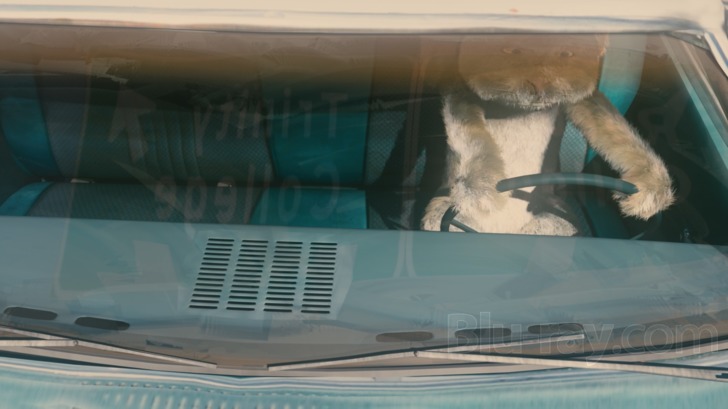
Blue Like Jazz is presented on Blu-ray courtesy of Lionsgate Films with an AVC encoded 1080p transfer in 1.78:1. Like the film itself, this is a somewhat anemic high definition presentation. Again like the film itself, while there's nothing outright horrible here, there's also very little real pop and clarity. The look of the film is overall very soft, with muted colors and a lack of impressive fine object detail in everything but close- ups. Contrast is problematic as well, though that seems to have been an intentional choice at least some of the time. There are some major stability issues in several shots. One of the speakers' patterned suit jackets in the Powell's Bookstore segment is so unstable it almost looks three dimensional some of the time.
Blue Like Jazz Blu-ray Movie, Audio Quality

Blue Like Jazz's lossless DTS-HD Master Audio 5.1 mix is great as far it goes, though the problem is it often doesn't go very far. This small scale feature tends to anchor things pretty resolutely in the front channels, though surrounds do spring to life in some crowd scenes and in boisterous segments like the Renn Fayre outing. The evocative score and use of source cues (including a lot of Coltrane) also sound great and do use the side and rear channels well. Fidelity is very good and the overall mix is very well prioritized, with good dynamic range.
Blue Like Jazz Blu-ray Movie, Special Features and Extras
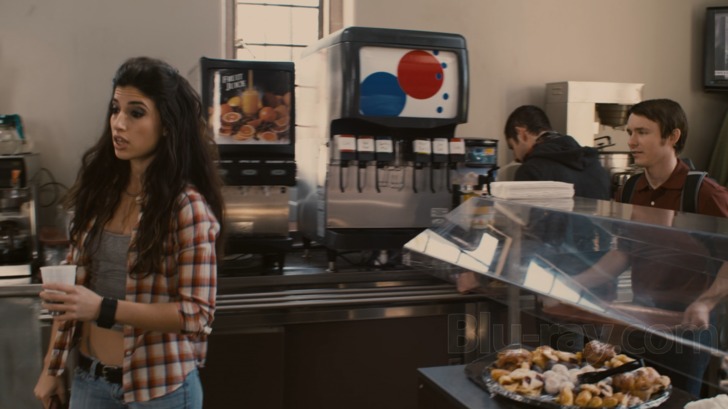
- Commentary with Director Steve Taylor, Author Don Miller and Cinematographer Ben Pearson.
- Making Blue Like Jazz (HD; 11:40) has Don Miller kind of hosting as a bunch of behind the scenes footage is presented.
- The Music (HD; 6:24) features composer Danny Seim (along with Geddy Lee, his dog).
- Save Blue Like Jazz (HD; 2:48) is about the funding challenges the film encountered in pre- production.
- The Cast (HD; 4:18) features little moments with Marshall Allman, Tania Raymonde and other cast members.
- The Animator (HD; 1:19) is a sweet little piece on animator Jonathan Richter, hosted by a charming little boy who is attempting to read a description about the animator.
- This is My Story (HD; 3;15) is a little promo piece put together to publicize the effect of the book and film on various people.
- Deleted Shots (HD; 1:56) has some funny subtitles describing why the scenes were jettisoned.
- Master Class: Directing Actors on Set (HD; 3:46) is a funny little piece that has Taylor doing silly voice overs accompanying various shots.
- Theatrical Trailer (HD; 2:23)
- Photo Gallery
Blue Like Jazz Blu-ray Movie, Overall Score and Recommendation
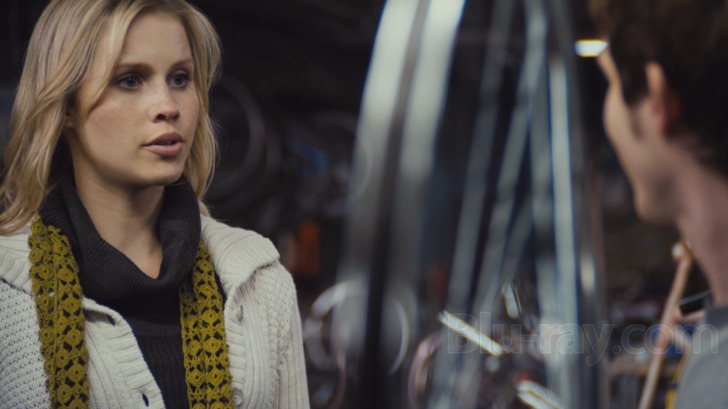
Miller and Taylor set themselves a formidable task to begin with by attempting to adapt a bunch of essays into a narrative film. The odd thing about this all is that while the narrative is fairly well handled, the film seems positively divorced from its Portland (and Reed) setting. The most "Portland-esque" thing about this film is the totally bizarre yet hilarious animated sequence featuring the giant bunny driving Don's car and chasing after the large animated carrot (adapted from a graphic element in the book, an element which according to the commentary was added at the last moment to meet the publisher's demand for a certain page count). Lovers of Miller's book will probably find enough here to enjoy the film, but many others are probably going to wonder what all the fuss was about.
Similar titles
Similar titles you might also like
(Still not reliable for this title)

A Hologram for the King
2016

Larry Crowne
2011

Please Stand By
2017

Mistress America
2015

Life of the Party
2018

Blindspotting
2018

Güeros
2014

The Swimmer
Deluxe Edition
1968

Rain Man
25th Anniversary Edition | Remastered
1988

Everybody Wants Some!!
2016

Crystal Fairy & The Magical Cactus
2013

My Blueberry Nights
2007

Wake in Fright 4K
Limited Edition
1971

The Young Messiah
Christ the Lord
2016

Lady Bird
2017

This Must Be the Place
2011

The Second Best Exotic Marigold Hotel
2015

Standing Up
2013

Dog
2022

Frances Ha
2012