Ai Weiwei: Never Sorry Blu-ray Movie
HomeAi Weiwei: Never Sorry Blu-ray Movie 
MPI Media Group | 2012 | 91 min | Rated R | Dec 04, 2012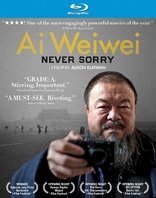
Price
List price:Third party: $18.00 (Save 40%)
Listed on Amazon marketplace

Buy it from YesAsia:
Movie rating
6.9 | / 10 |
Blu-ray rating
| Users |  | 0.0 |
| Reviewer |  | 4.0 |
| Overall | | 4.0 |
Overview
Ai Weiwei: Never Sorry (2012)
Ai Weiwei is known for many things—great architecture, subversive in-your-face art, and political activism. He has also called for greater transparency on the part of the Chinese state. Director Alison Klayman chronicles the complexities of Ai’s life for three years, beginning with his rise to public prominence via blog and Twitter after he questioned the deaths of more than 5,000 students in the 2008 Sichuan earthquake. The record continues through his widely publicized arrest in Beijing in April of 2011. As Ai prepares various works of art for major international exhibitions, his activism heats up, and his run-ins with China’s authorities become more and more frequent.
Starring: Ai Weiwei, Changwei Gu, Danqing ChenDirector: Alison Klayman
| Foreign | Uncertain |
| Documentary | Uncertain |
Specifications
Video
Video codec: MPEG-4 AVC
Video resolution: 1080p
Aspect ratio: 1.78:1
Original aspect ratio: 1.78:1
Audio
Mandarin: DTS-HD Master Audio 5.1
Subtitles
English, English SDH, Spanish, Mandarin (Simplified)
Discs
25GB Blu-ray Disc
Single disc (1 BD)
Playback
Region A (C untested)
Review
Rating summary
| Movie | | 4.0 |
| Video |  | 3.5 |
| Audio | | 4.0 |
| Extras | | 3.5 |
| Overall | | 4.0 |
Ai Weiwei: Never Sorry Blu-ray Movie Review
Art and Life as Dissent
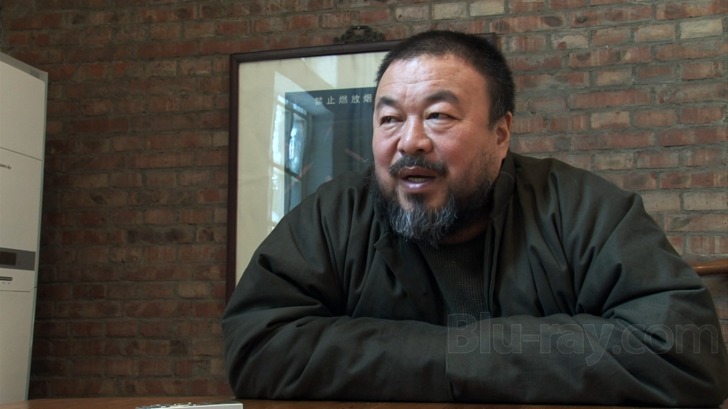
Reviewed by Casey Broadwater December 5, 2012Dissident Chinese artist Ai Weiwei makes no apologies for his art or his life, and those two things are frequently one and the same. A roly-poly figure
with a Buddha belly and a Lao Tzu beard, Ai came to international attention when he was commissioned to help design the Beijing National Stadium—
a.k.a. the "Bird's Nest"— for the 2008 Summer Olympics. Later, he courted controversy by decrying China's "false smile for foreigners" during the
games, describing the opening ceremony's "fake performances laden with propaganda" as an "empty event" and "the fantasy of a totalitarian society."
Harsh words. Since then, he's been on the Chinese government's shit-list, so to speak, for his increasingly high-profile political activism.
In 2011, after he'd spent 81 days secretly imprisoned by authorities, ArtReview magazine named Ai the "world's most powerful artist," so it seems
high time that someone released a film about him. That someone is American freelance journalist and debut documentarian Alison Klayman, who
moved to China in 2006, taught herself Mandarin, and met Ai in 2008, when she put together a video for an exhibition about the photos he took while
living in New York in the 1980s. Klayman would spent the next several years trailing Ai with a video camera and interviewing family, colleagues, and
cultural critics. The end result is Ai Weiwei: Never Sorry, a living portrait of the artist as an intractably persistent firebrand whose own daily
existence has become a subversive performance piece.
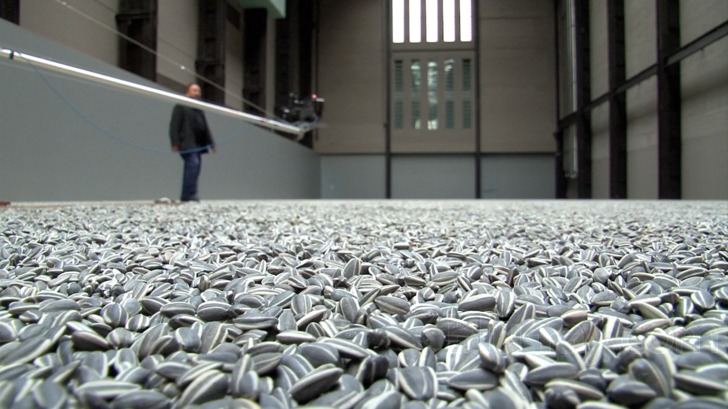
While the film gives a solid overview of Ai's career, Never Sorry is surprisingly light in its coverage of his more formal art, which typically consists of conceptual installations, produced "factory"-style, a la Andy Warhol or Jeff Koons. "I have very little involvement in the production of my works," Ai says. "I mainly make the decisions. I prefer to have other people implement my ideas." These ideas tend to be grand in scale. In 2010, he covered the floor of London's Tate Modern—several inches deep—with 100 million hand-painted ceramic sunflower seeds, produced by 1,600 artisans from the town of Jingdezhen. The connotations are clear. The piece comments on mass production, suggests the enormity of China's population, and serves to remind that all masses are made up of unique individuals.
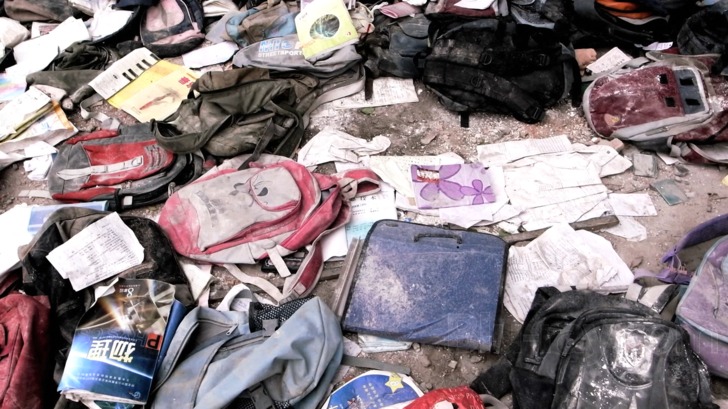
Ai's concern for "the people" is a theme that runs through much of his work. In a 2009 installation, he covered the facade of Munich's Haus der Kunst museum with 9,000 brightly colored children's backpacks, arranged to spell a single sentence in Chinese characters: "She lived happily in this world for seven years." The quote is from a mother who lost her daughter in 2008's massively destructive Sichuan earthquake, which killed several thousand students in poorly constructed schools.
A large section of Never Sorry follows Ai's attempt to investigate and uncover just how complicit the Chinese government was in these deaths, many of which could've been avoided had corners not been cut. When authorities refused to release official death tolls, Ai and his team traveled the countryside, collating data straight from local sources, and produced a documentary about the coverup. Throughout Never Sorry we see Ai passing out DVD copies to most everyone he meets. "Transparency is to Ai Weiwei what liberty was to another generation," says one commentator.
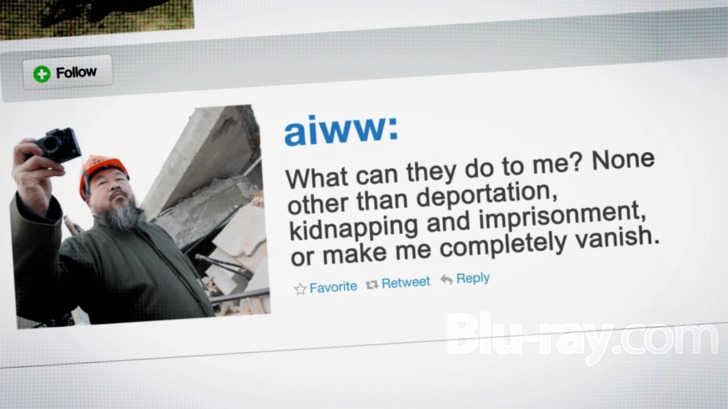
Since the government shut down his blog, Ai has turned to Twitter as his favorite medium, compulsively self-documenting as he rages against the machine of the state. He now has nearly 200,000 followers. There's a significant case to be made—and Never Sorry makes it, if not explicitly— that Ai's Twitter feed is just as, if not more important than his installations, exhibitions, and retrospectives. That's not to say his art isn't similarly subversive or confrontational. One of his most famous pieces is a 1995 triptych photograph called "Dropping a Han Dynasty Urn," which shows just that—Ai letting an ancient vase drop from his hands and shatter on the ground. He's painted other old urns—symbols of China's 2,000-year cultural heritage—with the Coca-Cola logo. In another series, he's photographed himself giving the middle finger to locations of entrenched political power, like The White House and Tiananmen Square.
The son of a revered poet who was persecuted by Communist authorities for being "rightest," it seems appropriate that Ai Weiwei, born in 1958, is now a perpetual thorn in the party's side. He stages "happenings"—think small flash mobs—and harangues the police with his personal videographer in tow. He files endless petitions and complaints with local authorities. He stands up for imprisoned Nobel Prize-winning writer Liu Xiaobo and is extremely vocal about the injustices of a government that actively shushes vocal dissidents. Naturally, he's become a target himself, with his home studio put under 24-hour surveillance.
He's even experienced physical violence. In the most harrowing section of the documentary, Ai travels to a small town to testify in the trial of earthquake activist Tan Zuoren. The night before he's scheduled to appear in court, the police kick open Ai's hotel room door, and in the scuffle, one of them punches him in the head. This is captured on audio only, but Ai tweets a picture of his battered face the next day, and it goes viral. A month later, while installing a piece in Germany, he had to have surgery to remove swelling in his brain. The climax of the film is Ai's mysterious disappearance and imprisonment in 2011, over charges of tax evasion and the spreading of "pornographic" images. He was released 81 days later on the condition that he wouldn't speak to the media, but, of course, Ai Weiwei is not so easily silenced. He's become bigger-than-life, a figure who symbolizes all efforts to make China a freer, more open society. What's most exciting about Never Sorry is that Ai's story isn't over, and that there's certainly more art-meets-politics drama to come.
Ai Weiwei: Never Sorry Blu-ray Movie, Video Quality

Shot primarily on small, portable HDCAM video cameras and featuring a variety of archival TV news clips—many in standard definition—Ai Weiwei: Never Sorry nevertheless looks great on Blu-ray, with a 1080p/AVC-encoded transfer that seems true to its sources. Of course, anytime you're shooting with fairly inexpensive video gear, you can expect certain issues to crop up—blown out highlights, occasional aliasing, heavy noise in darker situations—and while these are certainly present, they're never distracting. Just like many documentaries in the '60 and '70s were shot on 16mm— more flexible than 35mm but with reduced analog resolution—it makes sense for filmmakers to work with whatever type of camera suits their immediate needs, even if picture quality is slightly diminished. In this case, with Alison Klayman following Ai Weiwei around from police stations to galleries to hotel rooms, an HDCAM is perfect. Clarity can vary somewhat in the out-and-about scenes, but most of the sit-down interview material is quite sharp, with strong facial detail and visible fine textures. Color is strictly realistic—no heavy grading here—and while the highlights do often peak, contrast is otherwise right where it needs to be. Beyond some minor color banding, there are no obvious compression issues here. Overall, a faithful presentation that's a good step or two up, visually, from streaming or VOD options.
Ai Weiwei: Never Sorry Blu-ray Movie, Audio Quality
Never Sorry features a lossless DTS-HD Master Audio 5.1 surround track that's surprisingly well-mixed for a follow-a-guy-around-type documentary. What makes it is the fantastic score by Ilan Isakov, which drifts in and out of the background, filling all the channels with an ambient wash of guitar, Chinese instrumentation, and electronics. The music suits the mood of each sequence and has good dynamic presence without being overpowering. There's even occasional environmental noise panned into the rear speakers, like light rain, street clamor, and other outdoor sounds. The real focus, though, are the subjects' voices—expect to hear Mandarin and English about equally—which are always cleanly recorded and easy to understand. Any muffling or peaking here is fleeting. The disc defaults to English subtitles for sections spoken in Mandarin, but there are also optional English SDH, Spanish, and Simplified Chinese subtitles, all in legible yellow type.
Ai Weiwei: Never Sorry Blu-ray Movie, Special Features and Extras
- Audio Commentary: Director Alison Klayman, co-producer Colin Jones, and editor Jennifer Fineran discuss the details of the film's construction, from Klayman's early meetings with the artist to Ai's surprise imprisonment and the editing together of many, many hours of footage into a coherent story.
- Deleted Scenes (HD, 39:52): A sizable collection of cut scenes, following Weiwei around as he visits earthquake sites, buys a New York hot dog, chats with admirers, and more.
- Interviews (HD, 24:07): Here, Weiwei's mom and younger brother tell a few stories from his childhood, and Ai's studio manager gives us a tour of "258 Fake." There's also a short "Op-Doc" from the New York Times—a kind of mini-documentary—and a discussion with the people who run an English version of Weiwei's Twitter feed, using crowd-sourced translations. Finally, there's an additional interview with Weiwei at the Tate Modern, where he discusses his "Sunflower" installment.
- Trailer (HD, 2:33)
Ai Weiwei: Never Sorry Blu-ray Movie, Overall Score and Recommendation
One of the art world's most visible, vocal figures, Ai Weiwei makes for a fascinating documentary subject. Never Sorry focuses on the artist's political activism—which is itself a kind of all-encompassing performance piece—and the figure who emerges here is both recognizably human and bigger- than-life, a man and a symbol. (Sure, why not, let's call him China's dissident Batman.) This is a very well-put-together documentary, showing us not just what Ai has created, but what he's become. You'll definitely want to add the firebrand to your Twitter feed, and if you're an art follower or documentary fan, you'll probably want to add this film to your collection. Recommended!
Similar titles
Similar titles you might also like
(Still not reliable for this title)

When the Levees Broke: A Requiem In Four Acts
2006

All That Breathes
2022
Twenty Years Later
Cabra Marcado para Morrer / A Man Marked for Death
1984

Flying Clipper 4K
- Traumreise unter weissen Segeln / Mediterranean Holiday
1962

Jiro Dreams of Sushi
2011

Crazy Nights
Follie di notte
1978

The Mystery of Picasso
Le mystère Picasso
1956
The Captains Close Up
2013

Man with a Movie Camera
Человек с киноаппаратом / Chelovek s kino-apparatom
1929

Why We Fight
20th Anniversary Edition
2005

Forks Over Knives
2010

More Than Honey
2012

Tokyo Olympiad
東京オリンピック / Tôkyô orinpikku
1965

Awaken 4K
2018

Anselm 3D
Anselm - Das Rauschen der Zeit
2023

Triumph of the Will
Triumph des Willens
1935

Kedi
Nine Lives: Cats in Istanbul
2016

The Dark Glow of the Mountains
1985

Herdsmen of the Sun
1989

Agnès de ci de là Varda
Agnès Varda: From Here to There
2011