A Traveler's Guide to the Planets Blu-ray Movie
HomeA Traveler's Guide to the Planets Blu-ray Movie 
National Geographic | 2010 | 300 min | Not rated | Jun 29, 2010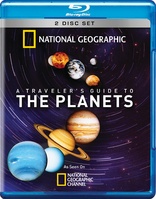
Price
List price:Listed on Amazon marketplace

Movie rating
7.2 | / 10 |
Blu-ray rating
| Users |  | 3.8 |
| Reviewer | | 4.0 |
| Overall | | 3.8 |
Overview
A Traveler's Guide to the Planets (2010)
Take a trip of a lifetime to visit our neighboring planets with A Traveler s Guide to the Planets. National Geographic takes off beyond Earth s boundaries for the ultimate tour of our solar system. From Mars monstrous mountains to Saturn s glittering rings, the sights are out of this world. Each hour offers breathtaking tours of the planets using modern-day high-tech telescopes and stunning CGI. Programs include: Saturn, Jupiter, Neptune and Uranus, Pluto and Beyond, Mars, Venus and Mercury.
| Documentary | Uncertain |
| Nature | Uncertain |
Specifications
Video
Video codec: MPEG-4 AVC
Video resolution: 1080i
Aspect ratio: 1.78:1
Original aspect ratio: 1.78:1
Audio
English: Dolby Digital 5.0
English: Dolby Digital 5.1
English: Dolby Digital 2.0
Subtitles
English
Discs
25GB Blu-ray Disc
Two-disc set (2 BDs)
Playback
Region A (B, C untested)
Review
Rating summary
| Movie |  | 4.5 |
| Video | | 4.0 |
| Audio |  | 3.5 |
| Extras |  | 1.5 |
| Overall | | 4.0 |
A Traveler's Guide to the Planets Blu-ray Movie Review
National Geographic does its own take on The Universe, or at least our corner of it, in this excellent new series.
Reviewed by Jeffrey Kauffman September 1, 2010Television viewers and Blu-ray aficionados have had a rare chance to compare how two different networks approach much the same material, as History Channel has just released The Universe: Our Solar System, a compendium of episodes of that long running series mostly focusing on our little neck of the woods, universally speaking, and National Geographic has now followed suit with their own A Traveler’s Guide to the Planets. There are some telling differences in approach, even if much the same actual information is imparted in both series. The National Geographic series clothes each episode in a sort of travelogue setting, imagining what a space traveler would need for the journey, and what sights and sounds would await the intrepid trekker as he (or she) ventured in the great unknown of outer space. That means that A Traveler’s Guide to the Planets features a lot of high-tech looking interstitials with young people gazing at a sort of control room full of screens upon which data about various planets is displayed. The NatGeo series is also a bit more deliberate than the History Channel outing, with a more relaxed attitude that actually features long stretches of imagery without omnipresent narration. The NatGeo approach is also helped by several scientists who worked on various probes of some of the planets being discussed, bringing an intimate knowledge not only of the planets themselves, but of how Man attempted to explore them. On the downside, the NatGeo Blu-ray is presented in 1080i (for you persnickety folks who insist on 1080p, as the History Channel Blu-rays offer), and a patently strange assortment of inconsistent audio options, all of them lossy. The universe is indeed full of choices. This two disc Blu-ray set offers six episodes (as opposed to Our Solar System’s ten), with a couple of forgettable shorts also included. (Note: On the review discs provided to me, the discs were mislabeled, with three episodes per disc shown. The review below lists the episodes as they were found on this review copy).
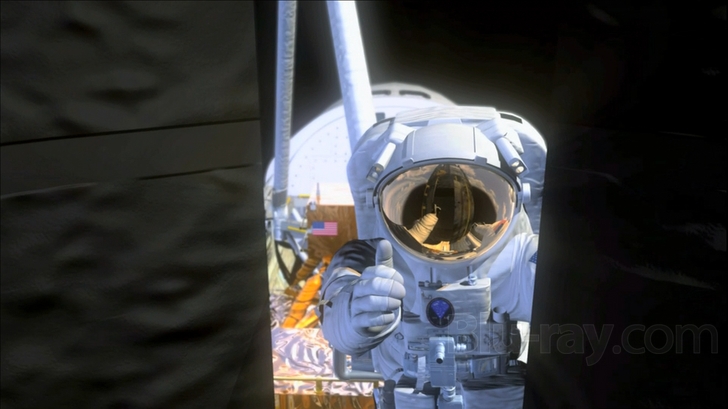
Be careful. . .that one small step is a doozy.
Disc One
Saturn. Our ringed faraway neighbor is described here as the “most photogenic” of planets in our solar system, though its beauty is only skin deep. This episode literally delves into the depths of Saturn’s poisonous atmosphere and spends quite a bit of time on the bizarre hexagonal storm system which remains stationary at Saturn’s North Pole (also covered in Our Solar System.) A nice segment on Saturn’s moon Enceladus is featured, showing the satellite’s salty geysers spewing their sodium into space. Another segment deals with the Cassini-Huygens space probe which got to the planet in 2004. This segment includes some incisive interviews with Cassini scientists.
Jupiter. Forgive the pun, but Jupiter comes off as hardly Jovial in this episode, as we go on what is described as a “high adrenaline adventure” of dropping through the planet’s massive cloud cover to discover a planetary surface that’s actually hotter than the Sun. Because of its massive weather systems, the planet has been a long lasting fascination for various meteorologists, some of whom discuss their interest in this informative episode. One of the best segments deals with Galileo pointing his telescope skyward in 1610 and discovering the planet, which then segues into information about the Galileo spacecraft which explored the planet centuries later. Nice sidetrips to Jupiter’s moons, including Ganymede and Callisto, are also offered.
Mars. As the planet we’ll most likely visit next, and quite possibly even set up a permanent base on, Mars is both tantalizing close and yet still far enough away to present awesome challenges as NASA attempts to strategize how to get men there (and back). Though it’s often called the “red planet,” Mars is actually bitterly cold, and keeping an exploratory team safe there presents huge obstacles, not the least of which is finding potable water. Though it’s presented in passing as almost an afterthought, entry speed into the planet’s atmosphere would be in excess of Mach 27. Now that’s pulling some G’s.
Venus and Mercury. As they are in Our Solar System, these two planets are lumped together in A Traveler’s Guide. Mercury appears lifeless, the planet which topographically most resembles our own Moon due to its battering by asteroids and meteorites, though for a “dead” planet, it emits a strangely strong magnetic field. Venus is somewhat humorously described by a scientist as “green hell.” Though this planet is named after the Goddess of Love, it’s a forbidding and disturbing place, the only planet in our solar system which rotates backwards, making the Sun rise in the West and set in the East. Because of Venus’ slow rotation, one day there lasts eight Earth months, longer than an actual Venusian year!
Disc Two
Pluto and Beyond. Unlike Our Solar System, which gave this maybe-is, maybe-not planet the short shrift, A Traveler’s Guide provides a really interesting and at times surprisingly spry look at this chunk of ice which was first named Planet X upon its discovery in 1930. Some sweet archival footage of Clyde Tombaugh, the man who discovered Pluto, is also featured. A long discussion of Pluto’s rather ignominious fate is also on tap, as the debate over what exactly constitutes a planet is covered.
Neptune and Uranus. Also left in the lurch in Our Solar System, these two “Ice Zone” planets get good and very informative coverage in A Traveler’s Guide. Both of these planets are largely gaseous, comprised of hydrogen, helium and methane. Both also feature insanely slow orbits, with Uranus taking some 84 years to traverse around the Sun, and Neptune taking an impossible to imagine 165 years to do the same thing. There’s some humor here, too, as Uranus’ first moniker of “George” is discussed.
A Traveler's Guide to the Planets Blu-ray Movie, Video Quality
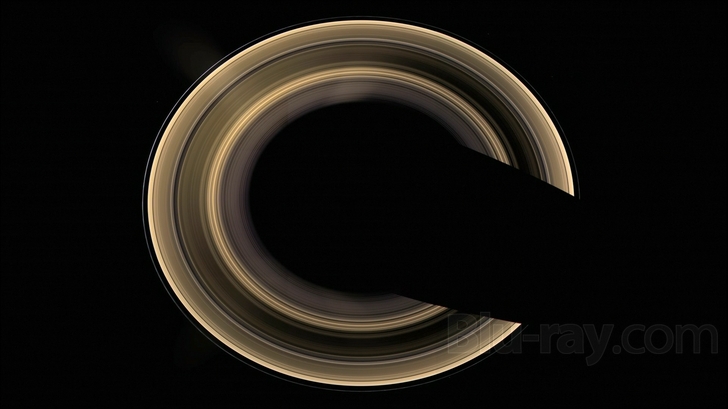
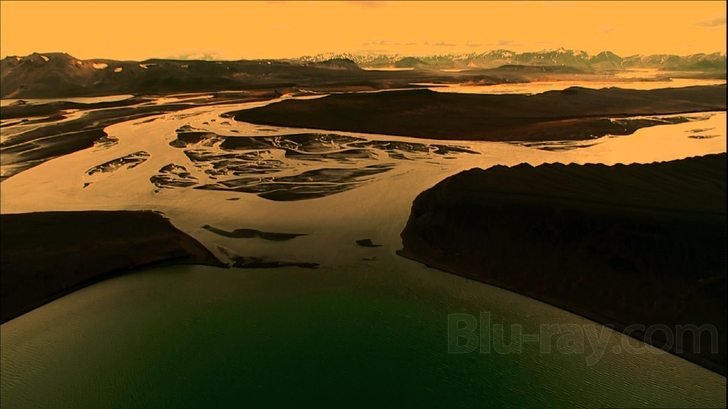
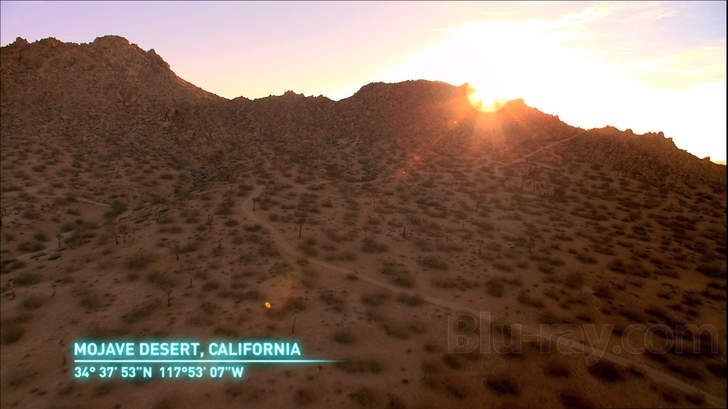
Though A Traveler's Guide to the Planets' 1080i presentation may make it less appealing than Our Solar System's 1080p presentation, the fact is there's really very little to complain about in this AVC encoded 1.78:1 image. As with the History Channel series, there's impeccable sharpness in the many CGI elements, and the interview segments also look generally very good. Archival footage exhibits the same ragged flaws which plagued Our Solar System. Strangely, interlacing artifacts are few and far between, and there's virtually none of the moire issues that cropped up on Our Solar System. Colors are robust and well saturated and overall this series sports a very clean, well defined look, with excellent contrast and nice, richly inky black levels.
A Traveler's Guide to the Planets Blu-ray Movie, Audio Quality
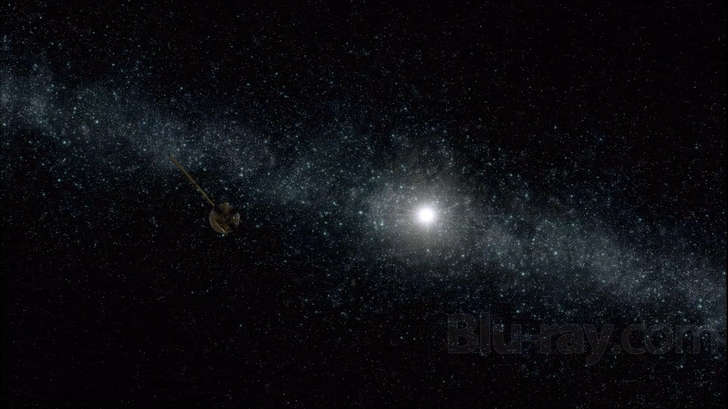
A strange assortment of lossy soundtracks is offered here. For some reason, the first episode is presented in Dolby Digital 5.0, while the rest have a full 5.1 surround mix. All of the episodes feature a standard Dolby 2.0 stereo fold down. While a lossless track of some kind certainly would have been appreciated, what's here suffices quite nicely, with narration front and center and the many sound effects utilized quite well to provide at least a semblance of immersion throughout each episode. LFE is quite frequently on display, both through scenes of explosions, but also more puatatively mundane things like spaceships blasting off. There's nothing amazing to hear here, but what is here is presented in a clear and crisp manner and shouldn't be too disappointing to too many, despite its lack of losslessness.
A Traveler's Guide to the Planets Blu-ray Movie, Special Features and Extras
Two fairly lame and extremely brief SD featurettes are included on Disc Two, The Sun (3:59) and The Moon (2:53). These are generalist overviews that are fine timekillers, but little more than that. Trailers for other NatGeo products are also included.
A Traveler's Guide to the Planets Blu-ray Movie, Overall Score and Recommendation
Having waded through both Our Solar System and A Traveler's Guide to the Planets over the past few days, I'd have to give the edge to this National Geographic outing. The best thing for me is the total lack of apocalyptic garbage, something that fills up far too much of History Channel's programming, not just The Universe. But NatGeo's interesting, if slightly goofy, framing device of this being a travelogue for a futuristic traveler gives the series an up close and personal experiential quality which is completely missing from The Universe. Image quality on both of these series is virtually identical, but I do have to give the aural edge to the History Channel's lossless stereo mix. Otherwise, A Traveler's Guide is a trip I highly recommend.
Similar titles
Similar titles you might also like
(Still not reliable for this title)

Wonders of the Solar System
2010

Discovery Atlas: Complete Collection

Serengeti
2019

Le monde du silence
The Silent World
1956

Over Ireland
1998

Journey Into Amazing Caves
IMAX
2001

Atmospheres: Earth, Air & Water
2008

Relentless Enemies
2006

National Parks Exploration Series: The Grand Canyon - A Wonder of the Natural World
2012

Inside the Milky Way
2010

Wonders of the Universe
BBC
2011

Journey to the Edge of the Universe
2009

Asia
2024

One Life
2011

Planet Ocean
2012

Secret Life of Birds
2011

Grand Canyon Adventure: River at Risk 3D
IMAX 3D
2008

Over California
1994

Great Migrations
2010

Over Alaska
2001