Inside the Milky Way Blu-ray Movie
HomeInside the Milky Way Blu-ray Movie 
National Geographic | 2010 | 90 min | Not rated | Jan 25, 2011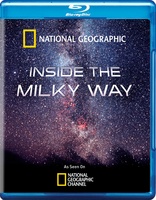
Price
List price:Listed on Amazon marketplace

Movie rating
7.7 | / 10 |
Blu-ray rating
| Users |  | 4.5 |
| Reviewer |  | 4.0 |
| Overall | | 4.2 |
Overview
Inside the Milky Way (2010)
Embark on an astounding journey across 100,000 light-years to witness key moments in the history of the Milky Way.
Narrator: Reg E. CatheyDirector: Duncan Copp
| Documentary | Uncertain |
| Nature | Uncertain |
Specifications
Video
Video codec: MPEG-4 AVC
Video resolution: 1080i
Aspect ratio: 1.78:1
Original aspect ratio: 1.78:1
Audio
English: DTS-HD Master Audio 5.1
Subtitles
English SDH
Discs
25GB Blu-ray Disc
Single disc (1 BD)
Playback
Region A (B, C untested)
Review
Rating summary
| Movie | | 4.0 |
| Video | | 4.5 |
| Audio | | 4.5 |
| Extras |  | 2.0 |
| Overall | | 4.0 |
Inside the Milky Way Blu-ray Movie Review
Fasten your seat belts, it's going to be a loooong flight.
Reviewed by Jeffrey Kauffman April 23, 2011Inside the Milky Way utilizes a unifying conceit that might initially seem kind of silly, but which as the special progresses becomes more meaningful. In the hustle and bustle of the urban life that most people live in nowadays, city lights extinguish our ability to see what this engaging National Geographic outing describes as “the city in the sky,” the vast network of stars known as The Milky Way. If you consider the Milky Way its own starry metropolis, you can then start exploring various “neighborhoods” and getting the the lay of the land. The history of the place can come alive in unexpected ways, and the future can be predicted based on what has happened to other neighborhoods in far away galaxies. That in a nutshell is how Inside the Milky Way progresses as it explores the quaint universal locale we call home, and which harbors some 200 billion (yes, billion with a “b”) stars. Inside the Milky Way posits what would happen if we moved the Earth around to various places in our galaxy, including graveyards where decrepit stars go to die as well as a “nursery” of sorts where new stars spring into vibrant, glowing life. Aided by a wealth of really stunning CGI, as well as gorgeous images from the Hubble telescope, and featuring some cogent commentary by several astronomers and astrophysicists, Inside the Milky Way is yet another excellent offering from the almost always reliable documentary unit at National Geographic.
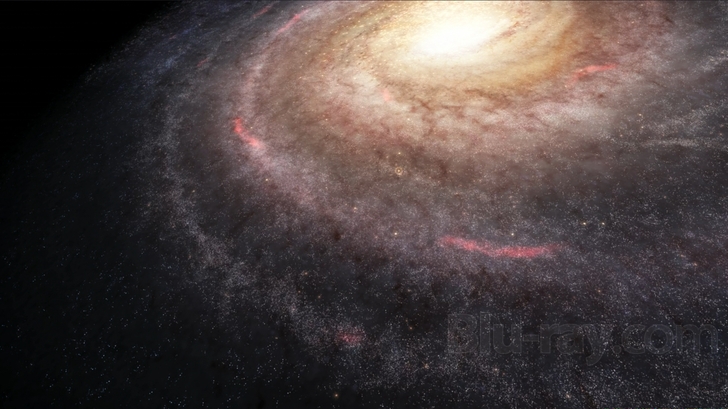
One of the most interesting things that comes out in this release, and something that most people have never even considered, is that since we’re still more or less largely Earthbound, and certainly “Milky Way bound,” we have no “outside” perspective of what the Milky Way really looks like. In fact, it is only postulated that we live in a spiral galaxy, as opposed to the other main type, elliptical. Nothing is really known for sure, and virtually everyhing we think we know has been extrapolated by examining other galaxies which we have a distant view of. Nonetheless, Inside the Milky Way attempts to answer some of the big questions facing astronomers as they search for information about our galaxy, including how it was born, what caused it to survive for so long, and how it will utlimately meet its demise.
The birth of galaxies is explored in a really interesting (and gorgeous) segment which centers on the Great Orion Nebula. The Milky Way is filled with billions of stars, brilliant pinpricks of light dotting the dark nighttime sky, but it’s actually the dark that more interests a lot of astronomers, as the darkness hints at cosmic dust hiding light behind it. Vast cosmic clouds actually stretch thousands of light-years and the Hubble Telescope finds them in most spiral galaxies. The most fascinating thing about this dust is that sometimes it glows, hinting even stronger at huge cosmic forces going on within its shadows. These glowing clouds are called nebulas and the various colors they emit give excellent clues about what kinds of gases are simmering within them. If there’s oxygen, the nebula looks green; hydrogen emits a red hue. We look at the work of astrophysicist Kimberly Weaver in this sequence, as she uses both infrared and xray technology to peek within the dust to uncover at least some of the starry mysteries held inside. Astronomers have come to understand that stars are born in a cosmic dance taking place between these gases, which tend to push outward, and gravity, which is sucking everything toward itself. Needless to say, gravity wins, and once gases are compressed and heated to an incomprehensible 18 million degrees, “magic” happens, hydrogen fuses to form helium and a star is born.
The flipside of this cosmic odyssey is explored in another fascinating segment, this time looking at the famous Crab Nebula in the Perseus system some 6,500 light-years from Earth. The Crab Nebula is made of gas and dust but it hasn’t created any stars yet, despite its gases expanding at an incredible rate of three million miles per hour. Some distant event obviously set these gases into motion, and perhaps unbelievably, Chinese texts from a mere one thousand years ago (one thousand years ago being less than a blink of an eye in cosmic terms) point the way. These manuscripts speak about a brilliant new star which lit up the daytime sky for some time before suddenly disappearing from view. The star was located where today we see the Crab Nebula. What the Chinese actually witnessed was the Crab Nebula being born from the remnants of a supernova, the death of a star.
Inside the Milky Way explores a couple of other ideas and locations as it moves along, including a visit to the heart of our galaxy’s “downtown,” its center where the density of stars is a billion times higher than in our neck of the woods. The idea of telescopes as time machines is also investigated, with astronomers likening looking through lenses at unimaginably far away light to actually looking backward through the mists of time, as what we’re seeing here on Earth is light that has taken sometimes billions of light-years to reach us. Inside the Milky Way also looks at the cloudy curtain of sorts that prevents us from seeing anything past 12.5 billion years ago.
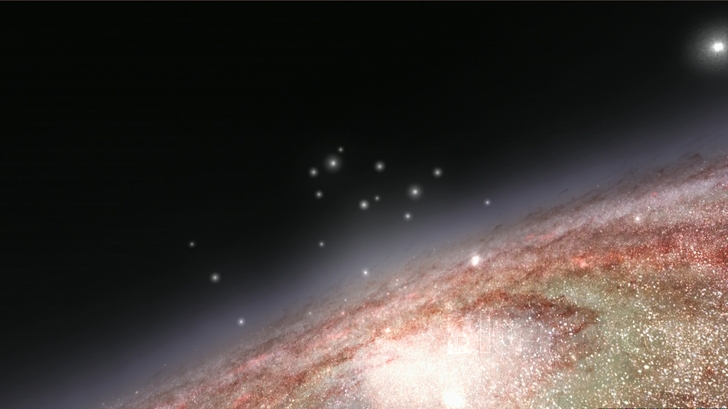
The special does go the route of History’s The Universe in its appropriately final segment when it looks at the apocalyptic data facing the Milky Way around three billion years from now, when astronomers postulate that Andromeda will collide with the Milky Way, leading to a starry catastrophe. Andromeda is currently 2.5 million light-years from us, but in the typically understated way of several of the astronomers utilized throughout this special as talking heads, one expert mentions that it’s “speeding” toward us, speed of course being a relative term here, since we have a few billion years left to work out a solution.
Inside the Milky Way is a sumptuously beautiful special that offers visual delights around virtually every corner and which manages to impart a wealth of information in a fairly short running time. The special wisely concentrates on the splendor of the images rather than staying Earthbound with its talking heads. The narration is brisk and well written, and the minimalist score is also engaging. If you want an excellent overview of current astronomical thinking on matters large and even larger, Inside the Milky Way is “investigative journalism” of the most cosmic kind.
Inside the Milky Way Blu-ray Movie, Video Quality
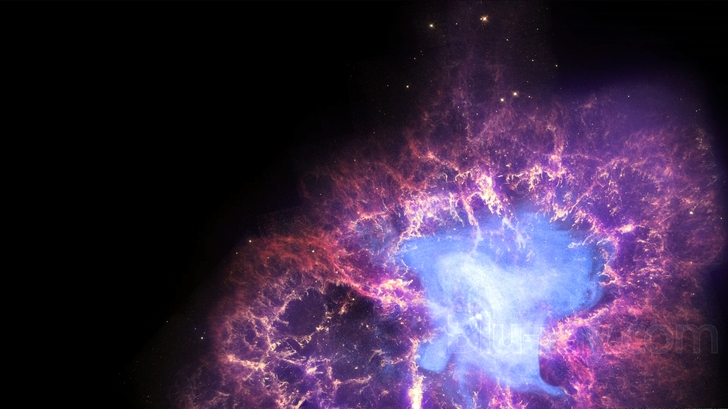
National Geographic presents Inside the Milky Way on Blu-ray with an elegant looking AVC encoded 1080i transfer in 1.78:1. This is one of the most lusciously colorful high definition presentations in recent memory, documentary or otherwise. Deep, lustrous purples, blues, oranges, reds, yellows and teals spill out of the screen in starry wonderment. The CGI elements here are top notch, as is usually the case with NatGeo, and the astounding variety of hues, all brilliantly saturated, should delight most videophiles. Interview segments, while certainly not as mindblowing as these CGI elements, are crisp and clear looking, with very good to excellent fine detail. Contrast and black levels are solid and overall, this is a spectacular looking Blu-ray.
Inside the Milky Way Blu-ray Movie, Audio Quality

Don't be dissuaded by the back cover of this Blu-ray which states only a Dolby Digital 5.1 mix is offered, because we do indeed have a lossless DTS-HD Master Audio 5.1 mix as the only audio option on this Blu-ray. This is a very well detailed and fun soundtrack, full of inventive sound effects and a better than average music score which trods a sort of Philip Glass minimalism a lot of the time. Fidelity is excellent, presenting the narration up front and delivering a wealth of sound effects to the surround channels. There's some really robust LFE in a couple of sequences, and this track offers both a great degree of immersion as well as some "space" for the listener to relax from time to time, presenting a nicely balanced mix that is most enjoyable.
Inside the Milky Way Blu-ray Movie, Special Features and Extras
Killer Asteroids (720p; 44:43) is slightly skewed toward a doomsday approach as it posits what would happen if a 200 million ton piece of rock slammed into the earth, delivering an explosion that would dwarf the combined effect of every nuclear bomb on our planet. Filled with some decent looking CGI, this special seems more like it would belong on the often apocalyptically oriented History Channel, but it's interesting and may have you looking up in the sky a bit more than you're used to to make sure nothing is about to rain down on your head.
Inside the Milky Way Blu-ray Movie, Overall Score and Recommendation
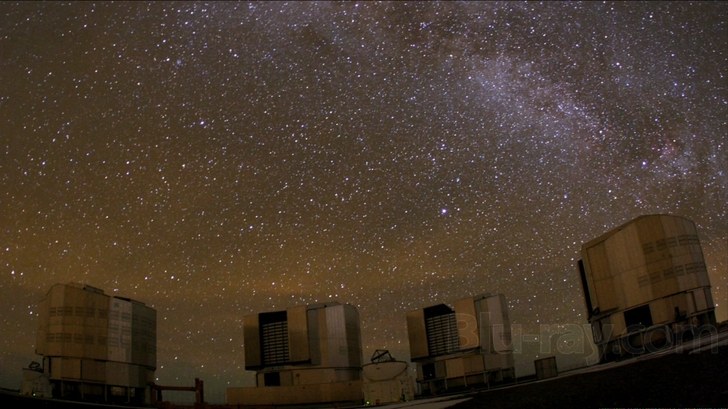
Inside the Milky Way manages to stuff an incredible amount of information into its approximate hour and a half running time. Filled with glorious imagery and an interesting conceit, whereby our little home planet of Earth is propeled about our galaxy on a mission of exploration, this is an appealing documentary that should certainly engage armchair astronomers as well as those with a more than casual interest in this subject. Recommended.
Similar titles
Similar titles you might also like

Wonders of the Solar System
2010

Winged Migration
2001

National Parks Exploration Series: The Grand Canyon - A Wonder of the Natural World
2012

Serengeti
2019

One Life
2011

Secret Life of Birds
2011

Over Ireland
1998

Grand Canyon Adventure: River at Risk 3D
IMAX 3D
2008

Over California
1994

Relentless Enemies
2006

Great Migrations
2010

Over Alaska
2001

Sharkwater
2006

Over America
1995

Discovery Atlas: Complete Collection

Le monde du silence
The Silent World
1956

Great Barrier Reef
2012

Journey Into Amazing Caves
IMAX
2001

Atmospheres: Earth, Air & Water
2008

Scenic National Parks: Grand Canyon
2008