Sony's New Strategy, What It Means for Consumers
HomeSony's New Strategy, What It Means for Consumers
Posted April 12, 2012 06:38 AM by Nayan Ashra
On a conference call this morning Sony's new CEO, Kazuo Hirai, set out a new strategy to revitalise core businesses and stop losing money in the key TV unit and eventually how to turn that loss into a profit.
With the company recording a revised $6.4 billion loss in the year just ended, March 31, 2012, a turn around for the giant consumer electronics and media company has become more desperate. Competition from Korean companies who have government support and a more nimble decision making process has eaten away at margins, while manufacturing in Japan is more expensive than manufacturing in China and Korea.
Since 2004 Sony's TV unit hasn't made profit, and it has lost enough money that it has moved Sony's group operation from profit into loss (once taking into account one-off charges) in the past three years. Turning this around is seen as a key element of Hirai's strategy. As a start Sony have decided to cut the number of TV models this year by 40% and next year will see further reductions in the product line up. Not only has Hirai decided to cut the number of models, he has decided to exit direct manufacturing of almost all TV's altogether for the medium term.
Future TV tech has also been named as a key development area for the short to medium term. Both OLED and Crystal LED (CLED) have been outlined as technologies that Sony will exploit. OLED is an area where Korean players are already making moves to enter into so Sony would be behind if they entered in 2013. CLED looks like Sony's future in display technology, the presentation specifically mentions that it is suited to large screen and high resolution. That means we could see 46" and above CLED TVs with 4k resolution sooner rather than later. Sony have not demonstrated OLED in a while now and despite being the first company to market OLED with the XEL-1 in 2008, they have not made another model since then, therefore their interest seems to have cooled down because of cost and manufacturing concerns. In the presentation CLED seems to takes prime place as their future technology for displays.
All of these moves will decrease fixed costs by 60% in the TV business by the end of March 2014 and allow Sony to turn a profit. Sony's LCD TVs, from 2013 onwards, will likely be built by third parties such as Hon Hai Precision (Foxconn) in much the same way Apple have their products built by third parties to control costs. This year could be the last in which Sony make their own LCD TVs.
Another area where Sony's business has gone down is mobile communication and merging businesses. The title of the conference call was "One Sony" and therein lies Sony's problem. The sum of Sony's parts is much greater than the individual components in theory, but in practice this has rarely been seen lately. Today, Hirai laid out the strategy for Sony Mobile Communications. It will be the lightning rod for all of Sony's creative and service outlets as the slide outlines.
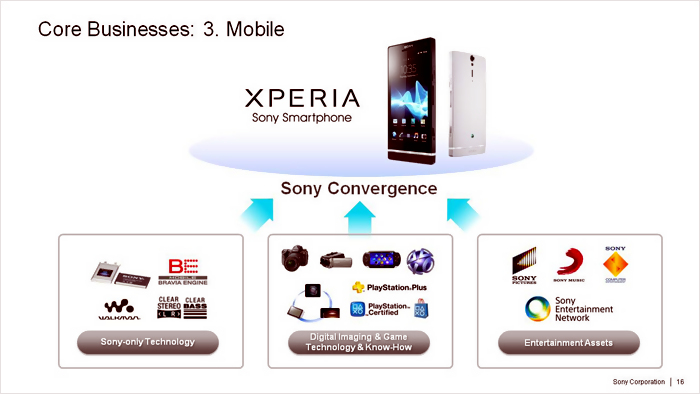
We can see here that all of Sony's gaming interests are going to be leveraged into the mobile phone unit, along with their knowhow in AV technology, such as the Bravia Engine and their Walkman legacy that has already been integrated. What will be new to Sony's mobile offering is the Sony Entertainment Network (SEN). SEN is a culmination of all of Sony's online and media services and will offer music from Sony Music, movies from Sony Pictures and games from Sony Computer with a single sign in. Sony are also going to leverage their imaging technology in future phones. For the consumer the most interesting part is that Sony Pictures movies could well be sold via UV (codes are included on many SPHE BD releases now) so they are compatible with other Sony and UV devices from the off. Right now Sony's content offering on mobiles has been lacking because previously owned movies or games had to be bought for a second time. One hopes that the management have done away with this.
The final area where Sony have dedicated time is 4K resolution, that is 4096x2160 pixels, 4x as many pixels as Full HD. As of now, management have outlined the areas where 4K is going to be pushed for consumers:
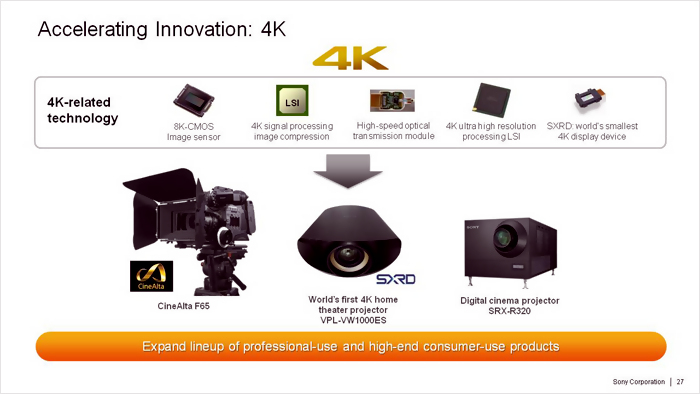
As we can see they are going to promote harder their first ever 4K consumer SXRD projector, the VPL-VW1000ES, though with a $21,000 price tag it may still prove beyond the reach of many consumers. An area that has not been outlined in the 4k push to consumers is a home video product such as Blu-ray 4K or 4K Direct View TVs. The presentation said that Sony will expand their 4K offering quickly so maybe those two areas will be addressed. It looks to me like BDXL would be perfect for 4K and as Sony mentioned in their presentation, CLED is suited to high resolution and large screens. It would be great to see a high end 4K player supported by SPHE and a Sony CLED 4K TV for people who want the very highest quality in home video.
What is noticeable in its absence is 3D. No mention of 3D was made in today's presentation, not for display technology or for Blu-ray. It looks like Sony now see 4K as the future of home video ahead of 3D. Whether this was a purposeful avoidance of 3D in their new strategy or an oversight is yet to be seen, but it could mean that Hirai is much less enthusiastic about 3D than his predecessor, Sir Howard Stringer.
All in all, not enough details have been given by Sony's management on the scale of their restructuring in TVs and what it entails, but it should become clear in May when Sony post their full year results. The company expects that by 2014 they will have an operating profit margin of above 5% group wide and 5% in electronics.
With the company recording a revised $6.4 billion loss in the year just ended, March 31, 2012, a turn around for the giant consumer electronics and media company has become more desperate. Competition from Korean companies who have government support and a more nimble decision making process has eaten away at margins, while manufacturing in Japan is more expensive than manufacturing in China and Korea.
Turning the TV Unit Around
Since 2004 Sony's TV unit hasn't made profit, and it has lost enough money that it has moved Sony's group operation from profit into loss (once taking into account one-off charges) in the past three years. Turning this around is seen as a key element of Hirai's strategy. As a start Sony have decided to cut the number of TV models this year by 40% and next year will see further reductions in the product line up. Not only has Hirai decided to cut the number of models, he has decided to exit direct manufacturing of almost all TV's altogether for the medium term.
Future TV tech has also been named as a key development area for the short to medium term. Both OLED and Crystal LED (CLED) have been outlined as technologies that Sony will exploit. OLED is an area where Korean players are already making moves to enter into so Sony would be behind if they entered in 2013. CLED looks like Sony's future in display technology, the presentation specifically mentions that it is suited to large screen and high resolution. That means we could see 46" and above CLED TVs with 4k resolution sooner rather than later. Sony have not demonstrated OLED in a while now and despite being the first company to market OLED with the XEL-1 in 2008, they have not made another model since then, therefore their interest seems to have cooled down because of cost and manufacturing concerns. In the presentation CLED seems to takes prime place as their future technology for displays.
All of these moves will decrease fixed costs by 60% in the TV business by the end of March 2014 and allow Sony to turn a profit. Sony's LCD TVs, from 2013 onwards, will likely be built by third parties such as Hon Hai Precision (Foxconn) in much the same way Apple have their products built by third parties to control costs. This year could be the last in which Sony make their own LCD TVs.
Merging Businesses, Game Meets Mobile
Another area where Sony's business has gone down is mobile communication and merging businesses. The title of the conference call was "One Sony" and therein lies Sony's problem. The sum of Sony's parts is much greater than the individual components in theory, but in practice this has rarely been seen lately. Today, Hirai laid out the strategy for Sony Mobile Communications. It will be the lightning rod for all of Sony's creative and service outlets as the slide outlines.
We can see here that all of Sony's gaming interests are going to be leveraged into the mobile phone unit, along with their knowhow in AV technology, such as the Bravia Engine and their Walkman legacy that has already been integrated. What will be new to Sony's mobile offering is the Sony Entertainment Network (SEN). SEN is a culmination of all of Sony's online and media services and will offer music from Sony Music, movies from Sony Pictures and games from Sony Computer with a single sign in. Sony are also going to leverage their imaging technology in future phones. For the consumer the most interesting part is that Sony Pictures movies could well be sold via UV (codes are included on many SPHE BD releases now) so they are compatible with other Sony and UV devices from the off. Right now Sony's content offering on mobiles has been lacking because previously owned movies or games had to be bought for a second time. One hopes that the management have done away with this.
4K and the Future
The final area where Sony have dedicated time is 4K resolution, that is 4096x2160 pixels, 4x as many pixels as Full HD. As of now, management have outlined the areas where 4K is going to be pushed for consumers:
As we can see they are going to promote harder their first ever 4K consumer SXRD projector, the VPL-VW1000ES, though with a $21,000 price tag it may still prove beyond the reach of many consumers. An area that has not been outlined in the 4k push to consumers is a home video product such as Blu-ray 4K or 4K Direct View TVs. The presentation said that Sony will expand their 4K offering quickly so maybe those two areas will be addressed. It looks to me like BDXL would be perfect for 4K and as Sony mentioned in their presentation, CLED is suited to high resolution and large screens. It would be great to see a high end 4K player supported by SPHE and a Sony CLED 4K TV for people who want the very highest quality in home video.
What is noticeable in its absence is 3D. No mention of 3D was made in today's presentation, not for display technology or for Blu-ray. It looks like Sony now see 4K as the future of home video ahead of 3D. Whether this was a purposeful avoidance of 3D in their new strategy or an oversight is yet to be seen, but it could mean that Hirai is much less enthusiastic about 3D than his predecessor, Sir Howard Stringer.
All in all, not enough details have been given by Sony's management on the scale of their restructuring in TVs and what it entails, but it should become clear in May when Sony post their full year results. The company expects that by 2014 they will have an operating profit margin of above 5% group wide and 5% in electronics.