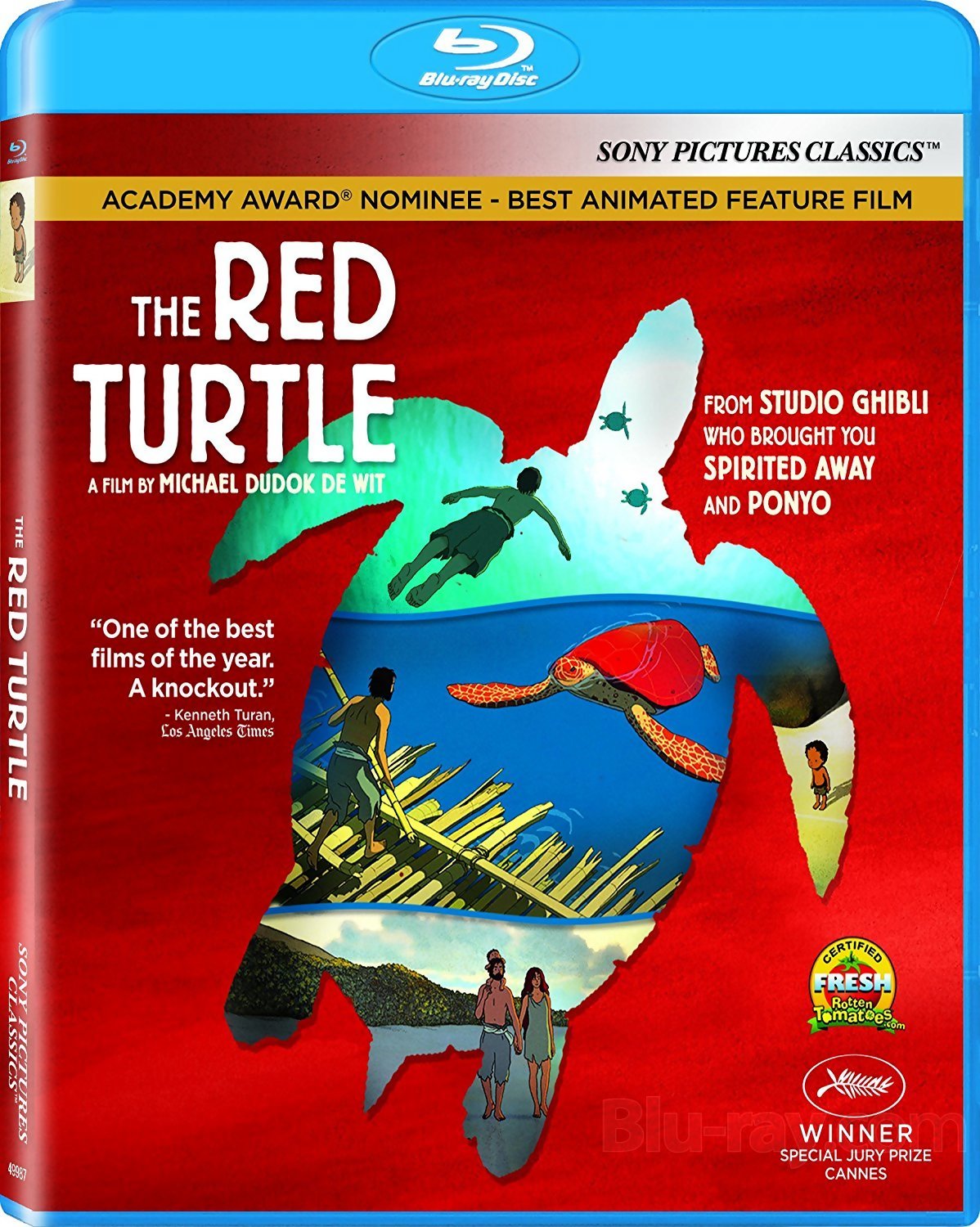
The Red Turtle Blu-ray
HomeThe Red Turtle Blu-ray
Posted March 20, 2017 06:14 PM by Webmaster
Sony Pictures Home Entertainment will release on Blu-ray director Michael Dudok de Wit's animated film The Red Turtle (2016). The release will be available for purchase on May 2.
Synopsis: Marking the much-anticipated return of Studio Ghibli, this masterfully animated fantasy film tells the story of a man shipwrecked at sea who becomes stranded on a beautiful but desolate island. He learns to live in isolation, seemingly tormented in his efforts to escape the island by a giant red turtle. Miraculously, he soon comes upon a young woman also lost at sea and they create a family together.
Special Features:
INTERVIEW WITH MICHAEL DUDOK DE WIT
- Among your animated shorts, at least two are now considered cult films. The Monk and the Fish, produced at the studio Folimage in Valence won a César in 1996 and was nominated for an Academy Award®. In 2001 Father and Daughter received widespread critical acclaim and won several awards (Annecy, Hiroshima, etc.) including an Academy Award®. A little girl watches her father leave. His memory follows her throughout her life. Here you express an indefinable feeling: longing…
Yes, it's hard to define as it's very subtle, but I think it's something a lot of people have experienced. It's a yearning for something that seems unattainable, a deep and silent desire. For an artist, this can be a quest for perfection, an ideal in music, drawing, poetry… A painful and yet beautiful absence. You cannot imagine the number of moving testimonies I received from friends and strangers alike, telling me the film evoked what they themselves had experienced. I'm incredibly lucky it has become a classic film.
- You were a member of the jury at the 2004 Hiroshima Festival. Did you meet Isao Takahata there?
Indeed, we exchanged a few words. He even spoke a little French. He loves French culture. Shortly afterwards, I was surprised to see him arrive with a translator at the Seoul Festival, where I was giving a seminar about my work to students. I thought he was just there to say hello, but he stayed for the whole conference! Perhaps he already had a collaborative project in mind.
- In November 2006 you received an unexpected email from Tokyo.
With two queries. The first was the Ghibli Museum asking for my permission to distribute Father and Daughter in Japan. The second was whether I would be interested in working with their studio on my very own feature film. Until then, I hadn't really thought about a feature film. Some of my friends had been promised wonderful things, had gone to California only to return disappointed after having seen their projects revised by producers.
But with Studio Ghibli, it's different. They told me that we would be working under French law, which respects art films. They gave me several months to write the script. I had the idea of a man on a desert island, a theme that has since then become somewhat recurrent on television, but I liked this archetypal idea. I didn't want to tell the story of how he survives, as this has been done so many times. I needed more than that. So I spent some time on one of the small Seychelles islands – a name which evokes luxury vacations. But I made a simpler choice, living with locals for ten days. I would go for walks alone, observing everything and taking thousands of photos. The idea was to avoid the 'holiday brochure' aesthetic. My castaway couldn't love the location – he wants to return home at all costs, as the island is not so welcoming. There are dangers, extreme solitude, rain and insects…
Then I made a classic mistake: my script was too detailed. The film would have been too long. But the basis of the story was strong. The next step was the animatic, which is a very simplified version of the film, drawn with fixed, static images. I discovered that it was sometimes tricky to translate the story into a cinematographic language. There were kinks that I couldn't smooth out. Pascal Caucheteux, my producer at Why Not Productions, suggested I meet Pascale Ferran. We saw each other regularly over the following months. We had in-depth discussions about the film as a whole, as we were unable to change isolated elements without affecting all the rest. She helped me to identify problems and to make the narrative clearer and more powerful. She also loved the idea that in animation films, the editing is so well thought out before the shots are made – she made some valuable contributions to this process.
- Once again, one of the themes is longing, the hero's inner expectations while gazing at the sea… But also what you call timelessness. It's a recurring theme in all your films – you can feel it in the shots of the trees, the sky, the clouds, the whirling birds…
Yes, these are pure and simple moments we are all familiar with. There is no past nor future, time stands still.
- But time is circular too. Generations succeed one another. The child makes the same gestures as his father, climbs the same rocks, and endures the same dangers. In the animal kingdom, it's another cycle: the dead fish feeds the flies, which are in turn eaten by the spider, the crab is carried away by the bird, etc…
That's right. The film tells the story in both a linear and circular manner. And it uses time to relate the absence of time, like music can enhance silence. This film also speaks of the reality of death. Man has a tendency to oppose death, to fear and fight against it, and this is both healthy and natural. Yet we can simultaneously have a beautiful and intuitive understanding that we are pure life and that we don't need to oppose death. I hope the film conveys that feeling.
- Another essential element is the first appearance of the turtle and the mystery that surrounds it.
The idea of creating a story with a big turtle came to me quite early. It had to be a majestic and respected sea creature. The sea turtle is peaceful and solitary; it disappears into the depths of the ocean for long periods of time and conveys an impression of quasi-immortality. Its deep red colour is fitting and makes it stand out visually. We gave a lot of thought to how much mystery we wanted to preserve in the story. In Studio Ghibli films for example, I think the presence of the mysterious is very well handled. Of course mystery can be wonderful, but not to the point where it disconnects the audience from the story. It has to be managed very subtly… And without words, since there is no dialogue in the film. It's so easy to explain things through dialogue but there are other ways of course, such as the behaviour of the characters, the music and the editing. And without dialogue, the sounds of the characters breathing become naturally more expressive.
- Let's talk about technique: apparently, you discovered digital at Prima Linea Productions.
That's right. Prima Linea is the studio – in Paris and Angoulême – where we made the film. While we were doing our first animation tests, another crew was finalising the film Wolfy, the Incredible Secret, using Cintiq, a digital pen that allows you to draw on a tablet that is also a monitor. With this tool, you can instantly visualize the results of your animation, without having to scan drawings separately. It's more economical, gives you more creative freedom and increased control for retouching. We animated two versions of the same shot, one with pencil on paper and the other with this digital pencil. The line of the digital pencil was more beautiful and that convinced us.
For the backgrounds, we chose a different process. The drawings were made with charcoal on paper, very freely, with broad strokes smudged with the palm of the hand. This artisanal quality was very important and gave the image a lovely, grainy texture. Only the raft and turtles were digitally animated. It would have been hell to animate them in 2D. As everything is finalised in the same graphic style, you can't tell it's digital. During the production I didn't do any animation or scenery, only small touch ups.
- How was the music conceived?
The music is key as there is no dialogue. I didn't have a clear idea of a specific musical style. Laurent Perez del Mar made a few suggestions including a very beautiful melody that was perfect for the main theme. I was delighted. He was quick to suggest music where I would not have thought to have any, and he was right. He often surprised me.
- Can you tell us about your meetings with Isao Takahata?
In fact, there were three producers from the start: Isao Takahata and Toshio Suzuki, the two producers from Studio Ghibli, and Vincent Maraval from Wild Bunch. We met a few times at Studio Ghibli and Isao Takahata and Toshio Suzuki also came to France. My conversation was mainly with Takahata. Sometimes we discussed details such as the characters' clothes, for example, but we mostly talked about the story, the symbolism and philosophical points: what the film truly wants to express. There were times when our cultural differences could be felt. For example, there is a fire in the story, and for Takahata, fire had a slightly different symbolic value than it did for me. Overall, we were on the same wavelength, thankfully, and I found our conversations sensitive and passionate. He was extremely involved and he is a highly qualified artistic producer.
- How long did the production take?
I started to write the script and draw the animatic in 2007. This took quite a long time and that's when I realised that the storyline didn't quite hang together. For several years I worked continually on the project (sometimes alone, sometimes with co-workers), but I realised this was too time-consuming. I'm grateful to my producers, who reassured me and were in fact, not surprised that it was taking so long. They pointed out that the most costly phase would come later, and that it was wiser to start production with a solid storyline. Some producers would have decided to finalise the story as we were animating, to avoid wasting too much time. I can understand that, but it would have been too risky for me. Production began in 2013 at Prima Linea in Angoulême; the artistic side was managed by Ghibli, Why Not and Prima Linea, where I could rely on the excellent head animator Jean-Christophe Lie, director of Zarafa and one of the pillars of this film.
Interview provided by Wild Bunch/France.
Synopsis: Marking the much-anticipated return of Studio Ghibli, this masterfully animated fantasy film tells the story of a man shipwrecked at sea who becomes stranded on a beautiful but desolate island. He learns to live in isolation, seemingly tormented in his efforts to escape the island by a giant red turtle. Miraculously, he soon comes upon a young woman also lost at sea and they create a family together.
Special Features:
- The Birth of The Red Turtle
- The Secrets of The Red Turtle
- AFI Fest Q&A with Director Michael Dudok de Wit
- Among your animated shorts, at least two are now considered cult films. The Monk and the Fish, produced at the studio Folimage in Valence won a César in 1996 and was nominated for an Academy Award®. In 2001 Father and Daughter received widespread critical acclaim and won several awards (Annecy, Hiroshima, etc.) including an Academy Award®. A little girl watches her father leave. His memory follows her throughout her life. Here you express an indefinable feeling: longing…
Yes, it's hard to define as it's very subtle, but I think it's something a lot of people have experienced. It's a yearning for something that seems unattainable, a deep and silent desire. For an artist, this can be a quest for perfection, an ideal in music, drawing, poetry… A painful and yet beautiful absence. You cannot imagine the number of moving testimonies I received from friends and strangers alike, telling me the film evoked what they themselves had experienced. I'm incredibly lucky it has become a classic film.
- You were a member of the jury at the 2004 Hiroshima Festival. Did you meet Isao Takahata there?
Indeed, we exchanged a few words. He even spoke a little French. He loves French culture. Shortly afterwards, I was surprised to see him arrive with a translator at the Seoul Festival, where I was giving a seminar about my work to students. I thought he was just there to say hello, but he stayed for the whole conference! Perhaps he already had a collaborative project in mind.
- In November 2006 you received an unexpected email from Tokyo.
With two queries. The first was the Ghibli Museum asking for my permission to distribute Father and Daughter in Japan. The second was whether I would be interested in working with their studio on my very own feature film. Until then, I hadn't really thought about a feature film. Some of my friends had been promised wonderful things, had gone to California only to return disappointed after having seen their projects revised by producers.
But with Studio Ghibli, it's different. They told me that we would be working under French law, which respects art films. They gave me several months to write the script. I had the idea of a man on a desert island, a theme that has since then become somewhat recurrent on television, but I liked this archetypal idea. I didn't want to tell the story of how he survives, as this has been done so many times. I needed more than that. So I spent some time on one of the small Seychelles islands – a name which evokes luxury vacations. But I made a simpler choice, living with locals for ten days. I would go for walks alone, observing everything and taking thousands of photos. The idea was to avoid the 'holiday brochure' aesthetic. My castaway couldn't love the location – he wants to return home at all costs, as the island is not so welcoming. There are dangers, extreme solitude, rain and insects…
Then I made a classic mistake: my script was too detailed. The film would have been too long. But the basis of the story was strong. The next step was the animatic, which is a very simplified version of the film, drawn with fixed, static images. I discovered that it was sometimes tricky to translate the story into a cinematographic language. There were kinks that I couldn't smooth out. Pascal Caucheteux, my producer at Why Not Productions, suggested I meet Pascale Ferran. We saw each other regularly over the following months. We had in-depth discussions about the film as a whole, as we were unable to change isolated elements without affecting all the rest. She helped me to identify problems and to make the narrative clearer and more powerful. She also loved the idea that in animation films, the editing is so well thought out before the shots are made – she made some valuable contributions to this process.
- Once again, one of the themes is longing, the hero's inner expectations while gazing at the sea… But also what you call timelessness. It's a recurring theme in all your films – you can feel it in the shots of the trees, the sky, the clouds, the whirling birds…
Yes, these are pure and simple moments we are all familiar with. There is no past nor future, time stands still.
- But time is circular too. Generations succeed one another. The child makes the same gestures as his father, climbs the same rocks, and endures the same dangers. In the animal kingdom, it's another cycle: the dead fish feeds the flies, which are in turn eaten by the spider, the crab is carried away by the bird, etc…
That's right. The film tells the story in both a linear and circular manner. And it uses time to relate the absence of time, like music can enhance silence. This film also speaks of the reality of death. Man has a tendency to oppose death, to fear and fight against it, and this is both healthy and natural. Yet we can simultaneously have a beautiful and intuitive understanding that we are pure life and that we don't need to oppose death. I hope the film conveys that feeling.
- Another essential element is the first appearance of the turtle and the mystery that surrounds it.
The idea of creating a story with a big turtle came to me quite early. It had to be a majestic and respected sea creature. The sea turtle is peaceful and solitary; it disappears into the depths of the ocean for long periods of time and conveys an impression of quasi-immortality. Its deep red colour is fitting and makes it stand out visually. We gave a lot of thought to how much mystery we wanted to preserve in the story. In Studio Ghibli films for example, I think the presence of the mysterious is very well handled. Of course mystery can be wonderful, but not to the point where it disconnects the audience from the story. It has to be managed very subtly… And without words, since there is no dialogue in the film. It's so easy to explain things through dialogue but there are other ways of course, such as the behaviour of the characters, the music and the editing. And without dialogue, the sounds of the characters breathing become naturally more expressive.
- Let's talk about technique: apparently, you discovered digital at Prima Linea Productions.
That's right. Prima Linea is the studio – in Paris and Angoulême – where we made the film. While we were doing our first animation tests, another crew was finalising the film Wolfy, the Incredible Secret, using Cintiq, a digital pen that allows you to draw on a tablet that is also a monitor. With this tool, you can instantly visualize the results of your animation, without having to scan drawings separately. It's more economical, gives you more creative freedom and increased control for retouching. We animated two versions of the same shot, one with pencil on paper and the other with this digital pencil. The line of the digital pencil was more beautiful and that convinced us.
For the backgrounds, we chose a different process. The drawings were made with charcoal on paper, very freely, with broad strokes smudged with the palm of the hand. This artisanal quality was very important and gave the image a lovely, grainy texture. Only the raft and turtles were digitally animated. It would have been hell to animate them in 2D. As everything is finalised in the same graphic style, you can't tell it's digital. During the production I didn't do any animation or scenery, only small touch ups.
- How was the music conceived?
The music is key as there is no dialogue. I didn't have a clear idea of a specific musical style. Laurent Perez del Mar made a few suggestions including a very beautiful melody that was perfect for the main theme. I was delighted. He was quick to suggest music where I would not have thought to have any, and he was right. He often surprised me.
- Can you tell us about your meetings with Isao Takahata?
In fact, there were three producers from the start: Isao Takahata and Toshio Suzuki, the two producers from Studio Ghibli, and Vincent Maraval from Wild Bunch. We met a few times at Studio Ghibli and Isao Takahata and Toshio Suzuki also came to France. My conversation was mainly with Takahata. Sometimes we discussed details such as the characters' clothes, for example, but we mostly talked about the story, the symbolism and philosophical points: what the film truly wants to express. There were times when our cultural differences could be felt. For example, there is a fire in the story, and for Takahata, fire had a slightly different symbolic value than it did for me. Overall, we were on the same wavelength, thankfully, and I found our conversations sensitive and passionate. He was extremely involved and he is a highly qualified artistic producer.
- How long did the production take?
I started to write the script and draw the animatic in 2007. This took quite a long time and that's when I realised that the storyline didn't quite hang together. For several years I worked continually on the project (sometimes alone, sometimes with co-workers), but I realised this was too time-consuming. I'm grateful to my producers, who reassured me and were in fact, not surprised that it was taking so long. They pointed out that the most costly phase would come later, and that it was wiser to start production with a solid storyline. Some producers would have decided to finalise the story as we were animating, to avoid wasting too much time. I can understand that, but it would have been too risky for me. Production began in 2013 at Prima Linea in Angoulême; the artistic side was managed by Ghibli, Why Not and Prima Linea, where I could rely on the excellent head animator Jean-Christophe Lie, director of Zarafa and one of the pillars of this film.
Interview provided by Wild Bunch/France.