Cold in July Q&A: Jim Mickle and Don Johnson
HomeCold in July Q&A: Jim Mickle and Don Johnson
Posted October 23, 2014 04:49 PM by Webmaster
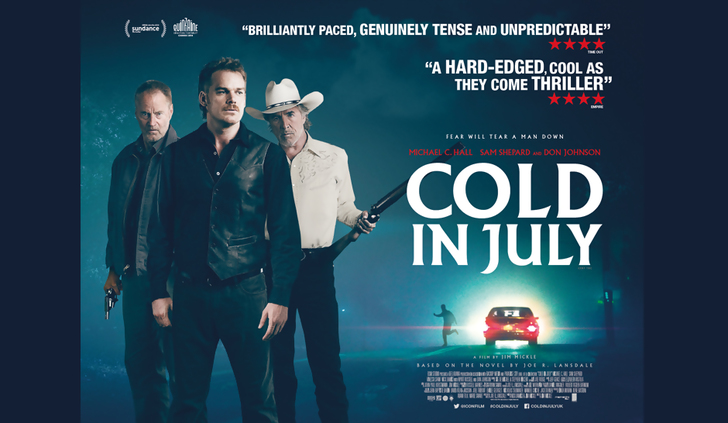
Icon Home Distribution has sent us two interviews with director Jim Mickle and Don Johnson for the new Blu-ray release of Cold in July , which was released on Blu-ray earlier this week.
Note: Blu-ray.com does not have a review for the UK Blu-ray release. However, staff member Michael Reuben has already reviewed the U.S. Blu-ray release, courtesy of MPI Media Group. Click here to read the review.
JIM MICKLE INTERVIEW
After tackling killer viruses in Mulberry Street, vampires in Stakeland and cannibals in We Are What We Are, Jim Mickle has swiftly carved himself a reputation as a filmmaker with a unique ability to play with genre. His latest film, Cold In July, continues this, albeit away from the horror world. Based on the novel by Joe R. Lansdale, it's an Eighties-set thriller inspired by such classics as Blood Simple, Red Rock West and The Hot Spot. Michael C. Hall, the actor best known for Dexter and Six Feet Under, plays Richard Dane, a picture-framer who becomes embroiled in the seedy underbelly of East Texas after he kills a burglar entering his property. Out for revenge is the criminal's grieving father, Russel (Sam Shepard), who pitches up with his friend – the incorrigible private eye Jim Bob (Don Johnson). Yet that's only the beginning of a labyrinthine story layered with small-town corruption. Below, Mickle talks about the difficulties of making Cold In July, playing his co-stars Sam Shepard and Don Johnson off one another and why he thinks Joe Lansdale is due for a re-appreciation of his work.
Q: You've been working on Cold In July for a long time. Why has it taken so long?
A: People always really liked it. That was the crazy thing. Everyone would dance around it but no-one would commit. A lot of it was, 'We just want to do a little script work' and then it would be little changes that added up. And it got to the point where the script had nothing to do with the original script, and the book I'd fell in love with. It had mutated; foreign sales people would say, 'We need to pick up the pace here.' All the things I love about the movie now, I remember hearing was bad…you can't have a movie where all of a sudden there's a different main character in the second half or you can't have something that jumps genres so much, or it's too goofy or it's not goofy enough. We wanted it to be more of a hard-boiled thriller. So it was all these things that I thought made it fresh, new and interesting – and people liked it but they didn't want to commit to that. So we kept tweaking it, tweaking it and tweaking it, trying to solve issues, but then it just becomes a puzzle; gridlock – you fix something and it opens up a bunch of other problems, and you're trying to fix those problems. So we just kept getting into that mess. And at one point, we had a script and the last foreign sales company had dropped off, so we had no commitment financially, no cast and a script that was problematic and was so different from the book.
Q: So what happened then?
A: Well, Stakeland happened because we were frustrated because we couldn't make this movie. We said, 'Let's just do things we can shoot at weekends.' We thought 'Oh, great, we'll do Stakeland.' And then we won [a prize in] Toronto and we had all this great festival experience and we thought: 'Now we get to make Cold In July.' And three years later, we still hadn't made Cold In July. And at that point, Memento Films said they'd got the rights to We Are What We Are – and would we like to remake this movie? And I said, 'Hmm, OK, so maybe this is something we can work on while we're trying to get this thing made.'
Q: What made you want to cast Michael C. Hall?
A: I was a huge Six Feet Under fan. I was just in love with that show. So I always held that character near and dear to me. So when I first started watching Dexter, I had difficulty accepting him as that. But I just kept seeing him pop up, in these incredibly chameleonic roles. I kept seeing him in different things. He would pop up in Gamer, which is a movie that's not good, but he's fucking amazing in it! And each character [he did] is so wildly different, and I was like, 'This guy is amazing. He's known for these two roles that he's played for fourteen years and in reality he's amazing at creating new characters.' And what was fun…we had an average Joe lead character. He's very much an everyman, but that can be boring for actors. Here was a guy who could create this cool character. I thought that was really exciting. He was going to be able to have fun playing a normal guy because he hadn't been cast as that at all.
Q: How would you describe the arc taken by Hall's character Richard Dane?
A: He's the guy that hasn't been tested. He finds himself, not bored or disappointed with his life exactly, but he's hit a point where he's realised this is his life, as we all do, and then he gets a taste for what it would be like if he was a cowboy, and he was seduced by that. I loved that idea. I kept saying that it reminded me of my Dad, if my Dad was mowing the lawn and Lee Marvin and Charles Bronson showed up in the drive-way and said, 'Hey, man, we need you to go on a mission with us.' And he'd say, 'Alright, I don't know why you want me but I'm going to go with you.' I loved that idea! And that's what kept me going back to it. The charm of that; that it wasn't Liam Hemsworth or something.
Q: How did you go about casting Don Johnson and Sam Shepard?
A: We sent it to both at the same time. We heard that they were both interested, but both wanted the other to be on. So I flew to New Mexico and I met with Sam. He said, 'So Don's going to do this?' I was like, 'Yeah, Don's going to do this.' Then next week I had breakfast with him and Don said, 'So Sam's going to do this!'
Q: So how was working with Sam Shepard?
A: Great. Scary. Intimidating. And it took three or four days before he trusted us, and vice versa. I think Michael really helped to grease that. I think he saw how game Michael was, and he came around, but he showed up and I think it was probably the lowest budget thing he'd done. The first couple of days he had no dialogue; he was just in the background of the shot, giving us a dirty look. So he'd show up, give us the look and then leave. I think he was like 'What the fuck am I doing?' But he did come around. At first I tiptoed around him, but then I realised that he needs to be pushed back and engaged. And then that happened, and he trusted me. If he didn't, we'd talk through why. I think he realised what we were trying to do and appreciated it. It's funny…we went to Sundance, and a friend of his said, 'He really liked this movie. He really liked the experience.' But he would never say it!"
Q: Cold In July feels like a film inspired by Eighties thrillers. Would you agree?
A: Yeah. Blood Simple is the biggest reference here. Then Red Rock West, One False Move, The Hot Spot…all those southern thrillers. And The Mean Season, with Kurt Russell. Angel Heart. That was a big reference for us, visually, with the lighting. It was fun – you start going back and exploring, and you remember how good they are. Even the lesser ones are good.
Q: How did you approach shooting a film set in this era?
A: I kept saying 'We don't want to do Wedding Singer. We don't want to pop on a cheesy Flock of Seagulls song.' We want to acknowledge it. We want it to take place then. But we don't want to make fun of it. It is what it is; for example, we had corded phones, so let's play with those elements. We build a lot of scenes around this one moment where he calls the cops and getting a busy signal and hitting *69 – there was a simplicity in this era that we've tapped into. It was a case of, 'Let's have fun with movies that were about normal life and stuck in a bubble.' So I think people always liked it, but they were worried because it would cost money and it was a pain in the ass…
Q: And was it?
A: Well, everything's period…we have the same three cars in the background! We had three Eighties cars and they drive through every shot! There's one moment where all three drive through the shot, then it cuts to a diner and all three are in the parking lot!
Q: So shooting the period was difficult?
A: Every movie we've done, there's always one thing that's completely crazily ambitious – like why did we try to do that? In this case, it was the Eighties and the fact we didn't shoot in Texas. We shot in the Catskill Mountains. We shot upstate New York, the same place we shot We Are What We Are. And we faked the Eighties. We Are What We Are – it never rained. It was all garden hoses, for a movie that's mostly set in rain. So every time, there's something…
Q: Has there been interest from Hollywood before you made Cold In July?
A: Not as much as I thought, but it is there. I want to find a middle ground…bigger that what we're doing. But a lot of the studio stuff is stuff that…it's all the things I didn't want this to be. So it's a matter of finding that one that's right. There are a couple of things I'm interested in, but then you find you're in the running with a lot of other people, with a lot of utility men. People with a track record. And if the script is good, and the project is good, then it's really tough. So that's tough to figure out. I'm waiting for the one that really connects.
Q: Now you're working on a TV series for Lansdale's book series, Hap and Leonard. Can you talk about that?
A: In a lot of ways, it's a continuation of Cold In July. Same author, same town, same time-period, same tone. And we're developing that with the Sundance Channel. We're writing the pilot right now, and then hopefully we'll be shooting that at the beginning of next year. I'd direct the first one, and then maybe another…but I like this idea of bringing in people we like and admire, and share sensibilities with. I think it would be very cool. So really hoping that works out. It looks very good. But that takes a lot of time. So it's been tough to dream up that next thing. After every movie, we always had Cold In July. Now we've done it – so what the hell do we do?
Q: Do you think we'll see a revival of Lansdale's work?
A: I think so, yeah. I think he's always had probably a dozen properties under option for the last ten, twenty years. But a lot of them can never get over that hump; I think this will help that. He just optioned his new one and he's got some interesting cast already involved. Bill Paxton is going to direct The Bottoms, which is my favourite Joe book. He's had that under option for a while and it looks like that is finally starting to go forward. We have the TV show. And then there was an earlier book of his, which has always had interest in and now it looks like there's some heavy hitters involved. So I think and I hope that it's the grease that his stuff needed to tip over.
Q Many people only knew Bubba Ho-Tep, which got adapted for the screen…
A: That's why I valued Cold In July specifically, of all his stuff. As a fan of his, it felt like a better representation of his work overall. I think people saw Bubba Ho-Tep and saw that Joe had written thirty novels and a hundred short stories and thought they were all crazy over-the-top stories and I was happy to show Cold, which represents more of his serious genre mash-ups, but also his hard-hitting noirs.
Q: Will Don Johnson also see a renewed interest in his work?
A: Totally. I've been lucky enough to work with Michael Parks and Kelly McGillis and Sam Shepard...I think it's unfortunate that moviemaking is pretty ageist, especially when it comes to cast. There's a world of amazing actors, who right now are at the height of their game and peak performance but there are no roles for them. Don's been onscreen more hours than I've been alive! So he's perfect right now. So I think luckily some people have seen Don and it catches on. He knows how to play the game, better than a lot of other people that age, who also deserve the same notoriety. He knows how to play the game and I think he knows how to build a brand and build himself up and get people to recognise him and want to put himself in stuff. So I think he's got a long career ahead of him! It's interesting.
Q: Is there anything we'll see on the Cold In July DVD – scenes you had to cut out?
A: Yeah. There's about fifteen or twenty minutes of deleted scenes that will be on the DVD. We just did commentary for all of them last week, and it's cool. It's interesting to go back and look at stuff. I remember every single scene; thinking, 'There's no way we can cut this. The story will never make sense unless we have this.' But once it's out, you're like, 'How was this ever in the movie?' It's a weird process.
Q: Was there any scene that pained you to cut out?
A: No, which is good. There's stuff we cut out of the script – that was in the book – that pains me that it's not in there, but I understand why. I think it was the right decision. There's a subplot that we put in, in the middle of the film, that involved the FBI being interested in Michael and spying on him. It wasn't in the book, but we had put it in because a lot of people read the script and said that the middle lost tension, that we had to keep the tension up. So we thought, 'OK, great. We'll insert this thing and Don can come and solve it all.' So we put that in, we shot it, the scenes are good, fun, interesting…but ultimately it was a distraction from the story. So that's in there, in its entirety – literally ten minutes lifted right out. There were a lot of scenes also that explained things with Jim Bob's character. In the film right now, there's a moment in the drive-in movie theatre where he comes in and tells the entire story of what the cops are doing; the original cut had a seven-minute scene. Right now, it's 45 seconds. We kept screening it and test audiences kept saying, 'I don't care, I don't care', which I always found really interesting because I always thought, 'We have to be a thousand percent clear'. So that's in there, in its original version – and it's really funny. Don does a great job in delivering it. And then there are a couple of quieter family scenes that help paint the picture, that are also really good but felt like double-ups of other scenes.
Q: So a lot of it was exposition?
A: Yep, and it's always the stuff that we cut in movies. It's amazing. Mulberry St, we didn't cut anything out. We started thin and we added scenes when we screened it and realised what we needed. And then Stakeland, the only scenes that we cut out were whenever characters pop up, we'd introduce them and tell their story – this is where I came from, this is who I am – and those were the four scenes we cut out. The same thing with We Are What We Are and the same thing here. I think it informs the actors and the actors know what to play, and you get a sense of that – which is more rewarding than being told.
Q: Let's talk about Nick Damici, your co-writer. He's also acted in every film of yours so far, right?
A: Yeah, he was the lead in Mulberry St and Stakeland. And then he played the sheriff in We Are What We Are and same in Cold In July.
Q: Where did you meet?
A: I went to NYU film school and I was working on a short film that a friend of mine was directing, and Nick was the lead in that short. I was so impressed by him. I was blown away by him. He played a hardcore ex-convict and usually in good films, you're never going to find that kind of guy. So I was blown away by him. And we were staying in these cabins in Connecticut, in the woods somewhere – it was a two week shoot – and his cabin was next to mine. At night, he'd be sitting on the porch sipping brandy and smoking cigarettes and playing guitar, and I would just come over. I think we both had a very same sense of movies – horror films and B movies; he and I both love I Am Legend, the Richard Matheson book. So I think we had the same taste. He told me about a script he was writing and when we got back to the city, he sent me the script and I loved it. I sent him some notes and he worked those in and sent me the next script he wrote. So it was this cool, organic meeting-of-the-minds, even though we were completely different generations and completely different upbringings. It's been a pretty cool partnership.
Q: So now it's in his contract that he must have a role in every film you make?
A: Ha! He would love that to be! He's one of my favourite actors to work with. He's so unbelievably committed. He was in my student film – which was about dogs that rise up and attack a town. I was 18 or 19 years old, making this film that was this '50s style B movie and everything went wrong...all the dogs freaked out and attacked the dog trainer on set, so nobody trusted the dogs! Nobody trusted the trainer! They went home. We were shooting 35mm at night in the snow on short ends – everything fell apart. I remember at some point I was having a nervous breakdown and he came over and said, 'Yo, yo, yo! Check this out!' And he just grabbed meat from a hamburger from craft service and he rubbed it on the side of his face and he pulled one of the mean dogs over and it looked like the dog was eating the side of his face! So we just changed everything in the script and he fell down so the dog could eat his face! I was like, 'This is somebody I want to make movies with – who can match the enthusiasm and absolute insanity of moviemaking.'
Q: Before you made Mulberry St, you worked on Shortbus, Transamerica and Pride and Glory. What were you doing?
A: Everything! I was in school...after my freshman year, I got a job storyboarding a feature. That was something I was really interested in – illustration and comic books. So I took a storyboarding class and for the bulk of my college experience, my day-job was storyboarding and it was perfect. It was such a cool way to learn but also make a living and do something I was into. And then I graduated and all these jobs completely dried up. So I bounced around and did art department for one or two movies, and then I fell in with a group of guys who were doing lighting and electric work, and I did that for three years. Which was cool – travelling all around. I spent six weeks on Transamerica. And then I met and fell in love with the producer on Transamerica, Linda Moran, and she produced my stuff after that.
Q: What happened then?
A: After that I got to a point where I thought, 'If I spend sixteen hours a day on set, six days a week, I'm never, ever going to make a movie.' And at that point it'd been about five years since I graduated. I was in despair thinking, 'I'm never going to get to make a movie.' So I quit, and I bought a computer and pitched myself as an editor. I started getting a lot of editing gigs.
Q: You really have done every film job going, right?
A: Yeah...I didn't set out to do that, but at the end when I look back on it, it was perfect. I spent a couple of years in pre-production, a couple of years in production and a couple of years in post-production.
Q: Does that give you more empathy for other crew members?
A: Yeah, exactly. And I used to joke – but it's not a joke, it's true – that usually the least experienced person on any set is the director. It's almost always the case. Especially if you're working with a good crew – they work back-to-back. They go from one film to another. Usually, it's their third movie that year that they're doing and meanwhile it's my first in three years! So, yeah, it was the best film school – probably even more so than actual film school. Movies are complicated; everyone has weird jobs, especially when you get into union stuff. Everyone has these very specific skills. And it gave a good insight into how to relate to those different people; how to know when people were doing a good job or a bad job; how to know when people were slow or fast. It was a good way to be able to get on set and know what a good set was like. And also to keep morale up too. Moviemaking is the ultimate team sport and a huge part of that is overall morale and a crew being valued and appreciated.
Q: Before Cold In July, did you ever get worried you'd be pigeonholed as a horror director?
A: A little bit, yeah. I think we did a good job of making horror movies that don't feel like horror movies. It wasn't like we made Friday 13th Parts 1 to 3. But, yeah, I was. You can tell in people's faces, when they said, 'What are you doing next?' and you said, 'We have this southern noir' and they'd be like 'Oh...' You could tell there was a lack of excitement for that. And that was tough. Whenever you would meet to talk about what you were going to do or talk about getting a film made, all anyone wanted to hear about was that, the horror stuff. Now everyone sends me scripts that feel like Cold In July!
DON JOHNSON INTERVIEW
He's one of the most iconic faces of the Eighties, thanks to his Golden Globe-winning role as detective Sonny Crockett in Miami Vice. But in Jim Mickle's southern fried thriller Cold In July, Johnson plays a very different kind of investigator. Part-time PI, part-time pig farmer, Jim Bob must rank as one of Johnson's most unique creations – which is saying something, given his recent work as a Mexican-hunting vigilante in Robert Rodriguez's Machete and a plantation owner in Quentin Tarantino's Django Unchained.
Created by Cold In July author Joe R. Lansdale as a character to run through several of his novels, here Johnson's Jim Bob becomes embroiled in a twisted plot, involving an innocent family man (played by Michael C. Hall) and a vengeful grief-stricken father (Sam Shepard) – resulting in a violent but darkly humorous saga. Below, Johnson discusses what drew him to the role, why he feels there is a thirst for Eighties films right now, and discusses his own time as a legend of the era.
Q: How did you get involved with Jim Mickle's Cold In July?
A: I was making two other movies at the same time – including The Other Woman in New York. Anyway, I got sent the script and I was taken by the different rhythms and tempos that were in it. So I agreed to meet the director, and when you've been doing this as long as I have, you get an instinct and an intuition about whether someone has film sense or whether they don't. I was taken right away by the fact Jim had really unique and specific storytelling skills and film knowledge. I asked him who he had in mind for the other parts, and he told me Michael C. Hall was attached as Richard Dane and that he wanted to get Sam Shepard. I said, 'OK, go get Sam Shepard and if you're successful with that, I'll consider it seriously.'
Q: Were you aware of Jim's previous films?
A: I sought them out afterwards. I watched a bit of Stakeland and I watched all of We Are What We Are. That was after I'd met with him. I was fairly convinced, by that point, based on what I saw and what he told me, that he was a gifted and talented filmmaker, and we had a good chance to make something exceptional, and I think we have.
Q: Were you aware of how influenced he was by your work?
A: No. Unbeknownst to me…I didn't know about it until I read about it, but some of his inspiration for the tone and the texture of the film came from a film I made called The Hot Spot, with Dennis Hopper and Jennifer Connelly. Dennis Hopper directed it, and Jennifer and Virginia Madsen co-starred with me in it.
Q: You mentioned Sam Shepard earlier. Were you and Sam friends?
A: I know him personally and I know him artistically, but this was the first time I'd gotten a chance to work with him. And I've always wanted to work with him, so it turned out quite nicely...we have a lot of the same sort of life experience and sense of reference. I'm in a place in my life where it's pretty easy for me to tell it like it is.
Q: Does that become easier as you get older?
A: It does if you make room for it. I've noticed that people tend to take one of two directions. Either they get very wise or they get very bitter.
Q: And would you put Sam in the very wise category?
A: Well, I'd put him in the wise category for the most part! No, he's a revered playwright...
Q: Did you two, and Michael C. Hall, hang out a lot off camera?
A: Oh, yeah. U-huh. Sam and I more than Michael and I. And probably Michael and Sam more than the three of us. Just by proximity. When I'm down with work I get the hell out of there!
Q: Is that your way of getting the character out of your system?
A: Yeah. M-hmm. I treat it as anybody else would: you go and do a thing, and then you leave it there and you pick it up tomorrow.
Q: How did you feel when you read the script?
A: If I know where it's going, I generally say, 'No, thank you!' But on this, my character doesn't even come into until about halfway through, and I liked the energy of the character and I liked the energy of the story. It was unique in that it's not really noir. For want of a better description, it's noir-ish. It's got a sense of humour which, so often, noir does not have.
Q: Did you know the work of Joe Lansdale?
A: Not really. I was probably tangentially aware of him, and stuff like that. I knew he had a big cult following.
Q: Do you see Cold In July as comparable to the Coens' Blood Simple?
A: I think so. When you re-look at Blood Simple, that was a good movie. But this is a far better crafted movie. Blood Simple was unique for its time. It was the first one that had this modern noir with offbeat, different themes.
Q: Why do you think there is such a thirst for Eighties product now?
A: You know what I find interesting about it? The Eighties were the last definitive era before e-mail and social media started to explode. One could argue that it didn't really start to happen until the mid-Nineties, but cell-phones were ubiquitous in the Nineties. Not so in the Eighties. You need two people to carry the box back then! I think that's a very interesting point of reference. I've written a piece that we're going to do in the fall called Score, and it's set in the Eighties, and I set it then specifically because the subject is the rise of big-time college football in America. That's when it started becoming big business. They started recruiting players from the inner cities; players that no way could get into college. It's a comedy. I take a shot at everybody! And the interesting thing is, it was pre-PC – pre-politically correct – and pre- cell-phones and social networking. AIDS was just becoming part of the lexicon, and it was one of those frightening things, but sex was still all over the place. So it was a very, interesting time, and fun to write about because a lot of times these days when you write a contemporary story, as writers, you get to a point where you go, 'Why doesn't he just pick up his cell-phone?' or 'Why doesn't he just Google it?'
Q: You were very much central to Eighties pop culture with Miami Vice, right?
A: Certainly a part of it! It was exciting. It was a fun ride. Listen – I can't complain. It took very good care of me and my family, and so on, and availed me of opportunities that otherwise I wouldn't have gotten. But it was also challenging.
Q: Do you mean the rigours of shooting episodic television?
A: That is gruelling. And then when it's that popular, that hot, and it was the first of its kind…we were on the covers of all the magazines. All the magazines. Time and Newsweek and Rolling Stone – it was just a factory. We would shoot all week and then on the weekends, we would have photo-shoots and these interviews. It was like feeding the machine, feeding the beast, and then the inevitable happens where it stops becoming stories that are flattering and starts becoming stories that are nonsense.
Q: Did you follow the career of Michael Mann after Miami Vice?
A: Yeah. He made Thief and he made Manhunter after. He made that in the second year of Miami Vice. He's a brilliant, intellectual director. He's got an incredible visual sense and he's articulate in the medium.
Q: How did you get into Jim Bob's mind-set – given he's a PI and a pig-farmer?
A: Well, he's an amalgamation of a lot of people I've known. He's part real and part imagined. And Joe Lansdale said something to me early on that gave me a clue as to the essence of Jim Bob. He never met a problem he couldn't solve and he wouldn't know a problem if he met one. I said, 'That's classic!' I took that and I started to build the character.
Q: So he's confident with his abilities?
A: I think he's childlike. He's curious. Whereas a lot of people would be deterred or daunted or give up, I think he's one of those people that just doesn't. There's an answer and he's going to find it.
Q: There's a lot of mythology around Texas. Is it a place you knew well?
A: Yes. I've worked in Texas over the years and I know it pretty well. Texas is so big. This takes place in East Texas and East Texas is completely different than central Texas, and that is completely different from Austin and the Hill country and that is completely is different, both culturally and accent-wise and behaviour-wise, from south Texas. Some people still consider that the Old West. They pack guns openly down there. It's crazy.
Q: What was the atmosphere like when you shot?
A: Well, we didn't shoot it in East Texas! We shot it in upstate New York! That was funny. Sam Shepard kept saying – we'd come up to a location and he'd say, 'This don't fucking look like Texas!'
Q: You grew up in Missouri – were the two states similar?
A: To some degree. But Texas is it's own...in fact, they wanted to secede from the United States! I'm not kidding you! There is a huge secession movement. It's a monster economy, as you can imagine. The state of Texas...I heard that it's the ninth largest economy in the world. It has tonnes of natural resources, and a lot of American businesses...they just made it very user-friendly for them to be there.
Q: Have you ever fallen out of love with acting ever?
A: Well, Sam said it best: 'Moviemaking is a conspiracy against acting!' And in some ways it is. But I enjoy the process. I don't bother with that.
Q: Recently, you worked with Quentin Tarantino on Django Unchained. How was that?
A: Tarantino – he is a cut apart from everybody else. He's a film historian, a true historian. His life is about film. His family is film. And his references and conversation and all of his friends are all about film. I had just finished making Machete and Robert Rodriguez did a party after the premiere. And Quentin was there. He started talking to me, and rattling off my credits – including films that I didn't remember that I'd made. He started describing this movie and I said, 'I didn't make that' and he went, 'Oh yeah – you made that', and started to name the director and who else was in the film, and who the DP was. I was astounded! I thought he was a little daft in the brain! And it turned out that I was!
Q: Even if you'd forgotten those early films, at least you had the experience of making them…
A: True. I get the joy of being the instrument of the process, and that's joyful. But once the moment has passed, it's onto the next moment. He's unique in this way, Tarantino. He's intellectual about film, and knows every shot and angle, and can tell you what lens they used in such-and-such movie and such-and-such shot, but he also has a very profound awareness of the creative process, without becoming conscious of it. That's unique in a lot of artists. There are a lot of artists who are very good technicians, very good craftsman, but when they become conscious – or take ownership in the creativity – then it shuts off the process.
Q: Working with these guys, does it feel like it's a good time for you now?
A: Hey, man, anytime you look at it, it's nice to be in the conversation when you're an artist.
Q: You've even seen your song 'Heartbeat' used in Grand Theft Auto V, right?
A: Yeah, I've heard about that! I know – isn't that bizarre? I've got my folks looking into it because I had no idea that was happening!
Q: What are you doing next?
A: I'm going to make another movie with Robert Rodriguez, and I'm going to direct a movie in Dubai early next year. It's an adventure. It's not something I was looking to do. I was asked to it and I read the script and there's an incredible story there that involves the independence of Arabia and the British. All great stories are love stories, and this is a great love story about the people of its country and these liberators. It's a melange of international personalities: British, American, Arabic and so on.
Q: Have you directed before?
A: Mm-hmm. On Miami Vice. And I produced a show called The Marshall, and I directed one of those episodes. They didn't invite be back because as the executive producer and the director, I took liberties that you're not allowed to take in television! Although it was an excellent episode, they didn't invite me back for more! Well, I didn't invite myself back!
Q: Jim Mickle's now making a TV series based around Joe R. Lansdale's series of books, Hap and Leonard. Are you involved?
A: I keep hearing rumblings. IFC bought the whole series of books and Jim Bob comes in around number four. He shows up in most of Joe's books. I'm hopeful that I'll be available and I can reprise the character, as he's fun to play.
Note: Blu-ray.com does not have a review for the UK Blu-ray release. However, staff member Michael Reuben has already reviewed the U.S. Blu-ray release, courtesy of MPI Media Group. Click here to read the review.
JIM MICKLE INTERVIEW
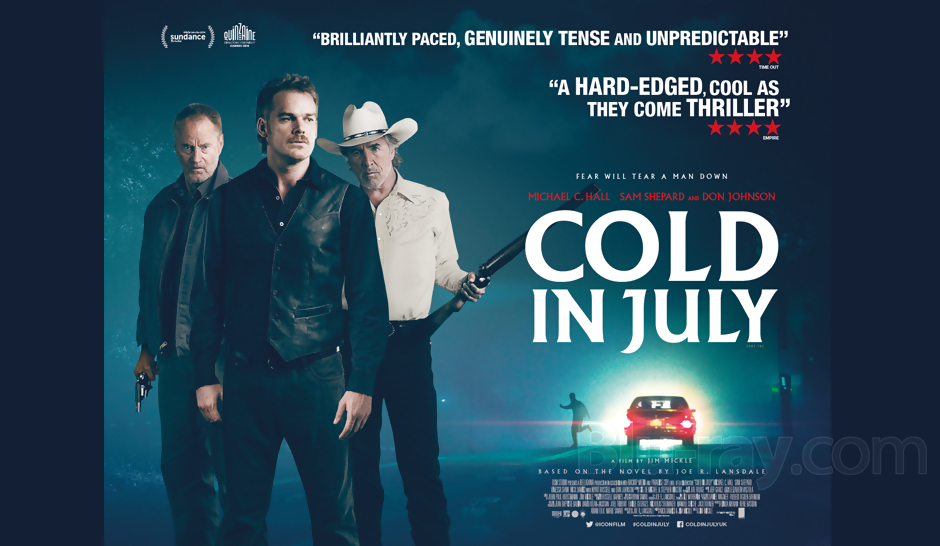
After tackling killer viruses in Mulberry Street, vampires in Stakeland and cannibals in We Are What We Are, Jim Mickle has swiftly carved himself a reputation as a filmmaker with a unique ability to play with genre. His latest film, Cold In July, continues this, albeit away from the horror world. Based on the novel by Joe R. Lansdale, it's an Eighties-set thriller inspired by such classics as Blood Simple, Red Rock West and The Hot Spot. Michael C. Hall, the actor best known for Dexter and Six Feet Under, plays Richard Dane, a picture-framer who becomes embroiled in the seedy underbelly of East Texas after he kills a burglar entering his property. Out for revenge is the criminal's grieving father, Russel (Sam Shepard), who pitches up with his friend – the incorrigible private eye Jim Bob (Don Johnson). Yet that's only the beginning of a labyrinthine story layered with small-town corruption. Below, Mickle talks about the difficulties of making Cold In July, playing his co-stars Sam Shepard and Don Johnson off one another and why he thinks Joe Lansdale is due for a re-appreciation of his work.
Q: You've been working on Cold In July for a long time. Why has it taken so long?
A: People always really liked it. That was the crazy thing. Everyone would dance around it but no-one would commit. A lot of it was, 'We just want to do a little script work' and then it would be little changes that added up. And it got to the point where the script had nothing to do with the original script, and the book I'd fell in love with. It had mutated; foreign sales people would say, 'We need to pick up the pace here.' All the things I love about the movie now, I remember hearing was bad…you can't have a movie where all of a sudden there's a different main character in the second half or you can't have something that jumps genres so much, or it's too goofy or it's not goofy enough. We wanted it to be more of a hard-boiled thriller. So it was all these things that I thought made it fresh, new and interesting – and people liked it but they didn't want to commit to that. So we kept tweaking it, tweaking it and tweaking it, trying to solve issues, but then it just becomes a puzzle; gridlock – you fix something and it opens up a bunch of other problems, and you're trying to fix those problems. So we just kept getting into that mess. And at one point, we had a script and the last foreign sales company had dropped off, so we had no commitment financially, no cast and a script that was problematic and was so different from the book.
Q: So what happened then?
A: Well, Stakeland happened because we were frustrated because we couldn't make this movie. We said, 'Let's just do things we can shoot at weekends.' We thought 'Oh, great, we'll do Stakeland.' And then we won [a prize in] Toronto and we had all this great festival experience and we thought: 'Now we get to make Cold In July.' And three years later, we still hadn't made Cold In July. And at that point, Memento Films said they'd got the rights to We Are What We Are – and would we like to remake this movie? And I said, 'Hmm, OK, so maybe this is something we can work on while we're trying to get this thing made.'
Q: What made you want to cast Michael C. Hall?
A: I was a huge Six Feet Under fan. I was just in love with that show. So I always held that character near and dear to me. So when I first started watching Dexter, I had difficulty accepting him as that. But I just kept seeing him pop up, in these incredibly chameleonic roles. I kept seeing him in different things. He would pop up in Gamer, which is a movie that's not good, but he's fucking amazing in it! And each character [he did] is so wildly different, and I was like, 'This guy is amazing. He's known for these two roles that he's played for fourteen years and in reality he's amazing at creating new characters.' And what was fun…we had an average Joe lead character. He's very much an everyman, but that can be boring for actors. Here was a guy who could create this cool character. I thought that was really exciting. He was going to be able to have fun playing a normal guy because he hadn't been cast as that at all.
Q: How would you describe the arc taken by Hall's character Richard Dane?
A: He's the guy that hasn't been tested. He finds himself, not bored or disappointed with his life exactly, but he's hit a point where he's realised this is his life, as we all do, and then he gets a taste for what it would be like if he was a cowboy, and he was seduced by that. I loved that idea. I kept saying that it reminded me of my Dad, if my Dad was mowing the lawn and Lee Marvin and Charles Bronson showed up in the drive-way and said, 'Hey, man, we need you to go on a mission with us.' And he'd say, 'Alright, I don't know why you want me but I'm going to go with you.' I loved that idea! And that's what kept me going back to it. The charm of that; that it wasn't Liam Hemsworth or something.
Q: How did you go about casting Don Johnson and Sam Shepard?
A: We sent it to both at the same time. We heard that they were both interested, but both wanted the other to be on. So I flew to New Mexico and I met with Sam. He said, 'So Don's going to do this?' I was like, 'Yeah, Don's going to do this.' Then next week I had breakfast with him and Don said, 'So Sam's going to do this!'
Q: So how was working with Sam Shepard?
A: Great. Scary. Intimidating. And it took three or four days before he trusted us, and vice versa. I think Michael really helped to grease that. I think he saw how game Michael was, and he came around, but he showed up and I think it was probably the lowest budget thing he'd done. The first couple of days he had no dialogue; he was just in the background of the shot, giving us a dirty look. So he'd show up, give us the look and then leave. I think he was like 'What the fuck am I doing?' But he did come around. At first I tiptoed around him, but then I realised that he needs to be pushed back and engaged. And then that happened, and he trusted me. If he didn't, we'd talk through why. I think he realised what we were trying to do and appreciated it. It's funny…we went to Sundance, and a friend of his said, 'He really liked this movie. He really liked the experience.' But he would never say it!"
Q: Cold In July feels like a film inspired by Eighties thrillers. Would you agree?
A: Yeah. Blood Simple is the biggest reference here. Then Red Rock West, One False Move, The Hot Spot…all those southern thrillers. And The Mean Season, with Kurt Russell. Angel Heart. That was a big reference for us, visually, with the lighting. It was fun – you start going back and exploring, and you remember how good they are. Even the lesser ones are good.
Q: How did you approach shooting a film set in this era?
A: I kept saying 'We don't want to do Wedding Singer. We don't want to pop on a cheesy Flock of Seagulls song.' We want to acknowledge it. We want it to take place then. But we don't want to make fun of it. It is what it is; for example, we had corded phones, so let's play with those elements. We build a lot of scenes around this one moment where he calls the cops and getting a busy signal and hitting *69 – there was a simplicity in this era that we've tapped into. It was a case of, 'Let's have fun with movies that were about normal life and stuck in a bubble.' So I think people always liked it, but they were worried because it would cost money and it was a pain in the ass…
Q: And was it?
A: Well, everything's period…we have the same three cars in the background! We had three Eighties cars and they drive through every shot! There's one moment where all three drive through the shot, then it cuts to a diner and all three are in the parking lot!
Q: So shooting the period was difficult?
A: Every movie we've done, there's always one thing that's completely crazily ambitious – like why did we try to do that? In this case, it was the Eighties and the fact we didn't shoot in Texas. We shot in the Catskill Mountains. We shot upstate New York, the same place we shot We Are What We Are. And we faked the Eighties. We Are What We Are – it never rained. It was all garden hoses, for a movie that's mostly set in rain. So every time, there's something…
Q: Has there been interest from Hollywood before you made Cold In July?
A: Not as much as I thought, but it is there. I want to find a middle ground…bigger that what we're doing. But a lot of the studio stuff is stuff that…it's all the things I didn't want this to be. So it's a matter of finding that one that's right. There are a couple of things I'm interested in, but then you find you're in the running with a lot of other people, with a lot of utility men. People with a track record. And if the script is good, and the project is good, then it's really tough. So that's tough to figure out. I'm waiting for the one that really connects.
Q: Now you're working on a TV series for Lansdale's book series, Hap and Leonard. Can you talk about that?
A: In a lot of ways, it's a continuation of Cold In July. Same author, same town, same time-period, same tone. And we're developing that with the Sundance Channel. We're writing the pilot right now, and then hopefully we'll be shooting that at the beginning of next year. I'd direct the first one, and then maybe another…but I like this idea of bringing in people we like and admire, and share sensibilities with. I think it would be very cool. So really hoping that works out. It looks very good. But that takes a lot of time. So it's been tough to dream up that next thing. After every movie, we always had Cold In July. Now we've done it – so what the hell do we do?
Q: Do you think we'll see a revival of Lansdale's work?
A: I think so, yeah. I think he's always had probably a dozen properties under option for the last ten, twenty years. But a lot of them can never get over that hump; I think this will help that. He just optioned his new one and he's got some interesting cast already involved. Bill Paxton is going to direct The Bottoms, which is my favourite Joe book. He's had that under option for a while and it looks like that is finally starting to go forward. We have the TV show. And then there was an earlier book of his, which has always had interest in and now it looks like there's some heavy hitters involved. So I think and I hope that it's the grease that his stuff needed to tip over.
Q Many people only knew Bubba Ho-Tep, which got adapted for the screen…
A: That's why I valued Cold In July specifically, of all his stuff. As a fan of his, it felt like a better representation of his work overall. I think people saw Bubba Ho-Tep and saw that Joe had written thirty novels and a hundred short stories and thought they were all crazy over-the-top stories and I was happy to show Cold, which represents more of his serious genre mash-ups, but also his hard-hitting noirs.
Q: Will Don Johnson also see a renewed interest in his work?
A: Totally. I've been lucky enough to work with Michael Parks and Kelly McGillis and Sam Shepard...I think it's unfortunate that moviemaking is pretty ageist, especially when it comes to cast. There's a world of amazing actors, who right now are at the height of their game and peak performance but there are no roles for them. Don's been onscreen more hours than I've been alive! So he's perfect right now. So I think luckily some people have seen Don and it catches on. He knows how to play the game, better than a lot of other people that age, who also deserve the same notoriety. He knows how to play the game and I think he knows how to build a brand and build himself up and get people to recognise him and want to put himself in stuff. So I think he's got a long career ahead of him! It's interesting.
Q: Is there anything we'll see on the Cold In July DVD – scenes you had to cut out?
A: Yeah. There's about fifteen or twenty minutes of deleted scenes that will be on the DVD. We just did commentary for all of them last week, and it's cool. It's interesting to go back and look at stuff. I remember every single scene; thinking, 'There's no way we can cut this. The story will never make sense unless we have this.' But once it's out, you're like, 'How was this ever in the movie?' It's a weird process.
Q: Was there any scene that pained you to cut out?
A: No, which is good. There's stuff we cut out of the script – that was in the book – that pains me that it's not in there, but I understand why. I think it was the right decision. There's a subplot that we put in, in the middle of the film, that involved the FBI being interested in Michael and spying on him. It wasn't in the book, but we had put it in because a lot of people read the script and said that the middle lost tension, that we had to keep the tension up. So we thought, 'OK, great. We'll insert this thing and Don can come and solve it all.' So we put that in, we shot it, the scenes are good, fun, interesting…but ultimately it was a distraction from the story. So that's in there, in its entirety – literally ten minutes lifted right out. There were a lot of scenes also that explained things with Jim Bob's character. In the film right now, there's a moment in the drive-in movie theatre where he comes in and tells the entire story of what the cops are doing; the original cut had a seven-minute scene. Right now, it's 45 seconds. We kept screening it and test audiences kept saying, 'I don't care, I don't care', which I always found really interesting because I always thought, 'We have to be a thousand percent clear'. So that's in there, in its original version – and it's really funny. Don does a great job in delivering it. And then there are a couple of quieter family scenes that help paint the picture, that are also really good but felt like double-ups of other scenes.
Q: So a lot of it was exposition?
A: Yep, and it's always the stuff that we cut in movies. It's amazing. Mulberry St, we didn't cut anything out. We started thin and we added scenes when we screened it and realised what we needed. And then Stakeland, the only scenes that we cut out were whenever characters pop up, we'd introduce them and tell their story – this is where I came from, this is who I am – and those were the four scenes we cut out. The same thing with We Are What We Are and the same thing here. I think it informs the actors and the actors know what to play, and you get a sense of that – which is more rewarding than being told.
Q: Let's talk about Nick Damici, your co-writer. He's also acted in every film of yours so far, right?
A: Yeah, he was the lead in Mulberry St and Stakeland. And then he played the sheriff in We Are What We Are and same in Cold In July.
Q: Where did you meet?
A: I went to NYU film school and I was working on a short film that a friend of mine was directing, and Nick was the lead in that short. I was so impressed by him. I was blown away by him. He played a hardcore ex-convict and usually in good films, you're never going to find that kind of guy. So I was blown away by him. And we were staying in these cabins in Connecticut, in the woods somewhere – it was a two week shoot – and his cabin was next to mine. At night, he'd be sitting on the porch sipping brandy and smoking cigarettes and playing guitar, and I would just come over. I think we both had a very same sense of movies – horror films and B movies; he and I both love I Am Legend, the Richard Matheson book. So I think we had the same taste. He told me about a script he was writing and when we got back to the city, he sent me the script and I loved it. I sent him some notes and he worked those in and sent me the next script he wrote. So it was this cool, organic meeting-of-the-minds, even though we were completely different generations and completely different upbringings. It's been a pretty cool partnership.
Q: So now it's in his contract that he must have a role in every film you make?
A: Ha! He would love that to be! He's one of my favourite actors to work with. He's so unbelievably committed. He was in my student film – which was about dogs that rise up and attack a town. I was 18 or 19 years old, making this film that was this '50s style B movie and everything went wrong...all the dogs freaked out and attacked the dog trainer on set, so nobody trusted the dogs! Nobody trusted the trainer! They went home. We were shooting 35mm at night in the snow on short ends – everything fell apart. I remember at some point I was having a nervous breakdown and he came over and said, 'Yo, yo, yo! Check this out!' And he just grabbed meat from a hamburger from craft service and he rubbed it on the side of his face and he pulled one of the mean dogs over and it looked like the dog was eating the side of his face! So we just changed everything in the script and he fell down so the dog could eat his face! I was like, 'This is somebody I want to make movies with – who can match the enthusiasm and absolute insanity of moviemaking.'
Q: Before you made Mulberry St, you worked on Shortbus, Transamerica and Pride and Glory. What were you doing?
A: Everything! I was in school...after my freshman year, I got a job storyboarding a feature. That was something I was really interested in – illustration and comic books. So I took a storyboarding class and for the bulk of my college experience, my day-job was storyboarding and it was perfect. It was such a cool way to learn but also make a living and do something I was into. And then I graduated and all these jobs completely dried up. So I bounced around and did art department for one or two movies, and then I fell in with a group of guys who were doing lighting and electric work, and I did that for three years. Which was cool – travelling all around. I spent six weeks on Transamerica. And then I met and fell in love with the producer on Transamerica, Linda Moran, and she produced my stuff after that.
Q: What happened then?
A: After that I got to a point where I thought, 'If I spend sixteen hours a day on set, six days a week, I'm never, ever going to make a movie.' And at that point it'd been about five years since I graduated. I was in despair thinking, 'I'm never going to get to make a movie.' So I quit, and I bought a computer and pitched myself as an editor. I started getting a lot of editing gigs.
Q: You really have done every film job going, right?
A: Yeah...I didn't set out to do that, but at the end when I look back on it, it was perfect. I spent a couple of years in pre-production, a couple of years in production and a couple of years in post-production.
Q: Does that give you more empathy for other crew members?
A: Yeah, exactly. And I used to joke – but it's not a joke, it's true – that usually the least experienced person on any set is the director. It's almost always the case. Especially if you're working with a good crew – they work back-to-back. They go from one film to another. Usually, it's their third movie that year that they're doing and meanwhile it's my first in three years! So, yeah, it was the best film school – probably even more so than actual film school. Movies are complicated; everyone has weird jobs, especially when you get into union stuff. Everyone has these very specific skills. And it gave a good insight into how to relate to those different people; how to know when people were doing a good job or a bad job; how to know when people were slow or fast. It was a good way to be able to get on set and know what a good set was like. And also to keep morale up too. Moviemaking is the ultimate team sport and a huge part of that is overall morale and a crew being valued and appreciated.
Q: Before Cold In July, did you ever get worried you'd be pigeonholed as a horror director?
A: A little bit, yeah. I think we did a good job of making horror movies that don't feel like horror movies. It wasn't like we made Friday 13th Parts 1 to 3. But, yeah, I was. You can tell in people's faces, when they said, 'What are you doing next?' and you said, 'We have this southern noir' and they'd be like 'Oh...' You could tell there was a lack of excitement for that. And that was tough. Whenever you would meet to talk about what you were going to do or talk about getting a film made, all anyone wanted to hear about was that, the horror stuff. Now everyone sends me scripts that feel like Cold In July!
DON JOHNSON INTERVIEW
He's one of the most iconic faces of the Eighties, thanks to his Golden Globe-winning role as detective Sonny Crockett in Miami Vice. But in Jim Mickle's southern fried thriller Cold In July, Johnson plays a very different kind of investigator. Part-time PI, part-time pig farmer, Jim Bob must rank as one of Johnson's most unique creations – which is saying something, given his recent work as a Mexican-hunting vigilante in Robert Rodriguez's Machete and a plantation owner in Quentin Tarantino's Django Unchained.
Created by Cold In July author Joe R. Lansdale as a character to run through several of his novels, here Johnson's Jim Bob becomes embroiled in a twisted plot, involving an innocent family man (played by Michael C. Hall) and a vengeful grief-stricken father (Sam Shepard) – resulting in a violent but darkly humorous saga. Below, Johnson discusses what drew him to the role, why he feels there is a thirst for Eighties films right now, and discusses his own time as a legend of the era.
Q: How did you get involved with Jim Mickle's Cold In July?
A: I was making two other movies at the same time – including The Other Woman in New York. Anyway, I got sent the script and I was taken by the different rhythms and tempos that were in it. So I agreed to meet the director, and when you've been doing this as long as I have, you get an instinct and an intuition about whether someone has film sense or whether they don't. I was taken right away by the fact Jim had really unique and specific storytelling skills and film knowledge. I asked him who he had in mind for the other parts, and he told me Michael C. Hall was attached as Richard Dane and that he wanted to get Sam Shepard. I said, 'OK, go get Sam Shepard and if you're successful with that, I'll consider it seriously.'
Q: Were you aware of Jim's previous films?
A: I sought them out afterwards. I watched a bit of Stakeland and I watched all of We Are What We Are. That was after I'd met with him. I was fairly convinced, by that point, based on what I saw and what he told me, that he was a gifted and talented filmmaker, and we had a good chance to make something exceptional, and I think we have.
Q: Were you aware of how influenced he was by your work?
A: No. Unbeknownst to me…I didn't know about it until I read about it, but some of his inspiration for the tone and the texture of the film came from a film I made called The Hot Spot, with Dennis Hopper and Jennifer Connelly. Dennis Hopper directed it, and Jennifer and Virginia Madsen co-starred with me in it.
Q: You mentioned Sam Shepard earlier. Were you and Sam friends?
A: I know him personally and I know him artistically, but this was the first time I'd gotten a chance to work with him. And I've always wanted to work with him, so it turned out quite nicely...we have a lot of the same sort of life experience and sense of reference. I'm in a place in my life where it's pretty easy for me to tell it like it is.
Q: Does that become easier as you get older?
A: It does if you make room for it. I've noticed that people tend to take one of two directions. Either they get very wise or they get very bitter.
Q: And would you put Sam in the very wise category?
A: Well, I'd put him in the wise category for the most part! No, he's a revered playwright...
Q: Did you two, and Michael C. Hall, hang out a lot off camera?
A: Oh, yeah. U-huh. Sam and I more than Michael and I. And probably Michael and Sam more than the three of us. Just by proximity. When I'm down with work I get the hell out of there!
Q: Is that your way of getting the character out of your system?
A: Yeah. M-hmm. I treat it as anybody else would: you go and do a thing, and then you leave it there and you pick it up tomorrow.
Q: How did you feel when you read the script?
A: If I know where it's going, I generally say, 'No, thank you!' But on this, my character doesn't even come into until about halfway through, and I liked the energy of the character and I liked the energy of the story. It was unique in that it's not really noir. For want of a better description, it's noir-ish. It's got a sense of humour which, so often, noir does not have.
Q: Did you know the work of Joe Lansdale?
A: Not really. I was probably tangentially aware of him, and stuff like that. I knew he had a big cult following.
Q: Do you see Cold In July as comparable to the Coens' Blood Simple?
A: I think so. When you re-look at Blood Simple, that was a good movie. But this is a far better crafted movie. Blood Simple was unique for its time. It was the first one that had this modern noir with offbeat, different themes.
Q: Why do you think there is such a thirst for Eighties product now?
A: You know what I find interesting about it? The Eighties were the last definitive era before e-mail and social media started to explode. One could argue that it didn't really start to happen until the mid-Nineties, but cell-phones were ubiquitous in the Nineties. Not so in the Eighties. You need two people to carry the box back then! I think that's a very interesting point of reference. I've written a piece that we're going to do in the fall called Score, and it's set in the Eighties, and I set it then specifically because the subject is the rise of big-time college football in America. That's when it started becoming big business. They started recruiting players from the inner cities; players that no way could get into college. It's a comedy. I take a shot at everybody! And the interesting thing is, it was pre-PC – pre-politically correct – and pre- cell-phones and social networking. AIDS was just becoming part of the lexicon, and it was one of those frightening things, but sex was still all over the place. So it was a very, interesting time, and fun to write about because a lot of times these days when you write a contemporary story, as writers, you get to a point where you go, 'Why doesn't he just pick up his cell-phone?' or 'Why doesn't he just Google it?'
Q: You were very much central to Eighties pop culture with Miami Vice, right?
A: Certainly a part of it! It was exciting. It was a fun ride. Listen – I can't complain. It took very good care of me and my family, and so on, and availed me of opportunities that otherwise I wouldn't have gotten. But it was also challenging.
Q: Do you mean the rigours of shooting episodic television?
A: That is gruelling. And then when it's that popular, that hot, and it was the first of its kind…we were on the covers of all the magazines. All the magazines. Time and Newsweek and Rolling Stone – it was just a factory. We would shoot all week and then on the weekends, we would have photo-shoots and these interviews. It was like feeding the machine, feeding the beast, and then the inevitable happens where it stops becoming stories that are flattering and starts becoming stories that are nonsense.
Q: Did you follow the career of Michael Mann after Miami Vice?
A: Yeah. He made Thief and he made Manhunter after. He made that in the second year of Miami Vice. He's a brilliant, intellectual director. He's got an incredible visual sense and he's articulate in the medium.
Q: How did you get into Jim Bob's mind-set – given he's a PI and a pig-farmer?
A: Well, he's an amalgamation of a lot of people I've known. He's part real and part imagined. And Joe Lansdale said something to me early on that gave me a clue as to the essence of Jim Bob. He never met a problem he couldn't solve and he wouldn't know a problem if he met one. I said, 'That's classic!' I took that and I started to build the character.
Q: So he's confident with his abilities?
A: I think he's childlike. He's curious. Whereas a lot of people would be deterred or daunted or give up, I think he's one of those people that just doesn't. There's an answer and he's going to find it.
Q: There's a lot of mythology around Texas. Is it a place you knew well?
A: Yes. I've worked in Texas over the years and I know it pretty well. Texas is so big. This takes place in East Texas and East Texas is completely different than central Texas, and that is completely different from Austin and the Hill country and that is completely is different, both culturally and accent-wise and behaviour-wise, from south Texas. Some people still consider that the Old West. They pack guns openly down there. It's crazy.
Q: What was the atmosphere like when you shot?
A: Well, we didn't shoot it in East Texas! We shot it in upstate New York! That was funny. Sam Shepard kept saying – we'd come up to a location and he'd say, 'This don't fucking look like Texas!'
Q: You grew up in Missouri – were the two states similar?
A: To some degree. But Texas is it's own...in fact, they wanted to secede from the United States! I'm not kidding you! There is a huge secession movement. It's a monster economy, as you can imagine. The state of Texas...I heard that it's the ninth largest economy in the world. It has tonnes of natural resources, and a lot of American businesses...they just made it very user-friendly for them to be there.
Q: Have you ever fallen out of love with acting ever?
A: Well, Sam said it best: 'Moviemaking is a conspiracy against acting!' And in some ways it is. But I enjoy the process. I don't bother with that.
Q: Recently, you worked with Quentin Tarantino on Django Unchained. How was that?
A: Tarantino – he is a cut apart from everybody else. He's a film historian, a true historian. His life is about film. His family is film. And his references and conversation and all of his friends are all about film. I had just finished making Machete and Robert Rodriguez did a party after the premiere. And Quentin was there. He started talking to me, and rattling off my credits – including films that I didn't remember that I'd made. He started describing this movie and I said, 'I didn't make that' and he went, 'Oh yeah – you made that', and started to name the director and who else was in the film, and who the DP was. I was astounded! I thought he was a little daft in the brain! And it turned out that I was!
Q: Even if you'd forgotten those early films, at least you had the experience of making them…
A: True. I get the joy of being the instrument of the process, and that's joyful. But once the moment has passed, it's onto the next moment. He's unique in this way, Tarantino. He's intellectual about film, and knows every shot and angle, and can tell you what lens they used in such-and-such movie and such-and-such shot, but he also has a very profound awareness of the creative process, without becoming conscious of it. That's unique in a lot of artists. There are a lot of artists who are very good technicians, very good craftsman, but when they become conscious – or take ownership in the creativity – then it shuts off the process.
Q: Working with these guys, does it feel like it's a good time for you now?
A: Hey, man, anytime you look at it, it's nice to be in the conversation when you're an artist.
Q: You've even seen your song 'Heartbeat' used in Grand Theft Auto V, right?
A: Yeah, I've heard about that! I know – isn't that bizarre? I've got my folks looking into it because I had no idea that was happening!
Q: What are you doing next?
A: I'm going to make another movie with Robert Rodriguez, and I'm going to direct a movie in Dubai early next year. It's an adventure. It's not something I was looking to do. I was asked to it and I read the script and there's an incredible story there that involves the independence of Arabia and the British. All great stories are love stories, and this is a great love story about the people of its country and these liberators. It's a melange of international personalities: British, American, Arabic and so on.
Q: Have you directed before?
A: Mm-hmm. On Miami Vice. And I produced a show called The Marshall, and I directed one of those episodes. They didn't invite be back because as the executive producer and the director, I took liberties that you're not allowed to take in television! Although it was an excellent episode, they didn't invite me back for more! Well, I didn't invite myself back!
Q: Jim Mickle's now making a TV series based around Joe R. Lansdale's series of books, Hap and Leonard. Are you involved?
A: I keep hearing rumblings. IFC bought the whole series of books and Jim Bob comes in around number four. He shows up in most of Joe's books. I'm hopeful that I'll be available and I can reprise the character, as he's fun to play.