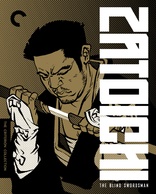
Zatoichi: The Blind Swordsman Blu-ray Movie
HomeZatoichi: The Blind Swordsman Blu-ray Movie 
Blu-ray + DVDCriterion | 1962-1973 | 25 Movies | 2203 min | Not rated | Nov 26, 2013

Movie rating
Movie has not been rated yetBlu-ray rating
| Users |  | 4.8 |
| Reviewer | | 5.0 |
| Overall | | 4.8 |
Overview
Zatoichi: The Blind Swordsman (1962-1973)
See individual titles for their synopses.
| Foreign | 100% |
| Drama | 66% |
| Martial arts | 42% |
| Action | 2% |
| Adventure | Insignificant |
Specifications
Video
Video codec: TBA
Video resolution: 1080p
Audio
See individual releases
Subtitles
None
Discs
50GB Blu-ray Disc
Twenty seven-disc set (9 BDs, 18 DVDs)
DVD copy
Playback
Region A (locked)
Review
Rating summary
| Movie | | 5.0 |
| Video |  | 4.5 |
| Audio |  | 4.0 |
| Extras | | 5.0 |
| Overall | | 5.0 |
Zatoichi: The Blind Swordsman Blu-ray Movie Review
Reviewed by Dr. Svet Atanasov December 4, 2013Featuring twenty-five films made between 1962 and 1973, "Zatoichi: The Blind Swordsman" arrives on Blu-ray courtesy of Criterion. The supplemental features included with the collection are: exclusive new video interview with critic and filmmaker Tony Rayns; original trailers for all twenty-five films; John Nathan's documentary "The Blind Swordsman" (1978); and a new video interview with the director. The release also arrives with a 100-page hardcover book featuring an essay by critic Geoffrey O'Brien, synopses of the films by critic, novelist and musician Chris D.; "The Tale of Zatoichi", the original short story by Kan Shimozawa; and twenty-five new illustrations inspired by the films, by twenty-five different artists. In Japanese, with optional English subtitles for the each film. Region-A "locked".

"I smell a woman"
The viewer’s immediate impression is that Zatoichi is an ordinary man. He wears simple clothes and isn’t athletic. He moves slowly because he is blind, which makes it even more difficult to believe that he can defend himself. But those who attack him always die. He is so fast that most of his opponents never see the sword that is hidden in his cane. Some of them can hear it, but it is usually only a few seconds before their bodies collapse.
This truly iconic Japanese character was first introduced in director Kenji Misumi’s The Tale of Zatoichi (1962), a modest film inspired by a short story written by Kan Shimozawa. Played by the great Shintaro Katsu, Zatoichi is a gambling masseur who befriends a proud but sick ronin (Shigeru Amachi, The Woman Vampire) who has been hired to protect the interests of a wealthy despot. Zatoichi is hired by his opponent, another wealthy and outspoken despot, who wants to rule alone. The film follows a familiar path, but Zatoichi’s honorable actions and words leave a lasting impression.
Completed by director Kazuo Mori only a few months later, The Tale of Zatoichi Continues begins exactly where the first film ends - with the blind masseur once again on the road. This film has a lot more complex plot but is significantly shorter. Here Zatoichi meets his older brother, Yoshiro (Tomisaburo Wakayama, Lone Wolf and Cub), and soon after the two find themselves chased by bandits and government people because there is an attractive bounty on their heads.
New Tale of Zatoichi, the third film in the series, and the first in color, was directed by Tokuzo Tanaka a year after The Tale of Zatoichi. It is notably better polished than the previous two films and with a plot that introduces far more nuanced characters. There are also good subplots linked to themes from the first two films, some of which will be reintroduced in later films.
The next three films, Tanaka’s Zatoichi the Fugitive (1963), Kimioyshi’s Yasuda’s Zatoichi on the Road (1963) and Kazuo Ikehiro’s Zatoichi and the Chest of Gold (1964), effectively change the tone and energy of the series. These are films with strong melodramatic overtones that counter well the action and in the process reveal a very different side of Zatoichi’s character - he is a person with strong morals and someone who already pays a lot of attention to the women around him (Zatoichi's interest will become a key theme in all future films). The female cast includes such beauties as Masayo Banri, who also appears in The Tale of Zatoichi, and Shiho Fujimura (Wrath of Daimjain).
The Daiei company funded three more films in 1964: a new film directed by Ikehiro named Zatoichi’s Flashing Sword, Misumi’s Fight, Zatoichi, Fight, and Yasuda’s Adventures of Zatoichi. All three have better choreographed action sequences, but only in the Misumi film they are balanced well with the drama (or in select segments with the humor). In it Zatoichi becomes a father figure and is presented with some rather unusual new challenges. This film was lensed by cinematographer Chisi Makiura, who also collaborated with directors Misumi and Tanaka on the first two Zatoichi films. (Some years later, Makiura again collaborated with Misumi on a few of the classic Lone Wolf and Cub films).
In 1965, the Daiei company produced three more films: Akira Inoue’s one and only entry in the series, Zatoichi’s Revenge, Mori’s Zatoichi and the Doomed Man, and Misumi’s Zatoichi and the Chess Expert. These films do not introduce drastic changes in Zatoichi’s profile, but the important role humor has in them effectively separates them from the previous films. Indeed, the new terrific one-liners and the carefully scripted sequences where Zatoichi targets the intelligence of his opponents before he uses his sword give the films a very different flavor. (Compare the two black and white films with Zatoichi’s Revenge and Zatoichi and the Doomed Man and see the drastic differences in their tone and attitude). Music also has a much more prominent role. In Zatoichi’s Revenge, for instance, there are numerous surprising but very effective guitar solos that easily could have been used in a classic spaghetti western film.
In 1966, only two new films were added to the series: Tanaka’s Zatoichi’s Vengeance and Ikehiro’s Zatoichi’s Pilgrimage. The first film is one of the most realistic in the entire series. This is primarily due to the fact that the majority of the new characters Zatoichi interacts with have human flaws and struggle. Also, the focus of attention is frequently on their personal stories. A good example is Zatoichi’s first encounter with the disillusioned prostitute Ocho (played expertly by the beautiful Mayumi Ogawa) which ends with a surprisingly honest conversation. The second film, Zatoichi’s Pilgrimage, is based on a screenplay by the great Kaneto Shindo (Onibaba, Kuroneko), but it does not match the depth of the previous film. Here Zatoichi is forced to kill the brother of a beautiful young woman, whom he later on befriends, and then in a familiar fashion confronts the ambitious leader of a local gang who frequently harasses her.
Yasuda’s Zatoichi’s Cane Sword, Satsuo Yamamoto’s Zatoichi the Outlaw, and Misumi’s Zatoichi Challenged premiered in 1967. This is the most diverse trio of films in the entire series. The first film is unusually light and playful, the second is loaded with political overtones, and the third borrows the sensitivity of Fight, Zatoichi, Fight. Arguably the best of the three is a Zatoichi the Outlaw, which was also the first film to be produced by Katsu’s new company, Katsu Productions.
Yasuda’s Zatoichi and the Fugitives and Misumi’s Samaritan Zatoichi were released in 1968. The atmosphere of these films reminds of the atmosphere in Akira Kurosawa’s classic Yojimbo. A lot of the humor also feels as edgy as that present in Kurosawa’s film. Visually, however, the two films rarely come close to matching the elegance of Kurosawa’s classic.
The Daiei company produced two of the most exciting films in the series between 1970 and 1971: Kihachi Okamoto’s Zatoichi Meets Yojimbo and Yasuda’s Zatoichi Meets the One-Armed Swordsman. In the former Zatoichi meets the drunk Yojimbo (marvelously played yet again by the great Toshiro Mifune) and rather quickly all hell breaks loose. This isn’t the most original film in the series, but it is very easy to argue that it is the best looking one. And this should not be surprising considering the fact that it was lensed by cinematographer Kazuo Miyagawa, who prior to Zatoichi Meets Yojimbo had contributed to such iconic Japanese films as Kurosawa’s Rashomon and Yojimbo and Kenji Mizoguchi’s Ugetsu and Sansho the Bailiff. The second film, Zatoichi Meets the One-Armed Swordsman, teams up Katsu with another formidable actor, Shaw Brothers legend Jimmy Wang. Needless to say, the result is an epic film with a distinctive international flavor.
The remaining four films - Misumi’s Zatoichi Goes to the Fire Festival, Mori’s Zatoichi at Large, Katsu’s own Zatoichi in Desperation, and Yasuda’s Zatoichi’s Conspiracy - offer a little bit of everything. Zatoichi Goes to the Fire Festival is a powerful action drama with an unforgettable cameo by the great Tatsuya Nakadai (Masaki Kobayashi’s Harakiri, Ran). This film also has the most exotic fight sequence in the entire series. In Zatoichi at Large, the blind masseur is again forced to confront the stubborn leader of a powerful gang. There are some very funny sequences here, including one in which Zatoichi temporarily becomes Mr. Mom, but the film is somewhat underwhelming. Zatoichi in Desperation is a surprisingly raw film with some very obvious political overtones. It looks and feels very different, but it is one of the most meaningful entries in the series. In Zatoichi’s Conspiracy, the blind masseur returns to his home village after years on the road and quickly realizes that there are few people around that still remember him. Soon after, he is forced to confront an old friend planning to take over the local mine. There are notable cameos in this film by Eiji Okada (Hiroshima mon amour), Kei Sato (Onibaba), and Takashi Shimura (Seven Samurai).
Zatoichi: The Blind Swordsman Blu-ray Movie, Video Quality
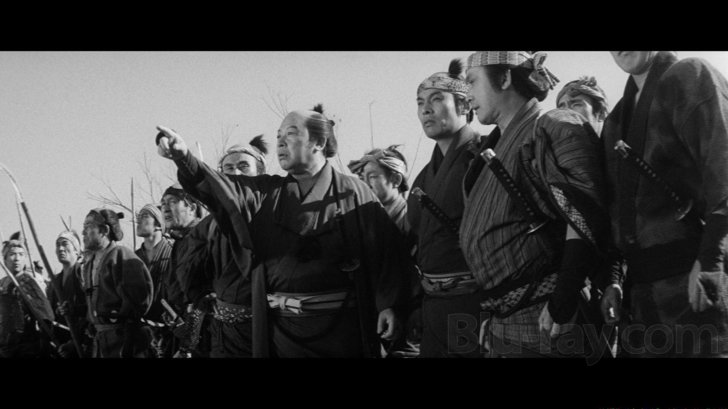
The twenty-five films included in Criterion's Zatoichi: The Blind Swordsman box set are presented in an aspect ratio of approximately 2.35:1, encoded with MPEG-4 AVC and granted 1080p transfers.
The following text appears inside the hardcover book included with the box set:
"The digital transfer of The Tale of Zatoichi was created in 2K resolution on a Lasergraphics film scanner from a 35mm print. Thousands of instances of dirt, debris, scratches, splices, warps, jitter, and flicker were manually removed using MTI's DRS and Pixel Farm's PFClean, while Digital Vision's Phoenix was used for small dirt, grain, and noise reduction.
2K scanning: John Rizzo/Metropolis Post, New York.
Colorist: Russell Smith/Criterion, New York.
The digital transfers of The Tale of Zatoichi Continues; New Tale of Zatoichi; Zatoichi the fugitive; Zatoichi on the Road; Zatoichi and the Chest of Gold; Zatoichi's Flashing Sword; Fight, Zatoichi, Fight; Adventures of Zatoichi; Zatoichi's Revenge; Zatoichi and the Doomed Man; Zatoichi and the Chess Expert; Zatoichi's Vengeance; Zatoichi's Pilgrimage; Zatoichi's Cane Sword; Zatoichi Challenged; Zatoichi and the Fugitives, and Samaritan Zatoichi were created in high-definition on a Spirit DataCine from the 35mm low-contrast composite prints. Thousands of instances of dirt, debris, scratches, splices, warps, jitter, and flicker were manually removed using MTI's DRS and Pixel Farm's PFClean, while Digital Vision's Phoenix was used for small dirt, grain, and noise reduction.
Transfer supervisor: Maria Palazzola.
Colorist: Gregg Garvin/Modern VideoFilm, Burbank, CA.
The digital transfers of Zatoichi the Outlaw; Zatoichi Meets Yojimbo; Zatoichi Goes to the Fire Festival; Zatoichi Meets the One-Armed Swordsman; Zatoichi at Large; Zatoichi in Desperation, and Zatoichi's Conspiracy were created in 2K resolution on a SCANITY film scanner from 35mm prints. Thousands of instances of dirt, debris, scratches, splices, warps, jitter, and flicker were manually removed using MTI's DRS and Pixel Farm's PFClean, while Digital Vision's DVNR was used for small dirt, grain, and noise management.
Transfer supervisors: Lee Kline, Russell Smith.
Colorist: Sheri Eisenberg/Colorworks, Culver City, CA."
Please note that the films in the box set are grouped as indicated below. With each dual-layer Blu-ray disc in the box set also included are two DVDs with the exact same content presented in standard definition (total: 9BDs/18DVDs). Finally, included with this review are numbered screencaptures for each film. See how they are grouped below.
Disc One
The Tale of Zatoichi #1-2 (Running time: 01.31.37)
The Tale of Zatoichi Continues #3-4 (Running time: 01.12.30)
New Tale of Zatoichi #5-6 (Running time: 01.31.37)
Disc Two
Zatoichi the Fugitive #7 (Running time: 01.26.15)
Zatoichi on the Road #8-9 (Running time: 01.27.49)
Zatoichi and the Chest of Gold #10 (Running time: 01.22.27)
Disc Three
Zatoichi's Flashing Sword #11 (Running time: 01.22.14)
Fight, Zatoichi, Fight #12-13 (Running time: 01.27.41)
Adventures of Zatoichi #14 (Running time: 01.26.13)
Disc Four
Zatoichi's Revenge #15 (Running time: 01.23.31)
Zatoichi and the Doomed Man #16 (Running time: 01.17.32)
Zatoichi and the Chess Expert #17-18 (Running time: 01.27.26)
Disc Five
Zatoichi's Vengeance #19 (Running time: 01.22.49)
Zatoichi's Pilgrimage #20-21 (Running time: 01.22.32)
Zatoichi's Cane Sword #22 (Running time: 01.33.09)
Disc Six
Zatoichi the Outlaw #23-24 (Running time: 01.35.27)
Zatoichi Challenged #25-26 (Running time: 01.26.41)
Zatoichi and the Fugitives #27-28 (Running time: 01.22.20)
Disc Seven
Samaritan Zatoichi #29-30 (Running time: 01.22.55)
Zatoichi Meets Yojimbo #31-32 (Running time: 01.56.04)
Zatoichi Goes to the Fire Festival #33 (Running time: 01.36.17)
Disc Eight
Zatoichi Meets the One-Armed Swordsman #34-35 (Running time: 01.34.33)
Zatoichi at Large #36-37 (Running time: 01.28.09)
Zatoichi in Desperation #38 (Running time: 01.32.35)
Disc Nine
Zatoichi's Conspiracy #39-40 (Running time: 01.27.48)
Bonus Features
Fans of the Zatoichi films who have previously seen them only on DVD will be hugely impressed with the manner in which they have transitioned to Blu-ray. Using brand new high-definition transfers, these films clearly look the best they ever have. Indeed, there are dramatic improvements in every single area we typically scrutinize in our reviews, from image depth and clarity to contrast stability to color reproduction to overall image stability. The darker/nighttime footage, in particular, has benefited tremendously as the macroblocking and shimmer/flicker present on previous DVD releases have been effectively eliminated. As a result, image depth is consistently very good. Some of the most notable improvements, however, are in the area of color reproduction. Especially in films such as Zatoichi Meets Yojimbo, Zatoichi Meets the One-Armed Swordsman, Fight, Zatoichi, Fight and Zatoichi in Desperation color saturation is very impressive. Also worth mentioning is that unlike so many other releases of classic Japanese films the black levels here are correctly set. Furthermore, there are no traces of problematic degraining corrections. There are minor fluctuations in certain films, but their origin can easily be traced back to the original source used to produce the new transfer. There are no problematic sharpening adjustments. Again, on films such as Zatoichi the Fugitive and Zatoichi and the Doomed Man there are sporadic sharpness fluctuations, but they are not caused by problematic lab work. Overall image stability is very good. I would specifically like to mention that the first two films look far healthier and cleaner than they do on DVD. Many of the late color films, such as Zatoichi Meets the One-Armed Swordsman and Zatoichi at Large, also impress. This being said, some minor flecks and even a few vertical lines can still be seen here and there (a rather large vertical line appears on the right side of the frame in Zatoichi's Flashing Sword). There are also a few quick shaky frame transitions with light color fading that appear in some of the early films. None of these minor source related issues, however, become distracting. Finally, the films are competently encoded and compressed. There are select areas here and there where some very light artifacts sneak in (for example, see screencapture #29 from Samaritan Zatoichi), but their presence also isn't distracting. In fact, I believe that even viewers with very larger TVs, or projectors, will not be in any way bothered by their presence. To sum it all up, even though there is room for minor some improvements on select transfers, I have to say that every single one of the Zatoichi films looks quite impressive on Blu-ray. Naturally, I have every reason to believe that fans of these films, as well as those who will experience them for the first time, will be very happy with the current presentations. (Note: All nine Blu-ray discs in the Zatoichi: The Blind Swordsman box set are Region-A "locked". Therefore, you must have a native Region-A or Region-Free PS3 or SA in order to access their content).
Zatoichi: The Blind Swordsman Blu-ray Movie, Audio Quality
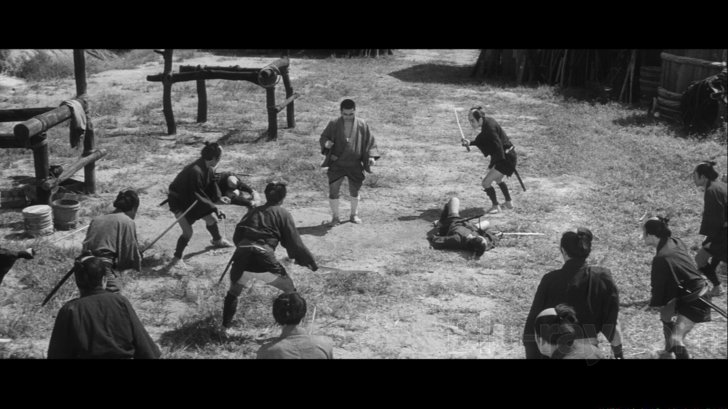
All twenty-five films in the box set arrive with Japanese LPCM 1.0 tracks. For the record, Criterion have provided optional English subtitles for each film. When turned on, they appear inside the image frame.
The lossless tracks have been created from 35mm optical soundtrack prints. Unsurprisingly, depth and clarity are very pleasing. Dynamic intensity is also very good, though you should not expect any of the films in the box set to test the muscles of your audio system. This being said, there are minor sporadic dynamic fluctuations, and some background hiss can also be felt during select sequences (see Zatoichi and the Chest of Gold and Zatoichi and the Doomed Man). The light hiss, however, never becomes distracting. Also, there are absolutely no high-frequency distortions. This makes quite a difference because in films where the music is prominent clarity remains very pleasing (listen to the great song in Zatoichi the Outlaw). For the record, there are no problematic audio dropouts to report in this review.
Zatoichi: The Blind Swordsman Blu-ray Movie, Special Features and Extras

- Serialized Success - in this new video interview, Asian cinema expert and filmmaker Tony Rayns discusses the original story that inspired the first Zatoichi film, the Daiei company's history with the Zatoichi films, the life and career of Shintaro Katsu, some of the unique themes in the films, the reasons behind their success in Japan, etc. The review was conducted exclusively for Criterion in 2013. In English, with optional English subtitles for the film clips and raw footage used with the interview. (28 min, 1080p).
- The Blind Swordsman - this documentary film focuses on the acting and directing methods of Shintaro Katsu, who played the iconic blind masseur Zatoichi and directed one of the films in the series. The documentary contains plenty of raw footage from the shooting of different sequences for the Zatoichi TV series with Katsu often seen directing them and later discussing his work. The documentary was shot by John Nathan, with legendary director Hiroshi Teshigahara's crew, in 1978. In English and Japanese, with printed English subtitles where necessary. (58 min, 1080p).
1. "This has to be me!"
2. Director Katsu
3. Karaoke confusion
4. Thinking up lines
5. Family life
6. Onstage
- Interview - in this new video interview, director John Nathan recalls his encounters with Shintaro Katsu in the late '70s when he directed The Blind Swordsman. The director also discusses Shintaro Katsu's career and legacy. In English, with optional English subtitles for the film clips and raw footage used with the interview. (18 min, 1080p).
- Trailers - a gallery of trailers for the twenty-five films in the box set. In Japanese, with optional English subtitles. (1080p).
1. The Tale of Zatoichi
2. The Tale of Zatoichi Continues
3. New Tale of Zatoichi
4. Zatoichi the Fugitive
5. Zatoichi on the Road
6. Zatoichi and the Chest of Gold
7. Zatoichi's Flashing Sword
8. Fight, Zatoichi, Fight
9. Adventures of Zatoichi
10. Zatoichi's Revenge
11. Zatoichi and the Doomed Man
12. Zatoichi and the Chess Expert
13. Zatoichi's Vengeance
14. Zatoichi's Pilgrimage
15. Zatoichi's Cane Sword
16. Zatoichi the Outlaw
17. Zatoichi Challenged
18. Zatoichi and the Fugitives
19. Samaritan Zatoichi
20. Zatoichi Meets Yojimbo
21. Zatoichi Goes to the Fire Festival
22. Zatoichi Meets the One-Armed Swordsman
23. Zatoichi at Large
24. Zatoichi in Desperation
25. Zatoichi's Conspiracy
- Serialized Success - 100-page hardcover book featuring an essay by critic Geoffrey O'Brien, synopses of the films by critic, novelist and musician Chris D.; "The Tale of Zatoichi", the original short story by Kan Shimozawa; and twenty-five new illustrations inspired by the films, by twenty-five different artists.
Zatoichi: The Blind Swordsman Blu-ray Movie, Overall Score and Recommendation

Zatoichi: The Blind Swordsman is without a shadow of a doubt Criterion's most ambitious project to date. I don't think that even during the DVD era there were any such special releases (the only one that comes close is the beautiful Ford at Fox box set). Naturally, I urge you to consider adding it to your collections, and by doing so let Criterion know that their efforts are very much appreciated. VERY HIGHLY RECOMMENDED.