Young Peoples Concerts Vol. 3 Blu-ray Movie
HomeYoung Peoples Concerts Vol. 3 Blu-ray Movie 
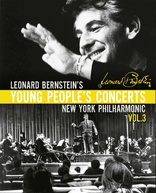
New York Philharmonic - Leonard BernsteinC MAJOR | 1958-1972 | 990 min | Rated G | Mar 20, 2020

Movie rating
7.3 | / 10 |
Blu-ray rating
| Users |  | 0.0 |
| Reviewer |  | 4.0 |
| Overall | | 4.0 |
Overview
Young Peoples Concerts Vol. 3 (1958-1972)
| Music | 100% |
Specifications
Video
Video codec: MPEG-4 AVC
Video resolution: 1080i
Aspect ratio: 1.33:1
Original aspect ratio: 1.33:1
Audio
English: LPCM 2.0 Mono
Subtitles
English, German, Italian, Japanese, Korean
Discs
Blu-ray Disc
Four-disc set (4 BDs)
Playback
Region A (B, C untested)
Review
Rating summary
| Movie |  | 4.5 |
| Video |  | 2.0 |
| Audio | | 4.0 |
| Extras | | 0.0 |
| Overall | | 4.0 |
Young Peoples Concerts Vol. 3 Blu-ray Movie Review
Reviewed by Jeffrey Kauffman September 13, 2022For anyone who has maintained a contact to Leonard Bernstein's own compositional output through the years, this very week (as this review is being
published) New York City will be celebrating a very special Mass, namely a 51st anniversary concert of the one Bernstein wrote to help the
Kennedy Center open in 1971.
At least some of the episodes gathered together in this winning third volume of Bernstein hosted Young Peoples Concerts were produced
either just before or just after Mass was written and produced, which is probably as much evidence as necessary to prove what a protean
talent Bernstein was, able to compose, conduct and teach with equal facility.
Two previous volumes of Young People's Concerts have been released and reviewed by yours truly:
Young People's Concerts Vol. 1 Blu-ray
review
Young People's Concerts Vol. 2 Blu-ray
review
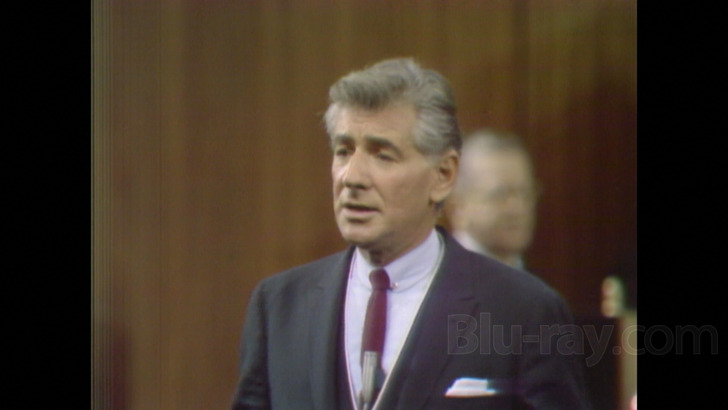
Disc One
The Road to Paris
Originally broadcast January 18, 1962
This collection gets off to a globe trotting start, at least vicariously, as Bernstein looks at three international composers, George Gershwin, Ernest Bloch (who spent much of his latter life in my home state of Oregon), and Manuel de Falla, who chose to live in Paris at the turn of the century, and how that French influence altered their music.
The Sound of a Hall
Originally broadcast November 21, 1962
This is a fun quasi-scientific episode which gets into some of the nuts and bolts (or perhaps more accurately cochlea and vestibular nerves) of acoustical properties of Philharmonic Hall. The "band" plays excerpts from Berlioz, Copland, Vivaldi, Walton and Tchaikovsky.
A Tribute to Teachers
Originally broadcast November 29, 1963
This is a heartfelt episode where Bernstein pays homage to some of his own mentors, including Serge Koussevitzky, while also lionizing the very act of teaching. Bernstein also kind of astonishingly if understandably calls Fritz Reiner the greatest conductor alive today. The emotional content of this episode may be upped by a realization that it originally aired just one week after the assassination of President Kennedy and may have provided a kind of "return to normalcy" for kids (and adults) who tuned in.
The Genius of Paul Hindemith
Originally broadcast February 23, 1964
This episodes serves as an elegy of sorts for the often thorny German composer, who had died on December 28, 1963. Bernstein gets into some of the more astringent aspects of Hindemith's works, and offers both smaller scale and orchestral pieces.
Farewell to Nationalism
Originally broadcast November 30, 1964
This may be billed as a "farewell to nationalism", which may be a kind of subtext in terms of the forward momentum of a global influence on composers, but Bernstein manages to work in a dazzling array of nation-centric writers and pieces, including evergreens like Liszt's Hungarian Rhapsody No. 2 to lesser known offerings like Babbitt's Composition for Twelve Instruments.
Disc Two
Charles Ives: American Pioneer
Originally broadcast February 23, 1967
If Bernstein is rightly recognized as having helped to resurrect (no second symphony pun intended) the music of Gustav Mahler, he also did similar service for the anachronistic offerings of Charles Ives, whom Bernstein dubs "the first great American composer". In color.
Alumni Reunion
Originally broadcast April 19, 1967
While there are a selection of the "Young Performer" episodes on Disc Four of this release, this episode, which was the final concert of the tenth season of Young People's Concerts, welcomes back three erstwhile young performers who made their debuts on the series, cellist Stephen Kates, soprano Veronica Tyler and pianist Andre Watts. In color.
Forever Beethoven
Originally broadcast January 28, 1968
Bernstein offers some expected snippets from Beethoven's oeuvre, including the epochal first movement from the Symphony No. 5, but then kind of surprisingly hands to baton over to assistant conductor Paul Capolong, who leads the orchestra in accompanying Joseph Kalichstein in two movements from the fourth Piano Concerto. In color.
Fantastic Variations
Originally broadcast December 25, 1968
This may not have exactly been the preferred Christmas present of children that year, but it's one of two very interesting episodes devoted to Richard Strauss' music in this collection. This one focuses on Don Quixote. In color.
Bach Transmogrified
Originally broadcast April 27, 1969
This is a really fun episode which looks at the venerable Johann Sebastian Bach through the lens of the late sixties, though a callback to a much earlier era is also accomplished with a fantastic guest appearance by none other than Leopold Stokowski. In color.
Disc Three
The Anatomy of a Symphony Orchestra
Originally broadcast May 24, 1970
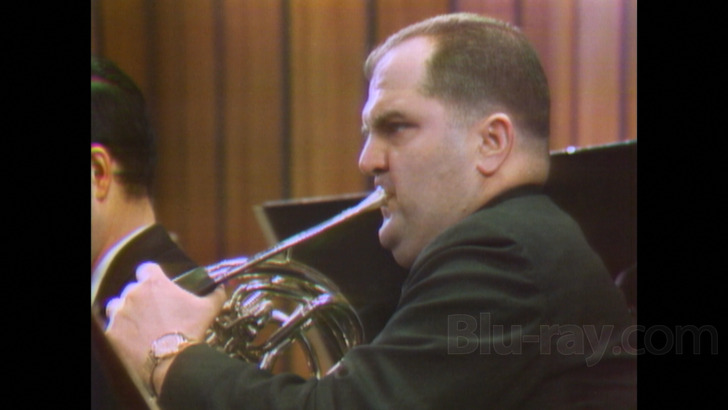
Bernstein "dissects" the modern symphony orchestra by offering accounts of the major sections, all within the context of a performance of Respighi's Pini di Roma. This had one of the funnier moments for me, and all I'll say is watch the orchestra members in front of the big brass instruments that Lenny asks to toot a bit to show how loudly they can play. In color.
A Copland Celebration
Originally broadcast December 27, 1970
Bernstein helps one of his main mentors celebrate his 70th birthday with a loving concert that offers the Concerto for Clarinet and String Orchestra and some excerpts from Billy the Kid. In color.
Thus Spake Richard Strauss
Originally broadcast April 4, 1971
Bernstein's innate ability to simplify incredibly complex concepts is brilliantly on hand with this exegesis of one of Richard Strauss' more notoriously layered compositions, Thus Spake Zarathustra, which had then recently enjoyed some unexpected popularity courtesy of both 2001: A Space Odyssey and especially Deodato's Top 10 jazz reworking of the opening "tune".
Lizst and the Devil
Originally broadcast February 13, 1972
Bernstein perhaps wisely stays away from another then recent cinematic referent, The Mephisto Waltz, in this analysis of Liszt's Faust Symphony. In color.
Holst: The Planets
Originally broadcast March 26, 1972
If you don't quite get all of the Holst piece in this engaging episode (only five of The Planets' seven movements are performed, you at least get Lenny riffing on a proposed piece for Pluto, which way back in the Dark Ages of 1972 was considered an honest to goodness planet and not some damned pretender. In color.
Disc Four
Young Performers, No. 7
Originally broadcast February 22, 1966
Bernstein continues his tradition of shepherding then young talent, with this episode featuring four pianists, Paul Schoenfield, Stephanie Sebastian David Oei and Horacio Gutierrez, as well as three young conductors, James DePreist (nephew of Marian Anderson and much later the Music Director my hometown's Oregon Symphony), Jacques Houtmann and Edo de Waart, all addressing Mussorgsky's Pictures at an Exhibition in both it s pianistic and orchestrated (by Ravel) versions.
Young Performers, No. 8
Originally broadcast January 27, 1967
This offering has an unusually wide array of artists, including everything from Mark Salkind on oboe to Fred Alston on bassoon to Stephen Dominko on accordion, and, yes, you read that right. The programs features pieces by Haydn, Mozart, Chopin, and Saint-Saens. In color.
Young Performers, No. 9
Originally broadcast March 31, 1968
Saint-Saens makes a return appearance here with a 14 year old Lawrence Foster taking on the composer's Cello Concerto No. 1, conducted by Alois Springer. Hindemith also gets another chance to disturb complacent ears (that's a joke, folks), but the real standout here may be twins Martin and Steven Vann on the piano playing Carl Maria von Weber.
Young Peoples Concerts Vol. 3 Blu-ray Movie, Video Quality
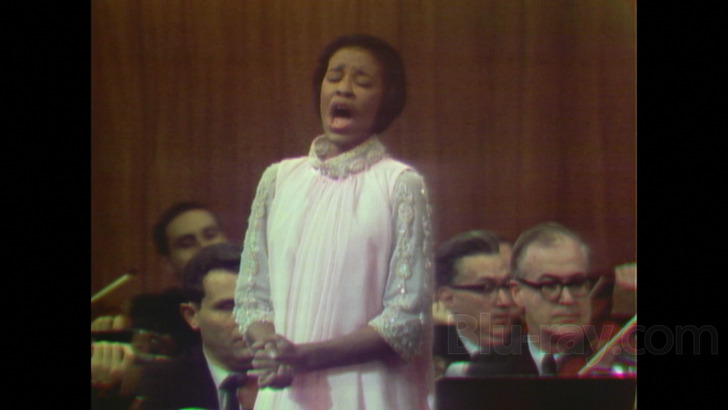
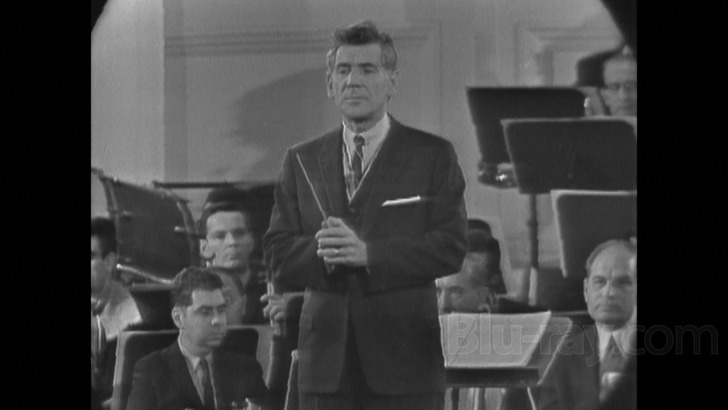
Young People's Concerts Vol. 3 is presented on Blu-ray courtesy of C Major and Unitel with AVC encoded 1080i transfers in 1.33:1. This set aligns pretty completely with the quality seen in the first two volumes. At least some of the older black and white episodes were almost certainly culled from kinescopes, and so there are the telltale rounded edges of the frame and often kind of weird warping and other anamorphic oddities, including both squeezing and stretching. The color episodes fare a good deal better, but even some of these are pretty badly damaged (long scratches down the left side of the frame recur). The color of the color episodes is somewhat variable, at times looking fairly wan and uninspired, but in several episodes actually popping relatively well. Combing artifacts on things like Lenny's peripatetic baton abound.
Young Peoples Concerts Vol. 3 Blu-ray Movie, Audio Quality
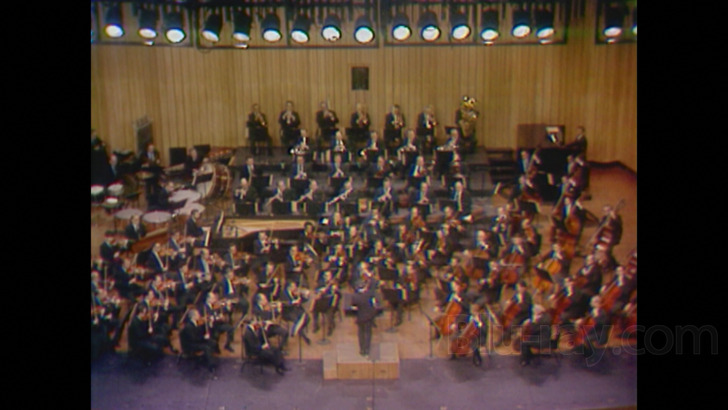
Much as with the video side of things, this set's LPCM 2.0 Mono tracks sound very similar to those on the previous two volumes of this set. The older episodes in particular have a somewhat hollow, boxy sound, but I have to say overall I found the audio in this collection to be a bit more consistently full bodied than in the prior volumes. There's appealing if probably inherently limited dynamic range here that manages to account for both full tutti passages and quieter solos without any major issues, and as always Bernstein's learned analyses come through without any issues whatsoever. Optional subtitles in several languages are available.
Young Peoples Concerts Vol. 3 Blu-ray Movie, Special Features and Extras
As with the first two volumes in this set, there are no on disc supplements offered. Once again the set is housed in a sturdy slipcase that comes with a nicely appointed insert booklet offering details on each of the episodes.
Young Peoples Concerts Vol. 3 Blu-ray Movie, Overall Score and Recommendation
Those interested in Bernstein's Mass may get a kick out of a patently goofy moment I experienced which I recount in my closing comments of my Young People's Concerts Vol. 1 Blu-ray review, and I suspect, based on several jokes Bernstein offers throughout these episodes, he would have laughed heartily at what happened to me (my favorite comment in this set is Bernstein closing out a detailed analysis by saying he can't offer more or "we'll be here until next Purim"). While this has some of the video (and to a lesser extent, audio) anomalies of the first two sets, there is so much sheer knowledge on display here, not to mention the glorious music, that this release seemingly requires being Highly recommended.