Young People's Concerts Vol. 2 Blu-ray Movie
HomeYoung People's Concerts Vol. 2 Blu-ray Movie 
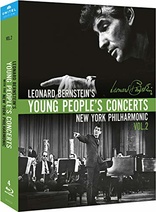
New York Philharmonic / Leonard BernsteinC MAJOR | 1958-1972 | 945 min | Rated G | Jan 24, 2020
Price
List price:Listed on Amazon marketplace

Movie rating
7.3 | / 10 |
Blu-ray rating
| Users |  | 0.0 |
| Reviewer |  | 4.5 |
| Overall | | 4.5 |
Overview
Young People's Concerts Vol. 2 (1958-1972)
Young Peoples Concerts Vol. 2 comprises 17 episodes of the legendary series.
| Music | 100% |
Specifications
Video
Video codec: MPEG-4 AVC
Video resolution: 1080i
Aspect ratio: 1.33:1
Original aspect ratio: 1.33:1
Audio
English: LPCM 2.0 Mono
Subtitles
English, German, Italian, Japanese, Korean
Discs
Blu-ray Disc
Four-disc set (4 BDs)
Playback
Region A (B, C untested)
Review
Rating summary
| Movie |  | 5.0 |
| Video |  | 2.5 |
| Audio |  | 3.5 |
| Extras | | 0.0 |
| Overall | | 4.5 |
Young People's Concerts Vol. 2 Blu-ray Movie Review
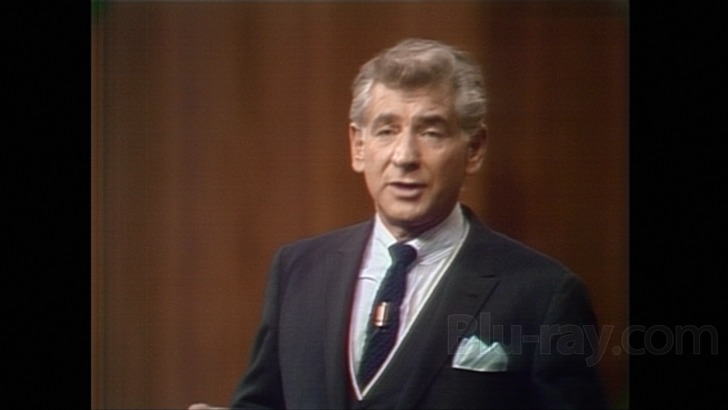
Reviewed by Jeffrey Kauffman January 24, 2020At least on occasion in the more than ten years I’ve been writing for this site, I’ve included some Blu-ray releases on our annual “Top Ten” lists that haven’t always had the very best technical merits, but which I’ve determined were among the better releases of that given year despite any perceived deficits. Such was the case in 2019 when I named Young People's Concerts Vol. 1 as one of my personal choices as “best” of the year. C Major and Unitel (along with Naxos) are back now with a second volume culled from the long running “public service” pieces that were hosted so memorably by Leonard Bernstein. Those of us who grew up under Lenny’s mentorship may sound a bit like Grandpa Simpson with our “back in my day” reminiscences, but despite the relatively low tech world of the 1960s, the Young People’s Concerts regularly delivered a touch of class and culture to kids scattered far and wide across the American continent. This second volume has another great collection of episodes (kind of oddly presented in a non-chronological fashion for some reason) and will no doubt capture the fancy of those with an interest in music generally and classical music in particular, though as tended to be the case with a man of Bernstein’s ecumenical and wide ranging tastes, what “classical music” ends up meaning in some of these offerings may be at least a bit up for debate. For those wanting a recap (reprise?) of the contents of the first volume of this nascent series, you can find details in our Young People's Concerts Vol. 1 Blu-ray review.
Disc One
What is Sonata Form?
Originally broadcast November 6, 1964
Bernstein offers his typically erudite and genre bashing approach toward analyzing sonate form, offering a glut of examples that include snippets of everything from Mozart's Symphony No. 41 to "Twinkle, Twinkle Little Star" to what was at that moment a hit of major proportions, "And I Love Her" by Lennon and McCartney.
A Tribute to Sibelius
Originally broadcast February 19, 1965
The one hundredth anniversary of the birth of one of Finland's most noted (sorry) exports is celebrated by "Lenny and the band", along with a little help from Sergiu Luca, who offers a nice performance of Sibelius' energetic Violin Concerto. There's some time devoted to Sibelius' Second Symphony (my own particular favorite of the composer's seven pieces in that idiom), along with a performance of the lovely fourth movement from that piece (some curmudgeons may have preferred the first movement, or in fact the entire symphony).
Musical Atoms: A Study of Intervals
Originally broadcast November 29, 1965
Music theory geeks (and you know who[m] you are) will, well, geek out at this episode, wherein Bernstein literally deconstructs the building blocks of melody and harmony. He returns to the venerable writing team of Lennon and McCartney (hey, it was 1965), but also spends considerable time with two Fourth Symphonies, the one by Brahms and the one by Vaughan Williams. Those same curmudgeons mentioned above may feel that Lenny missed the perfect opportunity to work in a little "south of the border" example courtesy of Antonio Carlos Jobim's "One Note Samba".
The Sound of an Orchestra
Originally broadcast December 14, 1965
This is an interesting if kind of far reaching episode that would have been a wonderful holiday present to kids in 1965. Lenny discusses various orchestral sounds in terms of what my be termed "nationalistic" approaches toward orchestration, drawing examples from a number of pieces like Stravinsky's L'Histoire du Soldat to Copland's Rodeo. The main emphasis is on Haydn's Symphony No. 88, though Lenny starts things off with a bit of a musical joke which in its own way perhaps presages folks like Peter Schickele's P.D.Q. Bach.
Disc Two
A Birthday Tribute to Shostakovich
Originally broadcast January 6, 1966
The sometimes thorny work of Russian titan Dmitri Shostakovich is the focus of this "sixtieth birthday celebration" for the composer. Bernstein is maybe just a bit circumspect about some of the darker forces in the Soviet world which tended to confine Shostakovich (those interested may want to check out Keeping Score: Shostakovich's Symphony No. 5, wherein Bernstein protege and future Young People's Concerts host Michael Tilson-Thomas discusses some of these aspects). Excerpts from the Seventh Symphony and a complete performance of the Ninth Symphony are presented.
What is a Mode?
Originally broadcast November 23, 1966
This is another episode which should appeal to theory geeks, as Lenny uses another panoply of hugely disparate examples to illustrate various modal writing. Some modes get a little bit more air time than others, but as usual Bernstein brings a great deal of flair to the pieces he has chosen to illustrate various "orderings" of scalar intervals. This was a particularly interesting episode for me, though, as in my college life I was part of an invited group of students who got to take a master class on the modes from the distinguished American composer Roy Harris. In color.
A Toast to Vienna in 3/4 Time
Originally broadcast December 25, 1967
Lenny and the band ring in Christmas Day with a fun tribute to the New York Philharmonic's "fraternal orchestra", the Vienna Philharmonic, offering a bunch of once again widely variant pieces, including everything from the expected Strauss waltz to some more unexpected examples culled from the likes of Mahler. In color.
Quiz Concert: How Musical Are You
Originally broadcast May 26, 1968
While gimmicky, this is a kind of fun episode where Lenny challenges the audience (both at Avery Fisher Hall and by extension the home viewers) by peppering them with various questions. In color.
Berlioz Takes a Trip
Originally broadcast May 25, 1969
Bernstein pays homage to the zeitgeist of the late sixties by describing Berlioz's Symphonie Fantastique as "the first psychedelic symphony", getting into the underlying foundation element of the so-called idée fixe. In color.
Disc Three
Two Ballet Birds
Originally broadcast September 14, 1969
Bernstein offers up a "two fer" of ballet offerings with avian subtexts, Tchaikovsky's Swan Lake and Stravinsky's Firebird. The maestro discusses his ideas of "abstract ballet" while offering copious examples from the two pieces. In color.
"Fidelio": A Celebration of Life
Originally broadcast March 29, 1970
The newest of the episodes included in this set is an appealing overview of the only opera written by Beethoven. The piece is often cited as having some "issues", and Bernstein delves into those perceptions with his typical wit and scholarship. In color.
Unusual Instruments of the Present, Past and Future
Originally broadcast March 27, 1960
Perhaps by design whoever put this package together follows up the newest episode in the set with the oldest in the set, a 1960 broadcast that is a really fun tour of various global instruments. There are some kind of cool if now laughably arcane examples of "new fangled" electronic music (including a piece by a composer I had the privilege of studying with, Vladimir Ussachevsky), as well as that legendary classical orchestra instrument, the kazoo.
Overtures and Preludes
Originally broadcast January 8, 1961
Some may feel there's not that much difference between an Overture and a Prelude, to which Maestro Bernstein might have cheekily responded, "Really? Well, let's see. This is another fun example of how affably learned Bernstein could be, and he also offers up his insanely delirious Overture to Candide.
Aaron Copland Birthday Party
Originally broadcast February 12, 1961
Bernstein's own mentor Aaron Copland gets a loving 60th birthday tribute which includes Copland himself conducting El Salón México.
Disc Four
Young Performers No. 4
Originally broadcast January 15, 1963
One of the recurring highlights throughout Bernstein's tenure as moderator of the Young People's Concerts were his episodes featuring up and coming young talent, and the fourth disc of this set features three wonderful episodes in that regard. This one offers Joan Weiner (14 years old), Claudia Hoca (12 years old) and Pamela Paul (13 years old), splitting up duties by each playing one movement from Mozart's Piano Concerto in a Major, with student conductors for each movement as well (Yuri Krasnopolsky, Zoltan Rozsnyai and Serge Fournier). The highlight of the episode for many, though, will be the early appearance of a then 16 year old Andre Watts performing Liszt's challenging Piano Concerto in E-flat Mauor, under the baton of Bernstein himself.
Young Performers No. 5
Originally broadcast December 23, 1963
In the wake of what was even then the devastating loss of President Kennedy, Bernstein summons a fantastic assortment of talent, including Heidi Lehwaler on harp, Wledon Berry on clarinet, Arnos Eisenberg on flute, Shulamith Ran on piano, and Stephen Kates on cello. Among the relatively young conductors featured is a guy named Claudio Abbado.
Young Performers No. 6
Originally broadcast January 28, 1965
This episode may frankly not have quite the "star power" of the two others, but it features Patricia Michaelian on piano and James Oliver Buswell IV on violin. Bernstein offers an appealing analysis of Ravel's Mother Goose Suite as well.
Young People's Concerts Vol. 2 Blu-ray Movie, Video Quality
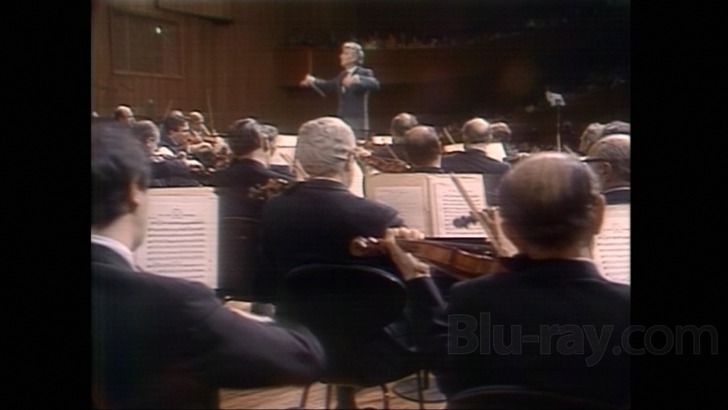
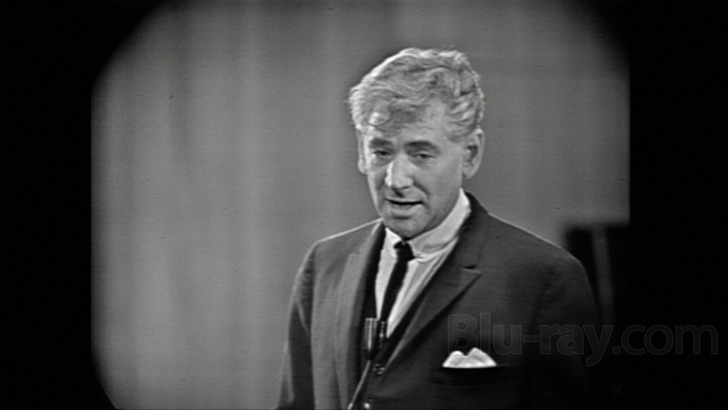
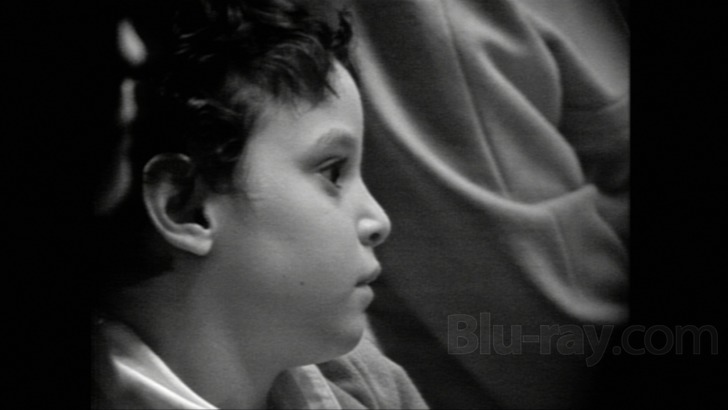
Leonard Bernstein's Young People's Concerts Volume 2 is presented on Blu-ray courtesy of C Major and Unitel with AVC encoded 1080i transfers in 1.33:1. This set has some of the same anomalies I noted in our Young People's Concerts Vol. 1 Blu-ray review, with what I can virtually guarantee are some episodes sources from kinescopes. In these older black and white episodes there are often a number of "baked in" curios, including strange warping during lateral pans and whites that can bloom pretty dramatically. Some episodes can occasionally look anamorphically squeezed (see screenshot 19). That said, things fare at least somewhat better for some of the newer episodes, which I'm assuming were culled from some kind of videotape master. Detail levels aren't exactly excellent even in these episodes, but general clarity is much improved, and the overall image has greater fluidity without some of the contrast issues that can afflict the black and white episodes. My score is 2.75.
Young People's Concerts Vol. 2 Blu-ray Movie, Audio Quality
As with the first volume, the LPCM 2.0 mono tracks here have withstood the tests of time at least a bit better than the video component, but in the older episodes especially there's still some of that inherent boxiness that I mentioned in our Young People's Concerts Vol. 1 Blu-ray review. As with the video side of things, some of the newer episodes have a somewhat fuller sound. There's nothing really very objectionable here, lest anyone feel trepidatious, and the bulk of the orchestral playing sounds reasonably full bodied, and Bernstein's always interesting "teaching moments" come through cleanly and clearly throughout. My score is 3.75.
Young People's Concerts Vol. 2 Blu-ray Movie, Special Features and Extras
As with the first volume in this set, there are no on disc supplements offered. Once again the set is housed in a sturdy slipcase that comes with a nicely appointed insert booklet offering details on each of the episodes.
Young People's Concerts Vol. 2 Blu-ray Movie, Overall Score and Recommendation
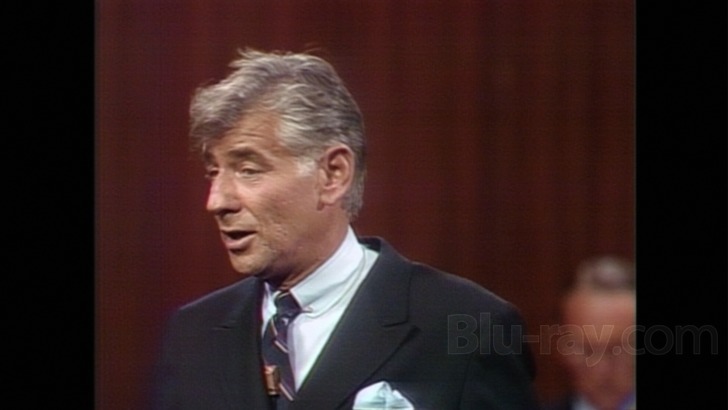
Some of you may have seen some recent press reports that Netflix has apparently optioned a proposed biographical film about Bernstein which is slated to star Bradley Cooper. Some of the articles question the wisdom of building a film around a composer and conductor who's been dead now for several decades, and who may not be that familiar to younger viewers. For those who were younger viewers during Bernstein's heyday, this second hugely appealing set of Young People's Concerts will be a nostalgic wonderland, but also perhaps a chance to "re up" their musical educations. For those who weren't around when these were first broadcast, that educational angle will most certainly still be intact and may in fact help spark interest for any proposed upcoming film about this unbelievably protean musician. Once again technical merits are a little iffy at times, but this set like its predecessor stands a good chance of making my list of Ten Best when we reviewers get around to assembling our lists in December 2020. Highly recommended.