Young People's Concerts Vol. 1 Blu-ray Movie
HomeYoung People's Concerts Vol. 1 Blu-ray Movie 
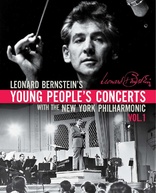
New York Philharmonic / Leonard BernsteinC MAJOR | 1958-1972 | 943 min | Rated G | Apr 19, 2019

Movie rating
7.6 | / 10 |
Blu-ray rating
| Users |  | 0.0 |
| Reviewer |  | 4.5 |
| Overall | | 4.5 |
Overview
Young People's Concerts Vol. 1 (1958-1972)
There had never been a communicator about music with anywhere near Bernsteins brilliance, humour, energy, reach and importance New York Times. Young Peoples Concerts Vol. 1 comprises 17 episodes of the legendary series, which remains unmatched until today.
Starring: Leonard Bernstein| Music | 100% |
| Family | Insignificant |
Specifications
Video
Video codec: MPEG-4 AVC
Video resolution: 1080i
Aspect ratio: 1.33:1
Original aspect ratio: 1.33:1
Audio
English: LPCM 2.0
Subtitles
English, German, Italian, Japanese, Korean
Discs
Blu-ray Disc
Four-disc set (4 BDs)
Playback
Region A (B, C untested)
Review
Rating summary
| Movie |  | 5.0 |
| Video |  | 2.5 |
| Audio |  | 3.5 |
| Extras | | 0.0 |
| Overall | | 4.5 |
Young People's Concerts Vol. 1 Blu-ray Movie Review
Reviewed by Jeffrey Kauffman June 10, 2019As much as Baby Boomers may admittedly be getting into Grandpa Simpson territory with any “back in my day” reminscences, there’s one memory many Baby Boomers have which unfortunately is largely a thing of the past: the kind of music education specials Leonard Bernstein made into “must see viewing” for (then) kids and (perhaps) teens in his now legendary Young People’s Concerts series. What even some nostaglic Baby Boomers may not realize is that the Young People’s Concerts had been around in one form or another for decades before Maestro Bernstein took the helm (in more ways than one). Bernstein’s initial ascension to the podium of the New York Philharmonic in the early 1940s is one of the more memorable tales of mid-20th century classical music, but it wasn’t until some time later in the mid to late 1950s that Bernstein started making forays into the then nascent world of television with “instructive” specials, the first of which aired on an old anthology series called Omnibus. When Bernstein assumed the Music Director position for the New York Philharmonic in 1957-58, it probably seemed only natural and right for a “marriage” of sorts between the Young People’s Concerts and television to become a reality, especially with such an affable, learned host as Bernstein standing front and center. The first televised Bernstein outing took place in January 1958 (and is included on this four disc set), and the template was set: “Lenny” (as he is of course affectionately referred to by even those who never met him) leading “the band” and occasional soloists through snippets of pieces, as he discussed various concepts in interstitial mini-lectures. The Young People’s Concerts may seem terribly quaint from a presentational standpoint to jaded modern day eyes, but for pure content, they have rarely been matched and as this new release more than capably proves, they are still a delight to watch and learn from.
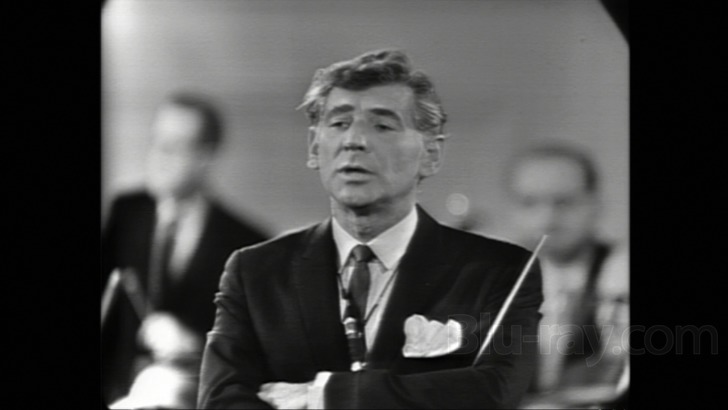
Bernstein’s tenure as host and moderator of the Young People’s Concerts lasted for well over a decade, and this first volume of episodes is chronological for the most part, though it does kind of oddly leave out a bunch of interstitial offerings that seem to be mostly from 1960 and 1961.
Disc One
What Does Music Mean?
Originally broadcast January 18, 1958
While some musicologists with a knowledge of “program music” or even what’s called “Mickey Mousing” in film scoring may argue with the venerable Bernstein’s pronouncement that music in and of itself is devoid of meaning, the good Maestro does make a cogent case for the inherent “unknowability” of or at least the inability to properly define tone in its pure form as a physical phenomenon. Kind of humorously, the little snippet Bernstein provides where he offers some “alternative facts” as to what a particular piece of music “means” comes from Don Quixote , one of the pieces that made Bernstein an overnight celebrity when he subbed for Bruno Walter at the last moment in the early 1940s.
What Is American Music?
Originally broadcast February 1, 1958
I must cheekily confess that I was part of an invited group of college students who got to take a Master Class from Roy Harris and his lovely pianist wife Johana, and I had the temerity to ask the iconic composer how he felt about being subsumed by Aaron Copland as an exemplar of so-called “American music”. (He took the question in stride, saying his works spoke for themselves.) Harris doesn’t make the “cut” here, but Gershwin and several others do. Aaron Copland does as well, who as a special guest conducts part of his Third Symphony.
What Does Orchestration Mean?
Originally broadcast March 8, 1958
This is one of the more interesting early episodes in the series, at least for those with a fascination for different timbres of instruments. Bernstein takes the work of a rather famous orchestrator (and writer about orchestration), Rimsky-Korsakov, as his jumping off part, using a number of well chosen pieces including Ravel’s Bolero to help elucidate ideas about different instrumental colors.
What Makes Music Symphonic?
Originally broadcast December 13, 1958
Bernstein deconstructs several iconic pieces of music in this offering, going over a number of technical aspects like development, variations, sequences and counterpoint. Quite a bit of time is given over to an analysis of Brahms’ Second Symphony, including a performance of the fourth movement.
Disc Two
What is Classical Music?
Originally broadcast January 24, 1959
This is a kind of thorny episode in a way, at least for those who prefer not to “classify” (and/or “classical-fy”) music, and one can almost feel Bernstein searching for a way to properly define what he feels passes muster as a “real” classical piece. There are some lovely examples of Bernstein’s inerrant ability to highlight ideas with appropriate pieces here, and there is an unusually wide array of music offered, including everything from Handel to Mozart to Bach.
Humor in Music
Originally broadcast February 28, 1959
Perhaps unavoidably, this is a really fun outing that shows that even “stuffy” classical music can be full of hijinks and shenanigans. A number of great pieces are offered, at least in passing, and some of them, like a snippet from Tristan and Isolde, may surprise even ardent classical fans.
What Is a Concerto?
Originally broadcast March 28, 1959
This is perhaps an “easier” exercise in definition than trying to account for the whole of classical music, and Bernstein gives a bit of history lesson, offering early quasi-concerti like Bach’s Brandenburg Concerto Number 5. A “larger” concerto, Bartok’s Concerto for Orchestra, gets more prominent treatment, though even here the entire piece is not played.
Who Is Gustav Mahler?
Originally broadcast February 7, 1960
This is one of the highlights of this first volume of Young People’s Concerts, since it offers a relatively early example of Bernstein championing one of the composers he would become most associated with in terms of his conducting career. With such gargantuan works from which to choose, it’s perhaps a little odd that Bernstein focuses quite a bit on Mahler’s Fourth Symphony, though that is one of Mahler’s most engaging and “easily accessible” orchestral pieces.
Folk Music in the Concert Hall
Originally broadcast April 9, 1961
Despite an emphasis on so-called “folk music” (then all the rage in popular music circles courtesy of such acts as The Kingston Trio and Peter, Paul & Mary), there is a glut of relatively traditional orchestral music here, including (perhaps unexpectedly) some Mozart and Ravel. Bartok, a composer known for collecting folk music and incorporating it in his larger pieces, is also well represented. Another composer whom Bernstein famously championed, Charles Ives, is also featured. This episode may hold special allure for lovers of film musicals, since it features a guest performance by noted “star dubber” Marni Nixon.
Disc Three
What Is Impressionism?
Originally broadcast December 1, 1961
Lenny attempts to elucidate the diaphonous charms of composers like Debussy and Ravel by sharing a bit of art, but he offers some nice “contrasting” material in terms of what he terms “realistic music” courtesy of warhorses like Beethoven’s Fifth Symphony.
Happy Birthday, Igor Stravinsky
Originally broadcast March 26, 1962
This is another standout offering, one which provides some biographical background on the legendary Russian composer, while also giving an overview of how his music changed several times over the course of his career (and indeed would continue to past even the point of this broadcast). There’s an in depth analysis (and complete performance of Petrouchka.
What Is a Melody?
Originally broadcast December 21, 1962
Bernstein was an inimitable “tunesmith” himself, as any lover of West Side Story (to name just one of about a zillion examples) will tell you, and he does a wonderful job in dissecting what makes something melodic. There are a bunch of famous “tunes” on hand here, along with some more unexpected examples, including some Hindemith.
The Latin American Spirit
Originally broadcast March 8, 1963
While concentrating on classical, orchestral pieces, this episode may well have been inspired at least in part by what was in 1963 the major craze of Brazilian music storming the American charts, the Bossa Nova. Bernstein features some lesser know composers like Oscar Lorenzo Fernandez, while also offering some Villa-Lobos and Copland. His own wonderful Symphonic Dances from West Side Story is also performed.
Jazz in the Concert Hall
Originally broadcast March 11, 1964
This may be at least a bit of a letdown for those who might have enjoyed, say, the likes of Benny Goodman showing up to perform something like Stravinsky’s Ebony Concerto. Instead, Gunther Schuller is on hand conducting one of his pieces, and Aaron Copland plays the piano in a performance of his own Piano Concerto. As such, this may be weighted more to the “classical” than the “jazz” side, at least for those who grew up on music that fell under the sway of what Schuller termed “the third stream”.
Disc Four
The fourth disc in this set is given over to what might be cheekily thought of as "real" Young People's Concerts, in that the episodes on this disc all feature (then) young virtuosos, some of whom would go on to rather vaunted careers.
Young Performers, No. 1
Originally broadcast March 6, 1960
Guest: Daniel Domb, Cello
Young Performers, No. 2.
Originally broadcast March 19, 1961
Guests: Lynn Harrell, Cello; Jung Ja Kim, Piano; Veronica Tyler, Soprano
Young Performers, No. 3
Originally broadcast April 14, 1962
Guests: Seiji Ozawa, Conductor; Gary Karr, Double Bass; Ruth and Naomi Segal, Pianists; Paola Robison, Flute; Paul Green, Clarinet; Tony Cirone, Xylophone; David Hopper, Glockenspiel
Young People's Concerts Vol. 1 Blu-ray Movie, Video Quality
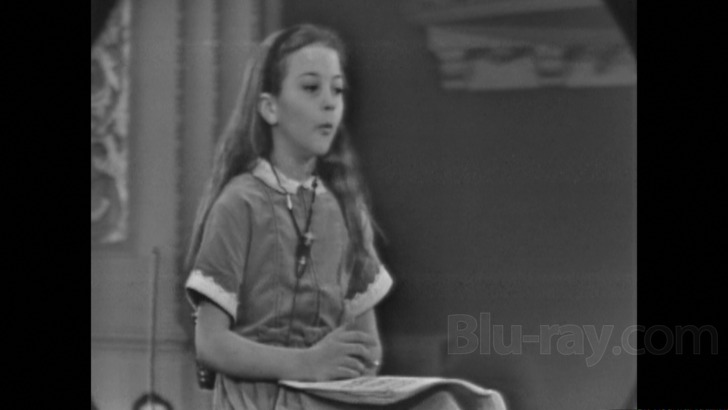
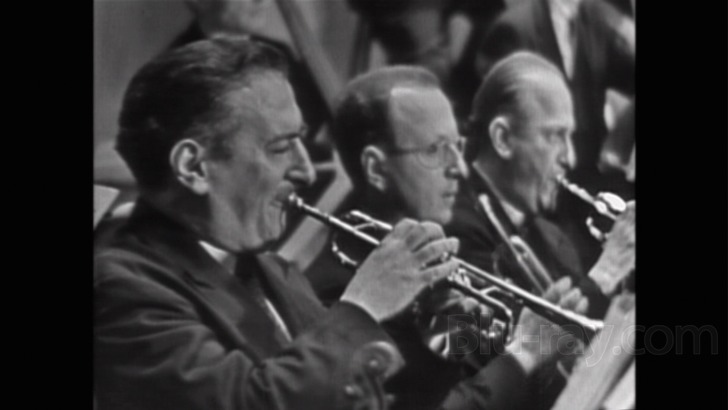
Leonard Bernstein's Young People's Concerts Volume 1 is presented on Blu-ray courtesy of C Major and Unitel with AVC encoded 1080i transfers in 1.33:1. It appears that at least the early episodes, and frankly perhaps all of them, were sourced off of kinescopes, and so allowances must be made for some technical issues. As is often the case with such transfers, there are "baked in" issues like lens warping (when lateral pans occur, backgrounds almost look like they're moving across a convex surface, something that may even provoke queasiness in more sensitive viewers). There is also widely variant contrast, and occasional jittery instability, along with slight ghosting and, occasionally at times, actual damage as can be seen in screenshots 18 and 19. All of this said, with an understanding of the age of the source material and the context of the technology used to preserve the broadcasts, these are all certainly watchable, if also all certainly far from the standards current day audiences are used to seeing. As historical documents, these are priceless, despite the obvious technical limitations of the presentation.
Young People's Concerts Vol. 1 Blu-ray Movie, Audio Quality
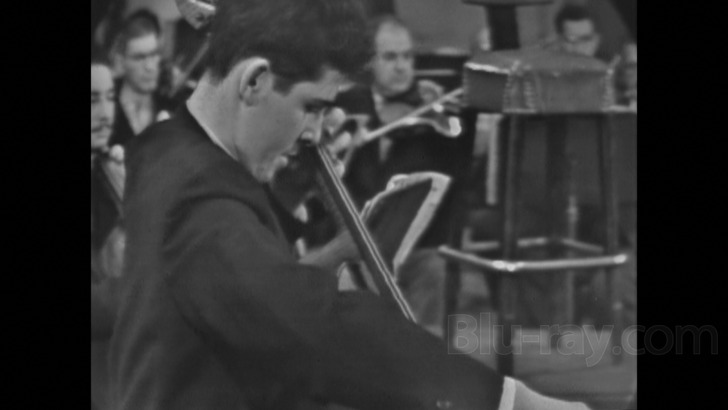
The LPCM 2.0 mono tracks on these episodes make it through the gauntlet of time surprisingly well, and arguably much better than the video component. There's an unmistakable boxiness and narrowness to the audio, but the orchestral playing actually sounds nicely full bodied almost all of the time, and Bernstein's commentaries are always easy to hear. There are occasional very slight signs of damage, but nothing approaching some of the issues on the video side of things.
Young People's Concerts Vol. 1 Blu-ray Movie, Special Features and Extras
There are no on disc supplements offered with this release. It does come housed in a handsome slipbox which also contains a nicely appointed insert booklet (more like a pamphlet, actually), which has details on each of the broadcasts included on the four discs.
Young People's Concerts Vol. 1 Blu-ray Movie, Overall Score and Recommendation
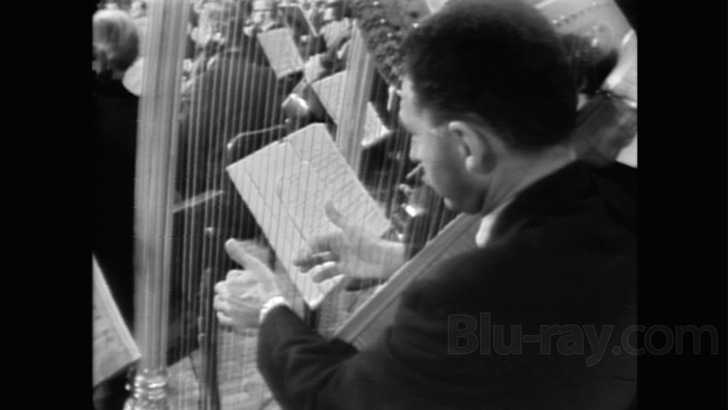
I got to share this hilarious (to me, anyway) anecdote with two of the three Bernstein children when they came out to Portland to visit a Bernstein Academy where my younger son was then a student. Years ago I walked into a sheet music store in Portland and asked the clerk, "Do you have 'A Simple Song' from Bernstein's Mass?", to which the clerk responded (and you might have to think about this for a moment to understand why it was so funny to me), "It depends -- what's it called?" "Lenny and the band" get through both "simple" and "complex" songs in abundance in this wonderful new set, and I for one can't wait to see subsequent volumes. Video is obviously less than pristine, as can easily be made out by the screenshots accompanying this review, but audio is surprisingly well preserved. With a bit of slack granted the video side of things, Leonard Bernstein's Young People's Concerts Volume 1 comes Highly recommended.