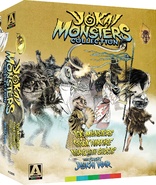
Yokai Monsters Collection Blu-ray Movie
HomeYokai Monsters Collection Blu-ray Movie 
Limited EditionArrow | 1968-2005 | 4 Movies | 262 min | Not rated | Oct 19, 2021

Movie rating
Movie has not been rated yetBlu-ray rating
| Users |  | 0.0 |
| Reviewer |  | 4.0 |
| Overall | | 4.0 |
Overview
Yokai Monsters Collection (1968-2005)
| Foreign | 100% |
| Horror | 49% |
| Family | Insignificant |
| Fantasy | Insignificant |
| Adventure | Insignificant |
| Action | Insignificant |
| Mystery | Insignificant |
Specifications
Video
Video codec: MPEG-4 AVC
Video resolution: 1080p
Aspect ratio: 2.35:1
Original aspect ratio: 2.35:1
Audio
See individual releases
Subtitles
English
Discs
Blu-ray Disc
Three-disc set (3 BDs)
Playback
Region A (B, C untested)
Review
Rating summary
| Movie | | 4.0 |
| Video |  | 3.5 |
| Audio | | 4.0 |
| Extras |  | 5.0 |
| Overall | | 4.0 |
Yokai Monsters Collection Blu-ray Movie Review
Reviewed by Jeffrey Kauffman November 7, 2021Louis Malle's 1958 film The Lovers has nary a spirit or monster in it, and yet it provides a kind of interesting entrée into the world (or at least the term) of yōkai. In one of the more contentious and perhaps even weirdly amusing decisions ever handed down by the Supreme Court, in a 1964 case known as Jacobellis v. Ohio the Court famously (some might say infamously) reversed some lower court decisions in Ohio which had held a theater owner liable for exhibiting "pornography" when he screened the sexually provocative Malle opus. While the vote was a relatively lopsided six to three in favor of reversing the theater owner's conviction, there was absolutely no agreement among the justices as to why the film wasn't obscene, or tangentially why the state could or could not regulate what kinds of "pornography" could be shown. In a phrase which has since entered the public vernacular, Justice Potter Stewart, in trying to explain his rationale for deeming The Lovers as not being pornography, perhaps hemmed and hawed just a bit, before announcing that while there may not be an all encompassing or agreed upon definition of what or what not constitutes so-called hard core pornography, "I know it when I see it" (which of course may beg the question as to what kind of material Potter was watching in his spare time, and, yes, that's a joke). In somewhat the same way, there seem to be about as many definitions of yōkai as there are people offering those definitions, and in fact both the insert booklet and a number of supplements included on the discs in this set offer various interpretations of what exactly yōkai are. While there may indeed be no ultimate agreement on the term, the often whimsically entrancing films included in Arrow's set may help viewers to "know it (and/or them) when they see it (and/or them)".
For reviews of the films included in this set, please click on the following links:
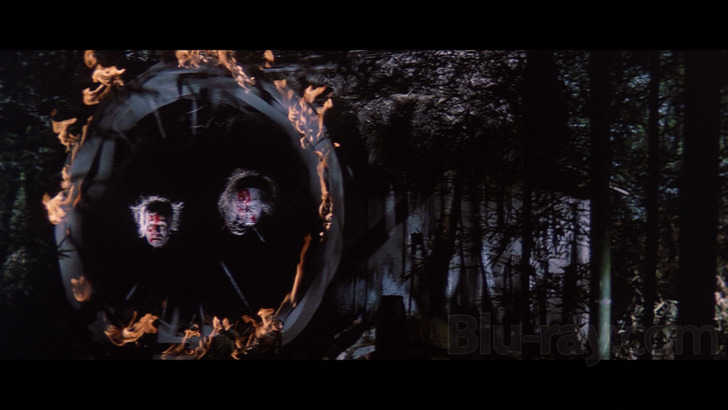
Yokai Monsters: 100 Monsters Blu-ray review
Yokai Monsters: Spook Warfare Blu-ray review
Yokai Monsters: Along with Ghosts Blu-ray review
The Great Yokai War Blu-ray review
Yokai Monsters Collection Blu-ray Movie, Video Quality
Video quality of each film is assessed in the above linked reviews.
Yokai Monsters Collection Blu-ray Movie, Audio Quality

Audio quality of each film is assessed in the above linked reviews.
Yokai Monsters Collection Blu-ray Movie, Special Features and Extras

Supplements included with each film are detailed in the above linked reviews. Note that there are some generalist supplements in this set which aren't necessarily confined to one particular film, or even these particular films. Additionally, this is another very handsomely packaged set from Arrow, which inludes an illustrated 60 page collectors' book featuring some really good essays, reversible sleeves featuring original and newly commissioned artwork by Jolyon Yates, postcards featuring newly commissioned artwork for each film by Jolyon Yates, and a really enjoyable foldout "yokai guide" poster written and illustrated by Jolyon Yates.
Yokai Monsters Collection Blu-ray Movie, Overall Score and Recommendation
Arrow continues to mine the catalog of Daiei, and this set should find a home for collectors who flocked to other releases like The Daimajin Trilogy and/or Gamera: The Complete Collection. While technical merits understandably vary between the films, overall things look and sound fine, and the supplements, both on disc and "extracurricular", are typically excellent per Arrow's standard operating procedure. Recommended.