Wolf Man Blu-ray Movie
HomeWolf Man Blu-ray Movie 
Blu-ray + Digital CopyUniversal Studios | 2025 | 103 min | Rated R | Mar 18, 2025
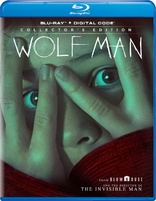

Movie rating
6 | / 10 |
Blu-ray rating
| Users |  | 0.0 |
| Reviewer |  | 3.5 |
| Overall | | 3.5 |
Overview
Wolf Man (2025)
A man must protect himself and his family when they are being stalked, terrorized, and haunted by a deadly werewolf at night during a full moon. But as the night stretches on, the man begins to behave strangely.
Starring: Christopher Abbott, Julia Garner, Matilda Firth, Sam Jaeger, Ben PrendergastDirector: Leigh Whannell
| Horror | 100% |
Specifications
Video
Video codec: MPEG-4 AVC
Video resolution: 1080p
Aspect ratio: 2.39:1
Original aspect ratio: 2.39:1
Audio
English: Dolby Atmos
English: Dolby TrueHD 7.1 (48kHz, 24-bit)
French: Dolby Digital Plus 7.1
Spanish: Dolby Digital Plus 7.1
French = Canadian, Spanish = Latin American
Subtitles
English SDH, French, Spanish
Discs
Blu-ray Disc
Single disc (1 BD)
Digital copy
Packaging
Slipcover in original pressing
Playback
Region A (B, C untested)
Review
Rating summary
| Movie |  | 3.0 |
| Video |  | 4.5 |
| Audio |  | 5.0 |
| Extras | | 3.5 |
| Overall | | 3.5 |
Wolf Man Blu-ray Movie Review
"If you go down in the woods today, you're sure of a big surprise."
Reviewed by Justin Dekker April 1, 2025The latest in a series of reimagining or updates of the Universal classic monsters, Director/Co-writer Leigh Whanell's 'Wolf Man' arrives on Blu-
ray
disc courtesy of Universal. The film stars Christopher Abbott ('Poor Things), Julia Garner ('Ozark'), and Matilda Firth ('Subservience'), and
features a host of impressive practical effects and stunt work. The disc features a solid 1080p presentation and a dazzling Dolby Atmos track.
Special features are highlighted by segments on the film's sound design and numerous prosthetics, along with an enlightening commentary by
Director/Co-Writer Leigh Whanell. A slipcover, and Digital Code redeemable through Movies Anywhere are also included.
No sooner does the film begin to unspool than text appears over the image of a remote and isolated farmhouse. It imparts that in early 1995, a
hiker went missing. Locals, few though there evidently were, concluded, after subsequent sightings, that the unfortunate soul had been
infected by an animal-borne virus they referred to, in the local parlance as "Hills Fever". From here, the film transitions to a young boy out hunting
with his father who takes every opportunity to instruct his son on survival skills and and developing a respect for nature. A startling encounter
disrupts the day's plan when they stumble upon something terrifying that isn't quite natural. Upon returning home, the boy observes his father
communicating with someone over a CB radio, discussing a sighting, presumably of someone afflicted by Hills Fever. Years later, the boy, Blake
(Christopher Abbot, Poor Things), is now a grown man with a child of his own. After receiving word that his estranged father has passed, he
and his wife, Charlotte (Julia Garner, Ozark) decide to head back to his boyhood home with their daughter Ginger in search of a fresh start
for their struggling
marriage. But before they even arrive at the remote Oregon home, they will encounter something that will change them forever.
In 1941, Lon Chaney, Jr. would turn in the performance for which most moviegoers would forever remember him. Though he would appear in well
over a hundred film and television roles in a career that spanned decades playing characters as diverse as the ill-fated Lenny in the 1939 adaptation
of John Steinbeck's "Of Mice
and Men" with Burgess Meredith, and Bruno in 1967's Jack Hill film "Spider Baby" alongside Sid Haig, it's his portrayal of the pitiable Larry Talbot
and
the nocturnally marauding Wolf Man that would provide him with his enduring fame and notoriety. Talbot was a fish out of water, a man returning
home to his familial estate in Wales after the tragic death of his brother. Likeable and charming in his way, Talbot had a bright future ahead of him.
After meeting and falling for Gwen, a local purveyor of antiques, he begins to hear of the local legends involving werewolves, and the viewer quickly
understands that Talbot's fate has been sealed. For all of his machismo and bravado in courting Gwen and attempting to integrate into a new life,
he's doomed to the supernatural affliction of lycanthropy with the "normal" life he'd envisioned and felt was his by right eternally out of his
reach. Though Lon Chaney, Jr. hulks over most of the other members of the cast, his character's confidence is quickly replaced by vulnerability. He's
wracked with fear and panic at what he's becoming and is frantically unable to find a solution. His everyman's terror and powerlessness despite his
obvious financial resources in the wake of a supernatural curse are what make the film so impactful and memorable. His pure heart and wealth
cannot save him. Nothing can.

That Leigh Whanell's Wolf Man intends to do something very different is immediately apparent. In this update (or reimagining) of werewolf mythology, the opening statement referenced above signals that Wolf Man isn't going to be playing by the established rules. When considered in conjunction with the fact that there aren't wandering bands of gypsies in the remote and wooded reaches of Oregon where the film is set, it's clear the film is positing a more earthly and biological cause for this transformation. It's still seemingly transmitted through blood or saliva from being bitten by one that is afflicted, but it's viral in origin not magical. The effect of this is somewhat discombobulating, and also, to a degree, questionable.
Though numerous cultures throughout human history have had tales of men who would transform into animals with a variety of different names applied to them, just as Dracula (1931) and the book from which it rose instructed the world in the ecology of the vampire, much of what modern film fans (and the society at large, for that matter) know about werewolves can be traced back to that 1941 film. Chief among those facts are the notions that the condition is transferred by the bite of a werewolf, that the transformation occurs during the night of a full moon, they have a particular weakness to silver, and they have a decidedly wolflike appearance replete with claws, fangs, and an abundance of fur. Adding to the supernatural aspect of the affliction is the verse repeated multiple times in the film by various characters: "Even a man who is pure at heart and says his prayers by night may become a wolf when the wolfsbane blooms and the autumn moon is bright". It brilliantly augments the atmosphere of the film and it's instantly memorable, so much so that it (or something very similar) has appeared in various other tales, films, and even songs like Cradle of Filth's "Queen of Winter, Throned". All serve as a testament to the power of the original film and the well-established and entrenched mythos. Here, though, a full moon isn't a requirement, the transformation does not seem to reverse during daylight hours, and silver is no longer necessary.
There are several factors that hold this re-envisioned Wolf Man back from standing shoulder to shoulder with the 1941 classic, or even on equal footing with some of the better modern horror fare. The first is pacing. Wolf Man has a strong opening verse as a boy and his father encounter something unknown while hunting in the remote woods, with the parent's reaction confirming just how terrifying the creature is. Back home, the boy is no less confused and unsettled when he overhears his father's CB radio conversation. Obviously, what they stumbled upon wasn't completely unexpected and unknown, and some unidentified number of others are looking for it as well. It's a tense and frightening opening salvo. Once the action transitions to the present, things slow dramatically.
The events in the moving truck notwithstanding, much of what happens next transpires glacially. Blake is infected, which is obviously problematic. But this goes hand-in-hand with the film's second issue, identity. Talbot's 1941 transformation from man to Wolf Man gobbled up barely a minute of screentime, but Blake's transformation consumes the bulk of the film's runtime bite by bite, slowly chewing each morsel, keeping the voluminous prosthetic effects of each subtle change on full display, and showcasing the admittedly interesting visual and sound effect elements that support each incremental change. Seemingly, the film wants to prevent itself from being the frightening (and occasionally campy) gory monster fests of the original film and its direct and spiritual descendants, preferring to be something more akin to Croninbergian body horror steadfast in its belief that the becoming is always more interesting than the being. Had Blake had more to lose, that may have been the case. But he's adrift, a relatively solitary piece of flotsam with little to tether him to the world. His father, from whom he's estranged, is missing and presumed dead. He's been so long absent from his boyhood home he no longer remembers how to get there. His relationship with his wife is rocky as well, there's a gulf that's grown between them, and rather than trying more conventional means of reconciling, he moves them to a place where neither is comfortable and other than the presumed fact that home in the woods is paid for, it has little to offer them. His daughter represents his greatest treasure and tie to the world, but his desire to bring her to his boyhood home has even less to offer her, considering it was a place he obviously could not wait to leave himself and once he did he never returned. As much as the film wants to position this move as a way forward for Blake and his family, from the first moment the words leave his mouth it appears more as the willful act of self-destruction of a man with nothing to lose and no idea how to regain what he's lost. He's no Larry Talbot.
As a lifelong devout watcher of zombie films, I also couldn't help but notice a number of elements that immediately called to mind George Romero's landmark Night of the Living Dead. The opening shot of Blake's boyhood home felt eerily similar to the isolated farmhouse that serves as the setting for most of that 1968 film, and the parallels continue from there. The initial ability to outrun the danger in a vehicle is eliminated early on due to an unlikely accident leading to a frantic dash to a remote house. Doors and windows are quickly boarded up, but in addition to known danger outside, there's a similar unknown danger inside. Hope is briefly restored with the promise of escape in an old pick-up truck that ultimately ends in failure. Even the professed desire to position werewolfism as biological in origin rather than supernatural pushes the film closer to zombie fare. Considering the volume, or, as some would contend, glut, of zombie content that has shambled onto screens large and small over the past several decades, some of which is among the very best the genre has to offer, it's an odd choice. And without giving anything away, once the zombie film in werewolf's clothing decides to wrap up the night's events, it does so with an ending that's too clever by half.
Wolf Man Blu-ray Movie, Video Quality
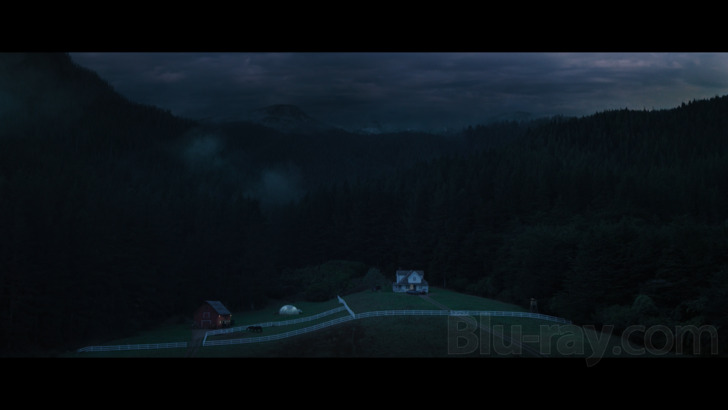
Wolf Man is a dark film. Even during daytime shots, the skies are typically overcast, and in the forest, due to the height and density of the tree cover, even if it were properly sunny, the shots in the wooded environment where a number of scenes are set would retain a certain amount of gloom. The same holds true once the family arrives at Blake's father's home. It's rooms are universally poorly and dimly lit, infected with a level of dirt and grime that are reflective of the space of a man living too long alone and away from the rest of society. As such, the darkness crafted by deep black levels is the most significant hurdle for the 1080p presentation to overcome. However, even in gloomy daytime scenes set in the woods, blacks can crush details in darker and shadowy elements. The same holds true in the dimly lit interiors of the home or the exterior nighttime shots as Blake, Charlotte, and Ginger fight for their lives. Given the fact that the film generally features a muted color palette, primaries don't often have opportunities to pop, but occasionally reds or yellows will spring up when given the chance. Fine detail is generally very high, with facial and costuming particulars being discernable. Most importantly, the high level of fine detail allows viewers to properly investigate and appreciate the numerous practical creature effects that are frequently on display during Blake's lengthy transformation and represent the one of the film's greatest strengths. The transfer is clean and devoid of banding, noise, and damage.
Wolf Man Blu-ray Movie, Audio Quality
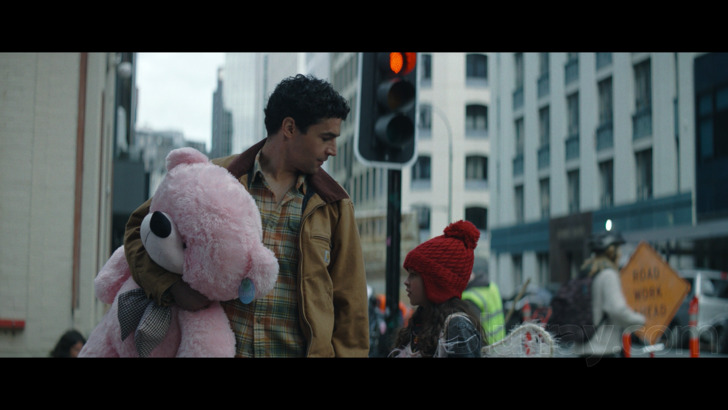
Not content to wait for the film to begin, Wolf Man 4K's English Dolby Atmos audio track swirls around the viewer with a confusing and undulating mix of sounds as the Universal logo is displayed on the screen. It's perplexing and unsettling, but is a preview of what's to come when Blake undergoes his unfortunate transformation. Sound separation is impressive here, and the bass rumbles with authority. The strange and disorienting cacophony continues through to the film's initial short scene of the insect fight (and grim though it may appear, it is clearly established in the special features that no insects were harmed during filming). Thunder then envelops the viewer as the title card is displayed informing the viewer of the context of the film's focus. It's an excellent sonic highlight and one that adds an ominous flare to the information given over what could otherwise be a mundane establishing shot. In the depths of the woods, surrounds spring to life with birds, insects, and other environmental sounds, convincingly placing viewers in the midst of the location. Sound effects are rendered with great accuracy, whether they be the flowing river, closing doors, the vehicle crash, or the booming and echoing gunshots. Dialogue is clean and centrally located. Directionality is spot-on. In my opinion, the other main sonic highlight of the film occurs whenever the viewer experiences how the world sounds from Blake's perspective after his transformation has begun. Exactly as foreshadowed when the studio logo played at the film's start, he viewer is encircled by layer upon layer of disorienting sounds which reflect his growing inability to audibly understand and experience the world in the manner to which he had been accustomed now that the wolfish elements have taken hold and are advancing. It's an intricate, spooky, moody, and well-designed track, potentially one of the most impressive I've heard in quite some time.
Wolf Man Blu-ray Movie, Special Features and Extras
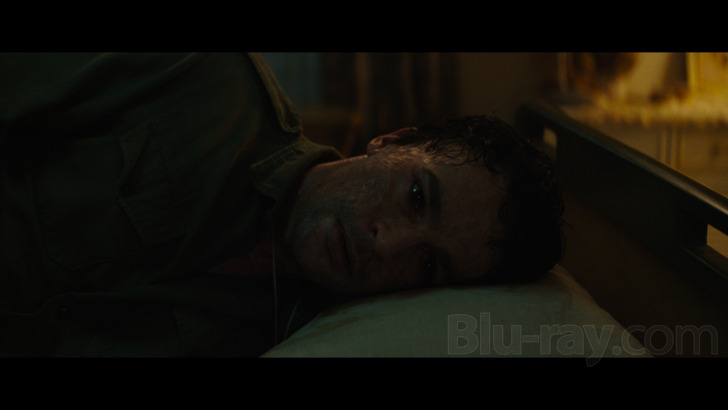
Liegh Whanell's Wolf Man is accompanied by a pleasant mix of on-disc supplemental material as detailed below.
- Unleashing a New Monster (8.07) - Director/Co-Writer Leigh Whanell and others discuss the writing process, reshaping the Wolf Man mythology into something more grounded in reality than the supernatural, cast members and their character choices, and locations used.
- Designing Wolf Man (8.54) - Director/Co-Writer Leigh Whanell, Special Make-Up Effects Designer Arjen Tuiten, and members of the effects share their thoughts on the practical effects used to create this new iteration of the Wolf Man. Whanell clearly wanted something very different from the traditional Wolf Man as portrayed by Lon Chaney, Jr.. The pair share their perspective of portraying this condition as being caused by an infection with slow but steady progression and is brought to life with the use of over 600 prosthetics.
- Hands on Horror (6.51) - Focused on stunt and action pieces, cast and crew cover the truck crash and the subsequent evacuation, the attempt to escape via the pickup truck, and the greenhouse sequence, all of which were accomplished on-location.
- Nightmares and Soundscapes (6.56) - Director of Photography Stefan Duscio and Director/Co-Writer Leigh Whanell share their inspiration for and execution of showing the world from Blake's (Christopher Abbot) perspective as his physical transformation progresses, both visually and audibly. Sound design also receives a fair amount of focus, as the tools and items used to craft sound effects are explored.
- Feature Commentary with Director/Co-Writer Leigh Whanell - Whanell shares a wealth of information, initially discussing what was done to make the New Zealand locations appear to be Oregon, and Wellington transform into San Francisco. Obviously working without prepared notes, he allows the on-screen action to prompt his comments which range from sharing his opinion that directors should do as much as they can to leverage practical effects, to his history with the cast and crew, and his filmmaking philosophies. He frequently pays particular attention to set elements, shooting locations, effects work, and the strength of the cast's performances. Whanell occasionally falls silent, but such moments do not last long, and his unique sense of humor never remains hidden for long.
Wolf Man Blu-ray Movie, Overall Score and Recommendation
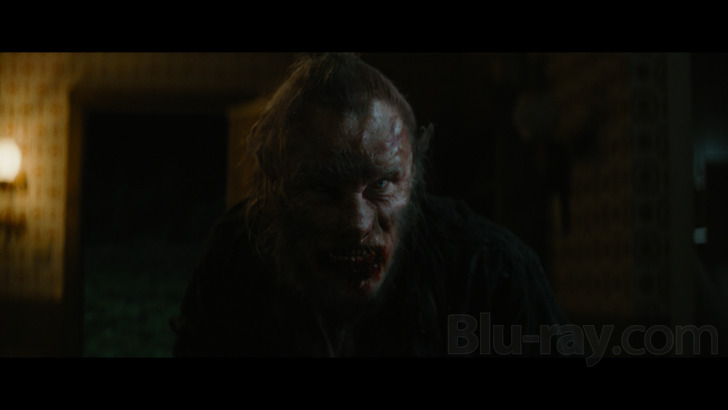
After a nail-biting and promising start, Liegh Whanell's Wolf Man takes an abrupt turn into the realms of body horror and zombie movie tropes that erode the film's initial promise. In an effort to differentiate this project from its 1941 progenitor, that film's direct sequels, and some genre standouts from the ensuing decades that it inspired such as An American Werewolf in London and The Howling. this film rejects the established rules regarding werewolves including their appearance, weaknesses, and origins. While it succeeds in those goals, in doing so it it fails to capture the spirit, character, and energy that epitomize the best werewolf films. Aside from the exemplary creature effects and sound design, the modifications to the central monster and the script leave the viewer more with a feeling of déjà vu instead of dread and impatience in the place of nervousness and wonder. Technical merits are strong, particularly the Dolby Atmos track, for those considering a purchase.
Other editions
Wolf Man: Other Editions


Similar titles
Similar titles you might also like

Final Destination: Bloodlines
2025

The Monkey 4K
2025

The Last Voyage of the Demeter
Collector's Edition
2023

Five Nights at Freddy's
Night Shift Edition
2023
Late Night with the Devil 4K
2023

The Strangers: Chapter 1
2024

Winnie the Pooh: Blood & Honey
Limited Edition
2023

X
2022

Pumpkinhead
Collector's Edition
1988

It: Chapter Two 4K
2019

Hellraiser III: Hell on Earth 4K
1992

Friday the 13th
Killer Cut
2009

Friday the 13th: The Final Chapter
1984

Friday the 13th: Part 3
1982

The Last House on the Left
2009

Heretic
2024

Friday the 13th: Part V - A New Beginning
Friday The 13th Collection Deluxe Edition Version
1985

Scary Stories to Tell in the Dark 4K
2019

Friday the 13th: Part VIII - Jason Takes Manhattan
Friday The 13th Collection Deluxe Edition Version
1989

Friday the 13th: Part VI - Jason Lives
Friday The 13th Collection Deluxe Edition Version
1986