Why We Fight Blu-ray Movie
HomeWhy We Fight Blu-ray Movie 
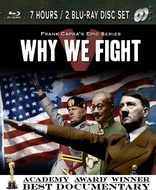
Set of 7 DocumentariesPeriscope Film | 1943-1945 | 7 Movies | 420 min | Not rated | Nov 09, 2013
Price
List price:Listed on Amazon marketplace

Movie rating
6.9 | / 10 |
Blu-ray rating
| Users |  | 0.0 |
| Reviewer |  | 3.5 |
| Overall | | 3.5 |
Overview
Why We Fight (1943-1945)
Director: Frank Capra| Documentary | 100% |
Specifications
Video
Video codec: MPEG-4 AVC
Video resolution: 1080p
Aspect ratio: 1.39:1
Original aspect ratio: 1.37:1
Audio
English: Dolby Digital Mono
Subtitles
English
Discs
50GB Blu-ray Disc
Two-disc set (2 BDs)
Playback
Region A (B, C untested)
Review
Rating summary
| Movie |  | 4.0 |
| Video |  | 3.0 |
| Audio |  | 2.5 |
| Extras | | 0.0 |
| Overall | | 3.5 |
Why We Fight Blu-ray Movie Review
Mr. Capra Goes to War.
Reviewed by Jeffrey Kauffman November 16, 2013Frank Capra will forever be associated with his homespun films like It's a Wonderful Life and Mr. Smith Goes to Washington, but like many successful professionals in the film industry, he forsook his comfortable Hollywood lifestyle to take part in America’s war efforts during World War II. Capra was old enough at the time that he had actually already fought in World War I, and his age actually precluded him from having to enlist for this new battle, but Capra, an émigré fiercely proud of his adopted land, knew there was only one morally acceptable course of action to be taken. Capra, like many other Hollywood stalwarts (James Stewart, William Wyler, et al), seemed to intrinsically understand that their privileged lifestyles didn’t jibe with the increasing threats everyday men and women were heroically facing as the war fires started to consume the entire globe. Much as with the case of William Wyler, the War Department realized that they had an unusually skilled ally to help them craft their undeniably propagandistic (some might even argue jingoistic) attempts to gin up public support for our entry into World War II, and to maintain that level of support as our nation’s fortunes waxed and waned over the ensuing several years. This was often framed as merely an “explanatory exercise”, but looking back on these films now from the vantage point of some seventy years, it’s obvious that the Americans had seen how other nations had used film to unite the masses (notably with the works of Leni Riefenstahl in Germany) and wanted to do something along the same lines for our country. Why We Fight’s very title reveals the context in which the films were at least initially released: the United States was coming out of a long era of so-called “neutrality”, where even President Roosevelt’s attempts to aid Britain with the Lend-Lease Act were met with some scathing derision. But Pearl Harbor changed everything, at least for most Americans (there were still some isolationists, but their arguments were outweighed by massive public outcries that it was time to fight back). The seven films which comprise Why We Fight are fascinating not only as historical documents but actually in terms of film theory itself. Capra was a master manipulator, as anyone who has felt that inexorable lump in the throat of It’s a Wonderful Life (no matter how many times it’s already been seen) can attest. Utilizing a nonstop array of montages, “historical reenactments” and even animated bridging sequences (evidently done by the Disney studios), Capra welds together a calculatedly effective stew of (to paraphrase a certain superhero) truth, justice and The American Way. Some modern day cynics may find at least parts of the films incredibly “cornball” by contemporary standards, but they are also a rather touching microcosmic display of an unforced and frankly unusual unity which swept over the United States as the horrors of World War II became an unavoidable reality in virtually everyone’s lives.
The seven films in this set are:
Prelude to War. There’s an absolutely fascinating moment early in Prelude to War that I personally couldn’t help but wonder if there was any way it could have made it through the gauntlet of present day sociopolitical punditry unscathed. The film is attempting to draw a clear distinction between our supposedly faith based nation and the “godless heathens” of other nations, but in quick order the film lists Judaism, Islam and then Christianity as the foundation stones for our moral superiority. How incredible. To think that Capra was forward thinking enough to include the three major religions and to not shy from expressing all three’s contributions to our moral understanding strikes me as really rather amazing. Again and again throughout the films, Capra (and the other directors) will return to religious texts to bolster their arguments that not only are we fighting an enemy, we’re actually fighting on the side of the angels and all that is right and true in the world. Capra repeatedly utilizes religious belief as the last bulwark against the invading hordes of Nazi and Fascist interlopers. In one iconic scene, a matte shot replaces part of a church’s stained glass window with a close-up of Adolf Hitler. The battle lines have been drawn, and Capra’s thesis seems to state that at least many of them emanate directly from the pulpit.
The Nazis Strike. This is a more overtly political outing, one which depicts German history, tracing Germany’s imperialistic ambitions back through several epochal historical events and placing Hitler’s then current ambitions in a more sweeping historical context. The Nazis Strike is an interesting historical document in terms of its seeming dismissal of the pact between Stalin and Hitler, something that no doubt needed to be dealt with since by the time the film was made, the Soviet Union had “switched sides” and become an Ally. The film is also curiously dismissive of Poland’s heroic efforts to fight off the Nazi incursion. But The Nazis Strike is almost viscerally ominous in its depiction of the burgeoning Nazi war machine and the threat that creates for both the United States and Britain.
Divide and Conquer. Capra aims his propaganda pulpit directly at Hitler’s hypocrisy in this film, showing how the Fuhrer’s repeated exhortations that he had no imperialistic ambitions with regard to several nations were consistently followed by invasions and subjugation. Time is given over to the “lesser” battles that defeated the more northern countries like Denmark and Norway, before the film traverses a bit eastward to deal with Belgium and France. Divide and Conquer actually does a fairly good job of tracing some of the historical animus between France and Germany, delving back into some of the recriminations that brought World War I to a somewhat unsettling close. The almost ridiculous reliance of the French on their supposedly impenetrable Maginot Line is also explored, but Capra does give Hitler a little backhanded credit for drawing attention away from his real strategy by creating diversionary skirmishes, which allowed the Germans to march into Paris (the film includes some of the iconic footage of the French reacting in tears and horror to the Nazi invasion).
The Battle of Britain. This is arguably one of the more forceful presentations of the series of documentaries, one which palpably portrays the desperation that swept over the free world with the fall of France and what seemed at the point the inevitable fall of Britain. This film is often rather interestingly psychological, detailing the differences between the “keep calm and carry on” British mindset and the supposedly more atavistic psyche of the Germans. The heroic efforts of the British—who were manifestly outnumbered—is detailed here, including some valuable lessons the British had learned by watching how the Germans had capitalized upon strategic mistakes made by other nations who had then fallen under Nazi domination. The film includes some stirring words from Winston Churchill which seem to sum up the indomitable British spirit.
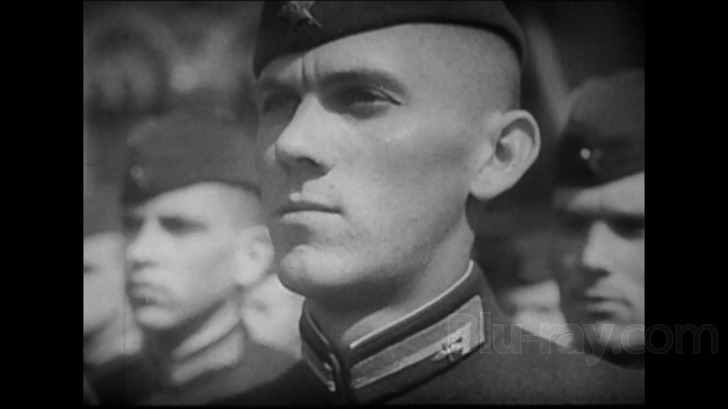
The Battle of Russia. Capra wasn’t above cribbing from the greats, and he does so in an interesting montage in The Battle of Russia which is culled, at least in part, from Sergei Eisenstein’s Alexander Nevsky. Russia’s seeming impenetrability is essayed over the course of several centuries, as if to imply that Hitler’s attempts to conquer the land were patently insane to begin with. This particular entry in the Why We Fight series has come under probably the most blistering attack for its blatantly propagandistic approach to the subject, completely sidelining the Soviet Union’s non-aggression pact with Germany as well as its own imperialistic efforts, making the Russians seem like unwitting victims rather than early coconspirators who found out that their “partner” wasn’t exactly a trustworthy ally. Still, the film has a certain emotional sway, especially when it concentrates on some of the everyday “common man” Soviets and the admittedly heroic efforts to withstand the battles of Stalingrad and Leningrad.
The Battle of China. This is one of the more interesting films in the set, if only because the aggression by Japan towards China is a strangely underreported aspect of World War II at times, at least with regard to Americans’ general knowledge of the conflict. This is one of the more disturbing entries in the series, filled with quite gruesome imagery detailing the atrocities suffered by the Chinese people at the hands of the Japanese. The almost unimaginable westward migration of huge hordes of Chinese is shown to good effect, but the film shies away from what was then the nascent conflict between the growing Communist movement and the republicans.
War Comes to America. This is undoubtedly the most jingoistic of the films, one which serves as a paean to “American exceptionalism”, in common day parlance. A rather rosy colored history of the United States is presented, one which tends to gloss over “minor” issues like slavery and the like, while highlighting the basic American tenets of democracy and freedom. One of the interesting things about this entry is its focus on what had been the United States’ long held position of neutrality or isolationism, a philosophy aided by the country’s “borders” of two immense oceans. The film builds up to a shattering climax showing the attack on Pearl Harbor, where it’s made clear that indeed war has arrived at America’s “shores”, if not directly at the territory of the (then) 48 contiguous states.
Why We Fight Blu-ray Movie, Video Quality
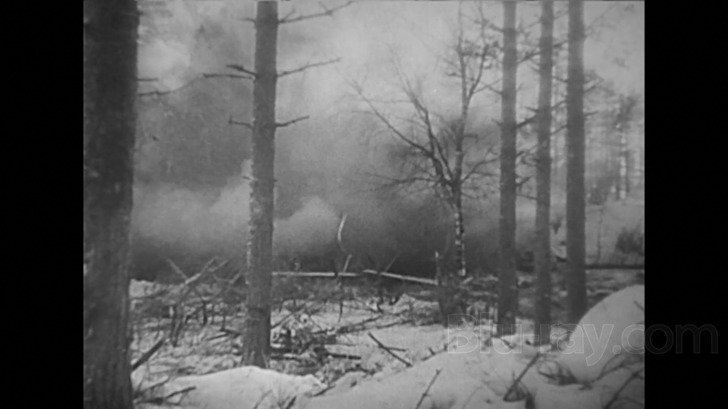
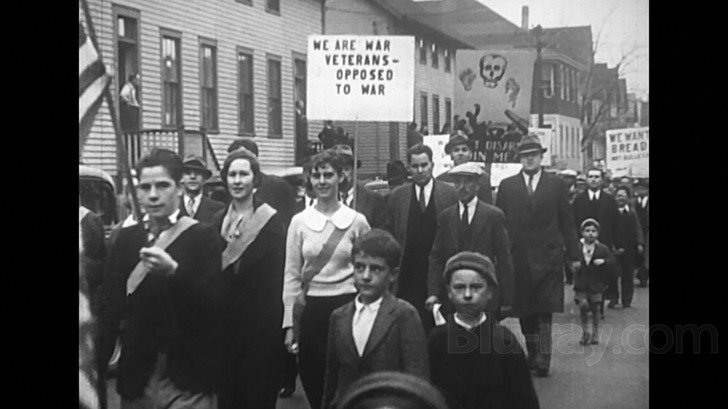
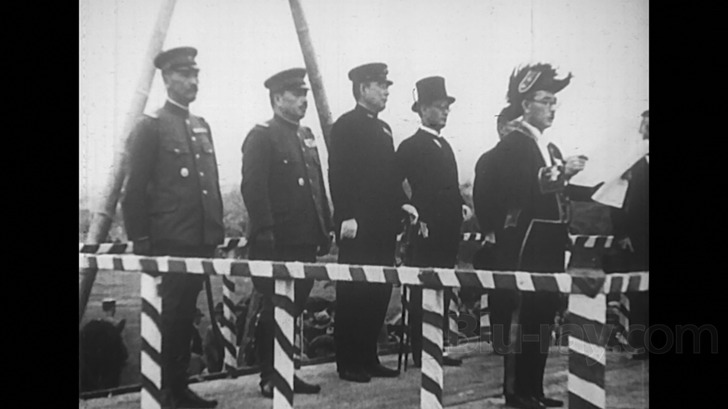
Why We Fight is presented on Blu-ray courtesy of Periscope Film with an AVC encoded 1080p transfer in 1.39:1 (some of the documentaries are slightly windowboxed as you will see in some of the screenshots accompanying this review). As some readers of this review will already know, Why We Fight lapsed into the public domain, and this release has been sourced from various elements which display a rather wide array of quality. As should probably be expected, there are fairly wide variances in contrast (compare screenshots 11 and 16 for good examples of the variance), image stability and damage when one surveys the set of seven documentaries as a whole. That said, Periscope has obviously done a bit of restoration here without completely wiping away grain structure (it does appear that some moderate noise reduction has been applied and there's little doubt digital sharpening has also been employed as halos are quite noticeable at times). None of these documentaries ever really rises to superlative high definition standards, but they are generally decent looking, with moments in all seven which actually look quite good (see the first screenshot for a reasonable example of some of the better looking footage). It appears that at least some of these may have come from interlaced source material, as there are occasional combing artifacts which can be spotted at times. Probably the best decision Periscope made with regard to these transfers was to not include their "bug" logo, which was a major detriment to some of their previous public domain releases. It must be hard for companies which deal in public domain material to take the time and money to restore and release them with no "watermarking" to make sure their efforts aren't copied, but it's to Periscope's credit that no bugs are included on this release.
Why We Fight Blu-ray Movie, Audio Quality
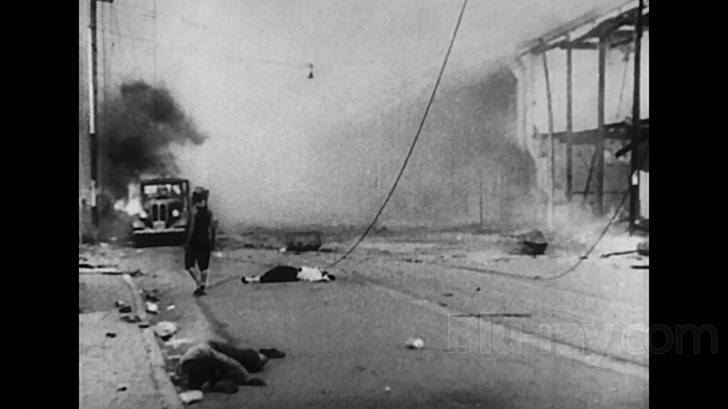
Audiophiles will probably be disappointed that Why We Fight contains only lossy Dolby Digital Mono mixes on all seven films, but really, there's not much here other than narration and sound effects, and with age related hiss, pop, and occasional drop outs, it's probably arguable how much could have been gained by lossless audio. There's nothing outright horrible in any of the films, but the audio has obviously not undergone any substantial restorative efforts.
Why We Fight Blu-ray Movie, Special Features and Extras
No supplements are offered on this two disc Blu-ray set.
Why We Fight Blu-ray Movie, Overall Score and Recommendation
Why We Fight is an absolutely fascinating set of documentaries that any historically minded viewer will want to watch. Capra fans may also be interested to see how the director repeatedly utilizes montage and subtly (and sometimes not so subtly) manipulative techniques to invigorate the audience's emotional investment in the epochal battles then sweeping the globe. This release is sourced from material with widely disparate quality, so a certain level of expectation needs to be moderated when approaching the look and sound of Why We Fight. That said, the release is certainly worthwhile, and comes Recommended.
Similar titles
Similar titles you might also like
(Still not reliable for this title)

Adventures on the New Frontier
1961

Rivers & Tides
2001

The Beales of Grey Gardens
included with "Grey Gardens" release
2006

Hearts of Darkness 4K
1991

Heartworn Highways
1976

Cameraperson
2016

Regrouping
included with "Born in Flames" release
1976

Nudist Life
10 Days in a Nudist Camp / Shangri-La Forbidden Fruit: The Golden Age of the Exploitation Picture, Vol. 14
1961

Streetwise
1984

Tiny: The Life of Erin Blackwell
2016

Color Adjustment
1992

Minding the Gap
2018

Vernon, Florida
1981

Pavements 4K
Slipcover in Original Pressing
2024

American Boy
included with "Scorsese Shorts" release
1978

My Generation
2017

F for Fake
1973

Paris Is Burning
1990

Tokyo-ga
included with "Late Spring" release
1985

On the Bowery
1956