Whoever Slew Auntie Roo? Blu-ray Movie
HomeWhoever Slew Auntie Roo? Blu-ray Movie 
Hammer Films | 1972 | 91 min | Rated BBFC: 15 | Aug 24, 2026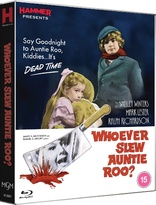

Movie rating
6.6 | / 10 |
Blu-ray rating
| Users |  | 0.0 |
| Reviewer |  | 4.5 |
| Overall | | 4.5 |
Overview
Whoever Slew Auntie Roo? (1972)
This is a retelling of the old tale of Hansel and Gretel, but set in England in the 1920's. To the children and staff at the orphanage, Auntie Roo is a kindly American widow who gives them a lavish Christmas party each year in her mansion, Forrest Grange. In reality, she is a severely disturbed woman, who keeps the mummified remains of her little daughter in a nursery in the attic. One Christmas, her eye falls upon a little girl who reminds her of her daughter and she imprisons her in her attic. Nobody believes her brother, Christopher, when he tells them what has happened, so he goes to rescue her...
Starring: Shelley Winters, Mark Lester (I), Chloe Franks, Ralph Richardson, Lionel JeffriesDirector: Curtis Harrington
| Horror | Uncertain |
| Thriller | Uncertain |
| Holiday | Uncertain |
| Drama | Uncertain |
Specifications
Video
Video codec: MPEG-4 AVC
Video resolution: 1080p
Aspect ratio: 1.37:1, 1.85:1
Original aspect ratio: 1.85:1
Audio
English: LPCM 2.0 Mono (48kHz, 24-bit)
Subtitles
English
Discs
Blu-ray Disc
Single disc (1 BD)
Packaging
Slipcover in original pressing
Playback
Region B (A, C untested)
Review
Rating summary
| Movie |  | 3.5 |
| Video | | 4.5 |
| Audio |  | 4.0 |
| Extras | | 4.0 |
| Overall | | 4.5 |
Whoever Slew Auntie Roo? Blu-ray Movie Review
"Isn't it a shame there isn't a way to make time stand still?"
Reviewed by Justin Dekker September 25, 2026One of the more interesting Hagsploitation films of the late 1960s and early 1970s, 'Whoever Slew Auntie Roo?' arrives on Blu-ray disc courtesy
of Hammer Films. The illustrious Shelley Winters stars as the titular character, alongside the young actors Mark Lester ('Oliver!', 'What the Peeper
Saw') and Chloe Franks ('The House the Dripped Blood', 'The Uncanny'), and the instantly recognizable Hugh Griffith ('Cry of the Banshee', 'The
Abominable Dr. Phibes). The release features a new restoration from the original film negatives, and is presented in its 1.85:1 theatrical aspect ratio
and the 1.37:1 as-filmed aspect ratio. On-disc supplements include a commentary track with Alexandra Heller-Nicholas, as well as a video essay. A
slipcover is also included, but a Digital Code is not. The Blu-ray disc is Region B "locked". Therefore, viewers who reside outside of that area will need
a region-free Blu-ray player to enjoy the film and other on-disc content.
An entertainer whose star has faded, Mrs. Forrest (AKA Auntie Roo, grandiosely portrayed by Shelley Winters) lives alone in a large home in the
country dubbed The Gingerbread House. Still secretly grieving over the loss of her daughter some years before, each Christmas she hosts
approximately ten lucky children from a local orphanage who share the holiday with her. Not well-behaved enough to be chosen for this honor,
Christopher and Katy crash the party and are soon discovered but are allowed to stay. When Katy can't be found after the festivities end, Christopher
returns to the house to search for her, and what he discovers causes him to think that Auntie Roo isn't the kindly woman she appears to be and that
both of their lives might be in danger.
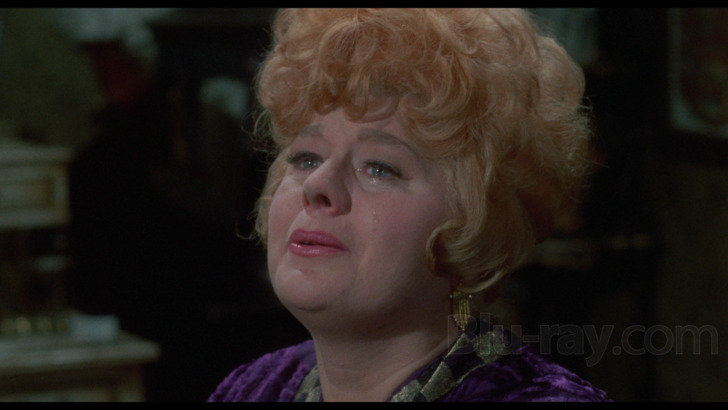
Director Curtis Harrington, though likely best remembered for his television work in the 1970s and '80s on series such as Logan's Run, Charlie's Angels, Dynasty, and The Colbys, also helmed a modest number of horror films prior to making the transition to the small screen. What's the Matter With Helen?, which starred both Debbie Reynolds and Shelley Winters directly preceded this film and is generally better regarded. 1977's Ruby would see the director dabble in supernatural Exorcist-inspired thrills that unfortunately didn't quite convincingly deliver on its potential. For me, though, it's his 1966 effort Queen of Blood for which I best remember Harrington. Positing that by the 1990s humans would be more routinely traveling in space, with a manned trip to Mars not at all being out of the question (we're just a few decades behind), the film starred Basil Rathbone, Dennis Hopper and genre standout John Saxon. Embarking on what they believe to be, in Star Trek terminology, a first contact mission, they instead find themselves confronted with a vampire from outer space played to perfection by Florence Marly.
While the action in Whoever Slew Auntie Roo? is much more down-to-earth and has nothing to do with the supernatural (aside from a medium who's clearly a boozy flim-flam man exploiting her grief), there is still something of of the fantastic in the story, which is distilled from the classic fairy tale Hansel and Gretel. While that original story had clearly drawn lines of good and evil, Whoever Slew Auntie Roo? does its level best not to trade in such absolutes. Unlike the witch, Winters' Auntie Roo is alone and in mourning for her long-dead little girl. After little Katharine died due to a tragic accident in the home, Auntie Roo has been somewhat stuck in time. Some of the ways in which this is made manifest in the film are mundane: the staff has dwindled yet she remains, rooms have been left unchanged since that night, and as she seeks to entertain her young holiday guests, its routines and photos from her time as a star that she leverages. Other elements are far more sinister though, such as the initial reveal in the film's first few minutes, and her obvious film-long desire to use the orphaned Katy as a direct replacement for her lost child. While kidnapping the young girl, impeding a police investigation, and sequestering her away in a secret room in the attic may seem extreme, to Auntie Roo's grief-stricken mind they seem a reasonable solution in an England when legal adoption may not yet have been possible for a potential parent from beyond its borders.
If Auntie Roo isn't initially viewed as a threat, certain elements from her home certainly provide an accumulating sense of dread. The subject of the initial reveal is revisited several times throughout the film, and each time sees Winters' Roo become a bit more unstable. The physicality of the house itself also provides a feeling of impending doom, from its oppressive facade to its rooms where time stands still, and from hidden rooms and secret passages to its colloquial name with its associated grim meaning. The trappings of her previous career as an entertainer are also rather spooky when encountered outside of their normal stage context an instead in an overcrowded room of one of the outbuildings. Here the fantastic becomes threatening after a streetwise and overconfident Christopher almost beheads his sister with what he believes to be a trick "head-chopper" - his word for a guillotine. Their surprising adventure ends when a masked figure, who on stage would have elicited laughs and cheers, startles them and earns terrified shrieks instead. The room in which Katy is held also exudes a dark and foreboding air; the small space is filled with old toys which transport her back to the time when Roo's daughter was alive. As her replacement, it seems the intent might be to keep her there as a child forever.
As the film progresses, it's Lester's Christopher who defines the story's elements of good and evil through his recurring references to Hansel and Gretel. Here, they are the children lured into the Gingerbread House through its promise of warmth, plenty, and good cheer. Therefore, it is Auntie Roo who must, in some way, be out to harm the children, and her actions which seem to come from a place of generosity and kindness must merely be the trap's bait, lulling her young visitors into a false sense of security. Given the fact that he is an innocent, a young person cast aside by society, and the source of his information is from something child-like, Harrington's film easily manipulates the viewer into believing Christopher. We believe that Auntie Roo is determined to fatten them up and eat them because that is what Christopher is convinced will happen. And Roo's suspicious and illegal behavior notwithstanding, we've really only his word for it.
It's in this ambiguity where the film exhibits its distinctiveness and separates itself from other films where a series of murders are carried out by a psychologically haunted and unstable person. As demonstrated partially through flashbacks, Auntie Roo's grief and pain are quite real - it's arguably the characteristic and the event that most singularly defines her. She no longer has her career to lean on and see her through her pain, as is made clear when one of the young attendees of her holiday event spies an old photo from Roo's performing days. The once grand entertainer of Paris relays the image is from "100 years ago", and that she gave it all up when she married. The world has moved on without her, and in her remote house, she's both physically and symbolically isolated. There is no child to give her hope for the future nor a sense of immortality through them, just as there is no one from her past with whom to revisit and relive her glory days. She has only the dreary present. And while her grief may have driven her to kidnapping, which is undeniably and clearly criminal, there is a wide gulf between that act and not only murder but also cannibalism.
But those heinous acts are precisely what young Christopher predicts, using nothing but his remembrances of Hansel and Gretel as his scrying tool. The film cleverly establishes that the young boy is not exactly well-behaved, and may be prone to fabricating and telling tall tales, with a woman from the orphanage classifying him as "and inveterate liar". We certainly observe that the young man is clever and experienced not only in stowing away but also in breaking out of and into homes. We're also given an opportunity to watch him steal what he believes to be valuable jewels from Auntie Roo so that he and his sister can eventually buy a home of their own and remain together forever. Sneaky and conniving, Christopher is not to be trifled with, and he has no compunction about imprisoning Auntie Roo and setting the house ablaze when the youngsters could merely have left her confined and escaped. As the pair are transported away from what remains of the fire-ravaged house, the knowing smile he flashes his sister is chilling. So who should we believe? Who is the real villain here? As it stands, the film only has one clearly defined and duly witnessed murder, and its perpetrator wasn't Auntie Roo.
Whoever Slew Auntie Roo? Blu-ray Movie, Video Quality
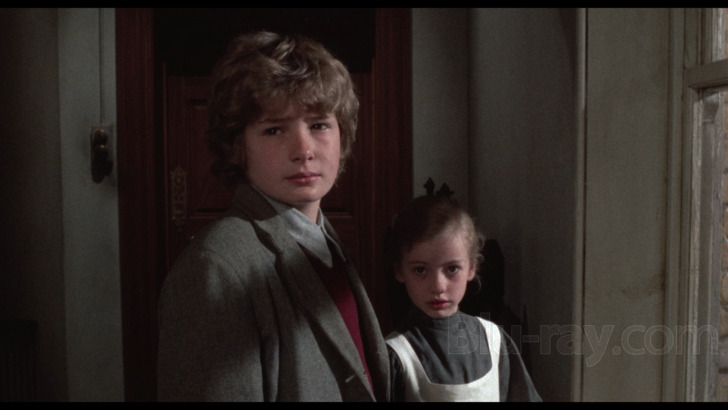
As stated in the enclosed notes, the original 35mm negative was retrieved from MGM, scanned at 4K resolution and restored at 2K resolution. After removing and resolving the customary dirt and minor damage, the most significant issue with which to contend was color instability/fluctuations that gave the film a flickering appearance, one that is no doubt familiar to those who frequently watch older un-restored films. The finished product on display here is quite impressive, with an image that exhibits none of the speckling or scratches seen on the Kino release from 2016. Colors are generally well-saturated and stable, with bold holiday reds and rich greens around every corner. Fine detail is high, and viewers are able to not only appreciate Winters' elaborate hairdo, but also her intricate costumes, the ornamentation and nick-nacks around the home, and the wear and age of certain elements within it - such as the dumbwaiter and the buttons used to open secret doors. Woods are warm and deep in the more formal upstairs but are no less appealing in the kitchen where some of the most important action of the film transpires. Skin tones are generally healthy and realistic. In some of the brief exterior shots, however, colors can appear slightly washed-out and detail can soften a bit. It's likely a function of the the film's production and not a defect of the transfer. One instance of judder was also observed near the seventeen-minute mark as the carloads of orphans are arriving at the house for the Christmas party, but it is very brief, lasting only a few seconds. Fine grain is present and resolves naturally. It's a very solid transfer.
Whoever Slew Auntie Roo? Blu-ray Movie, Audio Quality
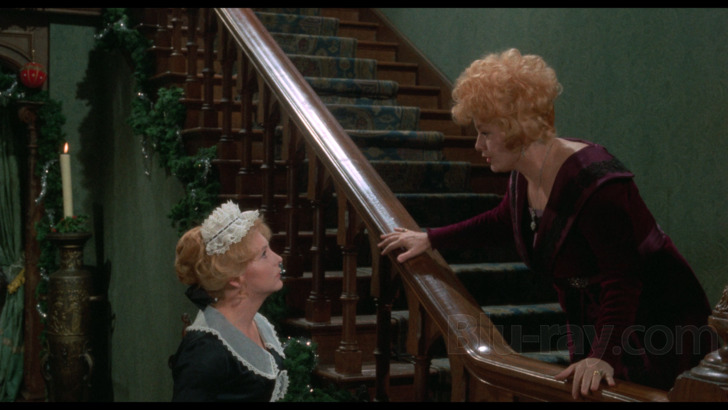
There may be an array of presents under Auntie Roo's tree to delight the young girls and boys, but there is only one audio option included with the film. It's an LPCM 2.0 Mono track that handles what the film asks of it with ease. Dialogue is clean and clear and is intelligible whether its a whispered utterance or a frantic scream. Voices are distinct in crowded scenes as well. Very mild sibilance is evident on occasion, but it's never overly distracting. The film's score is handled well and presents with a vintage quality, with strings and horns being precise. Mundane contemporary sound effects are appealing, whether they be sputtering car engines, closing doors, or hurried footsteps. Neither flashy nor fancy, it's a well-balanced and era-appropriate track, and is an agreeable companion for the film.
Whoever Slew Auntie Roo? Blu-ray Movie, Special Features and Extras
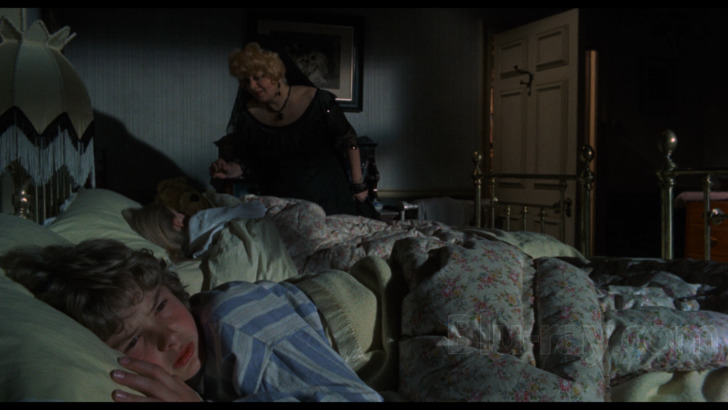
Hammer's Whoever Slew Auntie Roo? is outfitted with a pleasant assortment of on-disc extras, as below.
- 2026 Commentary with Alexandra Heller-Nicholas - The author professes her appreciation for Hagsploitation films, and her love of this term over all others for the genre. Heller-Nicholas goes on to state that she finds films from this era, the mid-'60s through the mid-'70s, to be particularly though-provoking. She traces the history of the genre over the course of the track, and spots their echoes in the films of today. She even quotes from several works that fans of the genre will want tock down for further reading on the subject. Clearly working from prepared notes but with obvious extemporaneous moments, it's a deeply informative and enjoyable track that is a must for fans.
- Theatrical Trailer (2.12)
- Textless Theatrical Trailer (2.12)
- Radio Spot (3.03) - The spot plays as posters and lobby cards are displayed.
- Grief as Horror: The Tragic Heart of 'Whoever Slew Auntie Roo?' (19.02) - This 2026 Video Essay by Heather Wixson argues for a new appreciation of the film and the layered character brought to life by Shelley Winters.
- Image Gallery (2.28) - Posters, lobby cards, stills, and other material auto advance in silence.
Whoever Slew Auntie Roo? Blu-ray Movie, Overall Score and Recommendation
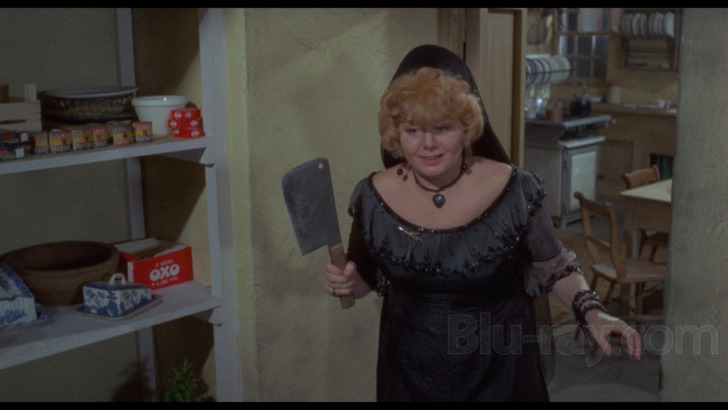
While young actors Mark Lester and Chloe Franks perform admirably in their roles, as does the rest of the cast, the film's ultimate success hangs on Shelley Winters' multi-faceted performance. Throughout the film, she evokes sympathy and generates fear in equal measure. While the film positions her once-grand and adored character as its villain due to the Hansel and Gretel infused elements, her obvious heartbreak coupled with Christopher's impishness crafts a certain amount of ambiguity that calls for viewers to draw their own conclusions and suggests the need for repeat viewings to either conform or deny them. While never truly terrifying in the traditional sense, its atmosphere of dread and impending doom is palpable as we wait to see who, if anyone will emerge from the Gingerbread House once the holidays are over. For fans of the cast or the Hagsploitation genre, Whoever Slew Auntie Roo? is strongly recommended.
Similar titles
Similar titles you might also like
(Still not reliable for this title)

The Awakening
Rental Copy
2011

The Other
Eureka Classics
1972

The Haunting in Connecticut 2: Ghosts of Georgia
2013

Dead of Winter
Slasher Classics Collection #8
1987

Satan's Slave
Evil Heritage / Indicator Series
1976

Puppet Master 2
1990

The Haunting of Hill House
Extended Director's Cut
2018

The Turning
2020

The Boy
2016

Stonehearst Asylum
Eliza Graves
2014

The Baby
1973

Curse of Chucky
2013

Schizo
1976

The Psychic
Limited Numbered Edition | Sette note in nero
1977

The Ghost 4K
Lo spettro 4K | Raro Video | Limited Edition
1963

The Phantom of the Opera
Indicator Series
1962

The Raven
Masters of Cinema
1935

Intruders
2011

Halloween V: The Revenge of Michael Myers
Halloween 5
1989

The Reflecting Skin
1990