Where Love Has Gone Blu-ray Movie
HomeWhere Love Has Gone Blu-ray Movie 
Olive Films | 1964 | 111 min | Unrated | Feb 28, 2012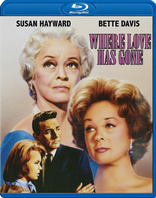

Movie rating
6.5 | / 10 |
Blu-ray rating
| Users |  | 3.0 |
| Reviewer |  | 2.5 |
| Overall | | 2.5 |
Overview
Where Love Has Gone (1964)
After his teenage daughter Danny is arrested for the murder of his ex-wife's current lover, Luke Miller recalls his marriage to Valerie Hayden and the subsequent events which led to the tragedy. The lurid story seems to have been suggested by the real-life Lana Turner/Johnny Stompanato/Cheryl Crane murder scandal of six years earlier when Lana's daughter Cheryl stabbed her mother's boyfriend (Stompanato) to death in the bedroom of Lana's Beverly Hills home.
Starring: Susan Hayward, Bette Davis, Mike Connors, Jane Greer, DeForest KelleyDirector: Edward Dmytryk
| Drama | 100% |
Specifications
Video
Video codec: MPEG-4 AVC
Video resolution: 1080p
Aspect ratio: 2.35:1
Original aspect ratio: 2.35:1
Audio
English: DTS-HD Master Audio Mono
Subtitles
None
Discs
25GB Blu-ray Disc
Single disc (1 BD)
Playback
Region A, B (C untested)
Review
Rating summary
| Movie |  | 2.0 |
| Video | | 3.0 |
| Audio | | 3.0 |
| Extras |  | 0.0 |
| Overall | | 2.5 |
Where Love Has Gone Blu-ray Movie Review
Wherever it's gone, let's hope it stays there.
Reviewed by Jeffrey Kauffman March 3, 2012The sensational story of Lana Turner’s lover, gangster bodyguard Johnny Stompanato, being stabbed to death by Turner’s daughter Cheryl Crane made international headlines in 1958 and seemed to almost be a subplot taken straight out of Lana’s then recent box office hit Peyton Place. Crane argued she was defending her mother from a vicious attack, and while some sources dispute this version of events, Crane was cleared of murder charges, though neither Turner’s nor Crane’s life was ever quite the same again. Though he wouldn’t confirm or deny it, it seems obvious that novelist Harold Robbins based a lot of his potboiler Where Love Has Gone on the Crane-Stompanato killing, changing the names and situations to “protect the innocent”, as that old Dragnet narration used to intone. Producer Joseph E. Levine had a soft spot for this kind of over the top melodrama, and with screenwriter John Michael Hayes and director Edward Dmytryk had just released The Carpetbaggers, a huge hit also based on a novel by Harold Robbins. The three reteamed for Where Love Has Gone, a film that seemed to be tailor made for the histrionics of star Susan Hayward. Also along for the ride were Bette Davis, Mike Connors and a young and not especially captivating Joey Heatherton. Like a lot of mid-sixties melodramas, Where Love Has Gone virtually drowns in glamour and risible dialogue, somewhat akin to (ironically) Lana Turner’s outings like Madame X. The film also seems oddly reminiscent at times of Mildred Pierce, with the rivalry between a mother and daughter playing out in flashback after a devastating murder has been committed.
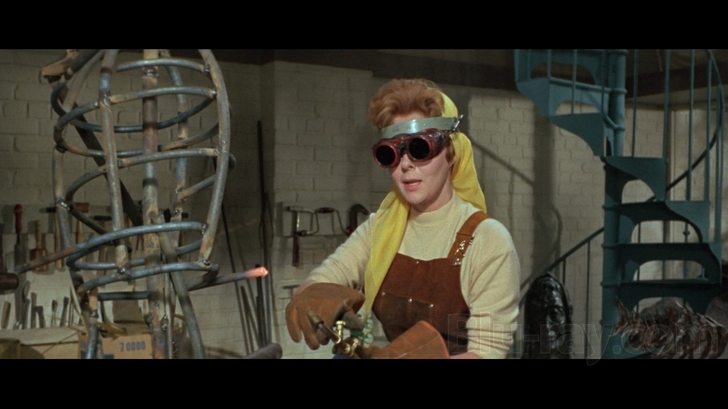
"Edith Head designed this outfit, don't ya know?"
Hayward portrays wealthy sculptress Valerie Hayden, a divorcée who starts the film out with a husky scream or two as her frisky daughter Danny (Joey Heatherton) stabs a man to death in their San Francisco apartment. We segue quickly to Arizona, where Valerie’s ex-husband (and Danny’s absentee father), Luke Miller (Mike Connors, here billed as Michael) is informed about the killing. He returns quickly to San Francisco, where he’s met at the airport by the Hayden family’s imperious attorney, Ellis (George Macready), who informs Luke that the only reason he’s been summoned is as “an actor” whose war hero record will help offset the bad publicity generated by Danny’s little peccadillo. We then get a homey little moment chez Hayden, where Valerie’s harridan mother (Bette Davis) barks out orders and informs the family how it’s going to handle Danny’s arrest and impending trial. That, of course, leads to the central flashback portion of the film, replete with wavy, waterlogged imagery indicating we’re traveling backward through the mists of time.
Those mists part to reveal a supposed World War II era timeframe, though of course none of the principals look one day younger and Hayward still sports her ultrachic sixties bouffant. (Even funnier, watch the rear projection in the scene where Connors and Hayward drive away from the Hayden mansion and note the many fifties and sixties era cars in the background.) Luke is a war hero, a Medal of Honor winner in fact, and he’s come to San Francisco for a parade in his honor, but he soon meets Valerie and her mother at an art show showcasing her work. Mrs. Hayden sets her sights on Luke as a suitable husband for her headstrong daughter, and in fact makes Luke a deal: marry Valerie and you can have a Vice Presidency in the Hayden corporate family. Luke does not respond well.
We then lurch through a turgid series of melodramatic events which (of course) see Luke and Valerie marrying, with Luke attempting to get out from underneath the domineering thumb of Mrs. Hayden, never very successfully. Valerie escapes to a series of affairs and Luke escapes to the bottle. Even the birth of Danny can’t prevent the divorce that seems somehow fated for these two ill matched personalities. Through it all, scenarist John Michael Hayes (who ironically wrote the screenplay for Turner's Peyton Place) crafts one incredibly awful scene after another, with dialogue that simply must be heard to be believed (and sometimes not even then). My own personal favorite, and indeed my new all time favorite innuendo: Macready, playing Ellis the lawyer, is talking about Valerie’s murdered lover, and says, “He wasn’t very good at double entry bookkeeping. He was much better at double entry housekeeping.” How that ever got past the censors is anyone’s guess.
This sort of over the top hoo-hah (technical term) is like catnip for a certain class of film lovers, and it can’t be denied that the glossily hyperbolic emotions on display throughout Where Love Has Gone offer at the very least some comedy relief. But several of the performances are simply off. While Hayward and Davis have their ice bitch portrayals down pat, Mike Connors seems rather ill at ease throughout the film and Joey Heatherton is just laughably bad. Bleating out raspy-voiced lines, like repeated entreaties of “Daddy! Daddy!” every time she sees Luke, it becomes clear why she never had much of a big screen career. Her gaze is often that of a confused child, not quite sure how she ended up on a soundstage surrounded by at least a couple of motion picture icons.
Edward Dmytryk directs with pedestrian competence, filling his widescreen vistas with lots of nice shots of San Francisco, as well as Edith Head’s appealing costumes. Walter Scharf’s music plays upon the Oscar nominated theme song by icons Jimmy Van Heusen and Sammy Cahn (interestingly, Cahn and Van Heusen had two Best Song nominations that year, the other being “My Kind of Town,” the Sinatra standard from Robin and the 7 Hoods). The film is big, glossy and about as deep as the two dimensional screen it was first projected on. If it’s a case study in being laughed at rather than laughed with, Where Love Has Gone is the kind of high falutin’ trash that harkens back to a time of big hair and small cinematic ambitions.
Where Love Has Gone Blu-ray Movie, Video Quality

Where Love Has Gone is presented on Blu-ray courtesy of Olive Films with an AVC encoded 1080p transfer in 2.35:1. As with the recent Olive Films release of Nijinsky, Where Love Has Gone is a decided step down from the quality from the recent Jerry Lewis releases. That seems a bit odd considering that Where Love Has Gone is considerably newer than the Lewis films, but it is perhaps not quite so odd as Nijinsky, which came out in 1980 (even putting aside the fact that the Lewis films were VistaVision). One way or the other, this is a soft and murky looking high definition presentation that also suffers from overly peach colored flesh tones and a lack of fine detail in all but close-ups. The elements utilized here do suffer from quite a bit of damage, including lots of white flecks and specks and even the occasional hair caught in the gate (see screenshot 16 for a good example). Colors seem just slightly faded and the overall look of this transfer is kind of bland.
Where Love Has Gone Blu-ray Movie, Audio Quality
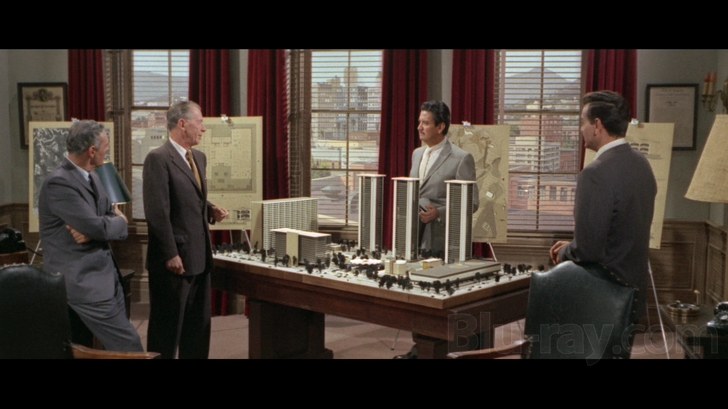
Where Love Has Gone features a lossless DTS-HD Master Audio 1.0 mono mix that suffices well enough, even if it provides little depth or nuance. Dialogue sounds just fine throughout this presentation, and Walter Scharf's score also is reproduced with some perhaps surprising full-bodied results. Jack Jones' warbling of the theme song over the opening and closing credits also sounds just fine. The track really doesn't display much boxiness and also shows few signs of age related wear or tear. While it's not a showstopper in any way, this gets the job done without any problems, albeit within a very narrow and conservative soundfield.
Where Love Has Gone Blu-ray Movie, Special Features and Extras
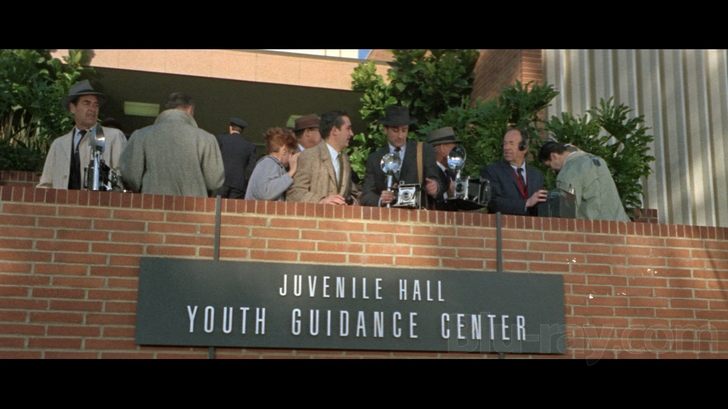
Once again as is typical with these Olive Films releases, no supplements of any kind are included.
Where Love Has Gone Blu-ray Movie, Overall Score and Recommendation
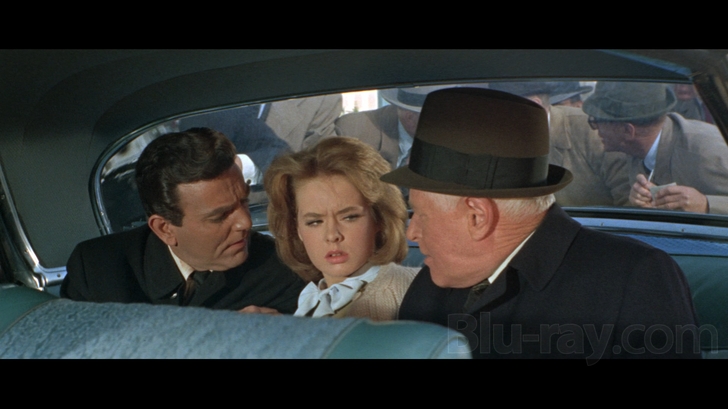
Bad film lovers will probably find enough badness here to revel in, but those expecting anything other than pulpy trash shellacked with a fine veneer of Hollywood gloss had better keep looking. Hayward and Davis (who reportedly couldn't stand each other in private life) spar with appropriate élan, but the rest of the film is surprisingly lifeless, with little of the manic hyperbole that usually makes films like this such guilty pleasures. Still, this is a handsomely mounted film, in that studio bound mid-sixties sort of way, and it's populated by a great cast of supporting actors (including Jane Greer and DeForest Kelley), which adds somewhat to its camp allure. The transfer here is problematic, one of the uglier looking high definition presentations we've seen from Olive (which is at the mercy of the masters provided to them by Paramount).
Similar titles
Similar titles you might also like
(Still not reliable for this title)

Hobson's Choice
1954

Freeheld
2015

Come Back, Little Sheba
1952

Woman in Gold
2015

North Country
2005
The Rainmaker
1997

Two for the Seesaw
1962

Moonlight Mile
2002

The Diary of a Teenage Girl
2015

The Story of Temple Drake
1933

Far from the Madding Crowd
2015

Black or White
2014

Manhattan Melodrama
Warner Archive Collection
1934

The Dressmaker
2015

Two Lovers
2008

The Magdalene Sisters
2002

Laggies
2014

Albert Nobbs
2011
Pinky
1949

Clean and Sober
Warner Archive Collection
1988