We Can't Go Home Again / Don't Expect Too Much Blu-ray Movie
HomeWe Can't Go Home Again / Don't Expect Too Much Blu-ray Movie 
Oscilloscope Pictures | 1973-2011 | 2 Movies | 170 min | Not rated | Nov 13, 2012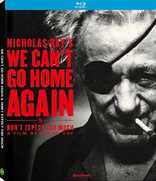
Price
List price:Listed on Amazon marketplace

Movie rating
Movie has not been rated yetBlu-ray rating
| Users |  | 0.0 |
| Reviewer |  | 3.0 |
| Overall | | 3.0 |
Overview
We Can't Go Home Again / Don't Expect Too Much (1973-2011)
Restored and reconstructed from its 1973 version, legendary director Nicholas Ray's We Can't Go Home Again embodies the director's practice of filmmaking as a "communal way of life." Made with his college students in upstate New York, the film features Ray as mentor, friend, and reference point to his students and their stories of love, sex, rebellion, and lost innocence.
| Drama | 100% |
| Documentary | 52% |
| Other | 3% |
Specifications
Video
Video codec: MPEG-4 AVC
Video resolution: 1080p
Aspect ratio: 1.78:1, 1.33:1
Original aspect ratio: 1.78:1, 1.33:1
Audio
English: DTS-HD Master Audio 2.0
Only the opening Oscilloscope logo is in 5.1, the films themselves are in 2.0 stereo
Subtitles
English
Discs
50GB Blu-ray Disc
Single disc (1 BD)
Playback
Region free
Review
Rating summary
| Movie |  | 2.5 |
| Video |  | 3.5 |
| Audio | | 3.5 |
| Extras | | 3.0 |
| Overall | | 3.0 |
We Can't Go Home Again / Don't Expect Too Much Blu-ray Movie Review
"Don't expect too much. Don't expect too much from a teacher."
Reviewed by Casey Broadwater November 20, 2012And don't expect too much from this film. We Can't Go Home Again is best regarded as a cinematic curiosity, the final—and unfinished—work
of the great Nicholas Ray, the boundary-pushing director of Rebel Without a Cause, Johnny Guitar, Bigger Than Life, and a
whole host of increasingly enigmatic and oversized projects. Mentored by Elia Kazan and Howard Hughes in his early Hollywood days, Ray became one
of the most revered American filmmakers of the post-war era, known for his architectural Cinemascope mise-en-scene, his strategic use of color, and
for telling raw-for-the-time stories about disaffected loners, pill poppers, and societal outsiders. He was especially championed by the Nouvelle Vague,
with a young Jean-Luc Godard proclaiming, "Cinema is Nicholas Ray."
But Ray's own story is ultimately a tragic one, marked by many of the same issues that his fictional characters faced. By the mid-1960s, Ray was
basically forced out of Hollywood for instability—brought on by prolific drinking, drug use, and gambling—after he collapsed on the set of his last
mainstream production, 55 Days in Peking. Eight years later, and nearly broke, Ray—vouched for by his pal Dennis Hopper—was offered a
teaching job in the nascent film/television department at Harpur College in upstate New York. Between 1971 and 1973, he worked with his students
on We Can't Go Home Again, a mess of an experiment in simultaneous narrative and overlapping images. The film debuted unofficially at
Cannes in '73 to a "generally baffled" audience, and Ray tinkered with it until his death by lung cancer in '79. It's been rarely seen since, and many
would argue for good reason. Nevertheless, Ray's widow, Susan Ray, recently commissioned a restoration of the film and produced her own
making-of documentary—yes, Don't Expect Too Much—both of which played at the 2011 Venice Film Festival and are now available on Blu-ray
courtesy of Oscilloscope Pictures.
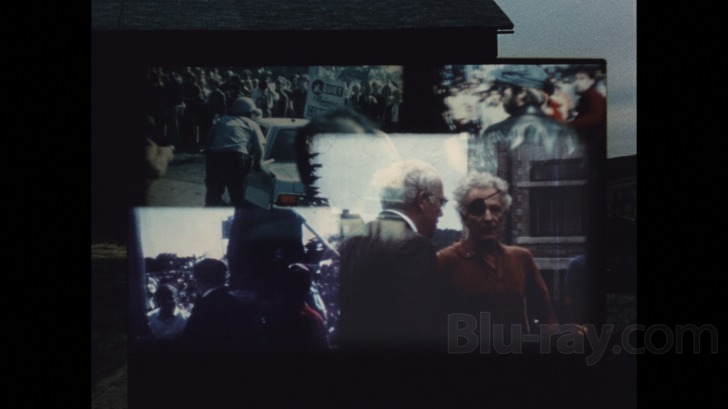
We Can't Go Home Again is a loose entanglement of fact and fiction, as it nominally follows Ray—as himself or "playing" himself—arriving at Harpur College, getting involved in his students' lives, and teaching them about cinema in a ragged, experiential way. As a young man in the 1930s, invited to participate in Frank Lloyd Wright's Taliesin Fellowship, Ray and other apprentices had lived and studied with the architect in his Arizona home. Ray would apply this same approach to his work at Harpur; he moved into a group house with several students, and they basically spent all of their time together. With his wild white hair, red suit, and iconic eye-patch, Ray emerges in the film as a mad cross between a professor and a father figure, a cult leader and a deranged mentor, emotionally manipulating his young proteges, the workers in his cinematic, Andy Warhol-style factory. We Can't Go Home Again is essentially a collectively-made meta movie then—a film about communal filmmaking—and it swerves between true-to-life documentarian fervor and the badly scripted dramatic vignettes.
Before we can get at the content, though, it's necessary to address the film's form. Inspired by Stan Brakhage and other contemporary avant- garde filmmakers, Ray was out to toy with preconceptions about image and narrative, and this resulted in an unusual split screen aesthetic. Ray had his students shoot on several mediums—8mm, 16mm, 35mm, and even color-warped video—and then used as many as six projectors simultaneously to display slightly overlapped frames on a single matte screen. The effect is something like an extension of Eisenstein's theory of montage—where a synthesis in meaning is created by the juxtaposition of unrelated images—but instead of cutting between shots, Ray shows them all at once. It's a lot to visually take in, and sustained across ninety minutes the style seems far more cluttered than evocative, partially because the contrapuntal pictures and narrative lines rarely form any interesting associations, but mostly because the footage—singularly or taken together—is amateurish and dull. This is, after all, just an assemblage of student films and what we might call "behind-the-scenes" material. Ray curates it, and even "stars" in it, but he had trouble—until his dying day—making something coherently meaningful of it.
That's not to say there isn't a unifying theme here. Ray is unusually prescient about what Tom Wolfe would eventually describe as the "Me Decade," the turn of 1970s youth—cynical about the failed optimism of the '60s—away from activism and social involvement and towards self-reflection and passivity. Most of the students-cum-characters in We Can't Go Home Again are dealing with issues of identity and image. A formerly obese student shows Ray his before-and-after weight loss photos, but confesses that he still thinks of himself as a fat person. Two lovers embrace, each wearing a face-obscuring Pierrot clown mask. One girl, Leslie, relates to Ray a story about her dabbling in prostitution, and later pleasures herself while watching footage of herself, the ultimate in masturbatorial self-obsession. And in the film's most powerful scene, the introspective Tom, teased for his hippie beard, chops it off with an enormous pair of shears, sobbing uncontrollably while Ray tenderly goads him on. There are numerous other mini-narratives —a stolen cash box, a dartboard near-mishap, Ray stringing up a noose in a barn—but they flash in and out of existence so quickly that they never make much of an impact. While not without its brief moments of cultural insight, the film is an incomplete experiment that ultimately doesn't produce very satisfying results.
By its very title, Don't Expect Too Much, Susan Ray's one hour and thirteen minute documentary about the making of We Can't Go Home Again, advises us to temper our expectations. The retrospective piece features interviews with numerous students from the film, who almost universally express a mixture of fondness and unease over the project, explaining how their initial enthusiasm—they all thought Ray would be their golden ticket to Hollywood—gave way to tedium and wariness, especially once their teacher's drink-and-drug problems resurfaced. Susan Ray doesn't whitewash her late husband's behavior—which one student says "bordered on abusive"—instead, she paints a loving but realistically unflattering portrait of the artist as a delusional has-been whose eccentricities and personal issues overshadowed the creative output of his final years. An interviewed film critic says that You Can't Go Home Again "captures the fleeting breath of a utopian experience," but we might better listen to the students who lived through that failed utopia, calling it "the biggest mess I've ever seen" and "a vast disappointment in the end."
We Can't Go Home Again / Don't Expect Too Much Blu-ray Movie, Video Quality
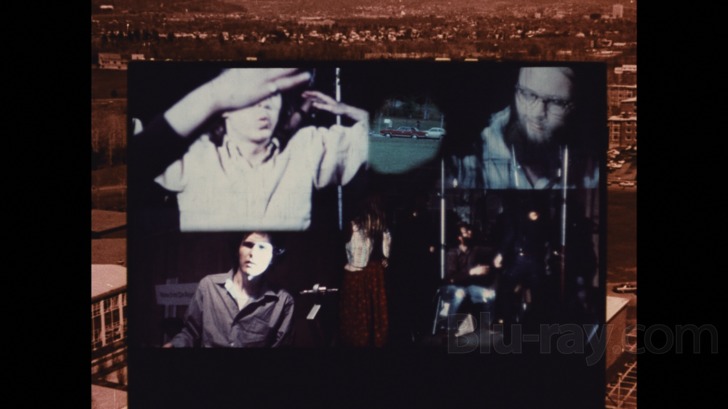
There's no use critiquing We Can't Go Home Again based on any of the usual perceived standards of "picture quality." The film is what it is, and
the best we can do is describe how it looks and how true Oscilloscope's 1080p/AVC-encoded transfer is to intent. As for the latter, the
presentation is free from the usual culprits—heavy compression, digital noise reduction, edge enhancement—and has a natural patina of visible grain. No
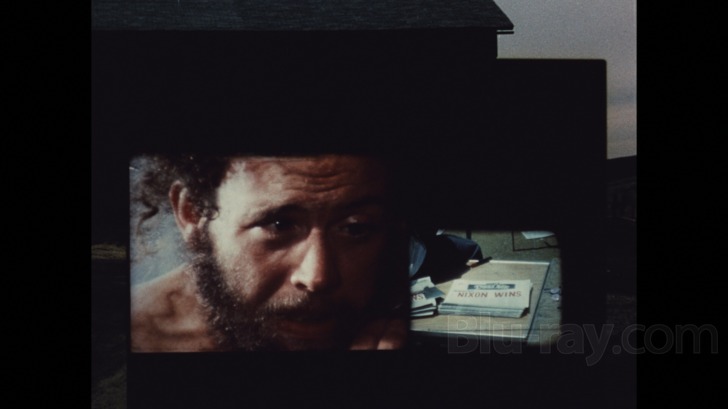
problems there. As you can see from the screenshots, the 1.33:1 "background" image—which varies between four or five different still photos—has a
smaller black mask inside it, onto which multiple streams of footage are projected, usually slightly overlapped. The source mediums span the spectrum—
8mm, 16mm, 35mm, video—so, naturally, clarity varies greatly, but given how small the images often are onscreen, this doesn't matter much. There
are two or three instances where Ray breaks out of the synchronous overlapping images routine and displays full-screen content, and these also vary in
sharpness. (Shot by student filmmakers inexperienced with focus pulling, you can expect lots of unintentionally blurry foregrounds.) The color balance
seems accurate, with good contrast and dense hues. As far as I can tell, this recent restoration seems to nicely represent Nicholas Ray's vision for the
project.
Susan Ray's Don't Expect Too Much is a similarly take-it-or-leave-it affair, presented in 1080p/AVC. She cobbles together behind-the-scenes and
archival footage from a number of sources—most transferred in high definition, some not—and uses photographs as illustrations as well, many of which
seem badly compressed or up-rezzed. Even the contemporary "talking head" interview sequences look a bit grungy, clearly shot against a green screen
that's been replaced by a black background. On the whole, the picture is quite soft and noisy, but it's watchable at any rate.
We Can't Go Home Again / Don't Expect Too Much Blu-ray Movie, Audio Quality
Like the picture, We Can't Go Home Again's lossless DTS-HD Master Audio 5.1 surround track is defined by its low-budget, lo-fi source material. (And I'm honestly baffled why this isn't just a stereo mix—I can't recall hearing much of anything out of the rear channels.) Recorded on location with a reel-to-reel machine, the audio often peaks, cracks, hisses, or cuts out suddenly, but in defense, it was and will always be this way. The best I can say is that it's almost always easy to make out what the actors/students are saying, and that the occasional narration and musical cues sound as good as they ever will. Don't Expect Too Much is presented in DTS-HD Master Audio 2.0, and while the vintage behind-the-scenes footage is subject to the same variations in "quality," the the modern interviews are clean and clearly recorded. Both the film and the documentary include optional English subtitles.
We Can't Go Home Again / Don't Expect Too Much Blu-ray Movie, Special Features and Extras
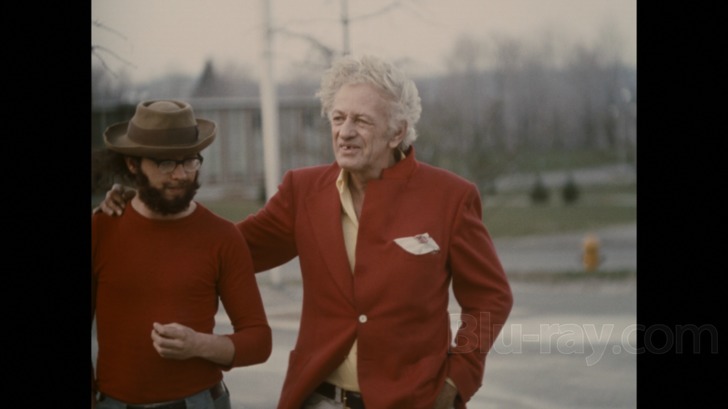
- Extended Interview - Jim Jarmusch (SD, 18:31): Featured sporadically throughout Don't Expect Too Much, wild-haired indie filmmaker Jim Jarmusch—who wasn't at Harpur, but served as Ray's assistant at NYU—gets to speak at length here about his time with Ray, who offered him some strategic guidance during the making of his first film.
- Extended Interview - Bernard Eisenschitz (SD, 19:21): Biographer Bernard Eisenschitz discusses Ray's place in Hollywood, the arc of his career, and how We Can't Go Home Again fits the continuity of his oeuvre.
- Camera Three - Profile of Nicholas Ray (SD, 28:51): A half-hour 1977 CBS interview with Ray, who fields questions about his career. This is the same interview that's included on the Criterion Collection's release of Bigger Than Life.
- Marco Rushes (SD, 28:36): Footage from a separate instructional film project—featuring a criminal interviewed by two cops—that Ray undertook with his students at The Lee Strasberg Institute.
- About Marco (SD, 9:39): Claudio Mazzatenta, the star of Marco, and Gerry Bamman—director, actor, and one of Ray's teaching associates—discuss working with the iconic filmmaker.
- The Janitor (SD, 12:11): Ray directed—and is featured in—this episode of Wet Dreams, an omnibus film produced by Max Fischer in 1974. Ray plays the titular janitor as well as some sort of—I dunno—cult leader? At an orgy. Or, something. Honestly, I'm not sure what's going on here, except that Ray's character gets fellated by a series of women.
We Can't Go Home Again / Don't Expect Too Much Blu-ray Movie, Overall Score and Recommendation
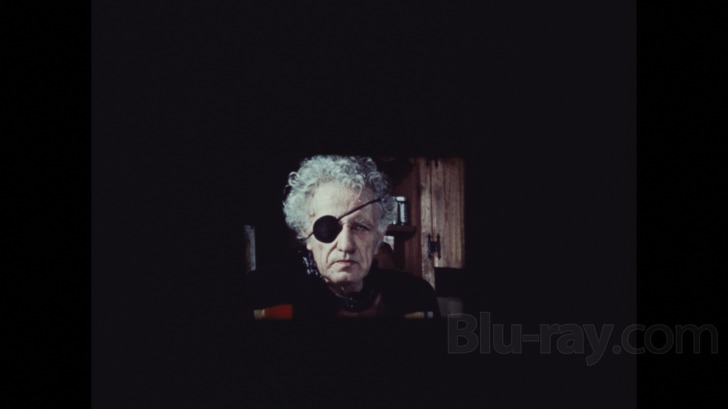
I'm glad Oscilloscope Pictures took a chance putting We Can't Go Home Again out on home video—it is the final film by one of America's greatest directors after all—but as the accompanying making-of documentary warns us, Don't Expect Too Much. The highly experimental project doesn't really yield workable results, reinforcing the consensus that Ray was at his best when working within—and pushing against —the Hollywood system. There are at least a few memorable scenes here, but as a whole, We Can't Go Home Again will probably only be of interest to Ray completists and cinema history buffs, who will be able to appreciate the film in its context.