War: Why Can't We Be Friends? Blu-ray Movie
HomeWar: Why Can't We Be Friends? Blu-ray Movie 
Quadio Blu-ray AudioRhino Music | 1975 | 44 min | Not rated | Dec 05, 2025


Movie rating
7.2 | / 10 |
Blu-ray rating
| Users |  | 0.0 |
| Reviewer |  | 4.5 |
| Overall | | 4.5 |
Overview
War: Why Can't We Be Friends? (1975)
Why Can't We Be Friends? is the seventh studio album by American band War, released on June 16, 1975, by United Artists Records. Two singles from the album were released: the title track backed with "In Mazatlan", and "Low Rider" backed with "So". Both A-sides were nominated for the Grammy Awards of 1976.
Starring: Howard Scott| Music | 100% |
Specifications
Video
Video codec: MPEG-4 AVC
Video resolution: 1080p
Aspect ratio: 1.78:1
Original aspect ratio: 1.78:1
Audio
English: DTS-HD Master Audio 4.0 (192kHz, 24-bit)
English: DTS-HD Master Audio 2.0 (192kHz, 24-bit)
Subtitles
None
Discs
Blu-ray Disc
Single disc (1 BD)
Playback
Region A (B, C untested)
Review
Rating summary
| Movie | | 4.5 |
| Video | | 0.0 |
| Audio |  | 5.0 |
| Extras | | 0.0 |
| Overall | | 4.5 |
War: Why Can't We Be Friends? Blu-ray Movie Review
Reviewed by Jeffrey Kauffman December 27, 2025As absolutely superb as many (most?) of Rhino's Quadio line of releases have been, there has been a pretty consistent lack of any decent supplemental material (much as with the Universal Music Group "Hi Fidelity Audio Blu-ray" releases of yore), and that lack may be especially noticeable with this release, given that War's own website is offering a Collector's Edition celebrating the 50th anniversary (!) of the album, with a wealth of bonus material. That said, those wanting to experience the album in hi res audio and (of course) four channel sound will have to opt for this release. Much as with several other Quadio releases recently, Rhino has already visited War's impressive discography with its release of War: The World is a Ghetto, which came out in 2024. This album wasn't quite the success of that earlier effort, but it still got to a more than respectable Number 8 on Billboard's album charts, and the title single was also a significant success for the band.
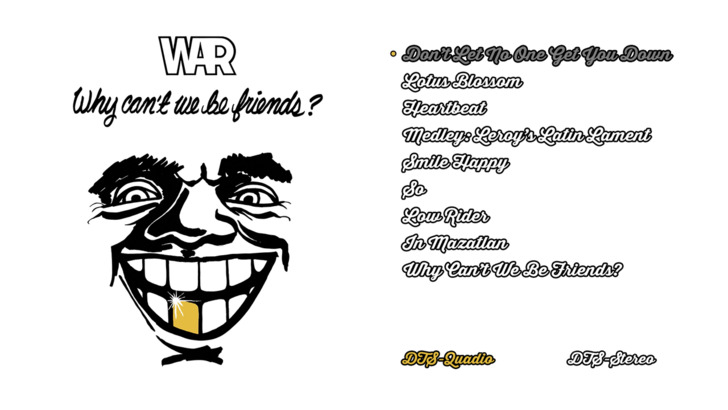
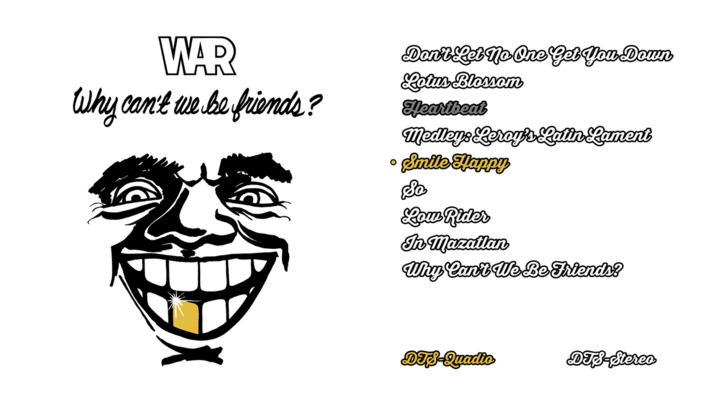
The album's track list can be seen in the screenshots of the (static) disc menu I've uploaded to accompany this review.
War: Why Can't We Be Friends? Blu-ray Movie, Video Quality
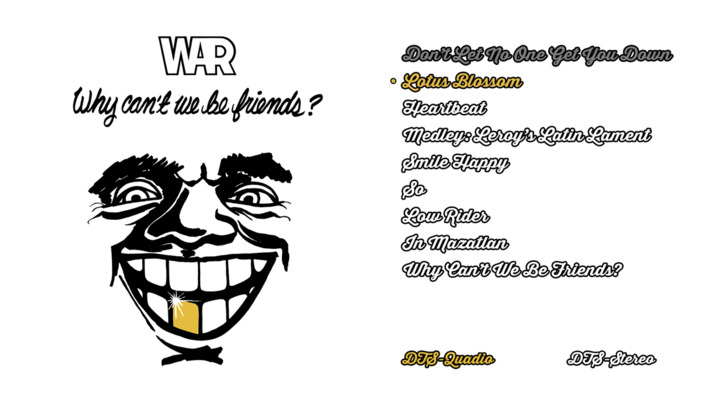
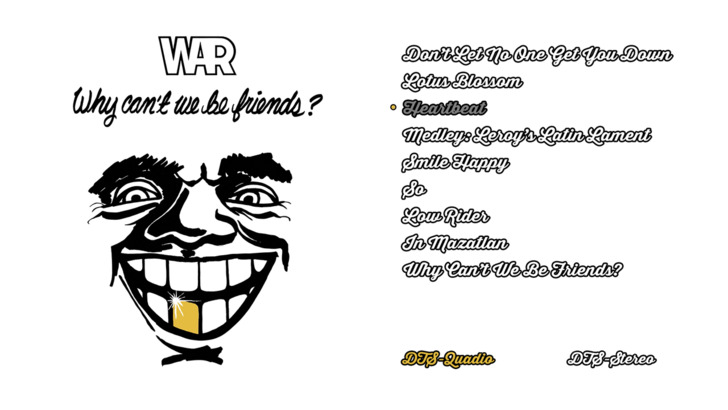
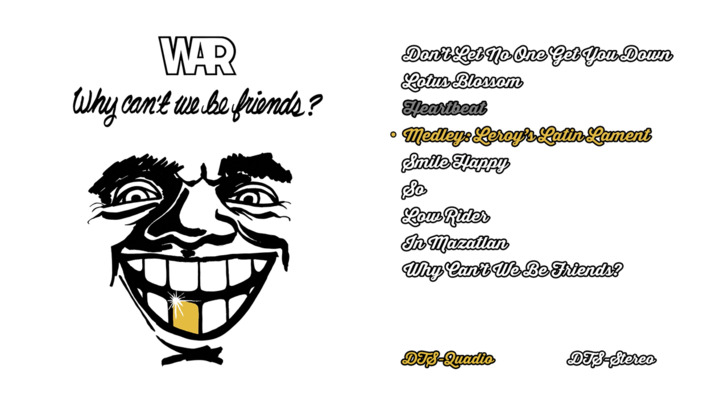
As mentioned above, while there is video content here, like most of Rhino's Quadio line of audio Blu-rays, it's simply a static menu. Longtime readers of my reviews know one of the bugaboos that tends to bother me is inconsistent authoring of these discs in terms of toggling between audio codecs, and unfortunately this latest batch of Quadio releases splits the difference between the two authoring methods. America: Hearts and Jefferson Starship: Spitfire offer what my hunch is most audiophiles would consider the preferable choice, namely being able to toggle between codecs with the colored buttons on the remote, something that typically does not start the song over, and offers an at least somewhat smooth transition (after an HDMI handshake) between codecs. Hot Tuna: America's Choice and this album on the other hand are Quadio releases where the codecs need to be accessed by moving through the menu to get to the bottom where the codec links are, and also unfortunately the song starts over when a new codec is chosen. This is the one area where I strongly feel Rhino could up their game for their generally fantastic line of hi res audio Blu-rays. In terms of this particular menu, there's a somewhat baffling assortment of colors when scrolling through the songs depending on whether the "next chapter" or "down" buttons are utilized, as can be seen by comparing some successive screenshots of the menu.
War: Why Can't We Be Friends? Blu-ray Movie, Audio Quality
War: Why Can't We Be Friends? features DTS-HD Master Audio 4.0 and DTS-HD Master Audio 2.0 options. As with all of the other Quadio releases in this particular batch, engagement of the rear speakers is immediate, with the evocative guitar chords that begin Don't Let No One Get You Down. Then when the rest of the instruments and notably the percussion and vocals enter, suddenly the entire soundstage is alive and immersive. Lotus Blossom provides some nice examples of directionality, with the Rhodes (with a Leslie effect) wafting in the front, and organ and guitar from the rear. Hearbeat has some fun rhythm guitar erupting from the front right speaker while the funky bass attacks from the rear. The percussion in this song is particularly effective and immersive. The album's hit title song offers great separation, with voices in the front and the propulsive rhythm accompaniment from the rear.
War: Why Can't We Be Friends? Blu-ray Movie, Special Features and Extras
As usual with Rhino's Quadio line, there are no on disc supplements. The insert booklet reproduces cover images and also includes credits and the typical verbiage on "bass management" along with the traditional photos of master tape boxes.
War: Why Can't We Be Friends? Blu-ray Movie, Overall Score and Recommendation
Maybe a little surprisingly for me, I think this particular album may be my overall favorite of this latest batch of Quadio releases, though I do have a soft spot for America: Hearts. There's some really gorgeous songcraft on this album, and it's both funky and melodic in about equal measure. The authoring is frankly a disappointment with regard to accessing audio codecs, but otherwise this comes Highly recommended.