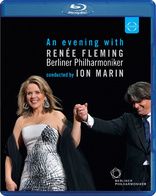
Waldbühne 2010: An Evening with Renée Fleming Blu-ray Movie
HomeWaldbühne 2010: An Evening with Renée Fleming Blu-ray Movie 
Waldbuhne - Mussorgsky: Night On Bald Mountain / Dvorak: Song To The MoonEUROARTS | 2010 | 130 min | Unrated | Oct 26, 2010

Movie rating
7.1 | / 10 |
Blu-ray rating
| Users |  | 0.0 |
| Reviewer |  | 4.0 |
| Overall | | 4.0 |
Overview
Waldbühne 2010: An Evening with Renée Fleming (2010)
American soprano Fleming joins the Berlin Philharmonic for their annual outdoor summer concert.
| Music | 100% |
Specifications
Video
Video codec: MPEG-4 AVC
Video resolution: 1080i
Aspect ratio: 1.78:1
Original aspect ratio: 1.78:1
Audio
Music: DTS-HD Master Audio 5.1
Music: LPCM 2.0
Subtitles
English, French, German
Discs
25GB Blu-ray Disc
Single disc (1 BD)
Playback
Region A (B, C untested)
Review
Rating summary
| Movie | | 4.0 |
| Video | | 4.0 |
| Audio |  | 4.5 |
| Extras | | 0.0 |
| Overall | | 4.0 |
Waldbühne 2010: An Evening with Renée Fleming Blu-ray Movie Review
The vagaries of love (not to mention the occasional haunted mountain) are explored in this beautiful concert.
Reviewed by Jeffrey Kauffman November 1, 2010Many Germans do not like to be reminded of their country’s infamous history of conflict. A particularly sore subject, especially for those of a certain age, is anything that has to do with World War II. Tourists to major German cities are often met with blank stares or disapproving glares when they ask for directions to sites where Nazi atrocities took place. And yet there are still relics of the Hitler regime which have managed to last into the 21st century which have managed to reinvent themselves and have been granted a new life in completely different circumstances than those in which they originally conceived. Berlin hosted the famously controversial 1936 Olympics, where Hitler’s theories of Aryan race superiority were put squarely to the test at the hands of Jesse Owens, an African American. But several structures built for the fest have withstood the vagaries of time, not to mention the immense bombing runs to which Germany was subjected for several years at the height of the war. One of these impressive structures is the glorious Waldbühne, the “Forest Theater” outside of Berlin which is wedged into an ancient glacial valley. This immense amphitheater, which seats well over 20,000 spectators, once hosted huge rallies where Hitler himself commanded a central box seat, surrounded by statues idolizing him. Of course the statues are long gone, but the structure remains largely as it was in 1936 and has provided the Berlin Philharmonic with a stunning annual outdoor concert in June of every year, a tradition for the orchestra since 1984. Of course one of the challenges of mounting an outdoor concert is dealing with the weather. Last year’s concert, which I reviewed here featured a torrential downpour which helped to make Stravinsky’s Le Sacre even more heart pounding than it usually is. Luckily, this year’s concert was greeted with a beautiful early summer evening, made all the more beautiful by Renée Fleming’s opening aria to the moon, sung just as afternoon begins to turn to twilight.

Before Fleming takes the stage, Romanian born conductor Ion Marin leads the Philharmonic in a rousing interpretation of Modest Mussorgsky’s iconic Night on Bare Mountain (the piece is alternately translated as Bald Mountain a lot of the time). Marin is a youngish man, just beginning to make his presence felt on the international stage, and he’s a bit too declamatory in his conducting style for my personal taste, but he acquits himself quite admirably with a bristling performance of this piece, which actually might have been more at home, so to speak, in the stormy weather of last year’s Simon Rattle conducted outing. Night on Bare Mountain has become such an orchestral cliché, especially post-Fantasia, that it’s hard at times to divorce one’s listening experience from the almost pre-programmed images which sometimes accompany the incredible music in the listener’s mind’s eye. Here, in an outdoor setting, watching the players furiously attack their instruments in this often technically demanding piece, brings a welcome fresh edge to the experience. It may not in fact be completely easy to remove the “Disneyfication” of this piece from the mind, but this rendition comes close to helping at least temporarily erase it from memory.
Rattle’s Waldbühne concert had an overarching Russian element to weave together its pieces, but here it’s a bit harder to generalize. That said, after the Mussorgsky piece, we get a series of odes to and about love in various guises, so this evening might be at least mostly labeled a “Love Story” of sorts. Fleming appears after the Mussorgsky in a flaming red dress and sings the lovely Dvorak “Song to the Moon” from Rusalka. Harp and clarinets make for a tranquil opening vocal number. Just as soon as she’s on, though, she’s off again, as Marin leads the orchestra in one of the lesser known pieces from the evening, a snippet from a ballet by Armenian composer Chatschaturjan (Khachaturian), probably best known for his invigorating “Sabre Dance.” Here, from Spartacus, we are introduced to a more sylvan and meditative side to the composer, with evocative flute trills and an inviting oboe solo.
Fleming is back onstage for another segment of the evening, with a nice variety of art songs from Richard Strauss (“Morgen Mittag um elf” from Capriccio op. 85 and “Zueignung” op. 10 Number 1) and perhaps more interestingly to film lovers especially, a languid, chorale like piece by iconic soundtrack composer Erich Wolfgang Korngold, “Glück, das mir verblieb.” Interspersed here is another purely orchestral outing, the Overture to Wagner’s Rienzi, given a nicely languid performance, including some standout trumpet work, just as the sun begins to set behind the massive cone where the orchestra is seated. This next section closes out with another pastoral piece, Elgar’s charming Salut d’amour, one of the best known pieces of the program.
Perhaps the most interesting collection of songs is included in the next part of the program, as Marin and Fleming (now clad in a striking blue dress) provide us a rare opportunity to contrast two settings of the same material. While Puccini’s La Bohème is regularly listed as among the most performed, if not the most performed, pieces in the standard operatic repertoire, few people know that Ruggero Leoncavallo, best known for Pagliacci, also wrote a version based on the same Murger source novel. Leoncavallo’s was written almost exactly simultaneously with Puccini’s, and yet the latter has become internationally famous while the former has gathered dust on music library shelves for over a century. Fleming and Marin start with Puccini’s “D’onde lieta usci,” and then give us two beautiful pieces from Leoncavallo’s version which prove this lesser known outing is well deserving of more attention. Fleming closes this section with “Tu che di gel sei cinta” from Turandot.
Marin then gives us two contrasting pieces, the Tchaikovsky’s standard bearer Romeo and Juliet Fantasy Overture and probably the least known, but exceptionally entertaining nonetheless, outing of the evening, Gregorias Dinicu’s Hora staccato, a riot of orchestral bombast and invention.
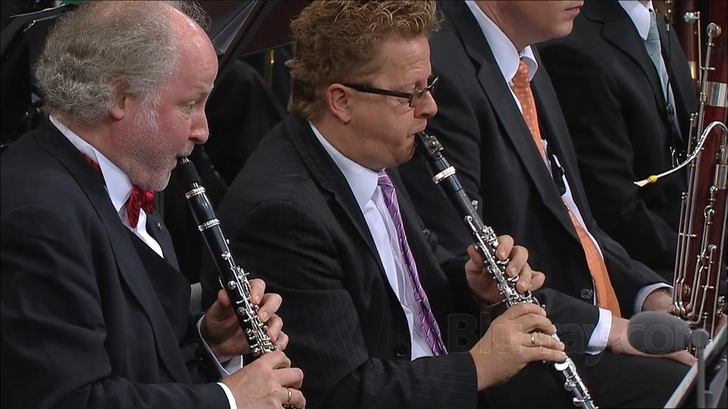
Fleming, in her final costume change now sporting an interesting graphic-covered white gown, brings a roar from the crowd as she closes her evening with a gorgeously liquid accounting of Puccini’s “O mio babbino caro” from Gianni Schicchi. As is the custom at Waldbühne, the orchestra closes the show with a vigorous accounting of Lincke’s Berliner Luft, but they have one final surprise in store. Earlier in the day of the concert, Germany had beaten England in the quarter finals of the World Cup. As this patently silly final piece plays, the brass section brings out the equally patently annoying vivuzelas which became infamous during the World Cup and bleat and buzz Berliner Luft as it’s probably never been played before.
The highlight of this evening is undoubtedly Fleming, whose richly burnished lyric soprano sounds gorgeously full and amazingly spry at the same time. Fleming has one of the most buttery tones imaginable, and she plies close intervals and leaps over wide ones with equal ease, showing an incomparable command, especially in her transitions from chest to head tones. She is obviously inspired by her surroundings throughout this magical afternoon and evening, and she communicates that magic effortlessly to a rapt audience.
Waldbühne 2010: An Evening with Renée Fleming Blu-ray Movie, Video Quality
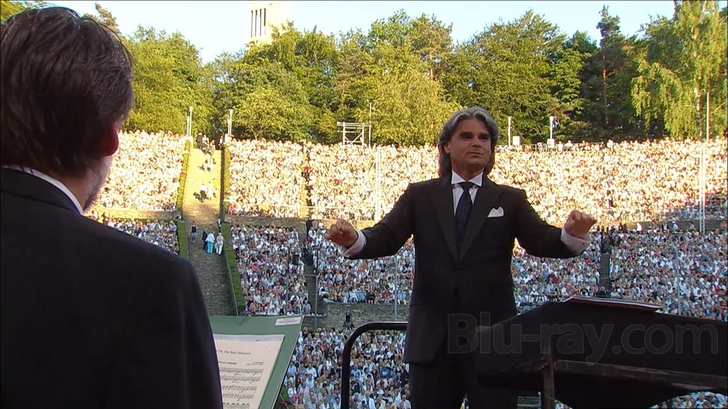
An Evening With Renée Fleming looks mostly spectacular in its AVC encoded 1080i transfer (in 1.78:1). The wide shots of the amphitheater as the light slowly changes from gorgeously suffused afternoon to the cherry tones of sunset to the shadows of night (where pesky bugs flit about Marin's head and baton) offer a wealth of detail and some exceptional depth of field. Close-ups of the orchestral players and Fleming especially also reveal a wealth of detail, including Fleming's sometimes misbehaving hair. The only real element that fails to resolve properly throughout this two-plus hour concert is the bold black graphic on Fleming's final gown for the evening. Here we get some fairly significant shimmer, but it's a temporary distraction from an otherwise very nice looking Blu-ray.
Waldbühne 2010: An Evening with Renée Fleming Blu-ray Movie, Audio Quality
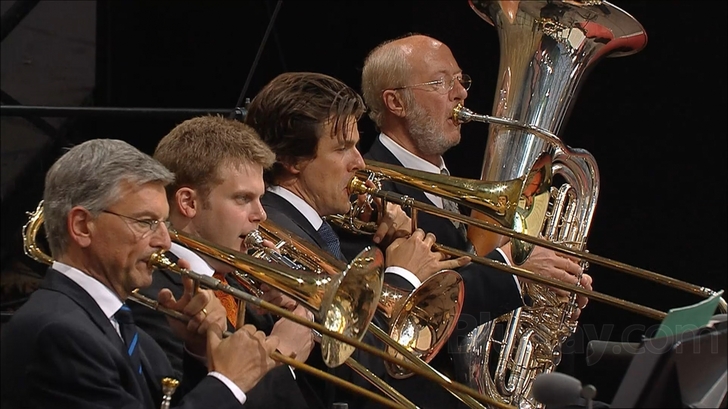
Both lossless audio options on this Blu-ray sound excellent indeed, especially considering this was recorded out of doors with a sometimes very vocal audience in attendance. The DTS-HD Master Audio 5.1 mix provides enormous spaciousness throughout the evening, with excellently discrete separation of the orchestral sections, but an overall cohesive sound which ably represents the Philharmonic's superb ensemble playing. Fidelity is top notch here, and Fleming's voice sounds perfect. Balance is exceptional, with Fleming never getting buried beneath the orchestral masses. Everything from the delicate pluck of harp in the Dvorak to the bombastic brass and wind crescendi in the Mussorgsky is brilliantly realized in this excellent surround mix.
Waldbühne 2010: An Evening with Renée Fleming Blu-ray Movie, Special Features and Extras
No supplements are offered on the Blu-ray. There's a short essay in the insert booklet. (Also be aware that the track listing on the back of the keepcase is not complete).
Waldbühne 2010: An Evening with Renée Fleming Blu-ray Movie, Overall Score and Recommendation
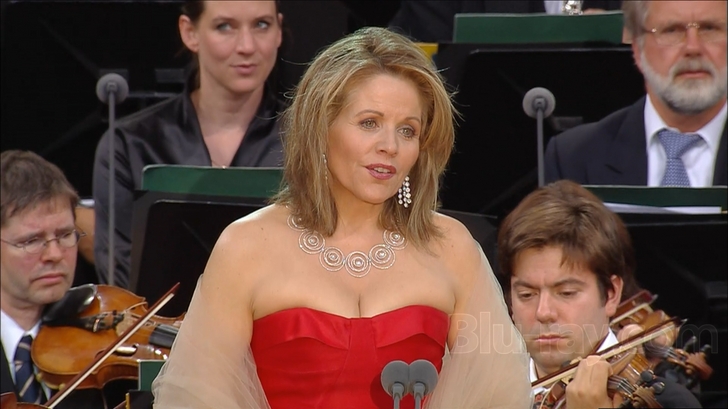
Fleming is one of the most charismatic vocalists on the international stage, and the reasons are abundantly clear in this engaging evening of love-related material. The opening choice by Marin doesn't seem to quite fit the rest of the evening, but the playing is spectacular in any case. This is an interesting selection of well known and not so well known material, and should be enjoyed by Fleming's legion of adoring fans. Recommended.