Wagner: Rienzi Blu-ray Movie
HomeWagner: Rienzi Blu-ray Movie 
Arthaus Musik | 2010 | 182 min | Not rated | Sep 28, 2010

Movie rating
Movie has not been rated yetBlu-ray rating
| Users |  | 0.0 |
| Reviewer |  | 4.5 |
| Overall | | 4.5 |
Overview
Wagner: Rienzi (2010)
Richard Wagner’s early opera “Rienzi” is stylistically closer to Meyerbeer and bel canto than to Wagner’s later masterworks.
Starring: Torsten Kerl, Kate Aldrich, Camilla NylundDirector: Philipp Stölzl
| Music | 100% |
Specifications
Video
Video codec: MPEG-4 AVC
Video resolution: 1080i
Aspect ratio: 1.78:1
Original aspect ratio: 1.85:1
Audio
German: DTS-HD Master Audio 5.1
German: LPCM 2.0
Subtitles
English, French, Spanish, German, Italian
Discs
50GB Blu-ray Disc
Single disc (1 BD)
Playback
Region A (B, C untested)
Review
Rating summary
| Movie | | 4.5 |
| Video |  | 4.0 |
| Audio | | 4.5 |
| Extras |  | 3.0 |
| Overall | | 4.5 |
Wagner: Rienzi Blu-ray Movie Review
Hitler's favorite opera receives an arresting new production.
Reviewed by Jeffrey Kauffman October 1, 2010When Hitler and Eva Braun perished in their fetid Berlin bunker at the end of the European campaign, they took with them a rather odd curio. Assumed burned to ashes in the firestorm which accompanied the final assault on the Third Reich was the original autograph score to Wagner’s Rienzi. Though some dispute the legend, Hitler evidently maintained he had seen the little know opera, only Wagner’s third essay in the idiom, as a young man and that it had changed his life forever. It’s both fascinating and ironic, when one looks at Rienzi objectively, that this Wagnerian opus above all others would capture the twentieth century’s most despicable dictator’s fancy so completely. First of all, it’s really not very good, at least comparatively speaking when stacked up against Wagner’s more mature oeuvre. It’s a lumbering, more than five hour piece (at least in its original version) which is clearly more influenced by the Grand Operatic tradition of Meyerbeer than any innovations Wagner brought to the compositional table. (Hans von Bülow famously quipped that Rienzi was Meyerbeer’s best opera). While that Grand Opera format clearly reveals the nascent underpinnings of Wagner’s more ambitious Music Theater proclivities which would soon take the world by storm, in Rienzi he’s working squarely in a largely antiquated format which prized spectacle over character, and size over nuance. Secondly, and perhaps more importantly in terms of how surprising Hitler’s obsession with this piece was, is the fact that Rienzi deals with its eponymous power mad dictator whose megalomania leads to his own destruction. While obviously frighteningly prophetic, Hitler was either in denial or too enamored of Rienzi’s quasi-hypnotic powers over his mid-14th century Roman masses to care about the ultimate fate of the leader.
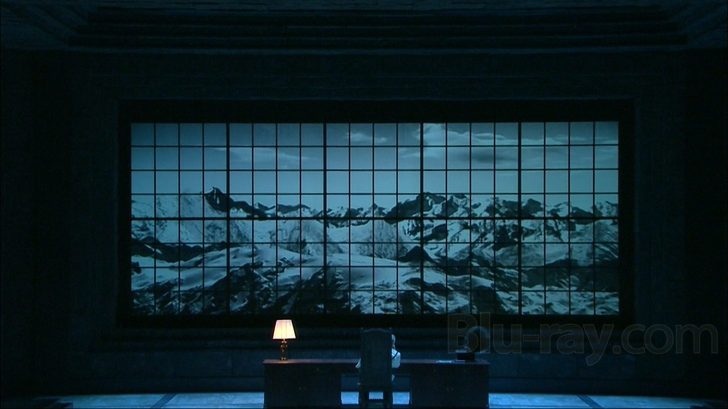
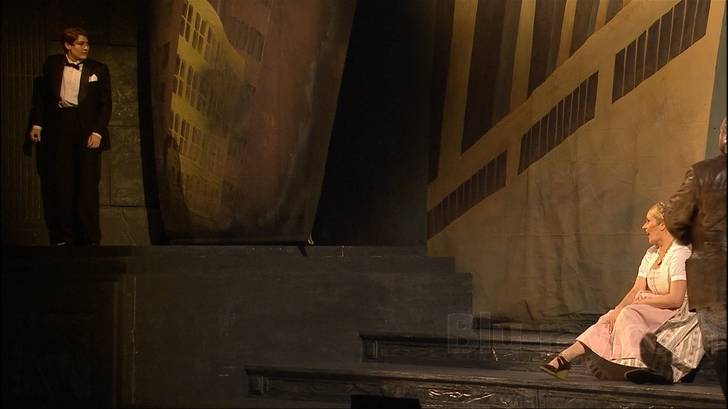
Though Rienzi officially bears the subtitle The Last of the Tribunes, this striking Berlin Opera production really could have utilized The Last Dictator as it soubriquet, as at the very least the weird and wonderful prologue director Philipp Stölzl has staged to Wagner’s Overture (which Hitler used for several Nuremberg rallies) is clearly redolent of the classic Chaplin film. Rienzi (here played by a stunt double) sits as a gigantic desk in front of intentionally scratched and debris filled projections of gigantic mountain peaks which of course recall Hitler’s Bechtesgaden. Rienzi begins to conduct, then dance, as the orchestra swells, ultimately cascading into a series of acrobatic moves like cartwheels. He then motions toward the projections, and they magically rise from the mountains to an outer space view of the entire planet, which Rienzi figuratively holds in his pudgy hands, much like Chaplin played with the globe balloon in The Great Dictator.
While Rienzi (Torsten Kerl) by objective standards has perhaps decent enough motives in Wagner’s original libretto, Stölzl and Artistic Production Manager Christian Baier, who basically halved the original down to around a two and a half hour playing time (Rienzi in its full form is actually Wagner’s longest opera, as incredible as that may seem), here layer on a very subtle, but completely a propos irony, obviously calling into question the entire history of 20th century despots who believed the ends justified the means. This post-modern take on Rienzi works absolutely perfectly, especially when married to the arresting use of projections which often ape such iconic pieces as Leni Riefenstahl’s Triumph of the Will.
There are parallels to be drawn between Rienzi and some of Wagner’s better known later pieces, especially in terms of the incestuous love affair between brother Rienzi and sister Irene (Camilla Nylund). In their original fourteenth century settings, there are also some perhaps unexpected relationships between Rienzi and Verdi’s Simon Boccanegra (Rienzi actually is mentioned in Boccanegra’s libretto), but those comparisons fade somewhat in this striking reimagining which doesn’t shirk, and in fact celebrates in its own subversive way, the epochal history that has occurred since Wagner first wrote this piece in the mid-19th century.
One interesting sidebar to consider in this very early effort by Wagner is his somewhat odd choice of voicing the male love interest for Irene, Adriano, as a soprano (here played by Kate Aldrich). Is this a not so subtle commentary on Irene’s rather commanding presence, one which at least partially negates Adriano’s incipient masculinity? I’m not sure I have any answers, and there certainly wasn’t the Handelian emphasis on castrati this comparatively late in the operatic game (Wagner premiered the piece in 1842), but it at least gives one pause when one considers Wagner’s obsessive compulsive attention to detail.
This is a brilliantly well sung and played, albeit drastically truncated (not that that’s a bad thing), production. Kerl is a very appealing Wagnerian tenor with a clear high timbre and absolutely formidable control. Both Nylund and Aldrich do extremely well with Wagner’s often very florid writing, and Aldrich’s sung “scream” at the opera’s denouement needs to be heard to be believed. The Orchestra and Chorus of the Deutsche Oper Berlin perform extremely capably under the direction of Sebastian Lang-Lessing, and actually help to circumvent some of Wagner’s comparatively pedestrian writing (and especially orchestration) in Rienzi. For anyone coming to this piece after having experienced Wagner’s later, more innovative, triumphs, be forewarned this is a resolutely diatonic outing which owes more to Italian and French traditions than to the nascent German national school which Wagner himself would help to elevate, pushing music into the chromatic hyperbole from which it has yet to fully emerge.
Wagner: Rienzi Blu-ray Movie, Video Quality
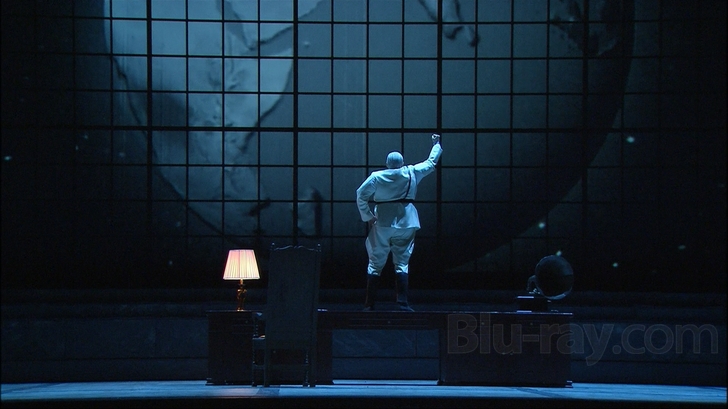
Rienzi is presented on Blu-ray by ArtHausMusik with an AVC encode in 1080i and 1.78:1. This is one of the most striking looking physical productions in recent memory, and aside from one or two artifacting issues, this Blu-ray supports the presentation very well indeed. The projections look fantastic (deliberately scratched and debris filled though they are), and the extremely varied palette presents a wealth of gorgeously saturated blues and reds, as well as some ghastly but very effective yellows, in the stage lighting. The Nazi-like black and white costumes sport brilliant contrast and really good detail. Most of the artifacting, as strange as it is, comes from Rienzi's starkly gelled and combed hair, which due to Kerl's dye job produces a fair amount of shimmer throughout the piece. Otherwise this is a fantastic looking production presented in a very clear and well detailed Blu-ray.
Wagner: Rienzi Blu-ray Movie, Audio Quality
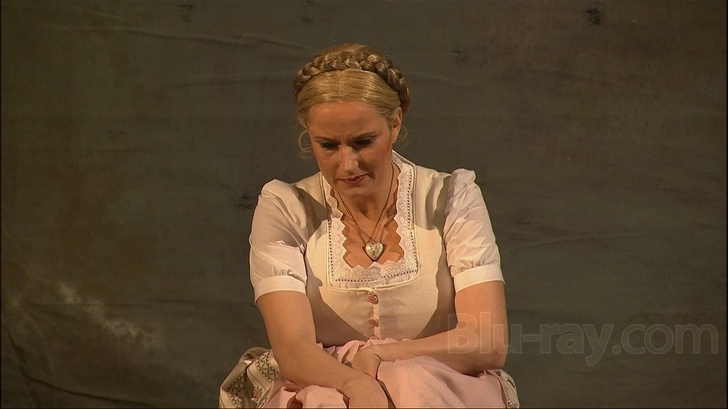
This may be far from Wagner's most challenging music, but the Blu-ray's lossless DTS-HD Master Audio 5.1 mix is marvelously clear and more immersive than a lot of these opera recordings tend to be. The best part of this sonic offering are the gorgeous voices of Kerl and Nylund, both of which are clear as a bell here, with absolutely top notch fidelity across their vocal ranges. The orchestra is well balanced and plays very well, though the music itself is so strangely "normal" sounding for Wagner, some listeners may actually be nonplussed. The brass and wind sections here are especially well represented on the DTS mix, with full, burnished tones and excellent balance. In fact, balance between the soloists, ensemble and orchestra is very good, perhaps heightened by the hall acoustics at the Deutsche Oper Berlin.
Wagner: Rienzi Blu-ray Movie, Special Features and Extras
An above average Making of featurette (HD; 27:00) gives some background on the piece, including copious rehearsal footage. It's kind of funny to see Kerl "marking" his parts by singing in falsetto, and equally funny to hear Stölzl refer to the unruly ensemble as "nursery school children." Pay attention to the banter between the director and his stars, as well; there's obviously some tension there. The insert booklet is also filled with good background on Rienzi, as well as a plot synopsis.
Wagner: Rienzi Blu-ray Movie, Overall Score and Recommendation
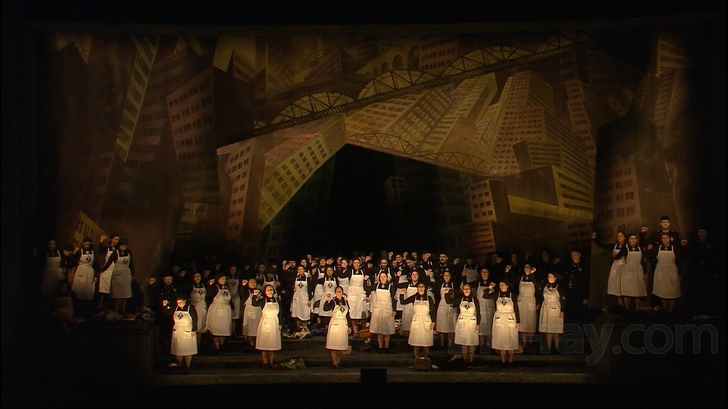
Purists may decry the substantial pruning this version of Rienzi underwent, but frankly I think it may have improved the piece. The physical staging here is smart and ironic without winking too deliberately at the audience, and the singing is spectacular. Rienzi doesn't get performed very much for a variety of reasons, but if you've ever been curious to see it, this is an impressively compelling production. Highly recommended.