Wagner: Parsifal Blu-ray Movie
HomeWagner: Parsifal Blu-ray Movie 
Opus Arte | 323 min | May 25, 2010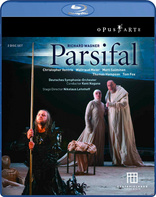
Price
List price:Listed on Amazon marketplace

Movie rating
Movie has not been rated yetBlu-ray rating
| Users |  | 0.0 |
| Reviewer |  | 4.5 |
| Overall | | 4.5 |
Overview
Wagner: Parsifal ()
Starring: Christopher Ventris, Waltraud Meier, Matti Salminen, Thomas Hampson, Tom Fox (XVI)Director: Thomas Grimm
| Music | 100% |
Specifications
Video
Video codec: MPEG-4 AVC
Video resolution: 1080i
Aspect ratio: 1.78:1
Audio
German: DTS-HD Master Audio 5.1
German: LPCM 2.0
Subtitles
English, French, Spanish, German, Italian
Discs
50GB Blu-ray Disc
Two-disc set (2 BDs)
Playback
Region A (B, C untested)
Review
Rating summary
| Movie | | 4.5 |
| Video | | 4.5 |
| Audio |  | 5.0 |
| Extras | | 4.5 |
| Overall | | 4.5 |
Wagner: Parsifal Blu-ray Movie Review
Wagner's most opaque opera gets a striking new production directed by Nikolaus Lehnhoff and conducted by Kent Nagano.
Reviewed by Jeffrey Kauffman June 11, 2010Richard Wagner isn’t celebrated for his transparency, either musically or in his often largely unfathomable libretti. That’s probably nowhere as true as in his final piece of music theater, Parsifal, a mystical trip supposedly through the halls of Arthurian knights that manages to attain heights of quasi-religiosity (and maybe not even quasi-) that even Wagner’s Ring cycle doesn’t regularly reach. And yet what are we greeted with, musically speaking, as Parsifal opens? An ambiguous Tristan chord? The dichotomy of polytonality or amorphous harmonies? Hardly. Instead, here post-Tristan and Ring, we get Wagner tracing an Ab major triad. One, three, five, neat as you like. And then, unbelievably, the major sixth and seventh, back to the tonic an octave above the starting note. Who is this composer, and what has he done with the real Richard Wagner? It’s as if after a lifetime exploiting the nooks and crannies of traditional harmony, pushing the envelope to multiple breaking points, here, as Wagner investigates a frankly Christian ideology in just slightly (OK, maybe not so slightly) obfuscated form, he decides a kinder, gentler musical language, one firmly rooted in diatonicism, is the order of the day. It’s a bracing and really rather shocking opening for a Wagner opera, if only by dint of the fact that so much chromaticism has come before it in Wagner’s oeuvre.
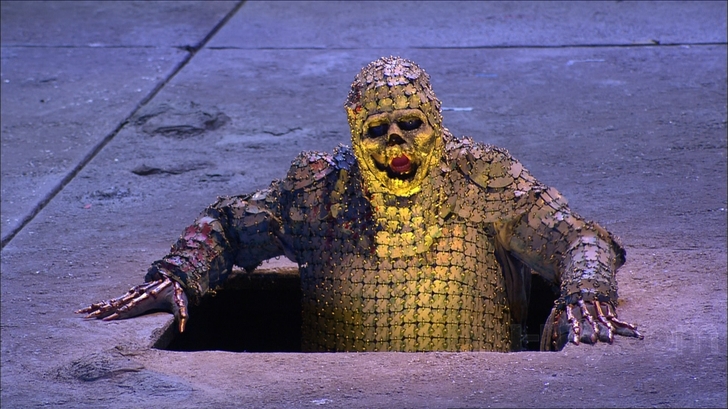
"Pardon me, have any of you seen Brendan Fraser?"
Director Lehnhoff waxes philosophical (could it be otherwise with Parsifal?) in his short but thought-provoking introductory notes in the insert booklet. “Parisfal is an existential drama about the dilemma of our human existence. . .an empty world stripped of all its former meaning. . .where lost souls wander aimlessly through time and space.” While Lehnhoff’s assertion that “Amfortas’ wound is also our wound—the wound of civilization; he is a symbol of Mankind’s eternal suffering” may in fact be true in a generalized way, it’s perhaps just as interesting to approach Parsifal as a refracted Christ story where disparate characters, at least two of whom can be seen as Christ typos themselves, seek redemption.
Therefore we have the honorable knight Amfortas (Thomas Hampson in an amazing performance), wounded in the side by the very spear which lanced Jesus, seeking to heal himself (and perhaps the world) after having been tricked by the Satanic stand-in, Klingsor (Tom Fox). Enter the “perfect fool,” that side of the Christ type pure as the driven snow, if not yet moved to Christian heights of compassion, Parsifal (Christopher Ventris). Add in the completely dichotomous Kundry (Waltraud Meier), who once laughed at Jesus himself as he bore his cross to Calvary, who now simultaneously seeks salvation with the Knights while just as easily becoming the literal puppet of Klingsor, and we have a gallery of characters in search of saving grace, whether or not that grace be symbolized by the Holy Grail.
Lehnhoff’s 1999 production of Parisfal for the English National Opera was seen as the new touchstone for presentations of the opera. Stripped of that Eurotrash directorial “vision” I so frequently lament in my opera reviews here, Lehnhoff fashioned a surprisingly literal physical production, which leaves these iconic characters playing out their millennial (even apocalyptic) drama on a spare stage that suggests a rend in Heaven itself with a large suspended rock cutting through the backdrop.
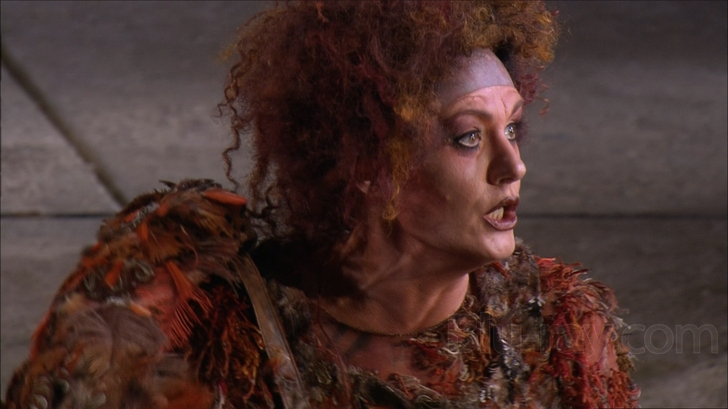
Lehnhoff was able to cherry pick his own actors for this recreation of that English National Opera tour de force, and he has assembled a world class cast that helps define these roles for a new generation of both longtime Wagner lovers and neophytes to the Wagner fold. Hampson is a towering and tragic Amfortas, with his deeply reedy baritone spilling over Wagner’s expressive music. Meier is a near perfect Kundry, evincing both terror and heartbreak in an astonishingly visceral performance. If Tom Fox’s Klingsor veers ever so slightly into parody (partly attributable to his “devil may care” costume), he still delivers the smarmy, nefarious goods. And Ventris’ Parsifal is wonderfully ingenuous and naive in the opening Act and then decidedly weary and wise as the opera moves toward its triumphant but somber conclusion.
A lot (and I mean a lot) has been written about the various influences that color Parsifal. The opera was based on the 13th century epic poem of Wolfram von Eschenbach, as was Wagner’s wont, his adaptation brought in a host of other literary and philosophical ideas from sources as disparate as Schopenhauer and Schiller. It’s perhaps just a little funny to go back and read Nietzsche’s blistering commentary on Parsifal, especially when the German philosopher was forced to admit at least the music was “sublime”. It becomes doubly ironic when 20th century critics have pointed to an at least perceived anti-Semitism running through Parsifal, with its quasi-Jewish Klingsor out to defeat the shining Christian aristocracy of the Grail Knights. All of this commentary is fascinating and excellent fodder for intellectual analysis and hindsight, but it can actually get in the way of simply experiencing the opera.
It’s perhaps a truism that a work of art this majestic and mysterious will never be able to be properly analyzed, either musically or in a literary sense, and frankly that’s probably a good thing. Schiller, one of the supposed influences on Wagner’s thinking, argued about the imbalance between the intellectual and emotional forces which make up the human psyche. Too often we rationalize our experience, letting language and mathematical thought paint a veneer over the visceral. This Parsifal strips away those tendencies and allows us into one of the most supremely moving works which sprang from Wagner’s pen. The depth of thought in the libretto is effortlessly supported by musical thinking that may lure you into a false sense of simplicity with tropes like that opening Ab major triad. It’s Wagner’s genius that is able to set the profound and the commonplace side by side and utilize them both to propel the audience toward its own cathartic salvation.
Wagner: Parsifal Blu-ray Movie, Video Quality
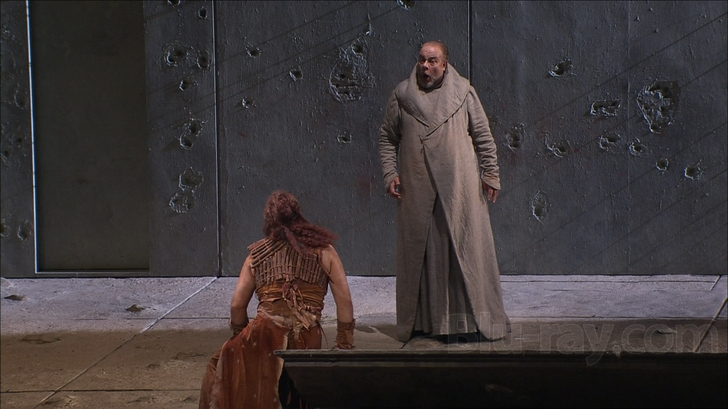
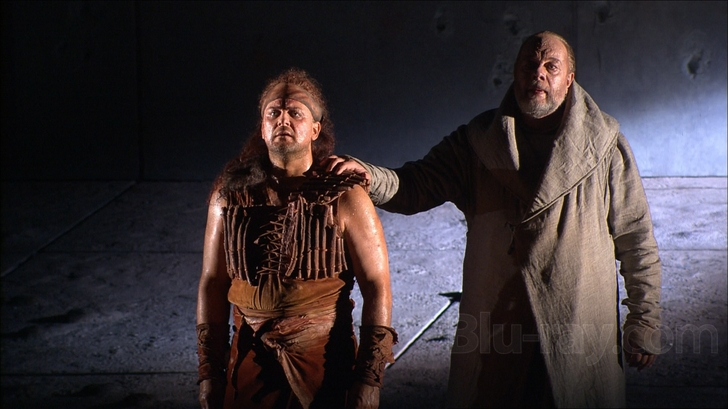
Parsifal builds slowly from a visual standpoint, in a sterling AVC encoded 1080i "live" transfer in a 1.78:1 aspect ratio. The opening Act is told in tones of beige, white and brown, with only Kundry's red streaked hair and costume offering a respite. Things get decidedly more colorful after that, with Klingsor's bright red makeup and costume a standout. This is a very subtle, but extremely well detailed, Blu-ray, with superb contrast and excellent black levels. When Gurnemanz (Matti Salminen) and Parisfal set out on their mystical journey, the entire stage turns to black, with beautiful shafts of light which seem almost like prismatic cubes thrusting through the darkness, and the Blu-ray reveals the subtlest shades in this scene effortlessly. But throughout the three acts, we're offered sharp and precise detail, down to the sweaty faces of these overworked singers.
Wagner: Parsifal Blu-ray Movie, Audio Quality
Kent Nagano conducts this production with his usual finesse and passion, and the playing of the Deutsches Symphonie-Orchester Berlin is for the most part absolute perfection. There are just a few fleeting intonation problems, mostly horn based, throughout the opera (you'll hear some in the Vorspiel, for example, if you listen carefully), but they're nothing major. The DTS-HD Master Audio 5.1 mix is simply amazing, allowing Wagner's massed lines to disperse through the channels, giving an airy ambience that I've rarely experienced with Parsifal. The blistering low end of Wagner's writing in Parsifal is simply clear as a bell here, and uncommonly well reproduced. Separation is excellent between the singers, and the singers themselves sound incredible throughout the presentation. There are thankfully no balance issues to report, especially impressive when Wagner's massive orchestration is taken into consideration. This is one of the finest Parsifal "recordings," as it were, I've experienced in years, and the DTS-HD MA 5.1 mix supports that brilliantly, with spot-on fidelity and very, very impressive dynamic range. I only spent a little time spot checking the LPCM 2.0 fold down, and it sounds clear and crisp, but offered too narrow a soundfield for me to want to spend a lot of time with it.
Wagner: Parsifal Blu-ray Movie, Special Features and Extras
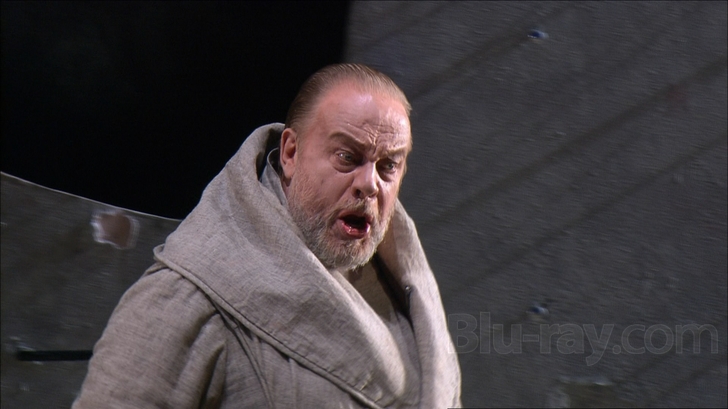
This is a two disc Blu-ray set. On Disc One, we get the typical Cast Gallery and Illustrated Synopsis (which runs a staggering 12-plus minutes). Disc Two is the real treat, however, with a surprisingly in-depth piece by Rainer Moritz called Parsifal's Progress (75:35), which gives us a good deal of background on the opera while also interviewing the current cast and crew about this particular production. It's unusually well done and comes highly recommended.
Wagner: Parsifal Blu-ray Movie, Overall Score and Recommendation
My advice to both newcomers and longtime admirers of Parsifal: don't worry so much about what it means. Let the glory of the music and the archetypal nature of these characters seep deep into your subconcious and slowly layers of meaning will indeed blossom out of your viewing and listening experience. There's no better place to start than with this extremely striking production which boasts an A-list cast, excellent conducting by Kent Nagano, and an arresting physical production.