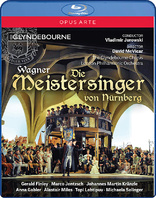
Wagner: Die Meistersinger von Nürnberg Blu-ray Movie
HomeWagner: Die Meistersinger von Nürnberg Blu-ray Movie 
Glyndebourne Festival Opera / London Philharmonic OrchestraOpus Arte | 2011 | 281 min | Not rated | Oct 30, 2012
Price
List price:Listed on Amazon marketplace

Movie rating
7 | / 10 |
Blu-ray rating
| Users |  | 0.0 |
| Reviewer |  | 4.0 |
| Overall | | 4.0 |
Overview
Wagner: Die Meistersinger von Nürnberg (2011)
Audiences have always found Die Meistersinger von Nürnberg to be a life-enhancing celebration of wisdom, art and song. So it proves in David McVicar’s production – the first at Glyndebourne – which is updated to the early 19th century of Wagner’s childhood. At the centre of a true ensemble cast is Gerald Finley, a ‘gleamingly sung’, ‘eminently believable’ Sachs (The Independent on Sunday), supported by the dynamic conducting of Vladimir Jurowski which, like McVicar’s production, uses Glyndebourne’s specialintimacy to bring sharp focus to bear on the subtlety of Wagner’s musical and dramatic counterpoint. Filmed in High Definition and recorded in true Surround Sound.
Starring: Gerald Finley| Music | 100% |
Specifications
Video
Video codec: MPEG-4 AVC
Video resolution: 1080i
Aspect ratio: 1.78:1
Original aspect ratio: 1.78:1
Audio
German: DTS-HD Master Audio 5.1
German: LPCM 2.0
Subtitles
English, French, German
Discs
50GB Blu-ray Disc
Two-disc set (2 BDs)
Playback
Region A, B (C untested)
Review
Rating summary
| Movie |  | 4.5 |
| Video | | 4.0 |
| Audio | | 4.5 |
| Extras |  | 1.5 |
| Overall | | 4.0 |
Wagner: Die Meistersinger von Nürnberg Blu-ray Movie Review
Rules are meant to be broken.
Reviewed by Jeffrey Kauffman November 30, 2012Let’s face it: Richard Wagner was never one to let a simple declarative utterance stand when thousands of obfuscating words might otherwise suffice. This most labyrinthine of composers and librettists delighted in allegory, metaphor, mythologizing and a score (no pun intended) of other techniques which one assumes were utilized to subvert the rational mind and appeal directly to some other, greater, apprehension. How bracing, then, is it to come to Die Meistersinger von Nürnberg, Wagner’s very personal ode to music, and, in a way, obviously to opera itself, but to find the composer-librettist at his most transparent and accessible in the process. This is one of the few Wagner operas without a mythological or supernatural element trodding laboriously around the stage, and it is also singular among his own “approved” oeuvre in that it has a decided, if somewhat dated, comedic element. But what is perhaps most remarkable about Die Meistersinger von Nürnberg is how autobiographical it is, and how Wagner refuses to couch that self examination in anything that makes the storytelling opaque and less self-referential. What’s all the more amazing about the clarity of Wagner’s conception and execution is that the composer was attempting to elucidate some of the most arcane philosophizing of all time, that of Schopenhauer, whose writing about Art (and specifically music) had deeply affected Wagner and led the composer to reevaluate many of his previous ideas about the role of various operatic techniques. Die Meistersinger von Nürnberg stands, therefore, as a sort of treatise on Wagner’s part, but unlike many screeds, it’s a completely (or at least mostly) undogmatic affair that posits the saving grace of music with some of the most luscious songcraft of Wagner’s illustrious career.
Anyone who has ever taken a college level Music Theory class will tell you there are rules to composition that have been codified over untold centuries and which uptight music professors are more than insistent need to be followed to a tee. No parallel fifths in voice leading, dominant sevenths must resolve either “naturally” to their tonic or “deceptively” up a step to the relative minor, tritones must contract to either a major or minor third, and so on and so forth, ad infinitum. Those proclivities are at the heart of Die Meistersinger von Nürnberg, at least by implication, and the ironic thing is of course that Richard Wagner was one of the most blatant rule breakers of all time, as is evidenced by one of the biggest bugaboos of advanced theory classes, namely properly identifying and analyzing Wagner’s so called “Tristan chord”. (I once infuriated my otherwise sanguine theory teacher by blurting out one of the more widely accepted analyses, that of an altered augmented sixth, when he passed copies of the music out one day, hoping to stump the class.)
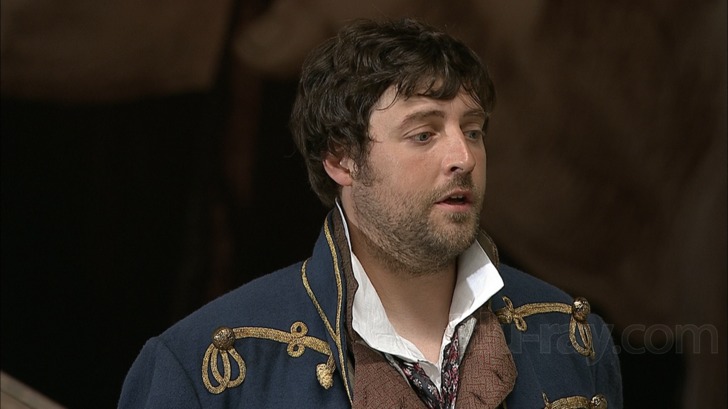
In the 17th century of Wagner’s original conception (moved up a couple of centuries in David McVicar’s otherwise faithful production at Glyndebourne), Nuremberg was a place where the Meistersingers (master singers) have rather recondite rules that had to be followed if new entrants were to be allowed in their exclusive guild. A young upstart named Walther (Marco Jentzsch) shows up and promptly falls in love with Eva (Anna Gabler), the daughter of Pogner (Alastair Miles), who has promised his daughter’s hand in marriage to whoever wins the meistersinger’s song festival (think the Eurovision contest, only without television). That upsets the most rigorous rule follower of them all, Beckmesser (Johannes Martin Kränzle), who had assumed winning the contest was a foregone conclusion.
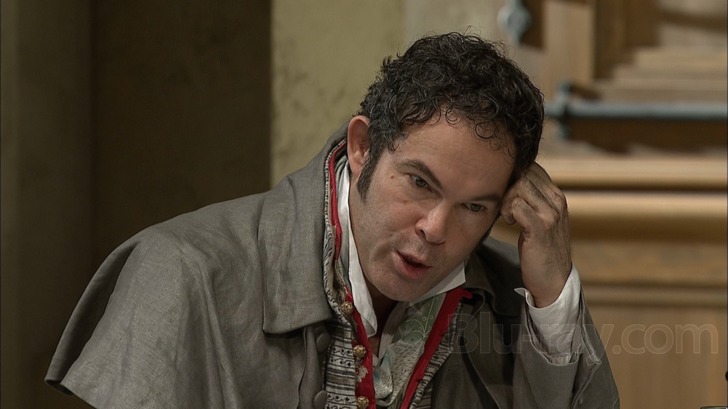
Wagner also brings a real life character to life in Die Meistersinger von Nürnberg, an actual historical figure named Hans Sachs, played by Gerald Finley in this production. Sachs serves as a sort of musical conscience of the opera, striking out against Beckmesser’s unthinking formalism while championing the intuitive inspiration of Walther. The character is also sort of bittersweet, with a deeply moving scene with Eva where he realizes that while she might settle on him for a husband, it’s Walther who has actually captured her heart.
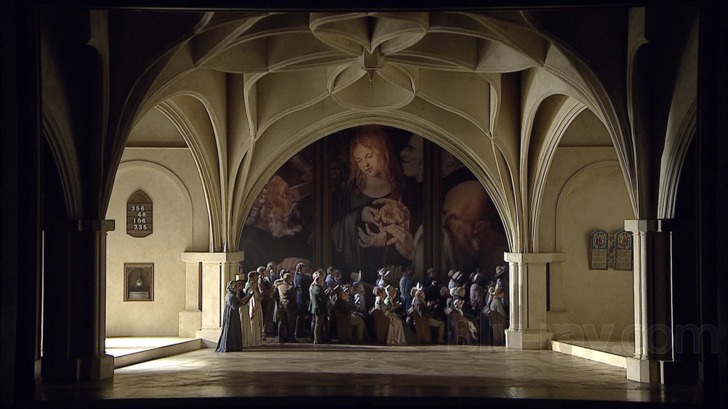
The Glyndebourne Festival Opera was originally conceived to be a sort of English Bayreuth, but circumstances prevented the Christie family from really exploiting Wagner until they finally were able to produce Tristan und Isolde there in 2003 (the Blu-ray features a 2007 remounting). In fact the Festival is probably best known for its Mozart interpretations, compositionally a world or more away from the heavier (in every sense of the word) works of Wagner. But under the inspired direction of David McVicar, this Die Meistersinger von Nurnberg actually has an incredibly engaging lightness, which at the same time never negates the intrinsic message the opera wishes to impart. McVicar wisely keeps his directorial “vision” to a minimum, staging the opera with a minimum of fuss and bother but with a gorgeous production design that places most of the action under the towering canopies of a church cathedral.
The singing in this production is largely impeccable, especially Finley’s Sachs, which is achingly, even heart breakingly, lyrical and well realized. Jentzsch’s Walther is a bit more problematic, but he’s an athletic and appealing presence who physicality helps to overcome some of his vocal shortcomings. Kränzle’s Beckmesser is appropriately dark and foreboding, but also inherently comical. The conducting of Vladimir Jurowski is a little on the brisk side at times, but he culls a really gorgeous sound out of the London Philharmonic Orchestra, with some incredibly lovely soli by some of the reeds.
Wagner: Die Meistersinger von Nürnberg Blu-ray Movie, Video Quality
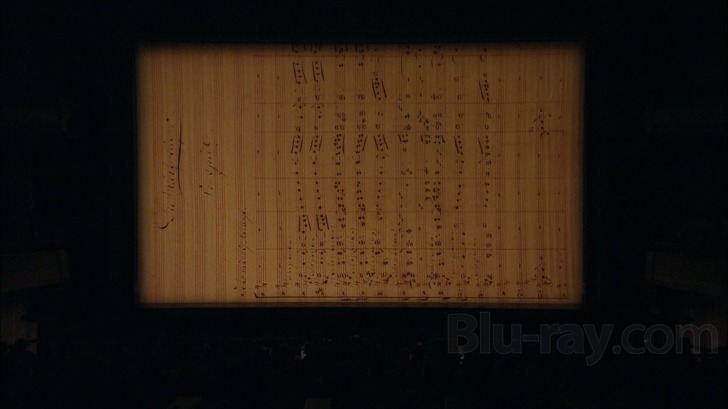
Die Meistersinger von Nürnberg is presented on Blu-ray courtesy of Opus Arte with an AVC encoded 1080i transfer in 1.78:1. This is a very nicely sharp and detailed looking high definition presentation that benefits from the sumptuous production design, including Vicki Mortimer's evocative sets and costumes. The full depth of Glyndebourne's stage is utilized under McVicar's direction, with the first act especially notable for its impressive depth of field, especially when the action takes place upstage. Most of the opera is well lit, meaning there aren't any issues with shadow detail, something that routinely hobbles these live performance Blu-rays. Close-ups reveal abundant fine detail, including at times some of the makeup on the singers.
Wagner: Die Meistersinger von Nürnberg Blu-ray Movie, Audio Quality
Die Meistersinger von Nürnberg features a lossless DTS-HD Master Audio 5.1 surround mix as well as an uncompressed LPCM 2.0 stereo fold down. This is one of those rare instances where there's a really noticeable difference between the two mixes, with the LPCM offering coming off as a bit anemic when compared to the much more robust and full bodied DTS-HD Master Audio mix. The 5.1 option offers superior fidelity, with a richly burnished orchestral sound ably supporting but never overpowering the singers. There's not a huge amount of separation between the singers when they're onstage together, but there is some appealing sense of ambient hall reverb in such scenes as the opening chorale when the ensemble is singing far upstage (and one assumes, also offstage). Dynamic range is also very wide.
Wagner: Die Meistersinger von Nürnberg Blu-ray Movie, Special Features and Extras
- Cast Gallery (1080i; 1:23)
- Die Meistersinger von Glyndebourne (1080i; 8:22) is a great background piece on this massive Glyndebourne production, the largest in fact that Glyndebourne has ever attempted. Glyndebourne's connection to Wagner and Bayreuth is detailed with various members of the Christie family.
- Die Meistersinger von Nürnberg—An Opera With Baggage (1080i; 10:38) focuses more specifically on this particular production and what director David McVicar sought to create, including divorcing the opera from some historical elements that have hobbled the opera since its premiere. The opera's status as a sort of "confessional" by Wagner is also explored.
Wagner: Die Meistersinger von Nürnberg Blu-ray Movie, Overall Score and Recommendation
"Richard Wagner" and "joyful" are not words one usually associates with each other, which is what makes this often ebullient production of Die Meistersinger von Nürnberg so inviting. Lushly staged and expertly played and sung, this production makes a few minor tweaks (like the time frame) without ever sacrificing the central message of Wagner's delightfully clear libretto. This may be a resolutely traditional production (at least for the most part), but that doesn't mean it's not bracing. This Blu-ray offers excellent video and superior audio and comes Highly recommended.