Wagner: Die Meistersinger von Nürnberg Blu-ray Movie
HomeWagner: Die Meistersinger von Nürnberg Blu-ray Movie 
Opus Arte | 2008 | 306 min | Not rated | Jan 25, 2011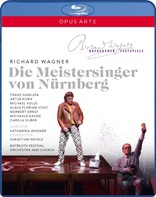
Price
List price:Listed on Amazon marketplace

Movie rating
6.5 | / 10 |
Blu-ray rating
| Users |  | 0.0 |
| Reviewer |  | 3.0 |
| Overall | | 3.0 |
Overview
Wagner: Die Meistersinger von Nürnberg (2008)
A double premiere, Katharina Wagner's first production on Bayreuth's Green Hill and the first live recording from the Festival on Blu-ray.
Starring: Franz Hawlata, Artur Korn, Michael Volle, Klaus Florian Vogt, Norbert ErnstDirector: Andreas Morell
| Music | 100% |
Specifications
Video
Video codec: MPEG-4 AVC
Video resolution: 1080i
Aspect ratio: 1.78:1
Original aspect ratio: 1.78:1
Audio
German: DTS-HD Master Audio 5.1
German: LPCM 2.0
Subtitles
English, French, Spanish, German
Discs
50GB Blu-ray Disc
Single disc (1 BD)
Playback
Region A (B, C untested)
Review
Rating summary
| Movie |  | 2.5 |
| Video |  | 4.0 |
| Audio | | 4.0 |
| Extras |  | 2.0 |
| Overall | | 3.0 |
Wagner: Die Meistersinger von Nürnberg Blu-ray Movie Review
Questionable judgment at Nuremberg.
Reviewed by Jeffrey Kauffman April 4, 2011The sins of the father are to be laid on the children. So wrote Shakespeare, paraphrasing The Book of Exodus. But in watching this often alarmingly anachronistic 2008 production of Die Meistersinger von Nürnberg, one has to wonder if perhaps the inverse is true, and that the sins of a child may be visited on the father, or in this particular instance, the great-great grandfather. Katharina Wagner, the great-great granddaughter of Richard, grew up in the great tradition not only of Wagneriana in general, but in the starry climes of that most redolent of all Wagner palaces, Bayreuth. Long the refuge of the Wagner family, and for a strange dialectic which pitted stark traditionalism against an urge to reinvent Richard for new generations, Katharina may be faulted for not toeing anything close to a traditionalist line, but she certainly can’t be accused of being a coward. By all accounts she faced two seasons of resounding audience catcalls when she took her post-Meistersinger curtain calls, and the production itself, which actually premiered in 2007, has seemingly been one of the most controversial ever at the Bayreuth Festival. It’s not exactly surprising that this new Blu-ray release omits Wagner’s appearance on stage, but even judicious editing couldn’t have omitted the overpowering “boo”’s which emanate from the audience before the curtain even has a chance to stop billowing across the stage. It’s one of the most amazing displays of audience negativity imaginable, especially at the usually extremely “structured” Bayreuth audience. But is the venom really warranted? In some ways, undoubtedly. But in others, probably not. Katharina Wagner may have made some serious errors in judgment in recasting the way she, and thus her audience, sees several main characters, but she obviously has an eye for stagecraft and for attempting at least to find a way to divorce this piece from its nationalistic subtext.
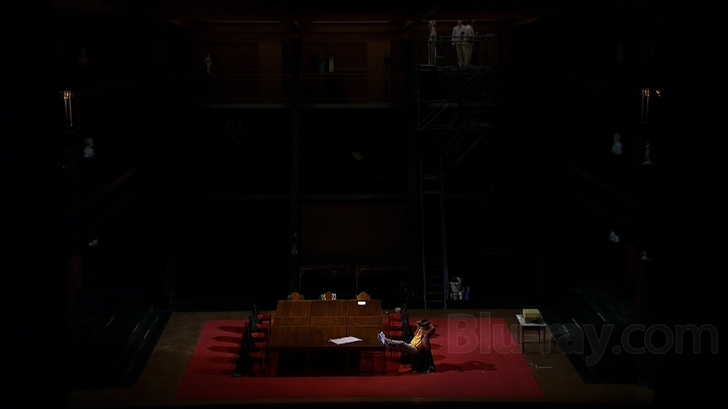
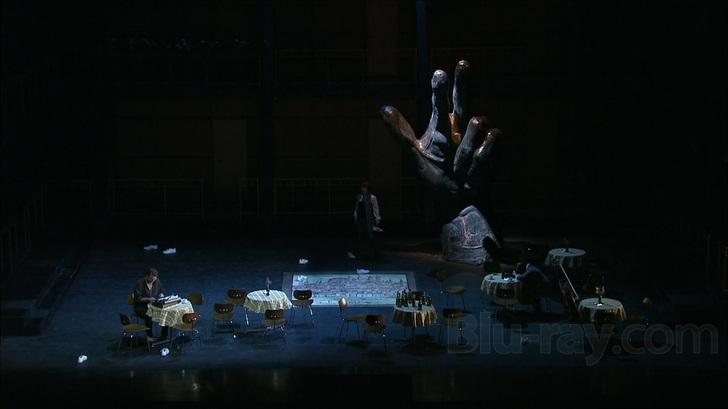
Wagner probably couldn’t have won no matter what she had tried, but the major problem with her approach may have simply been that she tried too hard. Her multi-plane staging is so full of busy activity it’s positively distracting a lot of the time. While it’s certainly okay to recast a scene like the opening without its expected church setting, what exactly are we to make of the scurrying (and noisy) ensemble literally assembling tables in the background as the main action plays out downstage left? This is just one example of directorial overkill. It probably sounded fantastic in the planning stages, but seeing it unfold onstage is a completely different animal, and one that should have been put out of its misery before the premiere curtain was raised.
There are other at the very least questionable elements here. Act III sees a coterie of mutant sized bobble heads of various iconic German art figures, included Great Granddaddy Richard himself (replete with trademark beret), dancing around in flagrante as their oversized heads (as well as other oversized appendages, if you catch my drift) wobble to and fro, looking for all the world like they’re about to fall off and crush the orchestra. And some cynical types might be wondering if that giant hand which graces the stage is just beginning to flip off the audience. Other visual tropes are interesting, like Sachs and Walter assembling jigsaw puzzles as they craft their own literal “master” pieces, but more cynical and inquiring minds may not just be asking “Why?” but also questioning any need for such a symbolic display of what the text is already telling us. In fact, more literal minded Wagnerians have evidently been the most upset by Katharina Wagner’s purported lack of Personenregie, i.e., a line by line analysis of the text and score with each of the leads, but that criticism seems to miss the rather glaring point that Wagner herself doesn’t seem all that concerned with traditional conceptions of Meistersinger, either the piece as a whole or certainly with respect to individual characters, notably Beckmesser (Michael Volle), whose function in the piece is almost willfully subverted from its original conception.
Madness. Madness. Everywhere madness. When the cobbler Sachs (Franz Hawlata) rails against the general zeitgeist as he perceives it, it becomes a perhaps piquant commentary on some of the excesses we’re witnessing on stage. In fact Sachs himself is supposedly hilariously shown as the only shoeless person onstage. (Get it? A cobbler, the only shoeless person?) But in other ways Wagner’s approach reaps better dividends. She has Walther (Klaus Florian Vogt) slather paint over portraits of Dürer and other icons and both Walther and Sachs are shown to be twin sons of different mothers in a way, each an iconoclast who gives up radicalism for a life of diffident conformity. While Die Meistersinger is often berated for its incipient Aryanism, there’s actually a very potent discourse here about art versus commerce, and that aspect is handled (for the most part at least) rather well by Katharina Wagner. Where she may have come up noticeably short is in trying to make the whole contest aspect a sort of operatic version of Nuremberg Idol.
The cast and orchestra seem to be occasionally off kilter here, perhaps thrown for more than a mere loop by Wagner grande-grande-fille’s anarchistic approach to her ancestor’s famous piece, one which has frankly never quite fit into the comedic niche with which it’s often labeled. Some of the singing is exceptional, notably Vogt, whose soaring tenor easily scales Wagner’s challenging peaks and valleys. Somewhat less successful is Franz Hawlata, whose heaviness is never able to nimbly make its way through some of Wagner’s more florid melismas. The orchestra also occasionally overplays its hand and the evening has a certain imbalance between accompaniment and singing as a result.
The most interesting thing about this production, for better or worse, may well be the backstage drama which accompanied it. Bayreuth was at a turning point, with Katharina’s father Wolfgang wanting his daughter to assume his leadership post, while others preferred Katharina’s half-sister, Eva Wagner-Pasquier. The Board of the Festival ultimately opted for the two to share the mantle previously held solely by their father, but there was evidently a lot of behind the scenes scuffling before the announcement was made, and perhaps this Meistersinger was nothing other than a show of force by Katharina, one which no doubt got her lots of attention, but perhaps not in the most favorable light. In fact this sort of family squabbling would make an ideal opera. Is there a free Wagner around somewhere?
Wagner: Die Meistersinger von Nürnberg Blu-ray Movie, Video Quality
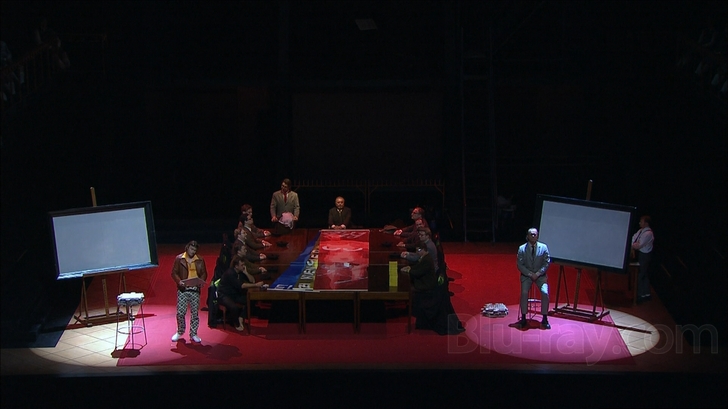
Die Meistersinger von Nürnberg arrives on Blu-ray courtesy of Opus Arte with an AVC encoded 1080i transfer in 1.78:1. This production is quite colorful (in more ways than one), and this Blu-ray captures that visual flair with an overall excellent degree of sharpness, clarity and fine detail. Camera coverage is almost overwhelming at times, giving us a variety of views, and close-ups reveal everything from the perspiring performers to some liberally applied makeup. Colors are robust and very well saturated. Black levels are also very good, and there's excellent delineation between some of the darker costumes and the black upstage area. There are some minor cases of artifacting, notably some minor aliasing and shimmer on an ornate screen and some of the sweaters the women wear.
Wagner: Die Meistersinger von Nürnberg Blu-ray Movie, Audio Quality
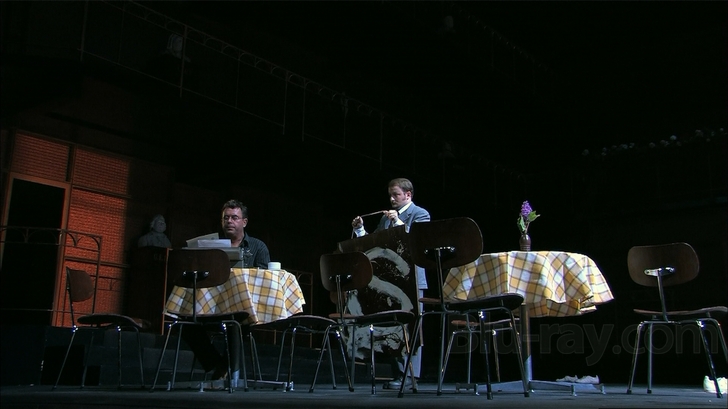
Both of the lossless tracks on this Blu-ray, a DTS-HD Master Audio 5.1 and an LPCM 2.0, perfectly recreate what was heard at the Bayreuth Festival, and that's both good news and bad news. Unfortunately, as mentioned above, conductor Sebastian Weigle never seems to have a firm enough hand on the dynamics end of things, and so there is more than occasional imbalance between the orchestra and individual singers. Generally the orchestra sounds fantastic here, aside from some volume issues, with incredibly burnished brass and some very warm string sounds. Fidelity is superb and the DTS track is able to support even the most bombastic moments of Wagner's score. Aside from the balance issues, the voices also sound very good to excellent, and there's some very good utilization of the surround channels in some of the ensemble singing, notably in some of the sections which are sung offstage.
Wagner: Die Meistersinger von Nürnberg Blu-ray Movie, Special Features and Extras
- Making Of (SD; 29:17). It's odd that Opus Arte, which usually grants us any extras in at least 1080i, offers this featurette in 480p. Be that as it may, this is an interesting enough piece, with copious interviews and lots of rehearsal footage, but it completely fails to address why exactly Katharina took such a radical approach to this piece, and furthermore, why exactly she made these choices.
- Cast Gallery (1080i; 2:00)
Wagner: Die Meistersinger von Nürnberg Blu-ray Movie, Overall Score and Recommendation
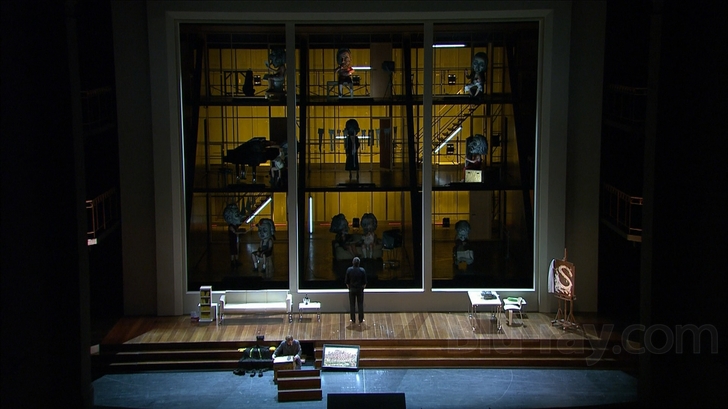
You may not be bored by this Meistersinger, but I have to wonder if you'll ever be fully engaged, either. The best revisionists are directors with a clear idea of both what and why they're doing what they're doing. Katharina Wagner strikes me as an incredibly talented young woman who hasn't quite found her footing yet and is still too eager to prove she can tackle her iconic great-great-Grandfather's legacy. Unfortunately there's not enough real thought behind many of her sleights of hand here, and we're left instead with a sort of smarmy interpretation that may be incredible to see, but which leaves a slightly unpleasant aftertaste.