Wagner: Der Ring Des Nibelungen Blu-ray Movie
HomeWagner: Der Ring Des Nibelungen Blu-ray Movie 
Kultur | 1991-1992 | 917 min | Not rated | Oct 30, 2012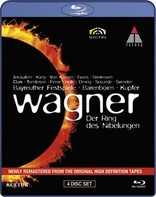
Price
List price:Listed on Amazon marketplace

Movie rating
7.3 | / 10 |
Blu-ray rating
| Users |  | 0.0 |
| Reviewer |  | 4.0 |
| Overall | | 4.0 |
Overview
Wagner: Der Ring Des Nibelungen (1991-1992)
Starring: John Tomlinson, Gunter von Kannen, Poul Elming, Siegfried Jerusalem, Anne Evans| Music | 100% |
Specifications
Video
Video codec: VC-1
Video resolution: 1080i
Aspect ratio: 1.78:1
Original aspect ratio: 1.78:1
Audio
German: LPCM 2.0
German: DTS 5.1
German: Dolby Digital 5.1
Subtitles
English, French, Spanish, German, Italian
Discs
50GB Blu-ray Disc
Four-disc set (4 BDs)
Playback
Region A (B, C untested)
Review
Rating summary
| Movie | | 4.0 |
| Video |  | 3.0 |
| Audio | | 4.0 |
| Extras |  | 0.5 |
| Overall | | 4.0 |
Wagner: Der Ring Des Nibelungen Blu-ray Movie Review
This Ring brings a whole new meaning to the term laser disc.
Reviewed by Jeffrey Kauffman November 19, 2012Suddenly it’s raining Rings. The past two or three years have seen an astounding variety of Blu-ray releases of that most grandiose of operatic achievements, Richard Wagner’s Der Ring des Nibelungen. Things didn’t get off to an especially auspicious start with Wagner: The Ring Cycle, a beautifully played and in many ways sung Staatskapelle Weimar production that still was hobbled by one of the most misguided directorial “visions” of The Ring that I’ve personally seen (you haven’t lived until you’ve seen Fafner as The Michelin Man meets The Pillsbury Doughboy meets a Sumo wrestler, as I described it in my review—but then again, maybe you wouldn’t want to). Things improved rather dramatically about a year later with a remarkably innovative take on the four operas by the Catalan acrobatic group La Fura del Baus (for those not wanting to spring for the complete set without have some frame of reference, there’s an excellent highlights disc also available, which includes some exclusive bonus content). Along the way we’ve also been offered standalone releases of various individual Ring operas, including Die Walkure and Götterdammerung (this release culled from that same dunderheaded Staatskapelle Weimar cycle linked to above). But this past year has seen two extremely high profile Ring releases, both of which were highly anticipated and which serve as sort of figurative bookends indicating demarcations in various eras of Ring productions. The highly controversial recent Metropolitan Opera production of Der Ring des Nibelungen was a high tech marvel that either ingratiated or infuriated audiences, depending upon their point of view and tolerance for “gizmos” and stagecraft. Though it was “only” a Blu-ray audio release, just as hotly anticipated was the George Solti cycle from Decca’s legendary 1958 – 1964 recordings, incredibly handsomely packaged with a veritable glut of supplementary material. Now plunked down somewhere in between these two bookends (perhaps skewed just slightly toward the Met side of things) is the well remembered 1991 and 1992 Bayreuth Festival productions of The Ring which were dubbed at the time “The Laser Ring”, due to some astoundingly innovative (for the time) lighting effects. This cycle is notable for a largely English cast, many of whom were new to their roles, as well as for Daniel Barenboim’s measured conducting of the gargantuan score.
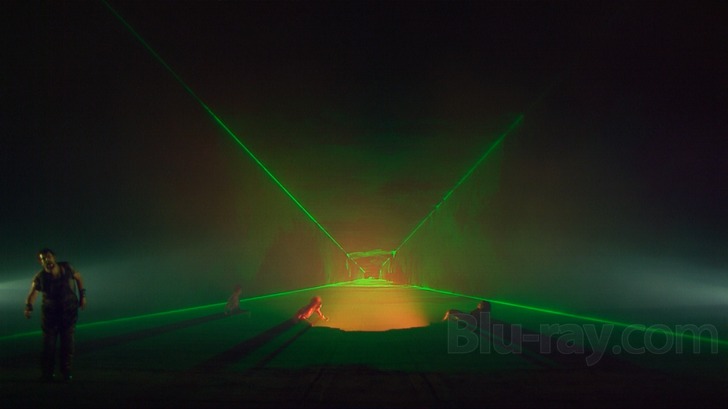
One of the really interesting things that the subsequent releases of The Ring may make more clear about this particular production, which was conceived and directed by Harry Kupfer, is just how transitory one era’s “high tech” becomes when a new generation of scientific wonderment comes along. Both the La Fura del Baus as well as the Metropolitan Opera versions made use of stupendous stagecraft, some of which simply wasn’t available or at least reasonably feasible as recently as the late eighties (when this version was originally done) or early nineties (when it was memorialized on video at the Bayreuth Festspielhaus). Kupfer’s conception is one of the more interesting Ring conceits in recent decades. The entire four opera arc plays out on what almost resembles an infinite runway of sorts that seems to fade off into an unimaginable distance. In Das Rheingold especially, but sporadically throughout the other three operas, laser light effects help create a mystical, almost hallucinatory, experience. In fact Kupfer’s conception of the Rhinemaidens in Das Rheingold is perhaps the strongest of any production I’ve personally seen, as some sort of stage magic which I can’t quite discern allows the keepers of the gold to literally disappear into the mists generated by the laser lighting scheme. It’s an unforgettable effect. (It should be noted that evidently the video production necessitated the use of a really ugly sickly green laser when evidently the actual stage production used a more noble blue light that for some reason did not translate well to video).
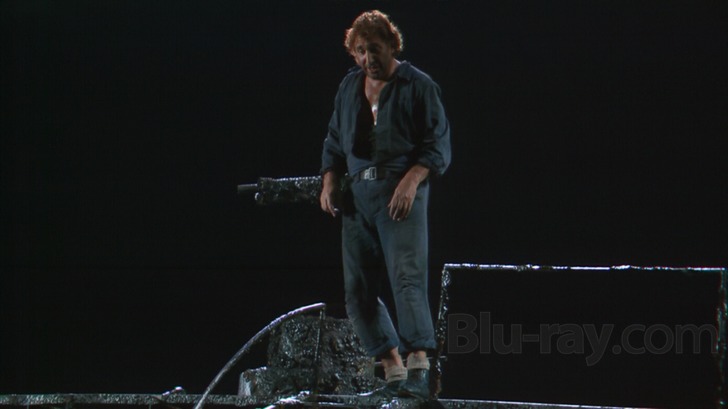
Kupfer’s conception aimed to be timeless, setting the myth in a post-Apocalyptic future where Gods and Men were doomed, in Kupfer’s own words, to repeat the mistakes of previous generations. While that may have been his conception, the actual physical production is somewhat more muddled. At times, there’s an almost laughable element to some of the costumes (the trenchcoats decorated with foliage is a prime example), while at other times, there are some striking new ideas bandied about. For example, the Norns at the opening of Götterdämmerung now almost resemble female versions of Death from The Seventh Seal, and instead of weaving a rope of destiny, they instead are binding together television antennas with metal cable. It may sound like Eurotrash, but it actually pays off in one of this cycle’s most riveting sequences, when at the end of the final opera, elegantly clad disaffected people gather around their tellies to witness the end of the world. It’s absolutely brilliant and really quite chillingly prescient in its own way.
From a performance standpoint, this is one of the strongest Rings, at least generally speaking, of the past generation or so, all the more remarkable in that so many of the primary roles were being sung for the first time by these particular actors. John Tomlinson is an absolutely commanding Wotan, and this cycle has one of the most heart wrenching Sieglindes ever, Nadine Secunde. The quite aptly named Siegfried Jerusalem (wow!) inhabits Siegfried with a visceral athleticism as well. Barenboim’s conducting ethos seems to boil down to something like, “Well, come on now, you know you’re in for four nights and around fifteen hours of music drama, so why rush things?” This is one of the more languorous Rings on record, but it still has some compelling energy. Barenboim seems to eschew the bombast of Wagner’s score in favor of a more deliberative, almost classical, approach. It’s unexpected, but it works quite miraculously well most of the time.
This Ring is certainly not as overtly showy as either the La Fura del Baus or the Metropolitan versions are, but its very minimalism perhaps allows Wagner’s evocation of the dialectic between the Gods and Mankind to reverberate more meaningfully. Wagner himself lamented the fact that his nineteenth century stagecraft could never adequately address the demands that his libretto made, and unfortunately a lot of twentieth and twenty first century directors have decided that the way to stage the Ring is to pull out all the bells and whistles imaginable so that everything Wagner imagined is up there on the stage for the whole world to see. This Ring hints at that directorial hubris, but actually refrains from going in whole hog, as it were, often populating large swaths of all four operas on a basically empty stage. How ironic, then, that those are some of the most convincing moments in this or any Ring.
Wagner: Der Ring Des Nibelungen Blu-ray Movie, Video Quality
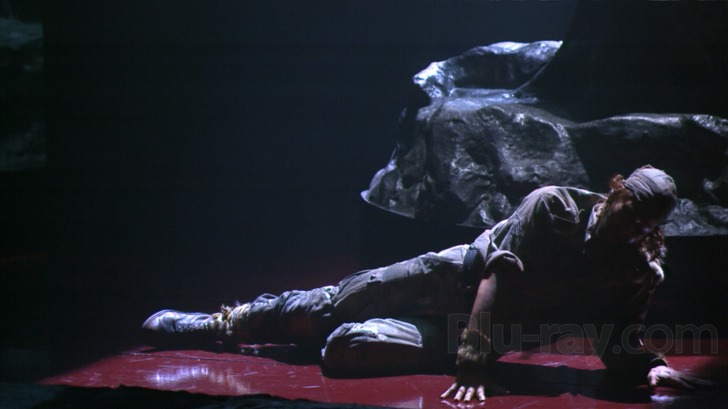
Wagner: Der Ring des Nibelungen is presented on Blu-ray courtesy of Kultur, Warner Classics and Unitel with a VC- 1 encoded 1080p transfer in 1.78:1. The following note is included in this set's insert booklet:
This famous recording has been remastered from Unitel's original High Definition tapes (analogue 1250 lines). After digitizing into the modern High Definition format (1080 lines), video restoration was undertaken to maximize the picture quality. Standards conversion was then made into the 16:9 NTSC format (genuine widescreen). There are occasional disturbing distortions in the video picture during the first 25 minutes of "Das Rheingold". These effects were caused by the on-stage laser technology used in the production. The laser frequencies caused interference in the circuitry of the video cameras. This was already noticed during the recording, but at the time this problem could not be overcome.Despite the care that this transfer has evidently been given, it can't really escape its video roots, even without the occasional laser-created anomaly. Things are pretty soft throughout all four operas, with only the occasional close-up finally popping with vigorous clarity and sharpness. Rather strangely, Siegfried looks the best overall, markedly better than the other three, perhaps because its lighting scheme is generally brighter. There are some issues endemic to the video source elements here, including some very minor ghosting and at times brief pixellation that includes very minor horizontal lines entering the image (usually at the bottom) for just a second or two. Colors are often nicely saturated here, but the use of that sickly green laser really robs a lot of the image in those sequences of anything even approaching modest fine detail. Contrast is generally quite good and black levels are solid. Considering the source elements, this is a decided step up from the previously released DVD box set, but it simply can't come close to more modern high definition video of live performances.
Note: My copy of Die Walküre had some freezing issues as it wound to around the two and a half hour mark. I was able to make it through the entire opera with a little patience (and several reloadings). None of the other three discs had any issues.
Wagner: Der Ring Des Nibelungen Blu-ray Movie, Audio Quality
Der Ring des Nibelungen features three audio options, an uncompressed LPCM 2.0 stereo track, a DTS 5.1 (not DTS-HD Master
Audio) and Dolby Digital 5.1 track. Perhaps surprisingly there isn't a whale of a lot of difference in terms of forcefulness of the LPCM and DTS
tracks, though the DTS track at times has a slightly odd phasing quality in the midrange as if some channels in the multitrack source tapes were
being played simultaneously and slightly out of phase. It may in fact only be a facet of expanding the original audio into a DTS surround track,
but it's slightly distracting at times. The LPCM track offers superb clarity and balance, with really elegantly handled prioritization between the
voices and Barenboim's orchestra. Brass sounds are aggressively burnished without ever sounding brash or brittle, and strings and winds
breathe beautifully throughout all four operas. The voices here, which should of course be the main focal element, all sound remarkably clear
and distortion free. Even Wagner's most declamatory vocal writing is offered with clarity and precision here, aided by some incredibly athletic
technique on the part of the principal singers. Dynamic range is quite wide (as anyone who has ever heard the Ring will attest).
Note: Pay attention to the English subtitles. This is not your father's Wagner translation.
Wagner: Der Ring Des Nibelungen Blu-ray Movie, Special Features and Extras
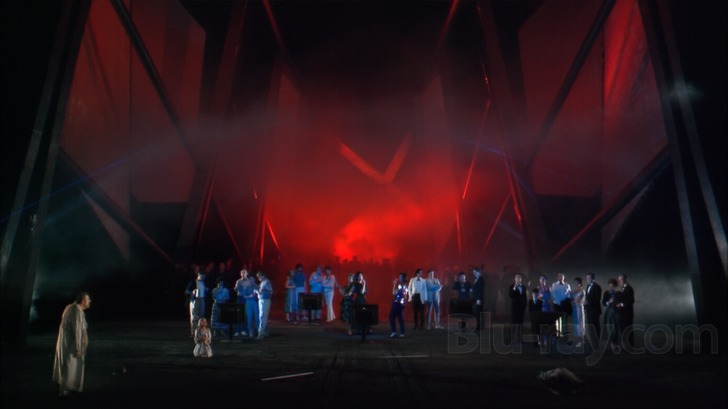
- Barenboim and Tomlinson About the Kupfer Ring (1080i; 13:22). John Tomlinson starts this excellent little featurette out by talking about being approached for the role of Wotan and not thinking he was ready. He goes on to discuss how many of the cast had either never essayed these iconic roles before, or at the very least not very often. Barenboim discusses director Harry Kupfer's minimalist but quasi- futuristic concept and how he wanted to give this Ring a timeless feeling.
Wagner: Der Ring Des Nibelungen Blu-ray Movie, Overall Score and Recommendation
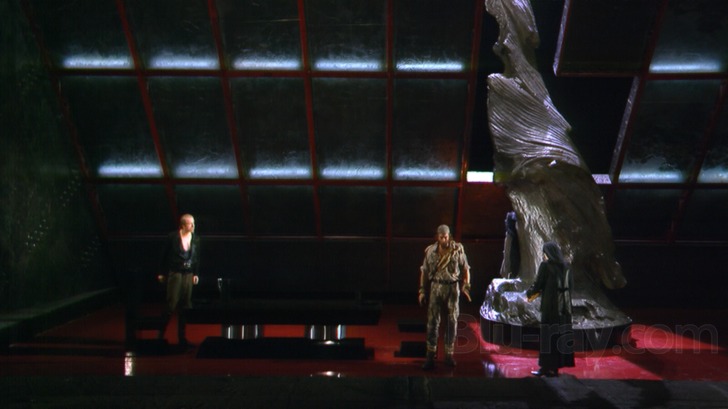
It had actually been quite a while since I had last seen this Ring, and it was a real joy to revisit it. Yes, some of its elements seem just a tad dated, and Kupfer's conception probably looked better on paper than it sometimes plays on stage. But what a bracing interpretation this often is, and even in some of the subtle but effective stagecraft—like when Sieglinde's hut just rises up around her and Siegmund in Die Walküre—you can clearly see where later productions like The Met's got some of their ideas. Despite this production having been granted the nickname "The Laser Ring", the laser elements are really rather conservatively utilized and they are undeniably effective and even haunting in Das Rheingold. Kupfer's final vision in Götterdämmerung may not actually make a lot of sense when held up to the cold rational light of day, but it's arresting and unforgettable. Barenboim conducts this opera without one eye on the clock as some baton wielders seem to, and the results, while inarguably slower than many Rings, are also emotionally resonant and very impactful. The video here has some age and source related issues, but the uncompressed stereo audio sounds fine and this Ring certainly ranks among the best "contemporary" versions currently available on Blu-ray. Recommended.