Wagner: Der Ring Des Nibelungen Blu-ray Movie
HomeWagner: Der Ring Des Nibelungen Blu-ray Movie 
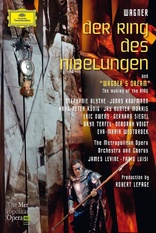
Metropolitan OperaDeutsche Grammophon | 2012 | 5 Movies | 912 min | Not rated | Sep 11, 2012
Price
List price:Listed on Amazon marketplace

Movie rating
7.7 | / 10 |
Blu-ray rating
| Users |  | 4.2 |
| Reviewer |  | 4.0 |
| Overall | | 4.0 |
Overview
Wagner: Der Ring Des Nibelungen (2012)
| Music | 100% |
Specifications
Video
Video codec: MPEG-4 AVC
Video resolution: 1080i
Aspect ratio: 1.78:1
Original aspect ratio: 1.78:1
Audio
German: DTS-HD Master Audio 5.1
German: LPCM 2.0
English: DTS-HD Master Audio 5.1
English: LPCM 2.0
English on "Wagner's Dream" only
Subtitles
English, French, Spanish, German, Mandarin (Traditional)
Discs
50GB Blu-ray Disc
Five-disc set (5 BDs)
Packaging
Slipcover in original pressing
Playback
Region A (B, C untested)
Review
Rating summary
| Movie |  | 3.5 |
| Video | | 4.0 |
| Audio | | 4.5 |
| Extras | | 4.0 |
| Overall | | 4.0 |
Wagner: Der Ring Des Nibelungen Blu-ray Movie Review
Engineering a new 'Ring' cycle.
Reviewed by Jeffrey Kauffman September 18, 2012Richard Wagner’s Der Ring Des Nibelungen is the most daunting operatic experience in the entire music theater
repertoire, and not just for audiences. Staging The Ring Cycle is a formidable task, one which often requires
years of pre-production and planning, and that’s one reason why this gargantuan quartet of mythic pieces is not as
frequently performed as one might think, at least considering the outsized reputation Wagner’s magnum opus
has among the musical cognoscenti. That may be one reason The Ring Cycle hasn’t been particularly well
served in terms of quantity if not of quality on Blu-ray—at least not yet. One of the only complete versions available in
Region A
thus far is the incredibly brilliant and stunningly staged version by La Fura del Baus. (A highlights disc of this version featuring snippets from
all four operas plus some exclusive bonus content is also available.) It also looks like Kultur has a complete version streeting in late
October. (For completists who might otherwise take me to task for not mentioning them, there are a couple of
standalone releases of individual operas from The Ring Cycle, including Die Walkure and Götterdammerung. And lest anyone
accuse me of leaving it out, there's also this complete version, which I recommend only for those who don't mind listening without
watching what is a production I consider to be remarkably dunderheaded a lot of the time.)
One might be tempted to speculate that The Metropolitan Opera took at least part of its inspiration for its first
new production of The Ring in over twenty years from the Fura del Baus interpretation, for they hired Robert
Lepage to conceive and stage the epic piece. Lepage has made his mark with a series of spectacular theatrical
achievements, chief among them some typically resplendent pieces for Cirque du Soleil. As I repeatedly pointed out in
my reviews of the Fura del Baus productions, there was a definite Cirque du Soleil “vibe” that ran through them, with
impressive acrobatic feats melded with a multimedia approach that seemed to push Wagner’s vaunted idea of a
synaesthetic music theater into the 21st century.
Rather than an attempt to sum up the labyrinthine Ring again, I refer those who don’t know much about the operatic cycle to my reviews of the Fura del Baus versions, which contain brief recaps of at least a few salient plot points:
Wagner: Das Rheingold Blu- ray review
Wagner: Die Walkure Blu-ray review
Wagner: Siegfried Blu-ray review
Wagner: Götterdämmerung Blu-ray review
In Wagner’s Dream, the fascinating and excellent bonus documentary included with this set, two Met employees jokingly attempt to sum up The Ring Cycle in two sentences, which boil down pretty much to gold being stolen from the Gods, leading to the end of a Divine Era and the beginning of a human epoch. (This may unintentionally bring to mind the currently ubiquitous commercials for gold on certain cable outlets, including the one featuring actor William Devane asking, “Don’t you just love the feel of gold?” Some cynics may be prone to ask what this trend may portend for the future of Mankind, considering the havoc wreaked upon the Gods when they lusted after gold.)
Because of its legendary stature, The Ring Cycle has fierce proponents (one might almost say “adherents”) who will insist that any given production either succeeds or fails based upon their subjective, yet supposedly unassailable, beliefs of how the operas should be staged. It’s therefore no huge surprise that the Met’s gargantuan new production was greeted with its fair share of brickbats along with some rapturously laudatory reviews as well. What is so fascinating about many of these reactions is how centrally they were focused not on the opera, not on the singing, not even on some of the playing or other supposedly ancillary content, but upon one main item: the 90,000 pound set piece at the center of the production (and the stage) which its creators nicknamed “the machine”. This fascinating quasi-sculpture resembles a row of parallel planks (planks being a decidedly relative term for structures this massive), all of which can move either singly or together in any number of variations. The planks therefore become everything from the waters of the Rhine to a rainbow bridge to various strata of Valhalla on which the Gods declaim to a precarious staircase that fleet footed characters traipse across. Rarely has one production (or set of productions in this case) depended so solely on one gargantuan conceit.
And yet there is a compelling reason for Lapage’s emphasis on this unusual piece of set design. As Wagner’s Dream elucidates, Lepage became enamored of the Icelandic mythic saga, the so-called Eddas (there’s a Poetic Edda and a Prose Edda), and became convinced that Iceland was actually the birthplace for much that eventually matriculated into Der Ring des Nibelungen. Lepage looked at the tectonic activity in Iceland and decided that these huge moveable planks would be the perfect visual analog to depict the massive changes that confront the Gods and humans populating the worlds of Wagner’s immense story.
There is however an inherent risk involved in literally building a production of The Ring around a set piece like this. We are obviously dealing with larger than life characters, and Wagner’s hyperbolic musical vocabulary doesn’t exactly lend itself to outright empathy a lot of the time. There’s a distance between the audience and the characters—whether Divine, semi-divine, or merely mortal—in much of The Ring. This is not to say that there’s not an emotional tether in the operas, for there most certainly is, but it’s one that is colored by an overt intellectualism, quite different than that found in operas that speak more directly to the heart. What Lepage’s gambit here does is actually emphasize that distance by focusing on stagecraft rather than characterization and plot. I repeatedly found myself being drawn out of the drama due to being admittedly awestruck by the giant plank structures morphing themselves into all sorts of evocative formations.
The ironic thing is, as striking as Lepage’s conception is for this Ring (and it undeniably is), it isn’t any more striking than that of La Fura del Baus. The documentary Wagner’s Dream catches some prospective audience members in line outside of The Met worrying about various aspects of the production, including rumors of a “light show”, but the funny thing is the Fura del Baus production does include many more multimedia elements than The Met production, along with a much more ambitious design aesthetic especially with regard to costumes and props, and yet that production seems in a way more fully integrated than Lepage’s conception.
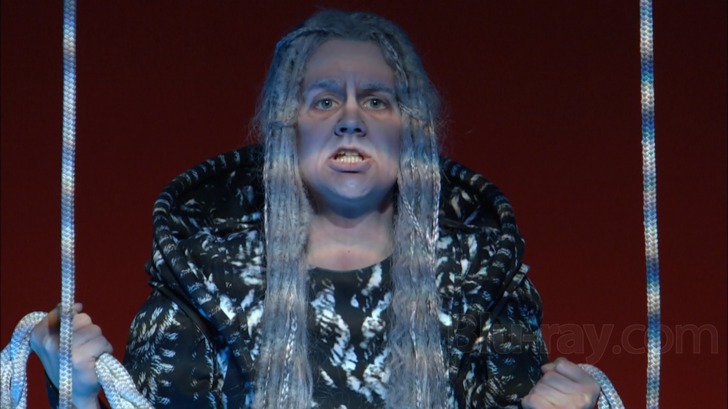
And so once one gets beyond the awesome technical wizardry, one is still left with a couple of salient questions: how does this Ring fare from purely dramatic and musical standpoints? The answer, perhaps surprisingly, is rather well, at least in fits and starts. It must be admitted that Lepage’s emphasis seems to be on spectacle rather than nuance, and so some of the drama is lost in the cogs of “the machine”. However, there are some real standout performances here, including a heart wrenching turn from Eric Owens as Alberich, one which instantly rises to the heights of the finest Wagnerian interpretations in the modern operatic era. The production was roiled by the last minute casting of Jay Hunter Morris as Siegfried, but he also rises to the occasion dramatically if not always vocally.
Musically things are on fairly solid ground, though here, too, the production had its fair share of backstage drama. Longtime Met Musical Director James Levine bowed out after the first two operas, ostensibly to tend to his longstanding health issues, with Fabio Luisi stepping in to man the baton for the final two installments. Rather interestingly, Luisi may actually have extracted greater clarity from The Metropolitan Opera Orchestra, but he also sacrifices some of sheer passion that seems to be at Levine’s virtual fingertips. Musically, this is a much “starrier” cast than the Fura del Baus ensemble, and that pays off in several commanding performances. Bryn Terfel is a commanding Wotan, though he has some occasional roughness in his midrange which some may find objectionable. Though some evidently weren’t especially impressed with Deborah Voigt’s Brünnhilde, I found her interpretation wonderfully adept and full of an almost palpable desperation as the story wended its convoluted course. The aforementioned Jay Hunter Morris jumps into one of the most notoriously difficult tenor roles of all time with Siegfried, and the results, while somewhat mixed from a purely aesthetic standpoint, are rather remarkable, especially considering Morris’ lack of rehearsal and preparation time for the part.
My hunch is that time will probably be kinder to this production than some contemporary critical analyses may indicate. Lepage obviously had his hands full with the stagecraft, and most likely left a lot of the dramatic and musical content up to a cadre of seasoned professionals and ambitious relative newcomers. The good news is when the cast is full of such names as Terfel, Voigt, Jonas Kaufmann and Eva-Maria Westbroek (among a large and varied ensemble), perhaps a sturdy directorial hand isn’t all that necessary. Some concentrated so much on the gimmickry of Lepage’s conception that they perhaps overlooked the towering achievements in much of the singing and the exquisite playing and conducting of Levine and (perhaps to a slightly lesser extent) Luisi. This Ring may not be as breathtaking or forward looking as the Fura del Baus version, but it manages to walk a fine line between the traditional and the innovative. Lepage may have substituted a “machine” for that tightrope, but generally speaking, he manages to guide everyone across the rainbow bridge more or less intact.
Wagner: Der Ring Des Nibelungen Blu-ray Movie, Video Quality
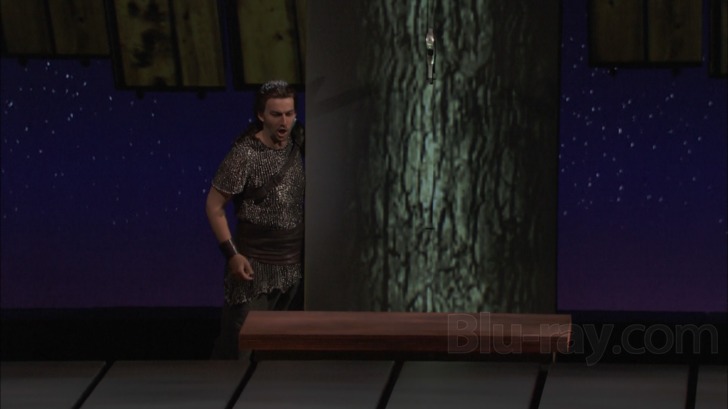
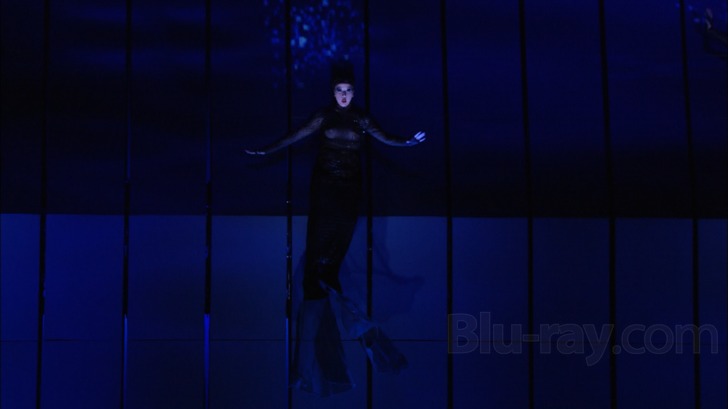
Der Ring des Nibelungen is presented on Blu-ray courtesy of Deutsche Grammophon with an AVC encoded 1080i transfer in 1.78:1. Met Director Peter Gelb has been trying to drag the Met into the 21st century, both with "updated" versions of classic operas (his Tosca was a major controversy in the hoity-toity world of classical music), but also with a series of high definition broadcasts piped into theaters nationally. These Ring performances were captured on high definition in performances directed for video by the top notch Gary Halvorson, who continues his excellent work with mostly fine coverage here. Halvorson occasionally opts for head scratching angles (why shoot the rainbow bridge from the side, which clearly shows the harnesses and rigging hoisting the actors upward, for example), he manages to capture a lot of the operas in great close-ups and midrange shots which pop rather well with some pleasing fine object detail. Once cameras move much further back than the pit, however, things tends to descend into fuzzy murkiness, something not helped by the fact that so much of this production is done in relative darkness. Shadow detail is negligible throughout quite a bit of this Ring, something which is manifestly obvious from several of the screencaps accompanying this review. A lot of the "machine" transformations look quite awesome in this high definition presentation. Colors are also robust and very well saturated. This isn't a slam dunk video presentation, but generally speaking it does very well, especially when Halvorson gets "up close and personal" with the large cast.
Wagner: Der Ring Des Nibelungen Blu-ray Movie, Audio Quality
Sonically speaking, this Ring is more often than not astounding, with the lossless DTS-HD Master Audio 5.1 mix beautifully spacious and offering sterling fidelity. Wagner fans know that the Ring presents the composer at his most overwrought and hyperbolic, and dynamic range here is incredibly wide. Brass is effulgent and wonderfully bright without ever sounding brash, and the strings and winds seem to breathe with life and energy. Best of all, the balance here between the orchestra and the singers is just about perfect all of the time. There are some occasional distractions which spill into the surrounds, including some errant coughs from audience members and what sounds like the machinery of "the machine" cranking away, but these pass quickly and don't amount to much of an overriding concern. For the record, there's also an uncompressed LPCM 2.0 track available as well.
Wagner: Der Ring Des Nibelungen Blu-ray Movie, Special Features and Extras
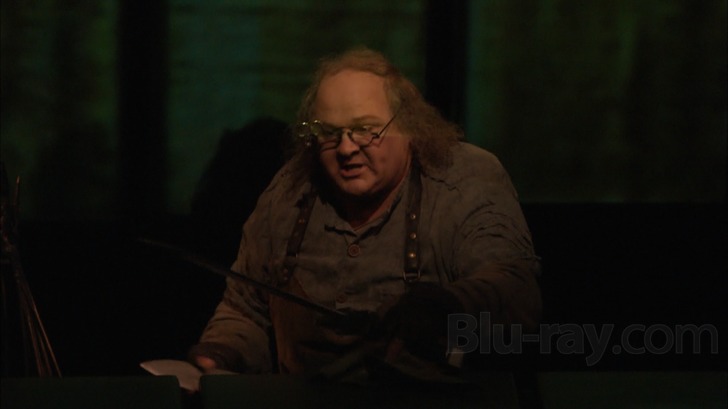
Deutsche Grammophon has wisely not included "interstitial" backstage interviews and the like as they have done with
other operatic releases. Each of the four operas contains various supplements, all accessed via the main menu and not
included as part of the actual performance.
Das Rheingold:
- Das Rheingold in rehearsal at The Met (1080i; 8:17) has some great footage of James Levine working with the orchestra as well as some of the work that was required on the gargantuan set.
- Deborah Voigt interviews Bryn Terfel (1080i; 3:02).
- Wagner's Leitmotifs (1080i; 5:31) is an excellent overview of one of Wagner's main organizing principles throughout the four operas.
- Placido Domingo interviews Deborah Voigt (1080i; 2:35)
- Joyce DiDonato interviews Stephanie Blythe (1080i; 3:09)
- Placido Domingo interviews Jonas Kaufmann and Eva-Maria Westbroek (1080i; 2:49)
- Joyce DiDonato interviews Bryn Terfel (1080i; 2:08)
- Joyce DiDonato interviews John Sellars (1080i; 2:34)
- Placido Domingo interviews The Valkyries (1080i; 1:58)
- A New Siegfried for The Ring (1080i; 11:47) doesn't shy away from one of the more controversial aspects of this production, the last minute casting of Jay Hunter Morris in one of the key roles in the opera.
- Renée Fleming interviews Jay Hunter Morris, Fabio Luisi, Eric Owens and Mojca Erdmann (1080i; 6:05)
- Mary Jo Heath interviews Roger Parent of Réalisations.net (1080i; 2:08)
- Renée Fleming interviews Gerhard Siegel, Bryn Terfel and Deborah Voigt (1080i; 7:03)
- Patricia Racette interviews Robert Lepage (1080i; 2:38)
- Patricia Racette interviews Wendy Bryn Harmer and Iain Paterson (1080i; 1:52)
- Patricia Racette interviews Waltraud Meier (1080i; 1:56)
- Patricia Racette interviews Jay Hunter Morris (1080i; 2:40)
- Patricia Racette interviews Deborah Voigt (1080i; 2:58)
- Patricia Racette interviews Fabio Luisi (1080i; 3:00)
- Wagner's Dream: The Making of the Metropolitan Opera's new Der Ring Des Nibelungen (1080i; 1:54:01). This incredibly interesting documentary by Susan Froemke. Shot over several years, the documentary traces the long evolutionary process that brought this gargantuan production to the stage. Though it focuses chiefly on "the machine", with all of its attendant trials and tribulations, we get an amazing first hand look at what it takes to stage an operatic quartet of such epic proportions. Froemke learned her stuff at the feet of the Mayles Brothers (Grey Gardens), and it shows in her unadorned treatment of both the triumphs and, frankly, disasters of this production.
Wagner: Der Ring Des Nibelungen Blu-ray Movie, Overall Score and Recommendation
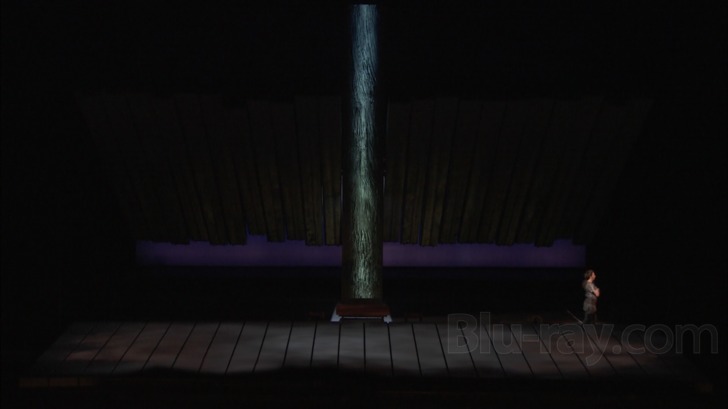
If a critical analysis of this Ring were based solely on ambition, this would be a five star affair all the way, no questions asked. One must give kudos to Lepage for at least attempting to meld an innovative concept with a more traditional dramatic approach. If the results are mixed, that doesn't mean they're lamentable, as has been the case with some Eurotrash reimaginings of these vaunted pieces. One of the major theses sparking the genesis of this production is that Wagner himself said The Ring was unstageable with 19th century technology, and this production at least attempted to solve some long lingering problems with how to depict the thornier aspects of Wagner's magnum opus. The major problem with this production is perhaps that La Fura del Baus did this all and a good deal more with their radical reinterpretation, and parts of this production seem like a pale imitation of that outing at times. On the other hand, this production has an A-list cast which for the most part does very, very well in one of the most difficult scores in the entire history of Western music. You may not be entirely pleased with this production, but I doubt you'll be deeply disappointed by anything, either. This is an often riveting vision of The Ring which doesn't work all of the time, but which does enough of the time to warrant checking it out. While some of the video here suffers from being too dark, the audio is superb, and the supplemental features are excellent. Recommended.
Similar titles
Similar titles you might also like
(Still not reliable for this title)

Pink Floyd: Wish You Were Here
Blu-ray Audio | 50th Anniversary Edition
1975

David Gilmour - Live at the Circus Maximus
2024

Prince and the Revolution: Purple Rain
Blu-ray Audio
1984

Fleetwood Mac: Rumours
Atmos Blu-ray Audio
1977

The Beatles: Let It Be
Super Deluxe Edition | Blu-ray Audio
1970

David Bowie: The Rise and Fall of Ziggy Stardust and the Spiders from Mars
Dolby Atmos Blu-ray Audio
1972
Depeche Mode: Strange Too
1990
Depeche Mode: Strange
1988

Pink Floyd: The Dark Side of the Moon
50th Anniversary Atmos Remix / Blu-ray Audio
1973

Roy Orbison: Black & White Night 30
1987-2017

Prince and the Revolution: Live
1985

John Williams: The Berlin Concert
Limited Deluxe Edition
2021

Pink Floyd: Pulse
1995

Pink Floyd: Animals
Atmos Remix / Blu-ray Audio
1977

Eric Clapton: The Lady in the Balcony - Lockdown Sessions 4K
2021

The World of Hans Zimmer: Live at Hollywood in Vienna
2018

Madonna: The Girlie Show - Live Down Under
1993

S&M2: Metallica and San Francisco Symphony
2019

John Williams - Live in Vienna
2020

Nick Mason's Saucerful of Secrets: Live at the Roundhouse
2019