WWII in Hi Def Blu-ray Movie
HomeWWII in Hi Def Blu-ray Movie 
Topics Entertainment | 1942-1963 | 410 min | Unrated | Oct 12, 2010

Movie rating
6.5 | / 10 |
Blu-ray rating
| Users |  | 0.0 |
| Reviewer |  | 4.5 |
| Overall | | 4.5 |
Overview
WWII in Hi Def (1942-1963)
A collection of documentaries from the U.S. National Archives is featured on this four disc set.
| War | Uncertain |
| History | Uncertain |
| Documentary | Uncertain |
| Period | Uncertain |
Specifications
Video
Video codec: VC-1
Video resolution: 1080p
Aspect ratio: 1.38:1
Original aspect ratio: 1.37:1
Audio
English: DTS-HD Master Audio Mono
English: Dolby Digital Mono
Subtitles
None
Discs
25GB Blu-ray Disc
Four-disc set (4 BDs)
Playback
Region A (B, C untested)
Review
Rating summary
| Movie | | 4.5 |
| Video |  | 3.5 |
| Audio |  | 3.0 |
| Extras | | 0.0 |
| Overall | | 4.5 |
WWII in Hi Def Blu-ray Movie Review
An amazing collection of documentaries from the U.S. National Archives is featured on this superlative four disc set.
Reviewed by Jeffrey Kauffman September 28, 2010Part of the joy of being in on the ground floor of a new format like Blu-ray is watching niche players grow and prosper as the format takes hold and provides greater audience access. Washington state’s Topics Entertainment’s product was long seen in the budget aisle of big box retailers like Walmart and Fry’s, offering a number of “ambient television” releases like Aquarium and Fire, as well as the occasional documentary, that provided good to excellent visuals and OK (if usually lossy) soundtracks that early Blu-ray consumers could snatch up by the handful to check out their systems without paying an arm and a leg. Topics is slowly expanding their horizons with some really interesting, and often top notch, releases. I was frankly blown away by the first two of their AMOS (A Matter of Substance) releases earlier this year, Rise and Rebel, short form Koyaanisqatsi-esque compendiums of footage set to some appealing music. But I must say I am more than impressed with this new four disc set of WW II in Hi Def from Topics featuring a slew of documentaries culled from the National Archives. While there are a couple of niggling complaints I have—no liner notes or insert booklet and packaging which stacks the four discs on a single spindle, as well as a very minor authoring error which will display Disc One as Disc Two and vice versa on your introductory PS3 screen if you use that system—they pale when one considers the breadth and depth of material contained herein. Though you wouldn’t know by the rather minimal listing on the back of the keepcase insert, this compilation includes several Oscar winners for Best Documentary, at least a couple of notably notorious releases (at least back in their day), and a who’s who of (uncredited) Hollywood royalty in front of and behind the camera, people like John Ford, John and Walter Huston, Henry Fonda, Alfred Newman, Dimitri Tiomkin and more.
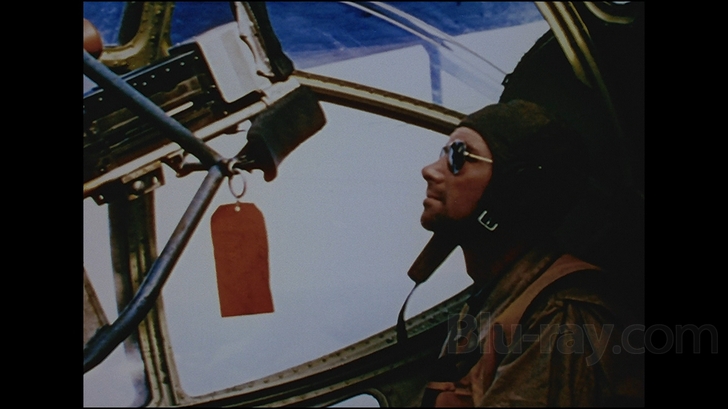
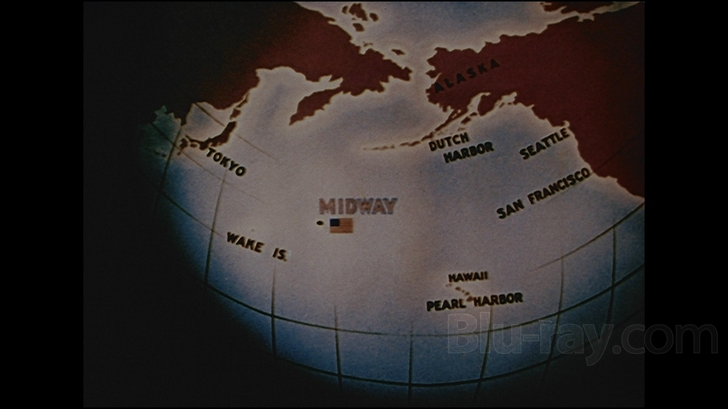
A pilot flying towards Midway.
WW II in Hi Def presents ten features spread over four discs.
Disc One
With the Marines at Tarawa (1944; Technicolor; 19:12) won the Best Short Subject Documentary Oscar in 1945. Directed by actor Louis Hayward, this chilling documentary recounts a fierce naval battle which for some reason has disappeared into the mists of history, though which was headline news in November and December 1943, when it occurred. Two Marine cinematographers were killed during the filming of this fascinating piece, and Hayward also took home the Bronze Star for his efforts. One of the more poignant moments shows Marines praying before battle as narrator William Lundigan informs us that many of the young men we’re watching died the next morning, part of the over 10,000 casualties of this confrontation.
The Battle of Midway (1942; Technicolor; 18:10) won the Best Short Subject Documentary Oscar in 1943. Directed by John Ford (who was wounded while filming this piece), and featuring voice work by Henry Fonda and Jane Darwell, The Battle of Midway is outright United States propaganda, made to comfort a distraught American public which had seen defeat after defeat in the early days of the War subsequent to the devastating attack at Pearl Harbor. While safety and strategy concerns precluded Ford and his team from filming most of the naval engagements which were the bulk of Midway, this is a fascinating, “you are there” look at one of the decisive turning points in the early days of World War II.
Let There Be Light (1946 [perhaps 1948]; Black and White; 57:57) is at once both the most intrinsically fascinating and the most disturbing documentary included on the four discs of this compilation. Long suppressed by the United States government (the film wasn’t even screened until the early 1980s), this John Huston helmed feature recounts the rehabilitation of the emotionally scarred veterans who returned from the war in mental shambles, proving that “Post Traumatic Stress Disorder” is not a relatively recent phenomenon. The film states that nothing was staged for dramatic purposes, and while some more jaded viewers may question that assessment, there’s no denying the gut wrenching drama of watching mentally unstable vets attempt to regain their emotional and rational equilibrium. In fact some of them are suffering from such extreme psychosomatic problems they need to regain their physical equilibrium. This is a no holds barred look inside psychiatry as it was practiced in the postwar era. There’s very little coddling going on, and an emphasis on drug-induced therapy, but as a glimpse into both a troubling phenomenon and a time capsule look as to how it was handled back then, Let There Be Light is completely visceral viewing.
Disc Two
December 7 (1943; Black and White; Short Version: 33:50; Long Version 1:15:08). Wow! That’s about all that most people will be able to muster after watching this odd and completely politically incorrect feature, at least in its long version. Helmed by iconic cinematographer Gregg Toland (with a little help from John Ford, who was evidently brought in to smooth over some rough edges), this completely peculiar feature is a fascinating look at how America perceived itself and the threats to its existence in the early days after Pearl Harbor. Contrasting the two versions of this film offered on this disc is equally fascinating. The short version of December 7 actually won the Oscar in 1944 for Best Short Subject, and it’s a fairly literal look at the bombing of Pearl Harbor, though it, like the longer version, suffers from some ham-handed recreations of the attack interspersed with actual footage from the event. But it’s the long version you should spend some time with, and not just because the image and audio quality are head and shoulders above the rather badly damaged truncated version (something I found odd, considering the fact the short version was an Oscar winner and one would think it would have been better preserved than it evidently was). In the longer version we get Walter Huston portraying Uncle Sam (he shows up briefly in the short version as well), who is on vacation in Hawaii on December 6, 1941. He’s soon visited by wonderful character actor Harry Davenport, playing Mr. C, the “C” standing for conscience. What ensues is a jaw-dropping look at anti-Japanese rhetoric as well as a rather bracing scolding about American inattention to a growing threat. You frankly may be flabbergasted by a lot of what is portrayed here, including a rather vicious indictment of Shintoism (of all things), but as a look back on the national emotional tenor in 1943, December 7 is quite simply unforgettable.
Disc Three
Unfortunately because Topics did not provide an insert booklet or supplementary material, I’m a bit at a loss to give copious information about the four episodes about famous generals contained on this disc. A cursory search of the internet indicates that in the 1950s the Army Pictorial Center produced a television series called The Big Picture, which was evidently syndicated for many years. Sometime in the early 1960s (perhaps 1963 from what I could gather), new introductions by Walter Matthau were filmed for some of these episodes, and three of the four features on this disc have those Matthau introductions. All of these black and white enterprises offer some great biographical background on their subjects, though all of them suffer from various levels of “hero worship,” failing to really dig into some of the personality failings of at least a couple of the general portrayed. Therefore, the MacArthur episode completely glances over his missteps in Korea and his eventual conflict with Truman, dealing with all of it extremely cursorily in little more than one sentence. The Patton episode is similarly fitted with blinders, unwilling to look into that general’s megalomania and volatile temperament. The four episodes featured are MacArthur (28:30), narrated by Walter Cronkite; Eisenhower (28:50), narrated by Raymond Massey; Omar Bradley (28:34), the unsung hero of World War II who let others hog the limelight while he did the actual fighting (he was my father’s immediate Commander and I have some wonderful letters from him to my Dad); and Patton (27:29), narrated by some one time actor named Ronald Reagan or something like that.
Disc Four
The fourth disc features only one item, Nuremberg (Black and White; 1:14:57), which, again because of no supplementary information given on this release, is hard to pin down, production wise. I am surmising due to the long segments of German text within this documentary that this is the international version of the 1946 German documentary Nürnberg und seine lehr. While this is one of the shoddier looking and sounding features included on this set, it’s nonetheless a fascinating first hand account of the Nuremberg trials, intercut with brief historical sketches of the history of the German aggression and its various consequences, including, of course, the Holocaust. If you’ve seen Stanley Kramer’s Judgment at Nuremberg, this makes a fascinating companion piece, and is especially interesting as virtually every German official called to testify insists they had “seen no evil, heard no evil” or “spoken no evil.” It’s a frankly disgusting testament to the most debased elements in Mankind’s soul, but it makes for extremely compelling viewing.
WWII in Hi Def Blu-ray Movie, Video Quality
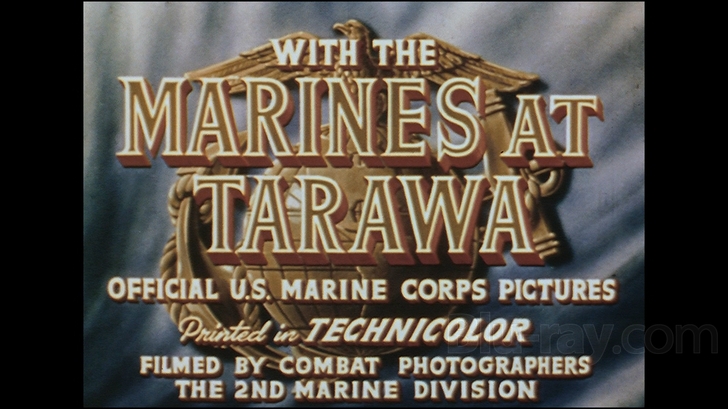
As with any compilation which spans this much material and various source elements, WWII in Hi Def's VC-1 encoded 1080p image (in 1.38:1) varies considerably. The good news is the vast majority of these ten features look pretty darned amazing in their hi-def upgrades, as long as you keep in mind many of these were originally shot on either 16mm or 35mm under battle conditions which frequently resulted in early exposure or damage to the actual negative. The Technicolor features included here are a tad on the soft side, though with fairly robust and well saturated color for something of this age. Aside from the short version of December 7 and Nuremberg, the black and white features look very good, with excellent contrast and generally very stable blacks. All of these features sport occasional (and sometimes more than occasional) blemishes, with scratches, dirt, white flecks and other debris dotting the image. But taking the historical import of these features into consideration, as well as their age, the image quality here for the most part is most definitely a pleasant surprise.
WWII in Hi Def Blu-ray Movie, Audio Quality
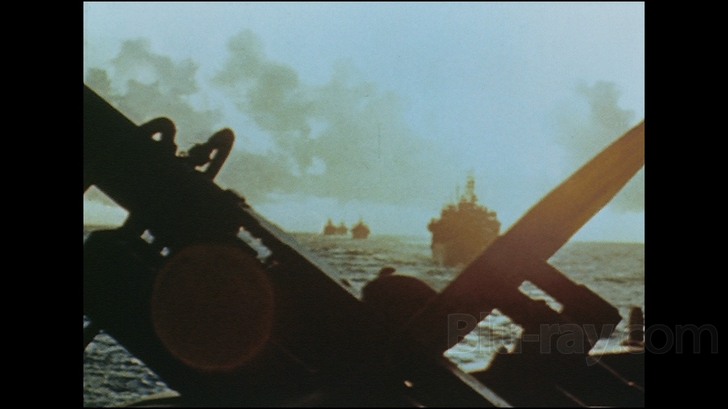
Two audio options are included on these Blu-rays, a DTS-HD Master Audio 2.0 mix and a Dolby Digital 2.0 mix (strangely the discs default to the Dolby mix--when are distributors going to figure out most Blu-ray consumers want lossless audio and will choose that mix if given the choice?). For the most part all of these features sound good to very good, within the confines of early 1940s recording techniques. A couple of the features have fairly badly damaged audio, including Battle of Midway, which easily fares the worst sound wise among the ten features included here. The short form December 7 also has some audio damage. The rest of the features, while boxy and lacking either extreme highs or lows, feature decent to excellent fidelity, albeit with hiss and the occasional pop and crack.
WWII in Hi Def Blu-ray Movie, Special Features and Extras
No supplements are included on any of the four discs. The one supplement this set cries out for is an insert booklet with background information on all of these features.
WWII in Hi Def Blu-ray Movie, Overall Score and Recommendation
This is an astoundingly fine set from Topics, and kudos to the label and the producers who assembled this excellent collection of documentaries. Anyone with even a passing interest in World War II and the United States' filmed history of it should have this set in their collections. Highly recommended.
Similar titles
Similar titles you might also like

WWII in HD
World War II in HD
2009

Vietnam in HD
2011

Victory at Sea
Deluxe Edition
1952-1953

The World at War
1973

They Shall Not Grow Old
2018

The Vietnam War
2017

Korengal
2014

D-Day: Normandy 1944 4K
75th Anniversary Edition
2014

Apocalypse: World War II
2010

Gettysburg
2011

Ken Burns: The Civil War
1990
Report from the Aleutians
1943

WWII From Space
2012

The World Wars
2014

The War
2007

Restrepo
2010

Last Days in Vietnam
American Experience: Last Days in Vietnam
2014

Ultimate Civil War
150th Anniversary Edition
2012

Apocalypse: Hitler
Apocalypse: The Rise of Hitler
2011

The Cold Blue
2018