Verdi: Otello Blu-ray Movie
HomeVerdi: Otello Blu-ray Movie 
Naxos | 2008 | 143 min | Not rated | Mar 30, 2010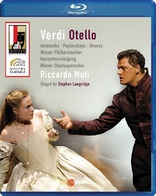

Movie rating
7.2 | / 10 |
Blu-ray rating
| Users |  | 2.0 |
| Reviewer |  | 4.0 |
| Overall | | 3.9 |
Overview
Verdi: Otello (2008)
Starring: Aleksandrs Antonenko, Marina Poplavskaya, Carlos Álvarez (XII), Barbara Di Castri, Stephen CostelloDirector: Peter Schönhofer
| Music | 100% |
Specifications
Video
Video codec: MPEG-4 AVC
Video resolution: 1080i
Aspect ratio: 1.78:1
Audio
Italian: DTS-HD Master Audio 7.1
Italian: LPCM 2.0
Subtitles
English, French, German, Italian, Spanish
Discs
50GB Blu-ray Disc
Single disc (1 BD)
Playback
Region free
Review
Rating summary
| Movie | | 4.0 |
| Video | | 4.0 |
| Audio |  | 4.5 |
| Extras |  | 2.5 |
| Overall | | 4.0 |
Verdi: Otello Blu-ray Movie Review
Verdi's penultimate opera receives an awesome production that introduces two premiere performances as Otello and Desdemona.
Reviewed by Jeffrey Kauffman June 1, 2010Will political correctness kill Shakespeare? For generations, artists and audiences have hotly debated the two most “problematic” characters and plays in the Bard’s oeuvre, Shylock in The Merchant of Venice, and Othello in his eponymous tragedy. Is Merchant anti-Semitic? It depends on whom you ask. Even such a redolent source as the Royal Shakespeare Company comes down on both sides of the debate, as is made apparent in one of the classic episodes of Playing Shakespeare (available on SD-DVD, and highly recommended to actors and non-actors alike). Just as controversial is the whole “Moorish” thing that underlies so much of Othello, though it’s often less patently obvious due to Shakespeare’s masterful interweaving of several plot threads, including jealousy, possible infidelity and betrayal, both platonic and otherwise. Political correctness has sometimes gotten in the way of Othello and its operatic counterpart Otello in sometimes silly sounding contretemps about things such as the use of the euphemistically labeled “Egyptian” makeup to make the title character appear black, or at least really well tanned. But in the current socio-religious climate fostered by the rise of radical Islam and the often threatening stance it seems to take to any and all things Western, one might be forgiven for wondering if Shakespeare himself would have been the target of a fatwa, as was Salman Rushdie several years ago. Though Shakespeare never attempts to depict the Prophet Muhammed, his whole subtext of the “otherness” of Islam and its adherent Otello’s reaction to the libertine sensibilities of the Christians of Cyprus may give some pause. But the fact is that same pause should set upon Christians themselves, as Shakespeare’s genius is that he finds the human flaws in everyone, no matter what their religious or sociological predilections might be.
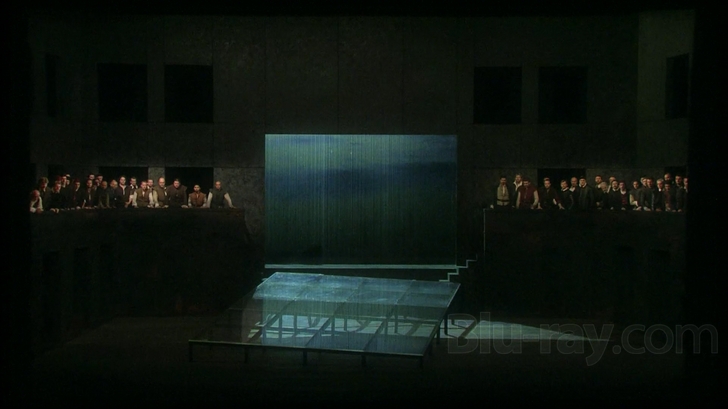
An unusual set design is a highlight of this 'Otello'.
Verdi came to the monument that is Otello very late in his career, having trod the Shakespeare turf early in his life with Macbeth. He would write one more opera after Otello, the Shakespeare pastiche Falstaff. But Otello is Verdi at the top of his game, miraculously setting the brilliant text of Arrigo Boito, which expertly distills and even expands on Shakespeare’s tragedy, opening it up for the sort of penetrating musical insight that only Verdi could provide. Is there any scene in opera as propulsively impressive as the opening moments of Otello? Verdi simply grabs us by our collective collars, shakes us a time or two, and lets us know we are in for an evening of unbridled drama and musical majesty. His orchestrations have never been more colorful or descriptive, and the vocal lines never more mellifluous and dramatically cogent, than they are throughout this magnificent piece, something that is brought home to bear from the opera’s opening bars.
The ménage á trois of Othello, Desdemona and Iago is perfectly operatic to begin with, with Iago’s seething jealousy and ultimate betrayal of Othello feeding beautifully into Othello’s own suppressed rage and torment borne of his own “otherness,” and Desdemona’s naïvete and, strangely, her own strength and resoluteness of will. Verdi took these three tragic figures and sought to illuminate their deepest emotional states—and there are no deeper emotions in the annals either of drama or opera—and against all odds, succeeded easily, one would almost say effortlessly, so lucent are the musical ideas which fulfill both strictly dramatic requirements while providing one of the most luscious listening experiences imaginable.
It’s a truism in the world of opera that there can be star conductors and star singers, but rarely do the two mix as easily as Verdi’s music and Shakespeare and Boito’s poetry. In this particular 2008 Salzburg production, the star conductor, Riccardo Muti, won out, and it is his musical vision which is depicted, for both better and worse. On the plus side, he is an absolutely ferocious conductor here, and he elicits a snarlingly effective performance from the Vienna Philharmonic. On the minus side, Muti regularly overpowers the singers with his interpretation and his volume. That’s especially sad as he has helped shape a beautifully lyrical performance by Marina Poplavskaya as Desdemona, making her fairly amazing debut in the role. Less effective is Muti’s personal choice for the title role, also making his debut as the character, Aleksandrs Antonenko. Antonenko seems uncharacteristically hesitant at times throughout this performance, as if the weight of one of the greatest roles in opera is settling uneasily on his soul (not to mention his sweat glands, which work overtime throughout the four acts of the opera). That actually works for the best in scenes where Otello is unsure, questioning the motives of everyone around him. When measured against the curt, evil concision of Carlos Alvarez’ raging Jago (Iago) and the liquid work of Poplavskaya, however, Antonenko is relegated to third wheel status, and is subsumed by the demands of the role.
Audiences at Salzburg were evidently skewing toward the negative in response to just about everything about this production, including what I personally feel is one of the strengths of Stephen Langridge’s stark presentation of Otello: the rather unusual unit set of George Souglidas. With a projection screen placed center stage, and a sort of Plexiglas terrace hovering in midair, this is a spare but effective use of space and contrast, and keeps this Otello slightly off kilter, something that works well with the emotional unrest of its characters.
Otello, like its source material, doesn’t need an awful lot added to the mix to make it incredibly effective. Perhaps Langridge and Muti are guilty of attempting to add too much to this particular production, though the charms and effectiveness of Poplavskaya and Alvarez help to mitigate any qualms. If Muti errs too much on making the orchestra the center of attention here, who can really blame him in the long run? With such ravishing instrumental virtuosity on display in virtually every note of this score, why should the singers get all the attention?
Verdi: Otello Blu-ray Movie, Video Quality
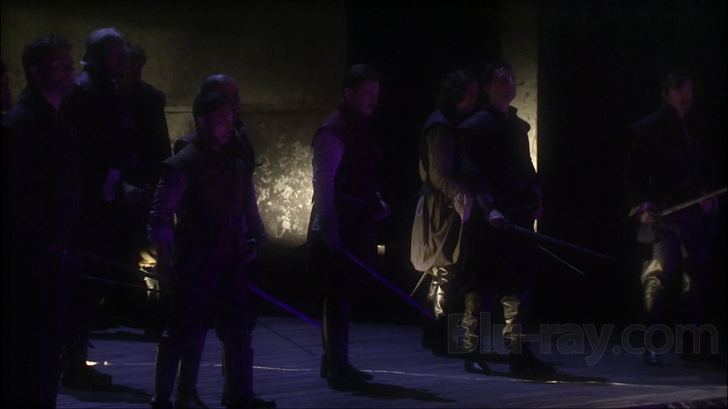
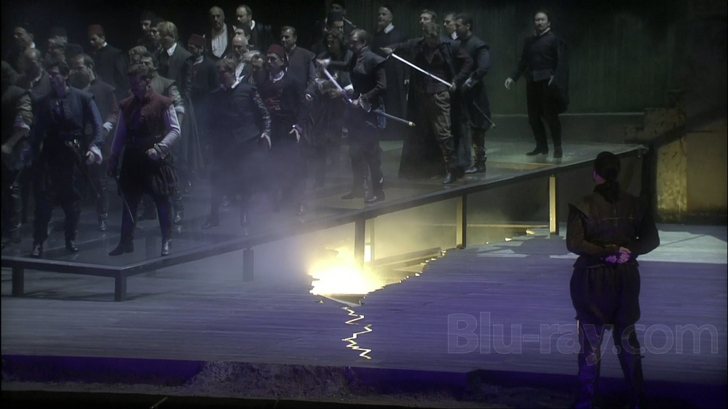
Otello arrives on Blu-ray from C Major and Unitel Classica with a generally very good AVC encoded 1080i "live" image presented in a 1.78:1 aspect ratio. This is neither the best nor the worst live opera release I've seen on a Naxos distributed release. While it sports decent enough color (though the bulk of this production plays out in tones of blue and purple), saturation is uneven and at times (Desdemona's final nightgown, for example) verges into blooming territory. Blacks are decent, if not incredibly deep, though shadow detail comes off quite well--note how Otello's black jacket never dissolves into the black backdrop. The sharpness of the Blu-ray comes through best in the brightly lit scenes, when we're privvy to perhaps a bit too much information on how ubiquitos Antonenko's perspiration problem seems to be. (To be fair, Alvarez also works up quite a face of sweat, though it takes him most of the evening to get where Antonenko is from virtually his first scene).
Verdi: Otello Blu-ray Movie, Audio Quality
I'm taking one half star off for what I lay squarely at Muti's conducting feet, that is, the occasional balance issue between orchestra and voices (strangely, it's the ensemble as much as soli). Otherwise, this splendid lossless DTS-HD Master Audio 5.1 mix is everything you could ask for in a Verdi recording. Lush, with incredibly forceful brass bursting through with appropriate punch and bombast, this is probably Verdi's greatest "roller coaster ride," compositionally speaking, and it all plays out here in really crystalline clarity. Singing is for the most part superb, especially in the cases of Polavskaya and Alvarez, and the DTS mix supports the range and dynamic sensibilities of both of these artists effortlessly. There's not an overwhelming wealth of surround activity here for a 5.1 mix, though Muti's orchestral forces fill and spill into the rear channels, helping to give at least the impression of immersion. The 2.0 fold down sounds rather remarkably clear and perhaps a bit more spacious than these things usually do. Stick with the 5.1 mix, though, if only for the ambient space it offers in this most resplendent of Verdi's writings.
Verdi: Otello Blu-ray Movie, Special Features and Extras
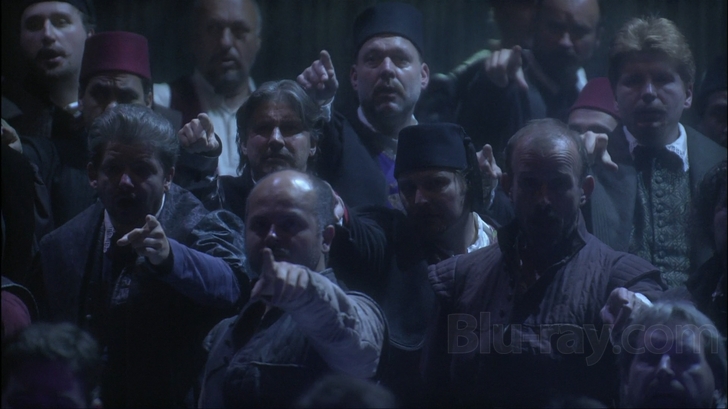
A fairly typical featurette entitled Talking 'Otello', (SD; 19:55) offers the cast and crew waxing philosophical about the great piece. A gallery of trailers is also included, and the insert booklet provides both some background on the production as well as a synopsis.
Verdi: Otello Blu-ray Movie, Overall Score and Recommendation
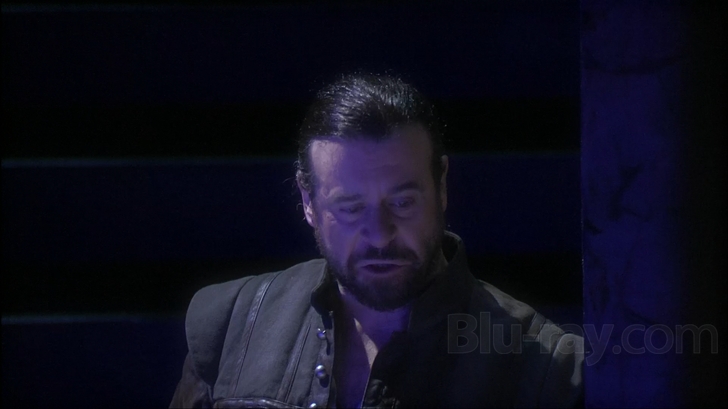
Otello simply defines grand opera, especially of the tragic variety. Graced by three of the most fascinatingly flawed characters ever to be put on stage, and with a literate and poetic libretto by Boito liberally borrowing from Shakespeare, not to mention the indescribably glorious music of Verdi, Otello stands at the summit of the mountainous output Verdi contributed to this art form. This production has its problems, that can't be denied, but even the artistic liberties taken by Muti and Langridge, and the ineffective work of Antonenko, can't seriously distract from the visceral impact of this impeccable piece of writing.