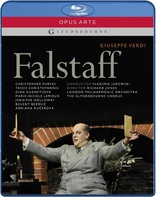
Verdi: Falstaff Blu-ray Movie
HomeVerdi: Falstaff Blu-ray Movie 
Glyndebourne Festival OperaOpus Arte | 2009 | 136 min | Not rated | Mar 30, 2010

Movie rating
6.8 | / 10 |
Blu-ray rating
| Users |  | 3.5 |
| Reviewer | | 3.5 |
| Overall | | 3.5 |
Overview
Verdi: Falstaff (2009)
Starring: Christopher Purves, Yannis Christoyannis, Dina Kuznetsova, Marie-Nicole Lemieux, Adriana KucerováDirector: François Roussillon, Richard Jones
| Music | 100% |
Specifications
Video
Video codec: MPEG-4 AVC
Video resolution: 1080i
Aspect ratio: 1.78:1
Audio
Italian: DTS HD-Master Audio 5.1
Italian: LPCM 2.0
Subtitles
English, French, German, Italian
Discs
25GB Blu-ray Disc
Single disc (1 BD)
Playback
Region A (B, C untested)
Review
Rating summary
| Movie | | 3.5 |
| Video |  | 4.5 |
| Audio |  | 5.0 |
| Extras |  | 1.5 |
| Overall | | 3.5 |
Verdi: Falstaff Blu-ray Movie Review
Falstaff gets transported to post-World War II Britain in this fitfully entertaining Glyndebourne production.
Reviewed by Jeffrey Kauffman May 8, 2010Success in any performing art usually risks the artist quickly being pigeonholed. Fans of the Golden Age of Hollywood are only too aware of this trend, with everyone from Joan Crawford to Gene Lockhart being asked to recreate basically the same role over and over. Television is an equally cruel mistress, forcing sitcom stars to remain sitcom stars forever, at least in the public consciousness at large despite sometimes impressive “crossover” performance (think Elizabeth Montgomery in A Case of Rape, for example). Top 40 musicians soon find any attempt to stray beyond their hitmaking sound usually soon spells marketplace disaster. And so it should probably come as no surprise that even an art form as recondite as classical music tends to “type” composers and expect them to deliver the same old, been-there heard-that, goods once a certain amount of acclaim and lucre have come their way. Perhaps no better example of this curious tendency exists than Giuseppe Verdi, he of the achingly romantic aria, patently melodramatic plot lines, and generally hyperbolically intense emotional style. Verdi compose a comedic opera? Surely, (no pun intended) you jest! And though Verdi only went to the buffa or commedia lirica well twice in his extremely long career, he beat the odds with Falstaff at least. This last opera of the composer is one of the most effortlessly ebullient, effervescent and just plain, downright funny operas in the entire repertory, let alone the usually staid and stolid world of 19th century Romanticism.
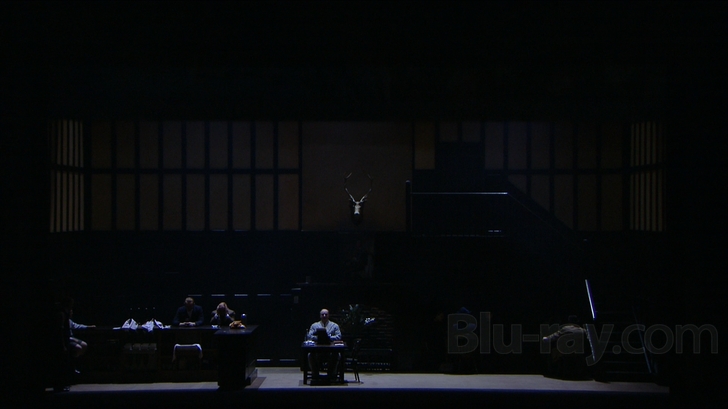
Falstaff types out some "form" love letters.
Verdi had traveled to the Shakespearean well twice before, with his classic tragedies Macbeth and Otello. What might seem a strange choice, this mixture of The Merry Wives of Windsor with elements from Henry IV turned out in fact to provide Verdi with a lightness of subject matter mixed with enough depth of characterization around which he could weave a surprisingly contrapuntally complex score. Falstaff (Christopher Purves) is a rich boor, ignorant or at least in denial about having let himself go, and still considering himself something of a ladies’ man. That of course sets him out on a farcical trip to a major comeuppance, as his attempts to simultaneously court Mistress Ford (Dina Kuznetsova) and Mistress Page (Jennifer Holloway) backfire when the women easily learn of his plans and decide to turn the table on him. There’s the usual operatic glut of subplots, including a nascent love affair between a younger couple, and the bumbling escapades of Falstaff’s servants, but the bulk of the evening is given over to Falstaff slowly being ensnared by his own machinations, leading to the denouement in a scene seemingly culled from another Shakespeare classic, A Midsummer’s Night Dream, although in this somewhat peculiar reimagining by director Richard Jones, it might be thought of as more of a midsummer’s night trip to a drive-in showing old Universal horror pictures (and no, I’m not joking).
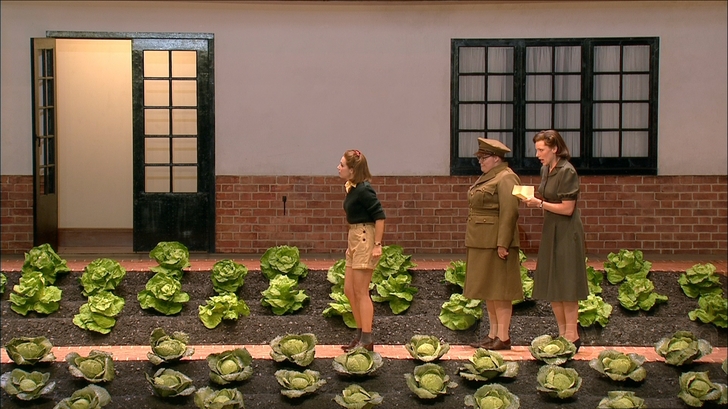
Jones has become something of a critical darling and/or enfant terrible (depending on your point of view) with his often outré stagings of operas. If this Falstaff is relatively reserved by Jonesian standards, it still bears the hallmark of a director seemingly obsessive compulsive about minutiae (the Stepford-straight rows of cabbages in the Ford’s garden, for instance), while never really explaining the main conceit of this staging, that is it’s setting in the post-World War II era of Britain’s “age of hatred,” as historian Niall Ferguson has called it. Certainly there was never a more egalitarian time in the class consciousness of Great Britain, as the privations caused by the war leveled the playing field, as it were, forging bonds between the landed gentry and the everyday working stiffs that helped offset not only the lack of staples (not to mention luxury items), but the growing threat of the cold war and the Iron Curtain.
Jones’ production never completely explicates why this Falstaff is taking place in this time period. It doesn’t seem a particularly smart commentary, given the opera’s emphasis on the class differences between the lords and ladies and the petit bourgeoisie. Instead what we’re offered is a very polished production design (by Jones’ frequent collaborator, Ultz) that is surface deep, never really helping to give insight into the matters at hand. That seems especially odd in the enchanted wood finale, when we literally have Frankenstein, his Bride, and Dracula traipsing about amidst the more expected nymphs and faeries. One almost expects to hear Mary Shelley’s famous monster slightly paraphrase himself and grunt “Conceit….bad.”
On the plus side, this is at least a sporadically deliciously sung and performed Falstaff, especially by Purves, whose first attempt at this role this is. Literally larger than life, Purves brings an odd, almost balletic, charm to the character, keeping him nicely balanced between imperious buffoon and hopeless, albeit hopelessly misguided, romantic. Adriana Kucerova does equally well with her Nanetta, offering a clear and fulsome soprano that is always delightful. I was less impressed by Tassos Christoyannis’ Ford, whose wavering baritone too often threw vibrato at the wall, hoping singular tones would stick.
This Falstaff doesn’t really ever devolve into the depths of “Eurotrash.” Jones’ intrinsic excellence helps propel the production forward, even when his individual choices frankly don’t make all that much sense. He’s aided immeasurably by a very precise reading of one of Verdi’s most convoluted, if incredibly melodious, scores by conductor Vladimir Jurowski, a measured and often fiery reading that helps give this outing some of the heart the staging seems to want to disguise under a wealth of mid-40’s parlor tricks.
Verdi: Falstaff Blu-ray Movie, Video Quality
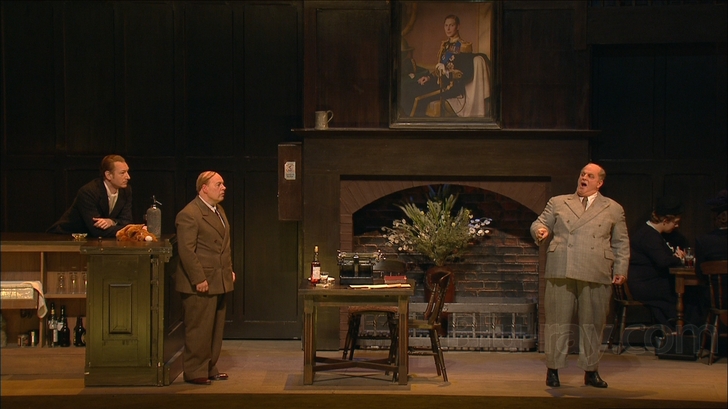
Falstaff is presented on Blu-ray by Opus Arte, which gives it their customarily excellent AVC encoded 1080i live transfer in a 1.78:1 aspect ratio. Ultz' production design and costumes are a highlight of this production (however odd they may be once you stop to think about them), and this Blu-ray offers brilliantly popping colors, albeit many of them in the drab post-World War II hues of brown and beige. Some of the more fanciful production design elements, like the gigantic green cabbages dotting the Ford's garden, or the Hallowe'en-esque haunted tree of the finale look very impressive indeed. Stage lighting here changes dramatically, often quite quickly, and the Blu-ray handles these palette changes effortlessly. This is especially impressive toward the end of Act III, where we're offered greens, blues and ultimately straight lighting in rapid succession. Flesh tones are accurate and fine detail is superb. Blacks are ever so slightly crushed at times--you'll see Ford's black suit disappear into the backdrop a time or two, but that's about the only minor issue there is to report in this otherwise top notch outing.
Verdi: Falstaff Blu-ray Movie, Audio Quality
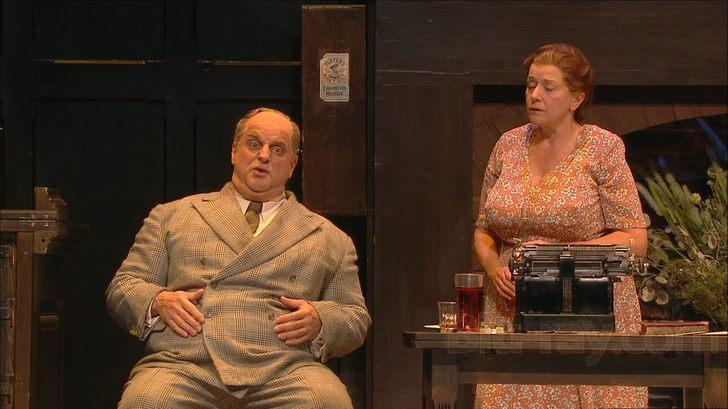
Verdi proved himself to be a consummate comedy writer in Falstaff, and all the uproarious swoops, slashes and orchestral mayhem he scored are beautifully rendered in the excellent DTS-HD MA 5.1 lossless audio option. This is a very brassy score, in both the figurative and literal sense, and the Blu-ray's audio supports that bombast easily. Dynamic range is excellent, with crystalline fidelity. There were literally one or two seconds of imbalance between orchestra and some individual singers, which you have to be as anal retentive as I am to worry about. Otherwise, this is a warm and fluid recording which makes Verdi's polyphonic extravaganzas clear as a bell and really almost palpably accessible. The amazing acoustics of Glyndebourne are also wonderfully reproduced with the ambient space afforded by the surround channels. I spot checked the 2.0 fold down and it seemed fine, though obviously with a narrower soundfield.
Verdi: Falstaff Blu-ray Movie, Special Features and Extras
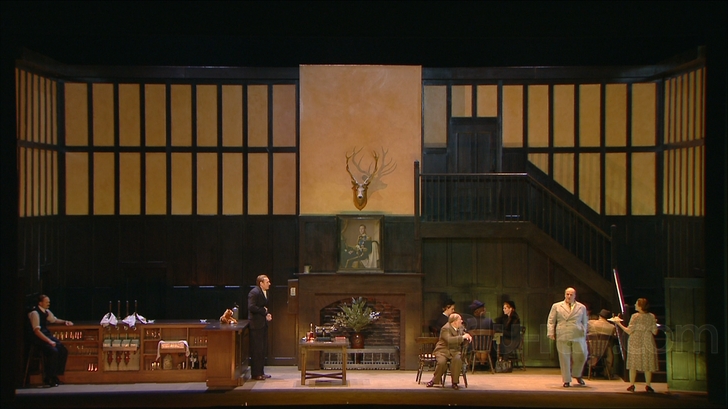
Despite the opera running just a little over two hours, Opus Arte offers only a short illustrated synopsis (running around seven minutes), a cast gallery, and an insert booklet essay as extras.
Verdi: Falstaff Blu-ray Movie, Overall Score and Recommendation
Verdi proved he couldn't be pigeonholed with this alarmingly creative foray into operatic comedy. Unfortunately, director Jones is in danger of being typecast as a trendy director who slathers his own "vision" onto a piece when it's not really called for. He hasn't completely stepped over the line into Eurotrash, but he's right up to the border with this too intellectual Falstaff. As the ensemble proclaims in the finale, Man is fated to waffle between head and heart. Jones needs to take that statement to heart and illuminate the emotion of a piece, not just "illustrate" it with a flashy production design.