Valvrave The Liberator: Season 1 Blu-ray Movie
HomeValvrave The Liberator: Season 1 Blu-ray Movie 
Aniplex | 2013 | 300 min | Rated 16+ | Sep 23, 2014
Price
List price:Listed on Amazon marketplace

Movie rating
7 | / 10 |
Blu-ray rating
| Users |  | 0.0 |
| Reviewer |  | 3.5 |
| Overall | | 3.5 |
Overview
Valvrave The Liberator: Season 1 (2013)
True Calendar, Year 71 - A new age where 70% of the human population lives in space thanks to the development of the "Dyson Sphere," a city in space. The world is divided into two main powers: The Dorssia Military Pact Federation, a power which grew out of a military alliance, and the Atlantic Rim United States (ARUS), which grew in power as it expanded its trade agreements. The minor nation of JIOR has declared neutrality between these two forces and maintained its peace through economic prosperity. Within JIOR's Sphere, Haruto Tokishima lived an ordinary life as a high school student in the division known as "Module 77" until the Dorssian military begins their sudden invasion. The whole world will be shaken when Haruto meets the mysterious humanoid weapon, Valvrave!
Starring: Ryôta Ôsaka, Ryohei Kimura, Asami Seto, Haruka Tomatsu, Yûki Ono| Anime | 100% |
| Foreign | 90% |
| Action | 15% |
| Adventure | 3% |
| Sci-Fi | 1% |
Specifications
Video
Video codec: MPEG-4 AVC
Video resolution: 1080p
Aspect ratio: 1.78:1
Original aspect ratio: 1.78:1
Audio
Japanese: LPCM 2.0
Subtitles
English
Discs
50GB Blu-ray Disc
Three-disc set (3 BDs)
Playback
Region A (B, C untested)
Review
Rating summary
| Movie |  | 3.0 |
| Video |  | 4.5 |
| Audio |  | 4.0 |
| Extras |  | 2.5 |
| Overall | | 3.5 |
Valvrave The Liberator: Season 1 Blu-ray Movie Review
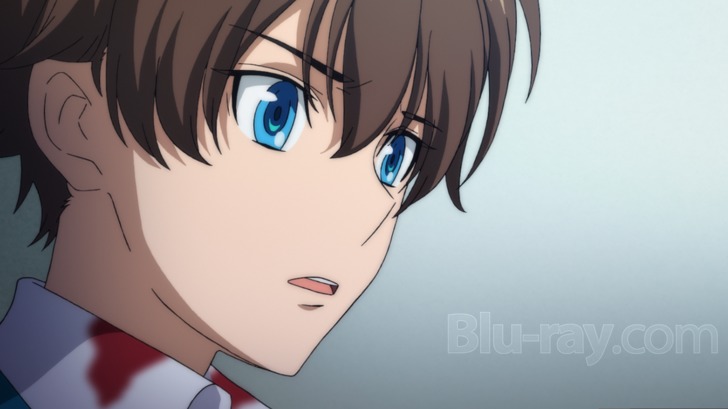
Reviewed by Jeffrey Kauffman December 8, 2014There are no doubt many anime fans who subscribe to the general premise that “if you’ve seen one mecha show, you’ve seen them all.” Like a lot of anime subgenres, the tropes of mecha outings are well developed and seemingly immutable, with scrappy, sometimes socially awkward, kids manning giant robots to stave off imminent (usually alien) attack. And in some ways 2013’s Valvrave the Liberator simply ticks off the check box list of various mecha clichés, offering little new for any longtime anime fan. However, Valvrave the Liberator also regularly throws bat guano crazy elements into the mix, as if to thumb its veritable nose at anyone who presumes to “know” what’s coming next. Perhaps the best example of this proclivity comes toward the end of an otherwise fairly rote opening episode. Valvrave the Liberator quickly sets up its general premise, wherein a future Earth (in a time referred to only as the “71st year of the True Era,” whatever that’s supposed to mean) has largely migrated to so-called Dyson Spheres in outer space. One of these Dyson Spheres, home to a neutral nation called JIOR, is infiltrated by a bunch of hooligans from a warlike nation called Dorssia. The Dorssian kids go on a rather gruesome killing spree while a bunch of initially unaware JIORian kids engage in an eating contest to see what group will have access to a sports playing field. The two combatants in this “food fight” are Haruto Tokishima and a girl he’d like to date, Shōko Sashinami. Shōko ends up winning the contest, further discouraging Haruto from revealing his true feelings to her. Later, he misses another chance in class, and even later, yet another chance at a shrine the two visit. Haruto seems to finally be about to confess his ardor for Shōko when the full extent of the Dorssian incursion becomes apparent. At that point, some JIORian defense types (who soon meet their fate at the hands of the Dorssian kids) launch their last ditch attempt at defense, a giant robot called Valvrave. Unfortunately, there’s no one to pilot it until a hapless Haruto, formerly a pacifist but now enraged by a certain supposed tragedy, simply climbs aboard and agrees to “resign his humanity” to become one with the robot. So far, so standard, right? Well, after Haruto manages to defeat this initial onslaught of Dorssians, becoming an instant social media celebrity as a result, Valvrave the Liberator takes the first of several rather violent left turns in its narrative arc. As Haruto climbs down from Valvrave, he’s met by L-Elf, the lead boy of the Dorssian kids. And L-Elf simply walks up to Haruto and viciously stabs and then (repeatedly) shoots him, seemingly killing him. Okay—that was unexpected. But perhaps not quite as unexpected as what comes next, when Haruto magically resurrects for a moment, bites L-Elf in the neck and then becomes L-Elf (in that Haruto’s consciousness is transported into L-Elf’s body).
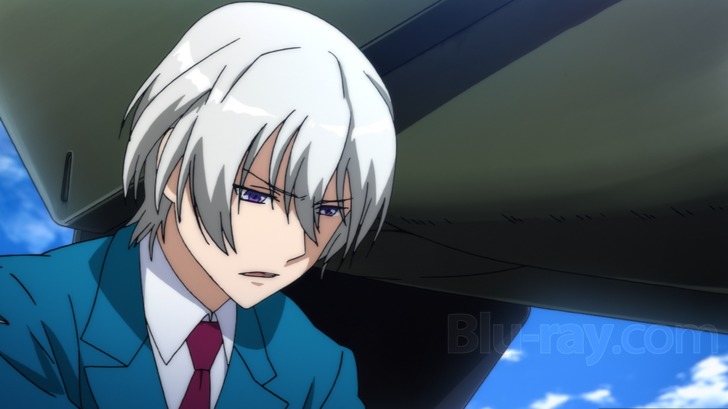
What might on its face seem to be a futuristic take on the trials of a teen boy forced to undergo a metamorphosis in a time of war actually is less of a riff on, say, Attack on Titan (so to speak), than almost a weird anime sibling to Hellsing. That surprising neck bite turns out to be a recurring plot motif, and if Haruto isn’t exactly a vampire, he at least experiences a bloodlust of sorts after he melds with Valvrave. That in turn allows him to withstand wounds that would normally kill mere mortals as well as to transfer his consciousness temporarily into other people.
Haruto’s possession of L-Elf leads to some interesting arcs for both characters (once Haruto is properly back in his own body, that is). As L- Elf, Haruto had attacked some of the real L-Elf’s Dorssian compadres, leading to L-Elf being more or less banished from his homeland. That sets up an intriguing subplot where former nemeses may be working on the same side. Less innovative is a subplot involving Shōko, the character whom Haruto longs to “confess” his feelings to. A supposed calamity involving the girl is what sets the whole Valvrave aspect into motion (at least with regard to Haruto), but the series, for all of its willingness to cast characters asunder, is resolutely predictable with regard to this character, bringing her “back from the dead” in order to provide a continuing amount of romantic angst, especially as Haruto’s “relationship” with Valvrave continues to degrade his humanity.
The outright bizarre nature of much of what goes on in Valvrave the Liberator may seem to be intentionally provocative, attempting to draw attention in any way possible to a series that really is at its core, yes, “just another mecha” outing. But for those who don’t mind a little weirdness riding along with their giant robots (as if giant robots weren’t weird enough on their own), Valvrave the Liberator is actually kind of fun in its own peculiar way. There are some interesting developments with regard to both Haruto and L-Elf that keep this first season generally compelling. If the tradeoff is some patently predictable content elsewhere, it’s probably a more or less fair trade.
Valvrave The Liberator: Season 1 Blu-ray Movie, Video Quality
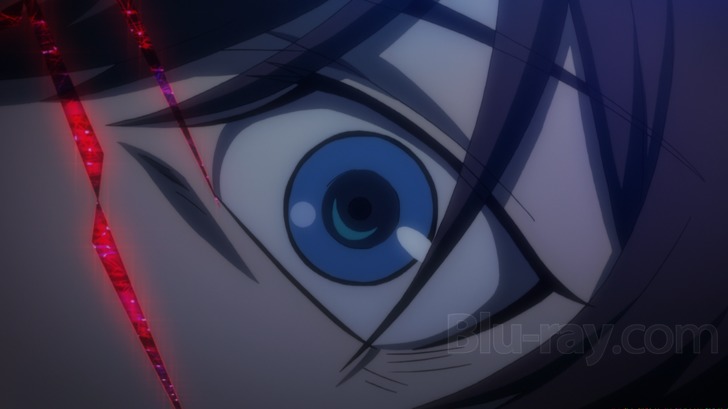
Valvrave the Liberator is presented on Blu-ray courtesy of Aniplex with an AVC encoded 1080p transfer in 1.78:1. This 2013 series pops really well in high definition, with a nice blend of traditional and CGI elements that are often incredibly colorful. Some of the more rendered elements, such as looks at Dyson Spheres and the like, can almost approach a mandala like magnificence at times. Character designs aren't especially innovative, but they're distinctive enough, with things like Shōko's bright green eyes or L-Elf's shimmering white-silver hair, looking great. Line detail is very sharp and stable. There's a probably intentional disconnect between the overall sharpness of the traditionally animated elements and a somewhat softer ambience for some of the CGI.
Valvrave The Liberator: Season 1 Blu-ray Movie, Audio Quality
Valvrave the Liberator offers the original Japanese language track (with optional English subtitles) with perfectly serviceable LPCM 2.0 audio. A surround track no doubt could have amped up the series' battle elements, but there's still a decently fulsome presentation here, with good, perhaps even surprisingly robust, low end, and a fluid mix that can emphasize dialogue or effects as the case warrants. Fidelity is excellent and there are no issues of any kind to report.
Valvrave The Liberator: Season 1 Blu-ray Movie, Special Features and Extras

Note: As with most Aniplex releases, Valvrave the Liberator boots right to the first episode (after the introductory copyright
information and Aniplex masthead). To
access supplements, press the Top Menu button for a complete listing.
Disc One:
- Textless Opening 1 (1080p; 1:32)
- Textless Opening 2 (1080p; 1:32)
- Textless Ending 1 (1080p; 1:48)
- Textless Ending 2 (1080p; 1:32)
- Commercial 1 (1080i; 00:17)
- Commercial 2 (1080i; 00:17)
- Commercial 3 (1080i; 00:17)
- Commercial 4 (1080i; 00:17)
- Commercial 5 (1080i; 00:32)
- Commercial 6 (1080i; 00:17)
- Commercial 7 (1080i; 00:32)
- Trailer 1 (1080i; 00:40)
- Trailer 1.5 (1080i; 00:42)
- Trailer 2 (1080i; 00:55)
- Trailer 3 (1080i; 1:22)
Non Disc Supplements:
- 6 Collectible Postcards
- Deluxe Poster Specially Illustrated by Katsura Hoshino (Original Character Designer)
Valvrave The Liberator: Season 1 Blu-ray Movie, Overall Score and Recommendation
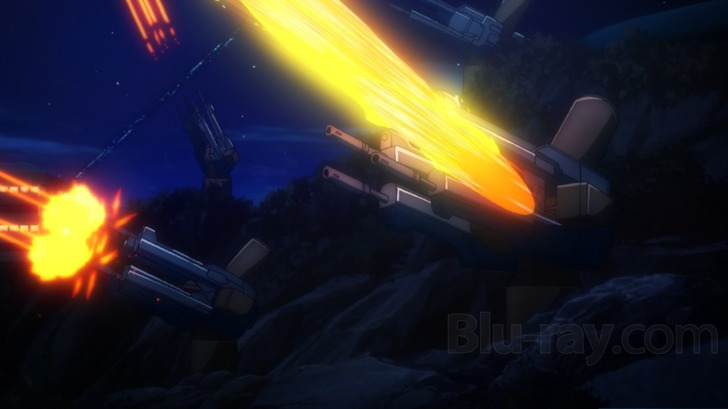
Is Valvrave the Liberator "just another mecha anime"? Well, yes and no. Large swaths of this series are routinely routine, as if a laundry list of mecha tropes had been checked off and inserted dutifully into the show to fulfill some kind of mecha quota. But then the series will just go off into left field with bizarre elements like Haruto's quasi-vampirism and ability to resurrect himself. Despite this somewhat schizophrenic approach, the series actually manages to work up significant momentum with regard to what begins happening to Haruto after the effects of bonding with Valvrave begin to make him understand exactly what "resigning as a human" really means. The arc involving L-Elf is also rather interesting, though Shōko is relegated to unconsummated, unrequited love interest territory. The series is very appealing from a design aesthetic standpoint, and that aspect pops beautifully in high definition. These Aniplex editions tend to be on the pricey side, so fans will need to determine whether twelve episodes plus a bit of swag justifies the cost. On a pure entertainment level and with regard to the technical merits of the Blu-ray, Valvrave the Liberator comes Recommended.

Similar titles
Similar titles you might also like
(Still not reliable for this title)

Gargantia on the Verdurous Planet: Complete Series
翠星のガルガンティア / Suisei no Garugantia | Special Edition
2013

Bodacious Space Pirates: Abyss of Hyperspace
2014

Heroic Age: The Complete Series
Essentials
2007
Kaiju No. 8: Season 1
怪獣8号
2024

S-CRY-ed: The Complete TV Series
2001

Akudama Drive: The Complete Season
2020

Star Blazers 2202: The Complete Series
Episodes 1-26 / Space Battleship Yamato 2202
2017-2019

Digimon Adventure tri.: Reunion
デジモンアドベンチャー tri. 第1章 再会
2015

Star Blazers 2199: The Complete Series
Episodes 1-26 / Space Battleship Yamato 2199
2012-2013

Digimon Adventure tri.: Confession
デジモンアドベンチャー tri. 第3章 告白
2016

Iria: Zeiram the Animation
Master Collection / イ・リ・ア ゼイラム The Animation
1994

Outlaw Star: Complete Series
Classics / 星方武侠アウトロースター
1998

Martian Successor Nadesico: The Motion Picture - Prince of Darkness
劇場版 機動戦艦ナデシコ -The prince of darkness-
1998
Gurren Lagann The Movie: The Lights in the Sky are Stars
劇場版 天元突破グレンラガン 螺巌篇
2009

Gundam Build Fighters Complete Collection
2013

Cyborg 009 - The Cyborg Soldier: Complete Series
SD on Blu-ray
2001-2002

Fist of the North Star: The Movie
北斗の拳
1986

Blue Submarine No. 6: Complete Collection
1998-2000

Gundam Build Fighters Try: Complete Collection
2014-2015

Mazinkaiser: The OVA Collection
2001-2002