Valley of the Gods Blu-ray Movie
HomeValley of the Gods Blu-ray Movie 
Well Go USA | 2019 | 131 min | Not rated | Aug 11, 2020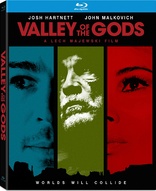

Movie rating
6.8 | / 10 |
Blu-ray rating
| Users |  | 0.0 |
| Reviewer |  | 2.5 |
| Overall | | 2.5 |
Overview
Valley of the Gods (2019)
Entwines Navajo lore with a reclusive trillionaire and his would-be biographer, creating a fascinating, mysterious and idiosyncratic vision of America.
Starring: Josh Hartnett, John Malkovich, John Rhys-Davies, Charlotte Rampling, Bérénice MarloheDirector: Lech Majewski
| Drama | 100% |
Specifications
Video
Video codec: MPEG-4 AVC
Video resolution: 1080p
Aspect ratio: 2.39:1
Original aspect ratio: 2.39:1
Audio
English: DTS-HD Master Audio 5.1
English: Dolby Digital 2.0
Subtitles
English SDH
Discs
Blu-ray Disc
Single disc (1 BD)
Packaging
Slipcover in original pressing
Playback
Region A (B, C untested)
Review
Rating summary
| Movie | | 2.5 |
| Video |  | 4.5 |
| Audio | | 4.5 |
| Extras |  | 1.0 |
| Overall | | 2.5 |
Valley of the Gods Blu-ray Movie Review
Where are the green ants when you really need them?
Reviewed by Jeffrey Kauffman August 9, 2020Having grown up in Utah, I can state from personal experience that the landscapes of the southern portion of the state are like something out of a science fiction movie, and of course they have been utilized as such on many occasions, as well as, of course, for many a western. Valley of the Gods is neither a science fiction extravaganza, though it certainly has its share of fantastical elements, nor is it a western, despite the prevalence of Navajo characters and a certain cowboy swagger on display from star Josh Hartnett. This opaque, seemingly willfully impenetrable film from Lech Majewski is something, but what exactly may be anyone’s guess. Its tale of an indigeneous culture threatened by the incursion of industrializing forces combined with a certain magical realist element certainly reminded me of efforts like Werner Herzog’s Where the Green Ants Dream (especially since uranium mining is featured in both films), but that whole plot element is (for better or worse) only part of this truly bizarre story. Hartnett portrays a character named John Ecas, who is in fact the first major character to whom the audience is introduced. Ecas is driving through the dusty backroads of Southern Utah and, perhaps too tired to continue, he pulls off at what appears to be a shuttered gas station and mini mart. Sitting in his truck and attempting to get comfortable, he witnesses the odd sight of a Native American walking up to an ATM and covering it with sand in what appears to be some kind of magical ritual. It’s just the first of several inexplicable images Majewski populates his film with, and interpretations are definitely left to the viewer, which may result in some audience members feeling like they’ve wandered into some madman’s hallucinations.
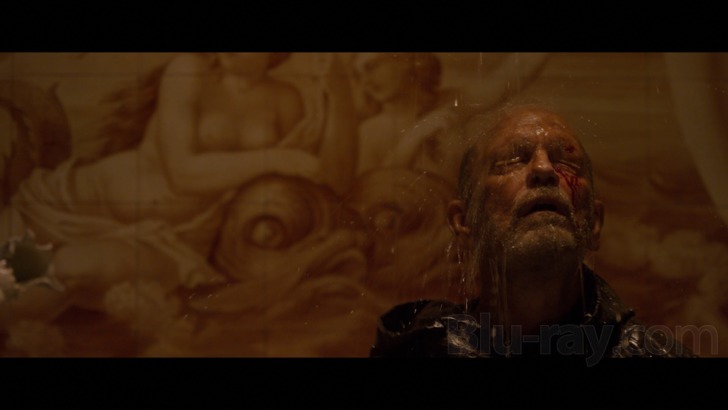
One particular aspect of Valley of the Gods couldn't help but remind me of one of my most troubling childhood experiences, one which took place on a camping and exploring trip with my father to the many parks in Southern Utah, including Valley of the Gods, when I was maybe seven or so. Closer to the Four Corners area, we stopped for some reason at an isolated market on a reservation, which was almost like a “general store” out of some long ago western, with a dust covered rickety wooden porch running the length of its facade. Tumbled over and unconscious on this porch, wrapped in a ragged burlap blanket, was an elderly and gaunt Native American man, and as a kid who had been raised on television westerns where the “Indians” (as they were inevitably called) were typically strapping, athletic villains, it was definitely a moment of culture shock for my young eyes. I couldn't help but think of that during Valley of the Gods since it's apparent that Majewski obviously wants to point out the abject poverty that many Native Americans in this region (and of course elsewhere) have to endure, something that plays into some variant responses to overtures made for their land, including some sacred territory. Majewski contrasts that downtrodden culture with what the film describes as the richest man on earth, Wes Tauros (John Malkovich), who has designs on the Native American territory due to its rich uranium deposits. Except — is Tauros a real person, or simply the product of writer Ecas’ imagination? That’s just one of many questions Majewski never really even attempts to answer.
The reasons for this obfuscation seem to be a deliberate gambit on the part of Majewski, though to what end may remain debatable. The film rather quickly details the dissolution of Ecas’ relationship with his wife Laura (Jaime Ray Newman), something that sends Ecas into a tailspin, and, evidently, the care of a therapist named Dr. Hermann (John Rhys Davies). Hermann encourages Ecas to “embrace the absurd” in order to achieve an emotional breakthrough, and so the already detour prone film takes off on a series of weird vignettes documenting activities like Ecas hiking through foothills with pots and pans roped to his feet, or walking backwards blindfolded on busy urban streets. The film’s nonlinear approach seems to plop down these aspects in a completely random fashion, so that any through line for Ecas seems willfully obscured.
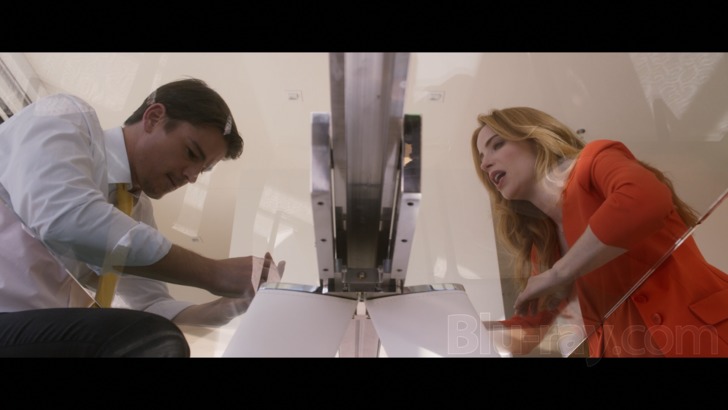
However, there’s an almost throwaway line by Hermann which I personally feel could be a key to understanding the film (if indeed it can be understood), when Hermann mentions Ecas’ longstanding wish to write a book featuring the character of the world’s richest man and Navajo legends (why the two are interlinked is, again, anyone’s guess, but there is an obvious dialectic at play in terms of relative wealth). When Ecas drives into the Valley of the Gods, and then pulls a desk out of the back of his vehicle, plops it down in the awe inspiring Utah landscape, pulls a sheaf of paper and a pen out of one of its drawers and begins writing something, it would appear plausible at least that all of the other story elements in this bizarre amalgam are just that — namely, a story, ostensibly one being written by Ecas. The fact that Majewski divides his tale into chapters, replete with titles, may also subliminally be suggesting this very thing.
If Where the Green Ants Dream may be lurking in the background of this film for Herzog fans if for no one else, there's another completely unexpected reference that may be more widely known by the public at large but whose inclusion may also be a salient example of just how gonzo this film can be. Keir Dullea is on hand as Tauros' butler Ulim, and of course many will probably unavoidably associate the actor with 2001: A Space Odyssey. Majewski does not seem immune to that perhaps inevitable connection, since one of the really weird sequences Majewski offers in this film is what I might describe as featuring the "Starchild" from the Kubrick opus having grown to toddler stage and marauding through a city of skyscrapers like a semi- human version of Gojira. (See screenshot 19, especially if you may understandably think I may be mischaracterizing or exaggerating this sequence.)
Valley of the Gods is one of those films whose ambitions may be able to be appreciated, and whose visual sense is rarely less than audacious, but which never manages to deliver a coherent message.
Valley of the Gods Blu-ray Movie, Video Quality

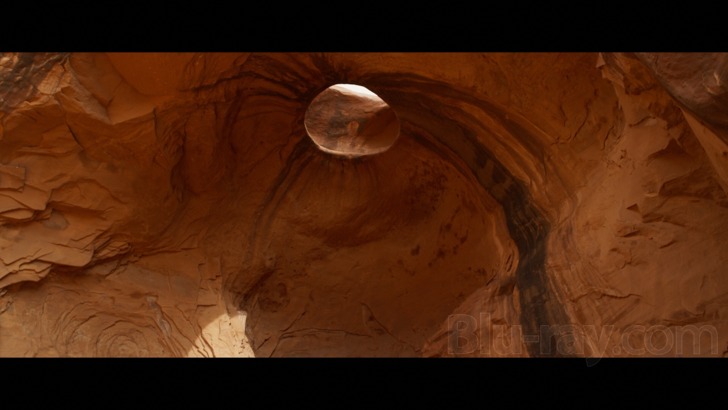
Valley of the Gods is presented on Blu-ray courtesy of Well Go USA with an AVC encoded 1080p transfer in 2.39:1. The IMDb has no technical data on the shoot, but the Making Of featurette has a couple of shots that feature a camera that looks like it has the Arri logo, and I managed to find several sites that mentioned different Alexa models as having been utilized, and I'm assuming a 2K DI was prepared. Aside from the typical Well Go USA bugaboo of some minor banding and a few pretty iffy looking moments of CGI, this is a really beautiful and I would even say at times lustrous looking presentation. The footage in Valley of the Gods and Utah in general looks gorgeous, with that burnt red sandstone tone in the rock formations contrasting wonderfully with well saturated blue skies. Some of the interior footage in Tauro's mansion is graded toward sickly yellows, and fine detail can occasionally ebb as a result. Surprisingly, though, some of the outright dusky or nighttime material offers above average detail levels on the whole.
Valley of the Gods Blu-ray Movie, Audio Quality
Valley of the Gods features a well rendered DTS-HD Master Audio 5.1 that offers some good placement of ambient environmental sounds, even despite the somewhat "barren" locations being utilized. Jan A.P. Kaczmarek's score also regularly populates the surround channels. Dialogue is typically rendered cleanly and clearly, though there are some Native Indian dialects and what also sounds like passing foreign language of some type bandied about by Tauro which the optional English subtitles do not translate.
Valley of the Gods Blu-ray Movie, Special Features and Extras
- Making Of (1080p; 19:15)
- Trailer (1080p; 1:39)
Valley of the Gods Blu-ray Movie, Overall Score and Recommendation

I might cheekily be tempted to describe Valley of the Gods by combining two completely different television advertisements by saying, "This is your 'Visit Utah' on drugs," but that perhaps as well as anything gives some idea of the completely hallucinatory experience watching this film can be. It's often undeniably fascinating, but I'm not sure it really means anything. Those who are willing to let little things like a comprehensible plot go by the wayside may enjoy this film simply because it's so undeniably gonzo. Technical merits are generally solid for those considering a purchase.
Similar titles
Similar titles you might also like
(Still not reliable for this title)

Hesher
2010

The Whale
2022

King of the Mountain
Mulholland Run
1981

George Carlin: It's Bad For Ya
2008
The Larry Sanders Show: The Complete Series
1992-1998

Four Lions
2010

Zola
@Zola
2020

Boy
2010

Human Nature
2001

Cemetery Junction
2010

House of Cards: The Complete Sixth Season
2018

Six Feet Under: The Complete First Season
2001

Roadracers
Director's Cut
1994

Thank You for Smoking
2005

Little Miss Sunshine
2006

He Was a Quiet Man
2007

Nip/Tuck: The Complete Fourth Season
2006

The Truman Show
1998

Bored to Death: The Complete First Season
2009

In the Loop
2009