Under African Skies Blu-ray Movie
HomeUnder African Skies Blu-ray Movie 
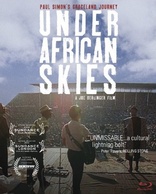
Graceland 25th Anniversary FilmSony Music | 2012 | 101 min | Not rated | Jun 05, 2012
Price
List price:Listed on Amazon marketplace

Movie rating
7 | / 10 |
Blu-ray rating
| Users |  | 0.0 |
| Reviewer |  | 4.0 |
| Overall | | 4.0 |
Overview
Under African Skies (2012)
Paul Simon returns to South Africa to explore the journey of his Graceland album, including the political backlash he received for allegedly breaking the UN cultural boycott of South Africa designed to end the Apartheid regime.
Starring: Paul Simon (I)Director: Joe Berlinger
| Music | Uncertain |
| Documentary | Uncertain |
Specifications
Video
Video codec: MPEG-4 AVC
Video resolution: 1080p
Aspect ratio: 1.78:1
Audio
English: LPCM 5.1
English: LPCM 2.0
English: Dolby Digital 5.1
Subtitles
English, French, Spanish, German, Dutch, Italian
Discs
50GB Blu-ray Disc
Single disc (1 BD)
Playback
Region A (B, C untested)
Review
Rating summary
| Movie | | 4.0 |
| Video | | 4.0 |
| Audio | | 4.0 |
| Extras |  | 1.5 |
| Overall | | 4.0 |
Under African Skies Blu-ray Movie Review
The road to Graceland.
Reviewed by Jeffrey Kauffman June 5, 2012The term “World Music” didn’t quite have the cachet in 1986 that it does now, and so many listeners weren’t quite sure what to call Paul Simon’s Graceland album. Simon, who had of course burst into fame as part of Simon & Garfunkel and then gone on to an equally successful solo career, had always hewed fairly closely to a folk and pop sound, albeit one intricately infused with Simon’s commanding musical and lyrical technique. Simon’s music was always very smart, something that occasionally got him into trouble with the critics. As Simon himself comments in Under African Skies, he had enjoyed a virtually unbroken series of hit albums and singles from his Simon & Garfunkel days on through his solo career, until suddenly that string was broken rather dramatically with Hearts and Bones. Instead of wallowing in grief, as so many artists probably would have done, Simon actually felt a sense of relief, thinking (perhaps wishfully) that the relative failure would mean that his label would stop as he put it “looking over [his] shoulder” and stay out of his creative process as he decided how to follow up an album that was a lackluster seller and never produced a huge single. That follow up turned out to be Graceland, and if Columbia Records wasn’t paying attention during its creation, it (and the rest of the world) sat up and took notice once it was released. Graceland became one of the biggest sellers of Simon’s career, and in fact Simon himself thinks of it as the defining (if not the crowning) moment of that career. But what few remember now some 25 years after the album’s release is just how controversial, even provocative, the creation of the album actually was, and not necessarily only from a Western perspective. Graceland of course melded South African rhythms and actual players with Simon’s own compositions and lyrics, but when the album was recorded, apartheid was still rearing its very ugly head in that beleaguered country, and was in fact according to one of the musicians interviewed in Under African Skies at its most “vicious”. There was actually a United Nations “cultural boycott” in effect when Simon flew over to South Africa and fairly quietly spent two weeks there recording, and as odd as it may seem, that has damned him in the eyes of some native South Africans, as well as to some perhaps more liberal leaning Westerners who feel to this day Simon was shortsighted and self serving in this particular situation.
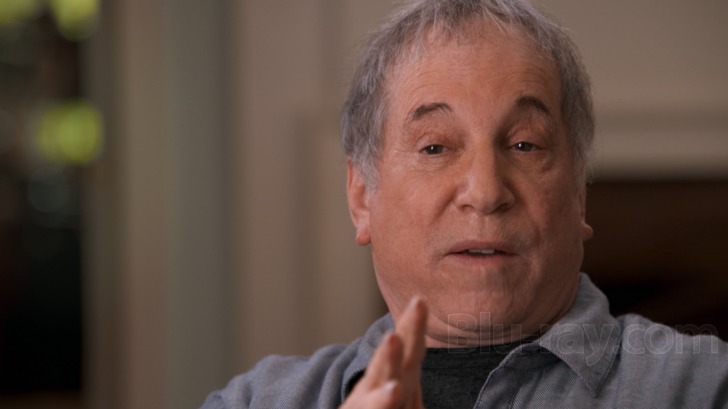
Paul Simon may seem like a fairly mild mannered singer songwriter, but he’s always had a bit of an edge, something that first became public knowledge during his acrimonious breakup with Art Garfunkel. Simon seemed a little like the smug, overbearing spouse in that musical marriage and wasn’t especially charitable to either Garfunkel’s nascent acting career or his early solo albums. That same quasi-boorishness comes through rather surprisingly in some of the reminiscences here, at least with regard to Simon’s insistence that his own artistic vision and freedom outweighed any consideration he needed to give political conditions in South Africa.
Harry Belafonte is one of several people interviewed in Under African Skies who express surprise (if not outright shock and disappointment) that Simon ignored the cultural boycott and actually refused to go through accepted channels with the African National Congress as he set up the recording sessions that would provide the foundation for much of Graceland. Simon for his part simply doesn’t seem to think he has anyone or anything to answer to or for: he had an idea and he felt he was free to pursue that idea, no matter what the sociopolitical consequences might be.
The fascinating thing about this brouhaha, even if it is a brouhaha largely consigned to the vagaries of hindsight now, is that Simon resolutely refused to address any political issues in his lyrics for Graceland, something that may in fact simply echo what some argue in this documentary was his tone deafness (no pun intended) in recording there in the first place. But it’s really interesting to contrast Simon’s approach with that of Peter Gabriel in songs like “Biko”, and in fact that very tune is mentioned here by both Simon (who eventually recorded it) and Gabriel himself. Is it a mistake not to mention something that could be seen as the very ugly elephant in the room, especially when you’re in the elephant’s territory, so to speak? There are still hurt feelings about Simon’s decision, as becomes quite clear in several telling confessionals and even a couple of interchanges between South African political activists and Simon himself.
What ultimately rises above all of the controversy, though, is the music, and both archival footage culled from the original recording sessions as well as even more copious footage of preparations for the 25th anniversary reunion tour bring that music fully alive. The sheer ebullience of the South African musicians is palpable. As one participant states, working with Simon was “like going back to music school”, but there’s also a sweet, almost childlike, sense of play and experimentation in a lot of the rehearsal footage, and to Simon’s credit, he comes off as less of an autocrat than a very willing and cooperative collaborator. The real irony here is that Graceland introduced untold millions of people to the joy of African music, something obviously far removed from the seething turmoil that was still visiting the land when the album was recorded.
What ultimately becomes clear is that for better or worse Simon's reaching out to African musicians, whatever its short- and even long term controversy, was an example of building bridges, something that may in fact not have done anything to end apartheid, but at least showed there was another way. As one of the musicians states, “music is a form of religion”, and maybe Simon’s reaching out to his African counterparts—however unintentionally misguided some may think it was and is—allowed some better angels to prevail, helping to emphasize the positive in a very negative situation.
Under African Skies Blu-ray Movie, Video Quality
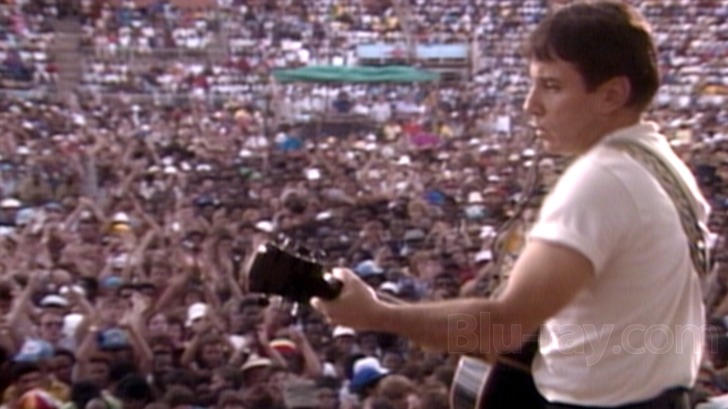
Under African Skies is presented on Blu-ray courtesy of Sony Music with an AVC encoded 1080p transfer in 1.78:1. The contemporary interview and rehearsal – performance footage here is very nicely detailed, featuring accurate and very beautifully saturated color. Fine detail is also very pleasing in these sequences. As should be expected, the archival footage included in this documentary comes from a wide variety of sources and features widely disparate levels of quality. Some of this footage barely rises above the level of home movies (and does indeed look like it was sourced from 8mm), while other footage is at least reasonably acceptable. Generally, though, most of the archival footage is pretty ragged looking, with bleeding colors and fuzzy image quality. It's kind a of a "glass half full, glass half empty" situation with this piece, as it's pretty evenly split between archival footage and contemporary sequences.
Under African Skies Blu-ray Movie, Audio Quality
As is typically the case with Sony Music releases, three audio options are offered on Under African Skies, two uncompressed LPCM mixes, one in 5.1 and the other in 2.0, with a standard Dolby Digital 5.1 surround mix bringing up the rear (so to speak). While the two uncompressed audio options are obviously the way to go, if only for the sake of the fantastic music, that right there is the rub with regard to the 5.1 mix: there is virtually no uninterrupted or talked over music throughout this entire documentary, which kind of defeats the purpose of a lossless surround mix. Otherwise, this is strictly talking heads material, which obviously doesn't afford much opportunity for a "wow" factor in terms of immersion. Fidelity is excellent throughout the piece, but it would have been great to have had either some bonus material featuring some unedited music or at least some within the documentary itself.
Under African Skies Blu-ray Movie, Special Features and Extras
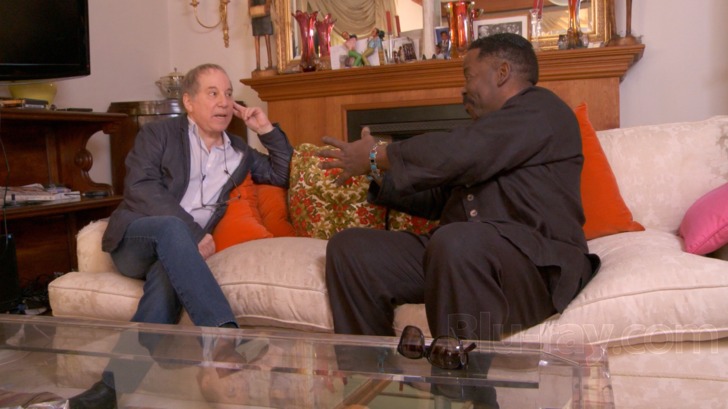
- Bonus Interviews include:
Whoopi Goldberg (HD; 5:39)
Harry Belafonte (HD; 3:43)
Ray Phiri (HD; 2:54)
Barney Rachabane (HD; 2:14)
Hugh Masakela (HD; 6:55)
Under African Skies Blu-ray Movie, Overall Score and Recommendation
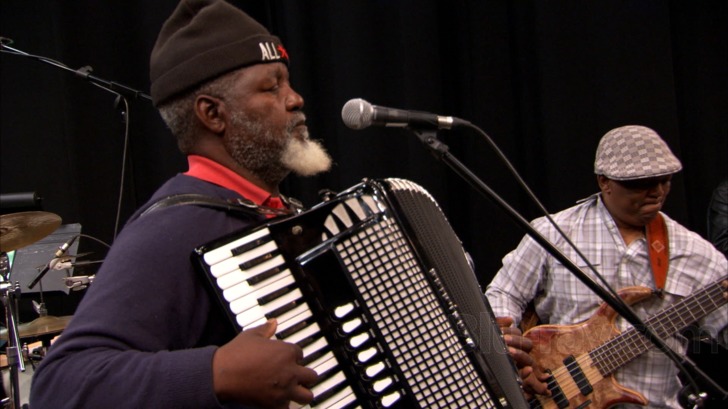
Under African Skies is a fascinating piece in that it shows emotions that are still surprisingly raw after some 25 years since Paul Simon journeyed to South Africa during what was the last, violent gasp of apartheid. It's true that Simon comes off as well intentioned but, yes, self serving and perhaps willfully ignorant to the sociopolitical turmoil he was witnessing, almost like it was a tourist attraction. But what also comes through quite clearly in this well constructed piece is how it was really only the music that interested Simon. If that's an indictment of his political conscience, so be it, but at least music fans got Graceland in the bargain. This documentary might have had a bit more impact had more of the music been allowed to shine through without voiceover commentary or so many interruptions. Generally, though, this is a fantastic piece that really helps put an epochal album into its proper historical perspective. Highly recommended.
Similar titles
Similar titles you might also like
(Still not reliable for this title)

Oasis: Supersonic
2016

History of The Eagles Parts 1 & 2
2013

Queen Rock Montreal & Live Aid
1981

Marley
with Bonus Disc
2012

The Stone Roses: Made of Stone
2013

Zappa
2020

George Harrison: Living in the Material World
2011

The Beatles: Get Back
2021

The Bee Gees: How Can You Mend a Broken Heart
2020

Country Music
Ken Burns
2019

The Police: Everyone Stares — The Police Inside Out
2006

Paul McCartney & Wings: Rockshow
1980

Concert for George
2003

Beyoncé: Life is But a Dream / Live in Atlantic City
2013

Beats, Rhymes, & Life: The Travels of a Tribe Called Quest
2011

Imagine: John Lennon
1988

The Beatles: Eight Days a Week - The Touring Years
Deluxe Edition | ~90m Bonus disc
2016

Searching for Sugar Man
2012
Dio: Dreamers Never Die 4K
2022

Soul Power
2008