Tributes - Pulse Blu-ray Movie
HomeTributes - Pulse Blu-ray Movie 
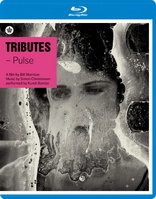
A Requiem For The 20th CenturyDa Capo | 2011 | 65 min | Rated G | Aug 30, 2011
Price
List price:Amazon: $29.06 (Save 19%)
Third party: $29.06 (Save 19%)
Only 1 left in stock (more on the way).

Movie rating
7.1 | / 10 |
Blu-ray rating
| Users |  | 0.0 |
| Reviewer |  | 3.5 |
| Overall | | 3.5 |
Overview
Tributes - Pulse (2011)
TRIBUTES-Pulse is a collaboration between American filmmaker Bill Morrison (b. 1965) and Danish composer and percussionist Simon Christensen (b. 1971). Christensen originally conceived of the project as a tribute to four American composers, Charles Ives, Conlon Nancarrow, Steve Reich and Trent Reznor. The project is comprised of four movements, with the themes of Shifting (slightest change), Multiple (simultaneously different), Across (different directions) and Beat (moving synchronized) respectively corresponding to each composer.
Director: Bill Morrison (II)| Music | 100% |
Specifications
Video
Video codec: MPEG-4 AVC
Video resolution: 1080p
Aspect ratio: 1.33:1
Original aspect ratio: 1.37:1
Audio
English: DTS-HD Master Audio 7.1
English: LPCM 2.0
Subtitles
None
Discs
25GB Blu-ray Disc
Single disc (1 BD)
Playback
Region A (B, C untested)
Review
Rating summary
| Movie | | 3.5 |
| Video |  | 5.0 |
| Audio |  | 4.5 |
| Extras | | 0.0 |
| Overall | | 3.5 |
Tributes - Pulse Blu-ray Movie Review
Unusual doesn't necessarily mean good.
Reviewed by Jeffrey Kauffman August 25, 2011There are certain projects whose descriptions—both before and after the fact—are actually more expressive than the actual work of art. Tributes - Pulse bears the evocative soubriquet “A requiem for the 20th century,” but this piece, while visually elegiac due to its very interesting use of decaying and degraded nitrate film scraps, is musically about as far from an elegy as one could imagine. In fact, some may feel the soundtrack to Tributes - Pulse is less music than semi-organized noise. One man’s avant-garde is another man’s pretentious mess, so as with all subjective reactions to artistic creations, some may really love Danish percussionist Simon Christensen’s droning, smashing, dissonant amalgamations of seemingly random ideas and tones. The problem with so much modern “music” (I’ll be charitable and remove the quotes for the rest of this review, but just assume they’re there) is that too many modern “composers” (oops, there are those quotes again) are incredibly facile with MIDI and sequencing but they have no real musical sense. One of the primary foundations of virtually all music is the interplay, the very real dialectic, between tension and release. Anyone who’s graduated from Theory 101 and had to resolve countless dominant sevenths into their respective tonics knows about this relationship at its most basic level. But moving up the analytical scale to something more “topographical” like a Schenkerian approach usually reveals overall strata of tension and release on the most general levels. Part of the problem with a lot of machine-based music is its relentlessness, something with which any lover of trance (or indeed even disco) music is well familiar. But even those pop-esque idioms (usually) give the listener the requisite “breathing room” with harmonic changes that incorporate some approximation of this most fundamental idea in music. There’s a long sixteen or so minute wait in Tributes - Pulse before there’s even a hint of relaxation, and by that time many ears may be bleeding (figuratively, one hopes) after having been pummeled by a nonstop barrage of low frequency repetitive drones that are so percussive they may affect the air pressure in your home theater room, especially if you have a powerful subwoofer and have the volume turned “up to 11.”

But back to descriptions and their sometimes tangential relationship to what they describe. The press sheet and insert booklet accompanying Tributes - Pulse are full of some high minded verbiage about the artists’ intentions in creating this piece. Filmmaker Bill Morrison attracted a lot of attention with his 2002 piece Decasia, another compilation of “found footage,” a lot of which exhibited profound nitrate decay. Like Tributes - Pulse, Morrison aided and abetted the decay with computer assisted overlays, and he also featured a weirdly abstract, though relatively more “musical” (I know, I know, I promised, sorry) score by Michael Gordon featuring prepared and detuned pianos. Gordon is part of the New York City based collective Bang on a Can, and there’s a “friend of a friend” six degrees of separation between Bang on a Can and Tributes - Pulse’s Christensen. The descriptions of this piece paint an intellectually challenging picture of four “movements,” subtitled Shifting, Multiple, Across and Beat, and supposedly inspired by the works of Charles Ives, Conlon Nancarrow, Steve Reich and Trent Reznor. The four sections are also supposedly meant to evoke the Four Elements of Water, Earth, Fire and Air. But the more cynical among you may be tempted to simply sigh and say, “Talk, talk, talk,” while not really caring much about these supposed influences and hidden meanings. Christensen also utilizes collaborator Peter Navarro-Alonso on four different saxophones (soprano, alto, tenor, baritone) to further differentiate the quartet of sections.
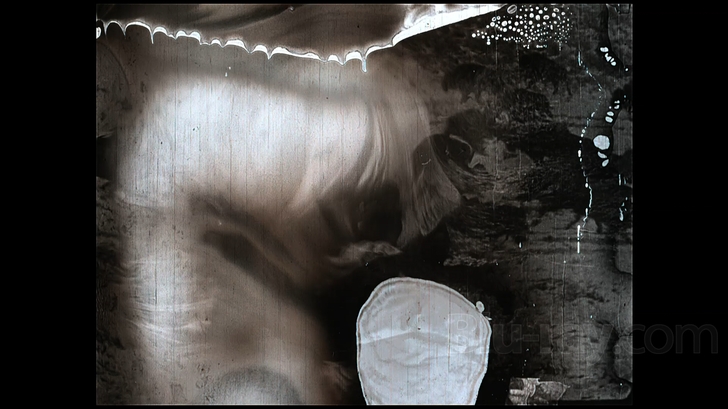
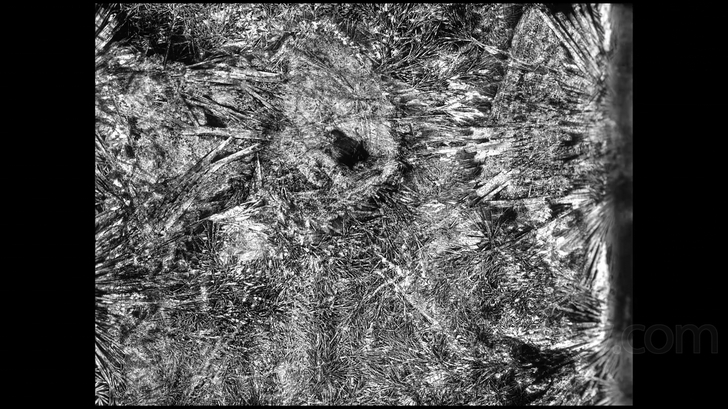
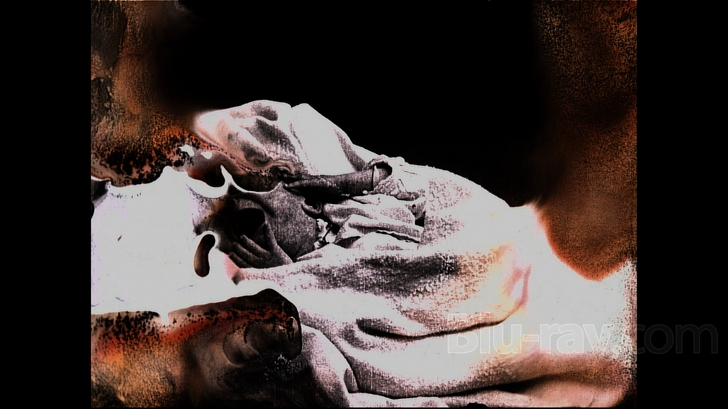
Whatever one may think about this piece’s score, there’s no arguing about Tributes - Pulse’s visual ingenuity. As with Decasia, we get weird little snippets of what appear to be silent films, many with blisters of decay, many of which Morrison has twisted and bent into bizarre shapes. Often he plays with the film itself and there’s one completely hallucinogenic moment with a baby where he twists and morphs the poor infant’s face until it looks like it’s possessed, incredibly apt since Morrison has what looks like flames envelope the hapless tot on several occasions. Morrison ups the visual ante quite a bit, however, with a really interesting and cool looking first movement which features what appears to be a bunch of ornate pencil drawings which flash by in incredibly rapid succession, creating a sort of subliminal series of Rorschach tests. Looking like some fractal hallucination based on the etchings of Dürer or Doré, these weird representations also seem to be hiding some found footage, which is just barely visible along the right side of the frame. These highly filigreed drawings are interesting in and of themselves, but it’s the dance from one to the next that creates the drama here, and it’s an intriguing and compelling use of video technology that many may find the most memorable thing about Tributes - Pulse.
Tributes - Piece also includes a relatively brief coda of sorts which is a bizarre (you expected anything else at this point?) old color film of aerial shots of what appears to be a ship graveyard. With deeply (perhaps artificially filtered) blue water and rusting hulks of old ships, this seems to be another example of decrepit material wasting away, much like the found footage Morrison employs earlier. Does any of this add up to the stated objectives of the artists involved? My considered opinion is no. That doesn’t mean this piece doesn’t have value, especially visually, for it’s a very interesting analog to that avant-garde of yore, musique concrete, a piece which subtly manipulates physical media (in this case drawings and film frames) to create something new and unexpected.
Tributes - Pulse Blu-ray Movie, Video Quality
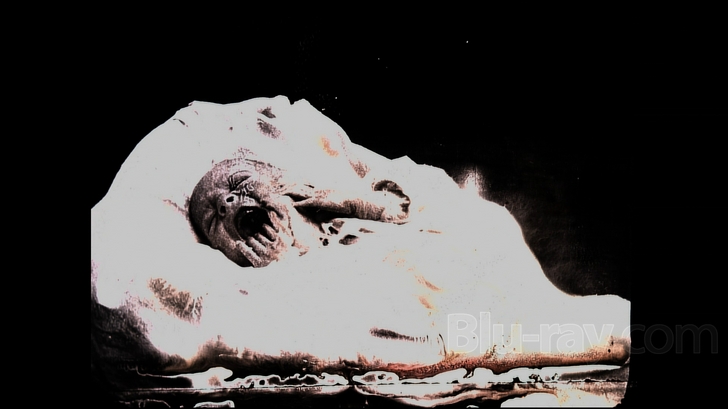
It's rather difficult to give an objective assessment of the image quality of something like Tributes-Pulse, a piece which so radically plays with image as part of its very raison d'être. That said, Tributes - Pulse's AVC encoded 1080p transfer in 1.33:1 is flawless from a technical standpoint, even if much, if not most, of the source material is so badly damaged it was literally being thrown away when Morrison rescued it for his own purposes. There isn't much color here to speak of, aside from the final sequence which features the rusting hulks of old ships. The opening sequence is entirely blacks, greys and whites, and occasionally subsequent sequences have emulsion which tends towards the yellow side. Morrison of course mixes in brief flashes of interpolated color, but they are indeed very brief. The image here is quite sharp, despite the source elements' degradations, and there is no artifacting to speak of, especially impressive since the opening sequence has so many close cropped patterns in the etchings.
Tributes - Pulse Blu-ray Movie, Audio Quality
Picture this: a certain Blu-ray reviewer has his receiver turned "up to 11" due to a low mix on a previous title, and he then pops in Tributes - Pulse and fires up the feature with its lossless DTS-HD Master Audio 7.1 mix. Then picture this: said Blu-ray reviewer lying stunned, perhaps close to death, after having suffered a heart attack at the bombastic explosion of low end sound waves which burst forth from the subwoofer from this piece's opening seconds. OK, I exaggerate, but not by much. The first fifteen to sixteen minutes of Tributes - Pulse will test the low frequency limits of your home theater system, not to mention the patience of any close by neighbors or housemates. Relentlessly aggressive and, well, pulsing, the sound design here is simply overwhelming and many may find it tiring after a few minutes, as I did. The score is extremely dissonant, full of effects like sul ponticello on the strings and raspy reed-heavy tones from the various saxes. Things get relatively lyrical starting at about the sixteen minute mark, but even then there are waves of LFE and electronic effects dotting the soundfield. The surround mix is very impressive, despite what one may think of the actual music. For the record, there is also an LPCM 2.0 stereo fold down of the surround mix.
Tributes - Pulse Blu-ray Movie, Special Features and Extras
No supplements are included on the disc. The insert booklet has the requisite essay.
Tributes - Pulse Blu-ray Movie, Overall Score and Recommendation
Remember when those with too much time on their hands discovered that Pink Floyd's Dark Side of the Moon made for a perfect soundtrack to The Wizard of Oz? You may want to search through your own CD or MP3 collection to find something else to listen to while you watch Tributes - Pulse, and in fact you might want to consider any number of pieces by the four composers Christensen is supposedly drawing inspiration from. Personally, I think Steve Reich's gorgeous neo-minimalist work suits Tributes - Pulse best, and I would recommend his achingly beautiful Tehillim as a nice alternate soundtrack to this visually appealing work. I'm no sonic fuddy duddy and have a long history with new compositional techniques, but there's only so much thumping, droning dissonance anyone can stand before they're aching for that most fundamental of musical ideas, resolution and release. For the visuals, though, Tributes - Pulse comes Recommended.