Tomorrow Blu-ray Movie
HomeTomorrow Blu-ray Movie 
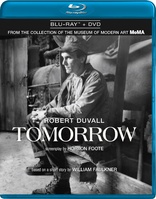
Blu-ray + DVDB2MP | 1972 | 103 min | Not rated | May 13, 2014
Price
List price:Listed on Amazon marketplace

Movie rating
6.5 | / 10 |
Blu-ray rating
| Users |  | 0.0 |
| Reviewer |  | 3.0 |
| Overall | | 3.0 |
Overview
Tomorrow (1972)
A lonely farmer takes in a pregnant woman and looks after her. After she gives birth, tragedy strikes.
Starring: Robert Duvall, Olga Bellin, Sudie Bond, Richard McConnell (I), Peter Masterson (I)Director: Joseph Anthony (II)
| Drama | 100% |
Specifications
Video
Video codec: MPEG-4 AVC
Video resolution: 1080p
Aspect ratio: 1.78:1
Original aspect ratio: 1.85:1
Audio
English: LPCM 2.0
Subtitles
English SDH
Discs
25GB Blu-ray Disc
Two-disc set (1 BD, 1 DVD)
DVD copy
Playback
Region A (B, C untested)
Review
Rating summary
| Movie |  | 4.0 |
| Video | | 3.0 |
| Audio | | 3.0 |
| Extras |  | 0.5 |
| Overall | | 3.0 |
Tomorrow Blu-ray Movie Review
What Makes a Future?
Reviewed by Michael Reuben July 22, 2014The great American actor Robert Duvall, now 83 and still working, is probably best known for his roles as Tom Hagen in The Godfather, Lt. Kilgore in Apocalypse Now ("I love the smell of napalm in the morning") and Gus McCrae in the TV mini-series, Lonesome Dove. Less noted is Duvall's relationship with the works of the late Horton Foote, the prolific Texan playwright and screenwriter who is only now being recognized as one of the nation's premiere dramatists. It was Foote's Oscar-winning adaptation of To Kill a Mockingbird that gave Duvall his first memorable screen role as Boo Radley in 1962. Just over twenty years later, Duvall would win the Oscar for Best Actor as Mac Sledge, the former country singer seeking redemption in Tender Mercies, for which Foote wrote the original screenplay (which won him another Oscar). In between these two projects, Duvall starred in a nearly forgotten independent film scripted by Horton Foote from his own played based on a story by William Faulkner. The film, Tomorrow, is said to be one of Duvall's personal favorites in his extensive (and still growing) body of work. Specialty publisher B2MP has released Tomorrow in a Blu-ray/DVD combo pack derived from elements held in the Museum of Modern Art in New York. The results are limited by the quality of the source, but they are remarkable for a film that has been little seen for the last forty years.
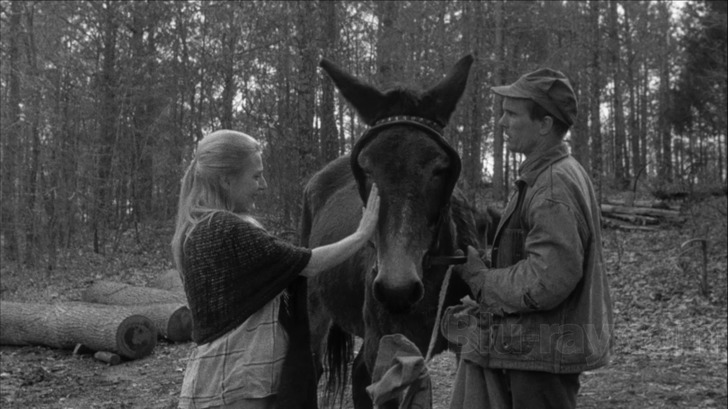
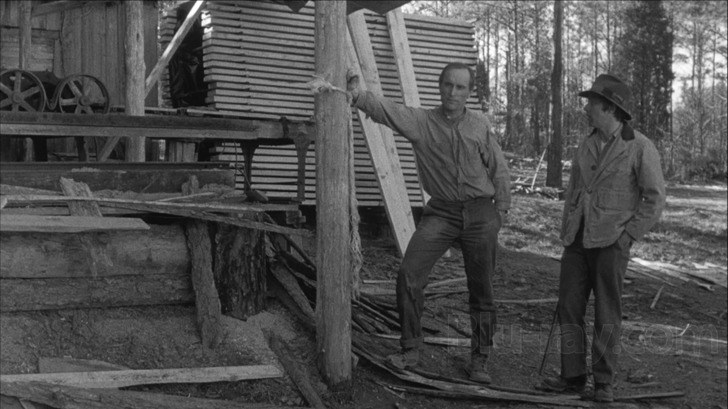
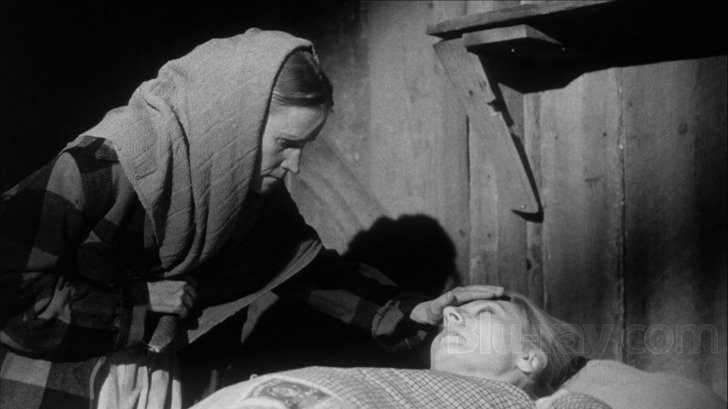
Tomorrow was released in the same year as Martin Scorsese's Boxcar Bertha and Robert Altman's Images, two films that mark the beginning of careers defined by one of the most fertile decades in American cinema. Tomorrow, by contrast, was the last film of accomplished Broadway director Joseph Anthony, whose previous works include such standard studio fare as The Rainmaker (starring Katharine Hepburn and Burt Lancaster) and The Matchmaker (starring Shirley Booth and Anthony Perkins), the filmed version of the play that later became Hello, Dolly! Tomorrow represented a radical departure for Anthony, who was best known for directing flashy Broadway musicals. Shot in black-and-white, the film has no score, a small cast and terse dialogue. Its characters express themselves primarily through their behavior and what they don't say. The film moves at a leisurely pace, even by the standards of the era, in which the exploration of character was often more important than the overall plot. Though made by a director not usually mentioned in connection with Seventies filmmaking, it is immediately recognizable as a product of that experimental age. The central character is Jackson Fentry (Duvall), a taciturn farmer in sparsely populated rural Mississippi. Fentry is first introduced as the sole juror holding out against acquittal in a murder trial, of which only the bare outline is provided in voiceover narration by the defense attorney, Douglas (Peter Masterson), who argues that his client acted in self-defense. Because of Fentry, the jury deadlocks and a mistrial is declared, which means that the state gets another chance to try the defendant. Having lost his first case, Douglas becomes interested in what motivated Fentry's stubborn resistance and begins inquiring into the farmer's background. To understand Fentry's actions, Douglas must go back in time. Twenty years before the trial, Fentry leaves his family's cotton farm and takes a job as caretaker at a saw mill owned by the Russell family. Isham Russell (Richard McConnell), the owner's son, warns Fentry that the previous caretaker couldn't endure the long periods of isolation during the winter months when the mill is shuttered, but Fentry seems to thrive on solitude. It is never explained why Fentry left his family home, but a suggestion lingers that he wanted to get away from something—or perhaps he just doesn't like to be around people. The arrangement proves satisfactory to both Fentry and the Russell family, so much so that Isham's father offers to build Fentry his own house near the mill. But before that can happen, Fentry's hermit-like existence is interrupted by Sarah Eubanks (Olga Bellin), an exhausted and shivering pregnant woman he finds collapsed next to the mill on the day before Christmas. Fentry brings Sarah inside to warm herself by the fire and learns that her husband abandoned her. She is desperate and alone. As Fentry attempts to nurse this sad creature back to a semblance of health, an attachment grows between them, although it isn't easy to understand why. Neither Foote's script nor Duvall's portrayal condescends to Fentry or Sarah by providing a psychological analysis. Fentry, in particular, remains inscrutable, even though it is apparent that much is happening behind his eyes. Possibly Fentry sees something of himself in Sarah. All we know is that, when Isham Russell is startled to find them together, Fentry introduces her as "my wife". Because of her weakened condition, Sarah develops complications during labor, with consequences that redirect Fentry's life. He will shortly return to his family farm, but now with his own family to care for. For a few years, Fentry will enjoy the experience of human connection in which he previously seemed to have no interest (or maybe he simply got used to doing without). But Fentry is living on borrowed time. Sarah's runaway husband is still out there, and he still has rights under the law. Many years later, the totality of Fentry's experience will result in his intransigent refusal to acquit Attorney Douglas' client of murder. (The details are best left for the viewer to discover.) By the end of the film, Douglas has learned enough to understand why he failed to win an acquittal, but has he truly penetrated the enigma that is Jackson Fentry? Tomorrow has the deceptive simplicity of a snapshot. It appears to present a whole picture, but there's always a sense that there's much more to it, just beyond the edge of the frame.
Tomorrow Blu-ray Movie, Video Quality
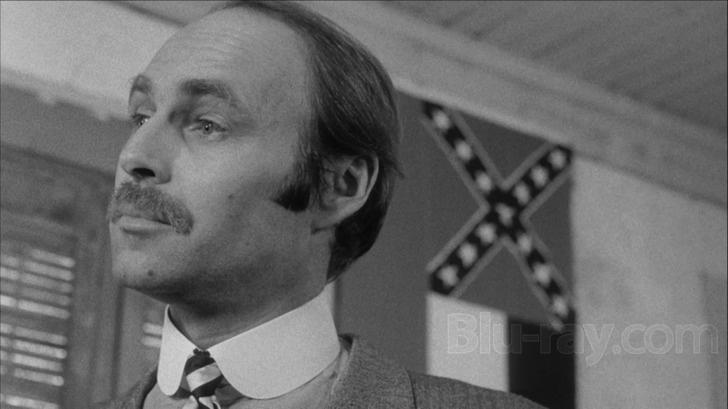
Specialty publisher B2MP has created its 1080p, AVC-encoded Blu-ray of Tomorrow from elements held by the Museum of Modern Art. The source material is in fine shape, with almost no damage or wear-and-tear, but it is obviously several generations away from the original camera negative, with a corresponding loss in resolution and fine detail. The image quality also varies considerably from shot to shot, which suggests that the original photography itself has significant limitations. Some shots are tightly focused and well lit and look accordingly sharp on the Blu-ray, while others appear overexposed and thus either "blown out" or noisy and overly contrast-y on disc. Still other shots are simply soft. The film's grain pattern is readily evident—often, I suspect, too much so for some tastes—so that any issues cannot be attributed to grain reduction. These are simply the best available elements for an independent film from 42 years ago. The blacks are strong, and in better resolved scenes, the shades of gray are well-delineated. It certainly appears that, whatever detail was available on the elements, the Blu-ray reproduces it. Technical limitations prevented me from measuring the average bitrate, but with only a trailer for extras, the 103-minute black-and-white film should fit adequately on a BD-25. In any case, compression errors were not among the issues I saw with this image.
Tomorrow Blu-ray Movie, Audio Quality
The film's original mono soundtrack is presented as PCM 2.0 with identical left and right channels. Although there is some background hiss, the track is generally free of noise, pops or distortion. The spare dialog is clearly conveyed, and the narration by Douglas at beginning and end has a suitably robust presence to underline its authority. The essential sound effects register convincingly, albeit with limited dynamic range.
Tomorrow Blu-ray Movie, Special Features and Extras
The only extra is a trailer (480i; 1.85:1, enhanced; 1:58), which has been updated from its original version to include a reference to Duvall's Oscar for Tender Mercies.
Tomorrow Blu-ray Movie, Overall Score and Recommendation
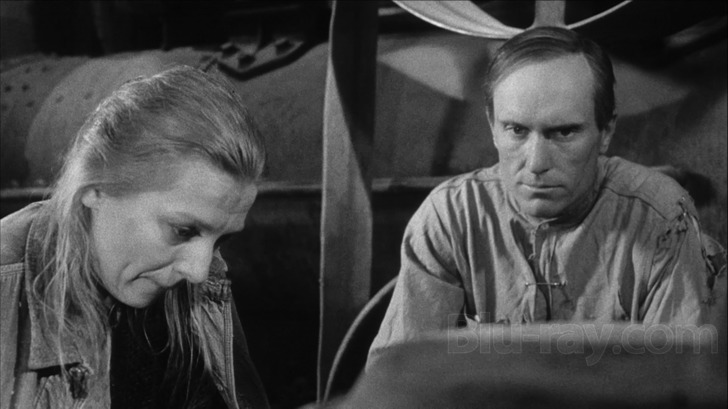
Tomorrow was shot on location in Mississippi, where the story is set, and it has an authentic look and feel about it. Both Faulkner and Foote were Southern writers, and Duvall, though born in California, descends from a Southern heritage and considers Virginia his home. Despite the reliability of such sources, Tomorrow was attacked in 1972, by no less an authority than Vincent Canby of the New York Times, for its "ludicrous" dialogue and "patronizing" attitude toward its characters. Canby thereby fell squarely into a well-established tradition of urban critics who reject depictions by knowledgeable filmmakers of backwoods life of which the critics themselves have no direct knowledge. (For a more recent example, see New York Post reviewer Kyle Smith's dismissal of the exceptional Winter's Bone.) On the contrary, Duvall's portrayal of Jackson Fentry elevates the character by making him singular, unique and memorable. Fentry is someone who might easily pass by unnoticed, simply because he wouldn't choose to call attention to himself, but Tomorrow makes him unforgettable. Recommended, but note that the disc is a B2MP exclusive, although it may be available from Amazon resellers.
Similar titles
Similar titles you might also like
(Still not reliable for this title)

Beautiful Boy
2010

Paradise
1991

Imaginary Heroes
2004

Unbreakable Kimmy Schmidt: The Complete Series
2015-2019

Prince Avalanche
2013

Mean Creek
2004

The Rider
2017

Demolition
2015

Maggie's Plan
2015

Best of Enemies
2015

The Standoff at Sparrow Creek
2018

Split Image
1982

London
2006

The Trip to Spain
2017

Animal Kingdom: The Complete First Season
2016

Road to Paloma
2014

Racing with the Moon
1984

The Trip to Italy
2014

Beau Brummell
Warner Archive Collection
1954

Game Change
2012