Titanoboa: Monster Snake Blu-ray Movie
HomeTitanoboa: Monster Snake Blu-ray Movie 
Inception Media Group | 2012 | 92 min | Not rated | Apr 03, 2012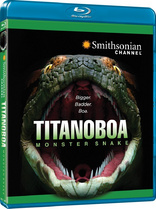
Price
List price:Listed on Amazon marketplace

Movie rating
7.2 | / 10 |
Blu-ray rating
| Users |  | 0.0 |
| Reviewer |  | 4.0 |
| Overall | | 4.0 |
Overview
Titanoboa: Monster Snake (2012)
In the Cerrejon Mine in Colombia, scientists found a host of giant fossilized leaves and super-sized reptiles that shed light on a prehistoric black hole, just after the death of the dinosaurs. These fossilized remains reveal that the earth endured a period of global warming leading to a whole new ecosystem - the birth of the rain forest - in which huge creatures battled it out to become the planet's top predators. Dominating this battle was Titanoboa, the biggest snake of all time.
Starring: Jon Bloch, Carlos JaramilloNarrator: Jim Conrad
Director: Martin Kemp
| Documentary | Uncertain |
| Nature | Uncertain |
Specifications
Video
Video codec: MPEG-4 AVC
Video resolution: 1080i
Aspect ratio: 1.78:1
Original aspect ratio: 1.78:1
Audio
English: Dolby Digital 5.1 (448 kbps)
Subtitles
None
Discs
25GB Blu-ray Disc
Single disc (1 BD)
Playback
Region A (B, C untested)
Review
Rating summary
| Movie | | 4.0 |
| Video | | 4.0 |
| Audio |  | 3.0 |
| Extras | | 0.0 |
| Overall | | 4.0 |
Titanoboa: Monster Snake Blu-ray Movie Review
"Monster Snakes. Why Did It Have to Be Monster Snakes?"
Reviewed by Michael Reuben March 28, 2012A documentary about the biggest snake ever discovered exerts instant fascination, even if the snake has been extinct for 60 million years. Fossilized remains of this ancient monster were first unearthed in 2004 in Colombia at the site of a massive mining operation, resulting in a multi-pronged effort by an international team of scientists to reconstruct a creature unlike any previously known to have existed on earth. And not just the snake itself (ultimately christened "Titanoboa", after it was determined to be related to the contemporary boa genus, of which the largest known member is the green anaconda), but also the unique ecosystem that allowed it to flourish and which, scientists now believe, arose in the aftermath of the meteor crash that wiped out the dinosaurs and became the source of all of South America's rain forests. Titanoboa: Monster Snake was made for the Smithsonian Channel, where it debuts on April 1 and, in a clever marketing move, will be available on DVD and Blu-ray the following Tuesday. The Blu-ray supplies no added features, but it does offer excellent views of the CG reproductions of the awesome predator that the scientific analysis ultimately developed, as well as of the exotic locations and present-day descendants that the scientific team studied to arrive at that analysis. If the only anacondas you've ever seen are the sleepy ones behind thick panes of glass at zoos, be prepared for something different.

Titanoboa used to live here. (Skeleton supplied by CGI.)
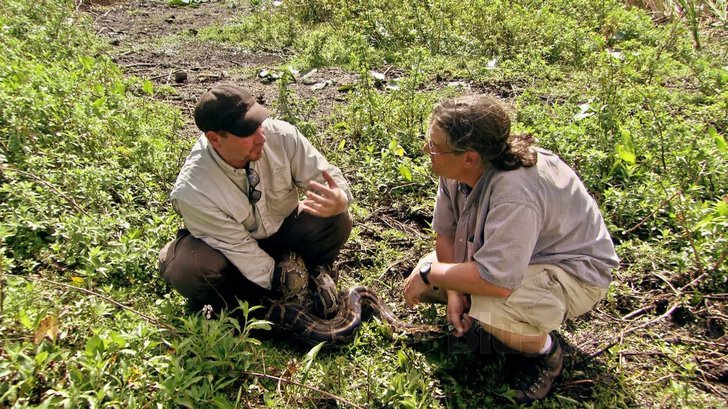
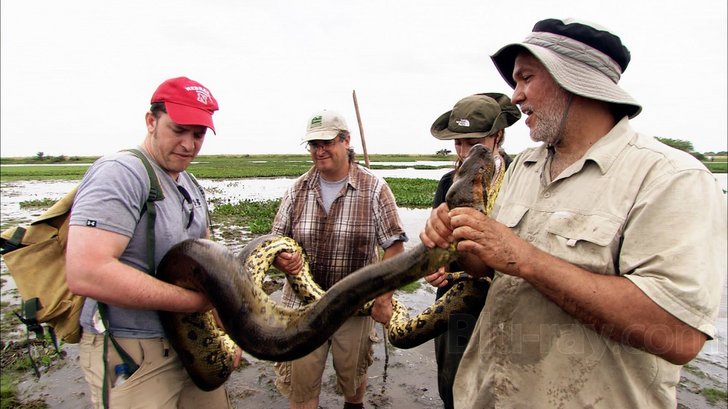
The story begins at the Cerrejon Mine in Colombia, a coal mine of enormous scale, where a team of scientists led by Dr. Carlos Jaramillo, a paleobotanist, and Dr. Jonathon Bloch, a specialist in vertebrate paleontology, are digging through newly uncovered layers of rock and finding beautifully preserved specimens of ancient plant and animal life. So numerous are the finds that the staff on site only has time to package and ship them to university labs, where analysis and cataloguing can be done at a more deliberate pace. At the University of Florida, a grad student named Alex Hastings is unwrapping specimens shipped from Cerrejon in a box that is supposed to contain crocodile bones, when he encounters a vertebra that he's certain is not from a crocodile. In consultation with another grad student, Jason Bourque, he identifies it as a snake vertebra many times larger than any ever before seen. The next morning, they show it to Dr. Bloch, who will later describe his reaction as identical to that of his seven-year-old son on being told they've found the biggest snake in the world. As the team identifies additional vertebrae, they bring in experts in both ancient and contemporary snakes. Eventually they hire a Canadian artisan experienced in translating archaeological data into life-size models of the original creature; the display of his work serves as a kind of climax of the documentary, although it is punctuated throughout by CGI renderings of the mighty Titanoboa, for which the life-size model was a crucial first step. But some of Titanoboa's most memorable footage is supplied not by its titular villain, but by his contemporary descendants. To find clues about the shape, size and behavior of the ancient predator they're trying to reconstruct, members of the team study the closest living analogs, which are giant anacondas and pythons. Dissecting specimens in the lab provides some insight, but for a complete picture one needs to observe them in the wild. The Burmese python is now a regular inhabitant of the Florida Everglades, thanks to Hurricane Andrew having "liberated" a large supply of the creatures in a warehouse where they were bound for the pet trade. Guided by Shawn Heflick, who is licensed by the State of Florida to try to control the exploding python population, Dr. Bloch ventures into the Everglades to discover how these big snakes behave. Watching Heflick wrangle a large female python is a master class in "don't try this at home". But that's just the warm-up. In the flooded grasslands of Venezuela known as the Llanos, a snake expert named Jesús Rivas wades barefoot through water past his ankles looking for green anacondas, the heaviest snake living today and an aquatic predator, as Titanoboa must have been. Why barefoot? Well, it's the best way to feel when you brush against a snake! It's an amazing sight to watch Rivas, Bloch, snake expert Dr. Jason Head and a fourth team member restrain an enormous green anaconda capable of killing any one of them. Getting bitten is just a hazard of the job—and the camera happened to be rolling for one such incident (Rivas welcomes the unlucky victim to the "club"). Watching Rivas pull one giant snake after another from the water is a reminder that expertise comes in many bizarre forms for which you'd never imagine there'd be any use. But Rivas was just the man Bloch and his team needed to help understand how Titanoboa would have moved and hunted. From a filmmaking perspective, one of the most interesting aspects of Titanoboa is the extent to which techniques borrowed from reality TV have influenced documentaries. The elaborate on-screen graphics, the urgent narration, the intense compression of time, the merging of after-the-fact interviews with in-the-moment events, the use of what are obviously reenactments in place of occurrences that no camera would have been there to capture—all these have been deployed to give the story the same breathless pace that, ever since the first Survivor, have successfully transformed many a banal encounter into the latest watercooler topic. It's a wonderful thing if it gets people interested in hard science, but the downside is that anyone who undertakes serious study will quickly learn that real scientific labor is never that exciting. (Neither is anything else, when you do it for real every day.)
Titanoboa: Monster Snake Blu-ray Movie, Video Quality

The bulk of Titanoboa: Monster Snake was shot on hi-def video, except for portions that were computer-generated and an occasional insert that appears to be upconverted from standard definition. Although the credits do not list a digital intermediate, a digital colorist is included, which would be essential to harmonize the variety of video, CG and archival sources. Inception Media's 1080i, AVC-encoded Blu-ray was presumably sourced from these digital files. With a minor quibble, the Blu-ray looks terrific: sharp, clean and clear, with very good blacks (essential for the CG footage) and accurate colors for the numerous locales to which the story takes the researchers. The only flaw is occasional aliasing on complex surfaces, usually in landscapes where light is hitting an area at just the wrong angle. The phenomenon is fleeting and not especially distracting, but it is noticeable. Perhaps 1080p treatment would have minimized or even eliminated it. It's not enough for me to recommend against the disc, especially given the superb clarity of such scenes as vistas of the Cerrejon Mine and the Llanos and and the "up close and personal" views of the various reptiles examined by the scientific team as they attempt to reconstruct Titanoboa.
Titanoboa: Monster Snake Blu-ray Movie, Audio Quality
Now, before anyone gets high and mighty about the lack of a lossless track on this disc, I'd like to point out that, having actually heard the DD 5.1 track, it sounds quite good. And why shouldn't it? The only major audio element is the narration by Jim Conrad and the voices of those interviewed, all of which remain clear and intelligible. The musical score and the sound effects (mostly accompanying the CG animation) remain very much in the background, so much so that I doubt even the most "golden" of ears could hear the difference between a lossy and a lossless presentation. Those who want to stand on principle should feel free. Those who are interested in this disc may acquire it with confidence that its DD 5.1 track is fine.
Titanoboa: Monster Snake Blu-ray Movie, Special Features and Extras
No supplements are included. Indeed, the disc is so barebones that the chapters aren't even labeled (although chapter stops have been included). The menu has a single item: "Play".
Titanoboa: Monster Snake Blu-ray Movie, Overall Score and Recommendation

There's an inescapable element of sensationalism in a film about a giant snake, but what I liked most about Titanoboa is that it ends up downplaying that aspect by focusing on the scientists instead of the snake. They come off as a likeable bunch of regular guys who just happen to have unlikely jobs, but they love what they do. The monster snake of yore may be gone, but the scientists and their curiosity remain, and they wind up becoming the true heroes of the story. Recommended, especially since you can catch it on the Smithsonian Channel first and then decide for yourself.