Tiger 24 Blu-ray Movie
HomeTiger 24 Blu-ray Movie 
Universal Studios | 2022 | 90 min | Not rated | Jan 31, 2023

Price
List price:Amazon: $12.57 (Save 48%)
Third party: $12.57 (Save 48%)
Only 4 left in stock (more on the way).

Movie rating
7 | / 10 |
Blu-ray rating
| Users |  | 0.0 |
| Reviewer |  | 4.0 |
| Overall | | 4.0 |
Overview
Tiger 24 (2022)
When a wild tiger kills men who enter his territory he is declared a man-eater and locked up in a zoo. This galvanizes massive social uproar and activists take their cause to the streets, online, up on to billboards and all the way to the Supreme Court.
Narrator: Warren PereiraDirector: Warren Pereira
| Documentary | 100% |
Specifications
Video
Video codec: MPEG-4 AVC
Video resolution: 1080p
Aspect ratio: 1.78:1
Original aspect ratio: 1.78:1
Audio
English: DTS-HD Master Audio 5.1
Subtitles
English SDH
Discs
Blu-ray Disc
Single disc (1 BD)
Playback
Region A (B, C untested)
Review
Rating summary
| Movie | | 4.0 |
| Video |  | 4.5 |
| Audio | | 4.0 |
| Extras |  | 3.5 |
| Overall | | 4.0 |
Tiger 24 Blu-ray Movie Review
"Tyger Tyger, burning bright, In the forests of the night"
Reviewed by Justin Dekker January 29, 2025Warren Pereia's debut feature film, the documentary 'Tiger 24', arrives on Blu-ray disc courtesy of Universal. When the tiger he is following for a
documentary is accused of killing a forest guard, it unleashes a chain of events throughout India, prompting a national debate and, ultimately, a
case that would wind its way to the nation's Supreme Court. Filled with lush imagery of tigers in their natural habitat, material about the attack and
its wake, and numerous passionate voices from each side of the issue of T-24's fate, the film goes well beyond the realm of the traditional nature
documentary. Neither a slipcover nor a Digital Code are included.
Before the film begins, viewers are met with the following title card:
Be aware: This documentary depicts brief, but very graphic
images of mutilated human bodies after a tiger attack.
While these images are certainly quite disturbing, it should also be noted that there are also several scenes of animal violence where tigers are observed attacking large forest animals. Additionally, there are also several scenes where tigers are being hunted which could be troubling to sensitive viewers. All of these scenes and their aftermath, which include footage from a post-mortem examination, can be quite graphic. The faint of heart should take this under advisement prior to screening this film.
It began in May of 2012 as a more straightforward documentary about a massive Bengal tiger weighing approximately 600 pounds named Ustad (which means "master"), or, as he is referred to by the government, T-24. He was the "pride of Ranthambore", a 109 square-mile park in northern India. It's the perfect habitat for tigers. Tiger tourism here is big business, bringing in millions of dollars each year, some of which is channeled back into conservation. But after he began shooting, tragically, the tiger that Warren Pereira was filming allegedly killed a man on May 8th, 2015. The victim was Rampal Saini, a local forest guard. As is the case with any animal that attacks humans, the concern is that once they develop a taste for humans or begin to associate them with (or as) food then the safety of all those within the animal's range is at risk.
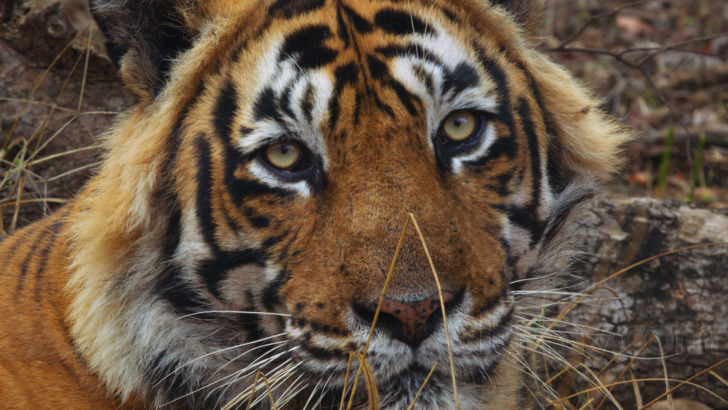
Part of the issue at the heart of the events depicted seems to be Ranthambore's design. Typically these areas are intended to have an area referred to as the "core" in the center which is supposed to be protected and reserved exclusively for the tigers. Around those areas is a buffer zone that is, to a degree, shared by both people and the tigers but effectively serves to separate it from villages and farms. Ranthambore, however, was not constructed to have a buffer zone with the core directly abutting a human settlement. Further exacerbating the issue, pilgrims routinely travel through the core on their way from local villages to a temple, essentially invading the tigers' home and putting themselves directly in harm's way.
Another key issue is Ustad's complicated history which is then examined, beginning with the 2009 treatment of an infected paw and getting fitted for a radio collar. That intervention didn't exactly go as planned, and the event that should have lasted mere hours extended to over two days. The frequency with which people entered his domain also potentially contributed to T-24's possible motivation to potentially attack humans. Their reasons for doing so are as numerous as they are diverse with pilgrims trekking through en route to a local temple, the ever-present tiger tourism excursions, locals who would take their animals into the area to graze, and the numerous people who would use the area to relieve themselves at all hours of the day and night. Any or all of these could have potentially diminished or eliminated the animal's natural fear of humans.
By the time he killed forest guard Rampal Saini, it was the fourth such attack of which T-24 had been accursed. Local officials felt they had no other choice but to relocate him to a zoo for the protection of those living in and passing through his range. And so, a few days later on May 16, 2015, T-24 is tranquilized and relocated to Sajjan Garh Biological Park where he is made to live in a small enclosure far from his natural habitat, his mate, and his offspring. Considering his natural range would be 40 to 50 square kilometers, reducing his living space to an area about the size of an American football field is quite a dramatic reduction, indeed. But the case against T-24 is certainly threadbare and circumstantial at best. On the night that he was killed, Rampal Saini was responding to the report of a tiger being seen. After walking a mere 20 feet off the road and into the core, he is attacked by a large tiger. The squealing tires of a jeep rushing to his aid frighten the tiger off but the driver was not able to positively identify the beast. After Rampal is taken to a local hospital where he would be pronounced dead, a group of forest guards returns to the scene of the attack. They observe a large male tiger licking Rampal's blood from the surface of the road. They take pictures and quickly determine that this tiger is T- 24, and these photographs become the decisive evidence to blame him for Rampal's death and set the plan to relocate him in motion. The film then spends time documenting the events surrounding the three other killings for which T-24 is blamed so that the animal's history can be more fully understood.
Where do the tiger's rights begin? Where do the rights of those who live nearby end? Who is responsible for maintaining the precarious balance between these neighbors? Voices on both sides are given time with some advocating more being done to protect the tigers' habitat from human encroachment and others positing that any action taken to protect human life is justified. Pereira explores each of these positions as the legal battle to determine Ustad's ultimate fate plays out in the courts. Those lobbying for the tiger's freedom contend that beyond the impact on T-24 of being removed and placed in a small enclosure, his absence puts his family at risk. Any new male who enters the territory will likely not tolerate the presence of T-24's male offspring, with attacking and killing them being a potential outcome. Noor, T-24's mate and the cub's mother would most certainly step in to defend them in the event of such an attack, putting her life in jeopardy as well. There is nothing that the National Tiger Conservation Authority, the Forest Director, or the forest guard will do to intervene in these potential events. Those on the other side contend that this man-eating tiger will kill again and keep on killing if he is not removed from Ranthambore. Valid arguments exist on both sides and other than expressing obvious admiration and awe of the massive tiger, Pereira is careful not to take a stance. That chore is up to the viewer.
(The quoted text at the top of the review is from William Blake's poem 'The Tyger' which was first published in 1794.)
Tiger 24 Blu-ray Movie, Video Quality
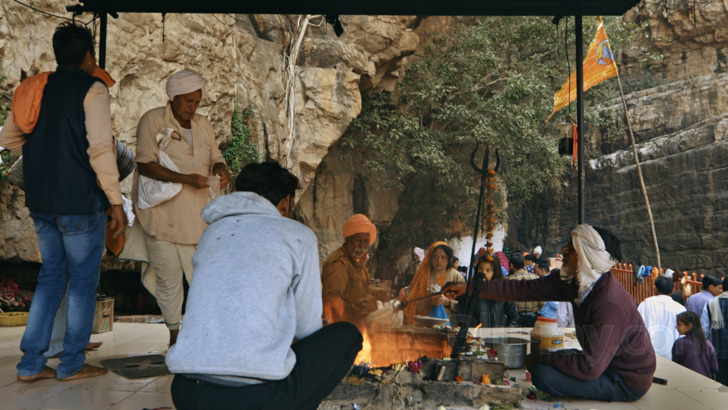
Shot primarily with a Cannon EOS C500 camera in 4K with Cinema Gamut, Tiger 24 features a richly saturated and colorful image. The film's colorist desaturated the color palette and added a bit of warmth to craft a gritty edge to the image in an effort to match the tone and subject of the film. The resulting image on display is frequently stunning. Every aspect of Ustad's visage is up for inspection during close-ups, with each strand of fur and every whisker clearly distinguishable. Environmental particulars such as leaves, blades of grass, pebbly stream beds, and the like are similarly clearly defined. Colors are lush, with the most vivid colors on display in villages and especially at the temple that resides in the core of Ustad's habitat. Blacks are deep and satisfying and depth and dimensionality are strong. Skin tones are universally healthy and realistic. Sparsely used vintage footage can appear a bit rough and betrays the limitations of the source materials, but it all looks about as good as it can here. It's a gorgeous transfer.
Tiger 24 Blu-ray Movie, Audio Quality
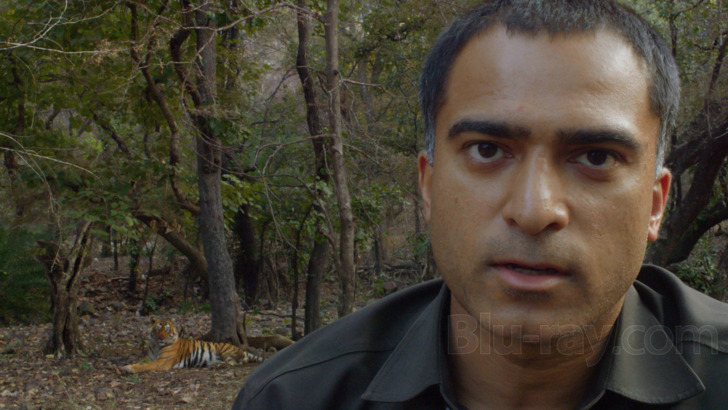
The DTS-HD Master Audio 5.1 audio track that accompanies Tiger 24 is more than satisfactory if unambitious. It's a very front-heavy presentation with much of the dialogue and music emanating from the front channels. Music, which is sumptuously rendered and occasionally allowed to swell receives excellent support from the surrounds, with the emotional tracks filling the space with the viewer perfectly positioned in the center. Bass is never overpowering but is instead emerges just enough to support vehicle engines, music, and other sounds. Occasionally, the limitations of the source audio are revealed, for example, when Pereira speaks in the back of a speeding jeep, but these should not be considered a fault in the track. The track does just enough to support the work but is clearly fashioned in such a way so as to allow the beautiful visuals to remain the focus in every scene just as they should.
Tiger 24 Blu-ray Movie, Special Features and Extras
Tiger 24's release is augmented by the following on-disc supplemental material:
- Valmik Thepar (Tiger Expert) Full Interview (46.34) - Responding to questions from Warren Pereira, Valmik Thepar begins by calling into question the tiger management practices in place at the time that T-24 was growing into adulthood and a botched effort to treat the tiger's infected paw and fit him with a radio collar. A common theme he returns to multiple times is to comment that people should be trying to "play God" to the tigers and events should allow things to progress naturally as much as possible. He covers several other topics as well and is always passionate, knowledgeable, and authoritative.
- Deleted Scenes (7.23) - Two deleted scenes are included: T-24 in the Wild (1.38) which shows the tiger napping by one of his recent kills (or stolen kills), and Activists Claim Sultan is Dead (5.45) which documents Pereira's effort to confirm that T-24's oldest male offspring has died. Their claims seem to be inaccurate as time-stamped photos show the tiger to still be very much alive.
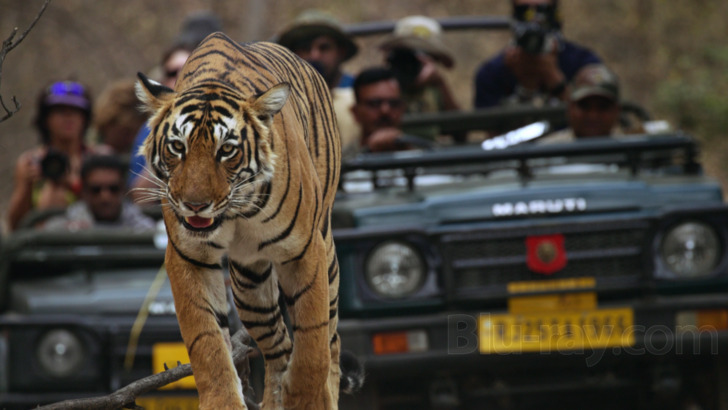
- Director's Commentary - Director Warren Pereira adds additional insight to Tiger 24, prompted to do so by his own love for director's commentaries. He begins by expressing his love of the film's opening shot of T-24 approaching their jeep with a fresh kill. He discusses the film's structure, the origin and timing of key shots, and the original idea for the documentary, which, somewhat nontraditionally, follows a male tiger instead of a female. especially given the perceived dangerousness of T-24. The tragedy of Rampal's death forced him to take the project much more seriously and learn significantly more about tigers, Ranthambore, meeting all of the concerned parties, and the big cat's history. He covers a great deal of technical details regarding the shoot as well as numerous asides loaded with behind-the-scenes information.
Tiger 24 Blu-ray Movie, Overall Score and Recommendation
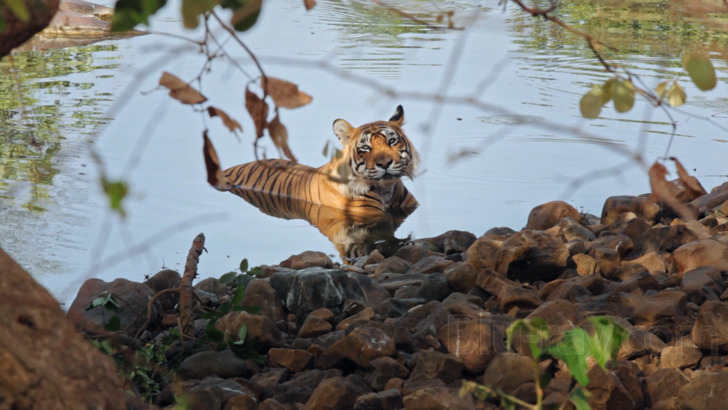
In a world growing increasingly crowded, the complexities involved with trying to have humans and potentially dangerous animals live side-by-side in a harmonious fashion are explored through the lens of Ustad's plight after being labeled a maneater. Feelings are mixed and emotions are high, with some expressing support for the decision to relocate the man-eating tiger, and others claiming the deaths attributed to the tiger were merely the result of human encroachment and not accepting the boundaries established to keep both man and animal safe. It's a complicated issue without a clear or easy answer. But one thing is certain; tigers are in need of help. Beautifully shot and offering a rare glimpse inside one of India's large tiger habitats, Warren Pereira's Tiger 24 comes strongly recommended.