Thurgood Blu-ray Movie
HomeThurgood Blu-ray Movie 
HBO | 2011 | 106 min | Rated TV-14 | Jan 17, 2012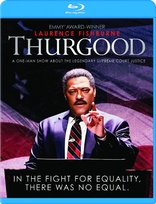

Movie rating
7.4 | / 10 |
Blu-ray rating
| Users |  | 0.0 |
| Reviewer |  | 4.5 |
| Overall | | 4.5 |
Overview
Thurgood (2011)
A one-man play/biopic in which Thurgood Marshall, lawyer and advocate for civil rights, recounts his life story to an auditorium of students at his old law school at Howard University. Hewing closely to the known facts of Marshall's biography, the story takes us from his childhood in Baltimore through his education, his legal career as counsel for the NAACP, his historic victory in the Supreme Court case of Brown vs. Board of Education, and his appointment as the first African-American Justice of the Supreme Court. Taped before a live audience at the Kennedy Center.
Starring: Laurence FishburneDirector: Michael Stevens (IV)
| History | Uncertain |
| Biography | Uncertain |
| Drama | Uncertain |
Specifications
Video
Video codec: MPEG-4 AVC
Video resolution: 1080p
Aspect ratio: 1.78:1
Original aspect ratio: 1.78:1
Audio
English: DTS-HD Master Audio 5.1
Spanish: DTS 2.0
Subtitles
English, French, Spanish
Discs
25GB Blu-ray Disc
Single disc (1 BD)
Playback
Region A (B, C untested)
Review
Rating summary
| Movie | | 4.5 |
| Video | | 4.5 |
| Audio |  | 4.0 |
| Extras | | 0.0 |
| Overall | | 4.5 |
Thurgood Blu-ray Movie Review
Lively Portrait of a Wily Subject
Reviewed by Michael Reuben January 10, 2012Supreme Court Justice Thurgood Marshall retired from the bench in 1991 and died just two years later at the age of 84. In the two decades since, his name remains recognized as that of the first African-American to serve on the nation's highest court, but few people today recall the extraordinary career that preceded Marshall's appointment as Justice. The omission is understandable, because when Marshall served his quarter century on the Court, it was much less available to public scrutiny than it is today. The Justices kept lower profiles, rarely appearing except at oral arguments, the announcement of decisions and an occasional bar association function. As he notes near the end of Thurgood, it took a while for Marshall to adjust to this monastic existence. He was used to being where the action was. Before being nominated to the Court by Lyndon Johnson in 1967, Marshall had led an active life trying and arguing cases in courts all over the country, mostly as a private attorney for the NAACP. For two years (1965-1967), Marshall also served as U.S. Solicitor General, the nation's official representative to the Supreme Court, the first African-American to hold the position, another of the many "firsts" in Marshall's life. (Although he didn't live to see it, one of Marshall's law clerks, Elena Kagan, would ultimately follow the same path, serving as Solicitor General before being appointed to sit on the same Court she had come to know so well as an advocate.) Marshall's most famous (some might say "infamous") victory as a private lawyer was the 1954 decision in Brown v. Board of Education, which overturned fifty years of precedent by ending segregation in public education—and, by extension, pretty much everywhere else. Thurgood is a one-man play about the former Justice written by George Stevens, Jr., a founder of the American Film Institute and the son of multi-Oscar winner George Stevens, director of Shane, Giant and A Place in the Sun. The play debuted in 2006 at Connecticut's Westport Country Playhouse with James Earl Jones in the title role, then came to Broadway two years later starring Laurence Fishburne. In 2011, Fishburne reprised his performance at the Kennedy Center in Washington, D.C., before both a live audience and cameras directed by Michael Stevens (the author's son) for HBO Films. That version aired on the cable channel and is now being released on Blu-ray.
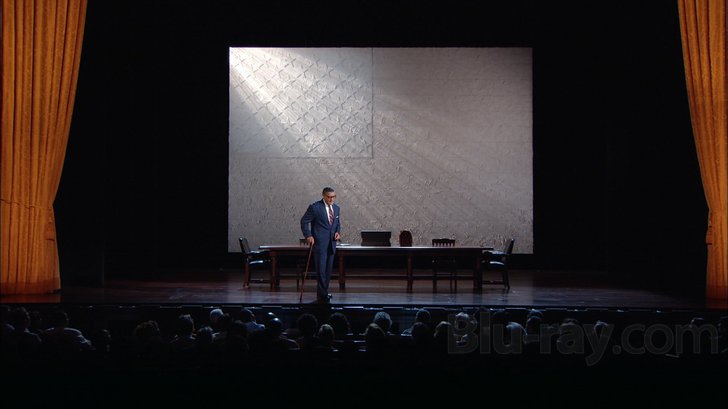
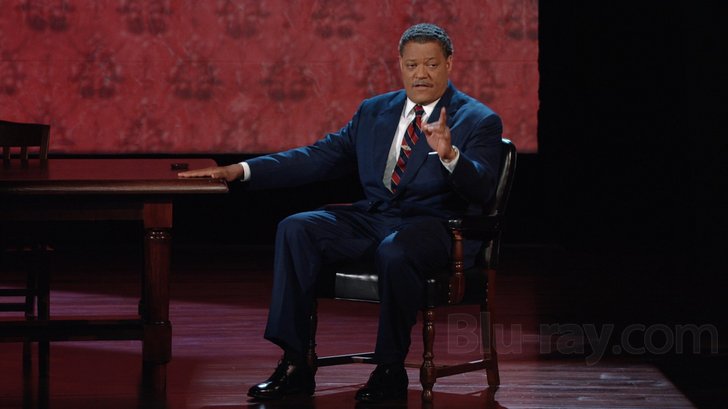
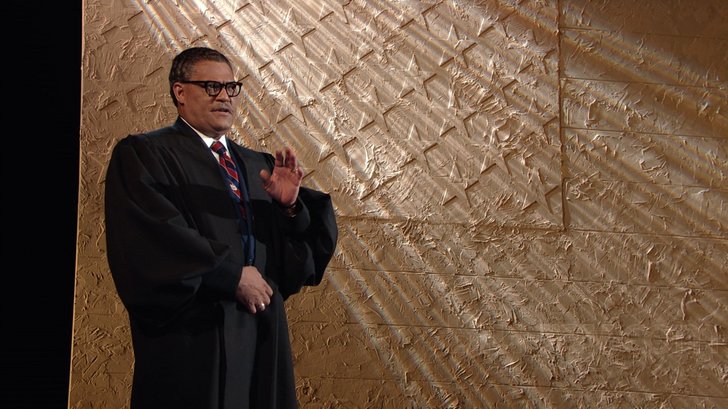
The narrative device of Thurgood is to turn the theater into an auditorium at Howard University, where Marshall attended law school and where he has now returned in his twilight years to speak to students about his illustrious career. It's a simple but effective setup, because it allows Fishburne to portray Marshall at his oratorical best, projecting to an audience with the unique mixture of erudition and plain speaking that was reportedly the hallmark of his courtroom manner. Fishburne, who is an accomplished stage actor in addition to his film work, is so comfortable with this material that he even departs from the script at one point to welcome a few latecomers to their seats, after which he returns effortlessly to the subject Marshall was discussing. The stage has been simply arranged with a long wooden conference table that serves multiple purposes as lectern, resting place and various forms of seating. On the rear wall, a giant screen with a mock-stucco pattern of an American flag shows projections of photographs that illustrate Marshall's stories or set their scene. Since this particular performance was staged for the camera, director Stevens has wisely omitted an "entrance", choosing instead to open on Marshall standing on stage at the front of the auditorium as he begins to speak. He doesn't want you to see an actor entering to applause, then assuming the role of Thurgood. You're just supposed to see Thurgood. In his distinctive Baltimore twang, the former Justice tells his entire life story. His great-grandfather was a slave brought to America from the Congo and freed, according to Marshall, because he was too ornery. Marshall's father, William, was a railroad porter whose hobby was listening to court cases. William would take his son with him, and afterward father and son would debate everything they'd heard that day. From this (and, no doubt, other activities), Marshall acquired a disposition that one of his teachers called "disputatious". As punishment, the teacher would send him to the furnace room with a section of the U.S. Constitution to memorize, assuming, presumably, that the dryness of the document would make the task painful. Instead, Marshall continued his disputatious ways and eventually memorized the entire document. His ability to quote the Constitution at will would come in handy. Marshall's mother, Norma, was a school teacher, who earned substantially less than her white counterparts. One of Marshall's early cases was a successful action to get his mother and her fellow African-American teachers equal pay. Another was a successful challenge to the University of Maryland School of Law, which had rejected him because they didn't accept blacks (which is why Marshall attended Howard). After cogent presentations by Marshall and his co-counsel in the lower courts, the Supreme Court of Maryland ordered the law school to admit Donald Gaines Murray, an African-American honors graduate from Amherst College. Marshall would always remember the case fondly as one of his sweetest victories. One of the most impressive qualities of Thurgood is how vividly and entertainingly it conveys vast amounts of U.S. history and technical legal information without ever seeming like a textbook. The trick is that Marshall, like any successful trial lawyer, was a good storyteller, and Stevens' script for Thurgood interweaves historical information with the kind of personal anecdotes and vivid character sketches that Marshall was known to love sharing with friends and law clerks. At one moment he's telling a story about the poet Langston Hughes, who was his college classmate at Lincoln University in Pennsylvania. At another he's arguing with Martin Luther King about the utility of civil disobedience (Marshall preferred using the law as a weapon rather than breaking it). At still another, he's making everyone laugh with an account of how he passed a teetotaling magistrate's "smell" test for intoxication, after two Southern cops arrested him on a spurious drunk driving charge. (The laughter is uneasy, though, because a lynch mob had formed on the edge of town.) And if you've ever wondered how segregation first became legal in America, then was ultimately overturned, Thurgood lays out the story in a direct, compelling narrative. Marshall's later years on the Supreme Court were not happy ones. When Richard Nixon took office as President, he embarked on a campaign to reshape the Court, with mixed results. (William Rehnquist, who would later become chief justice, was one of Nixon's appointees, but so was Harry Blackmun, who would go on to write Roe v. Wade.) Among other things, Marshall was deeply troubled by the Court's increasing willingness to allow the death penalty. As he notes, Marshall was the only member of the Court who had actually tried capital cases, and the experience had taught him what many more people have now learned thanks to DNA evidence and the Innocence Project: that criminal trials can wrongly convict innocent people of crimes they didn't commit. Kill the defendant, and you leave no option to correct such an error. Marshall's dissents from refusals to grant stays of execution or hear appeals in capital cases became legendary. Fishburne's incarnation of Marshall is remarkable. He's aided by the make-up and costume, of course, but the posture, movement and attitude are the actor's own accomplishments. And Fishburne uses subtle shifts in demeanor and tone to "regress" Marshall in tune with the story, so that he begins as an elderly man limping and leaning on a cane (as Marshall did), then puts down the cane and begins moving more fluidly and aggressively for the tales of his younger years. As he returns to the present era, he picks up the cane and resumes limping. By the end of the performance, I no longer saw Fishburne at all. He had disappeared completely into the person he was portraying, a titan of 20th Century constitutional law who, despite all his accomplishments, nevertheless experienced his proudest moment on the day he left the Supreme Court, because it was also the day he stood with his elder son and daughter-in-law (with his wife and other son looking on) and made the motion to have them admitted as members of the Court's bar.
Thurgood Blu-ray Movie, Video Quality
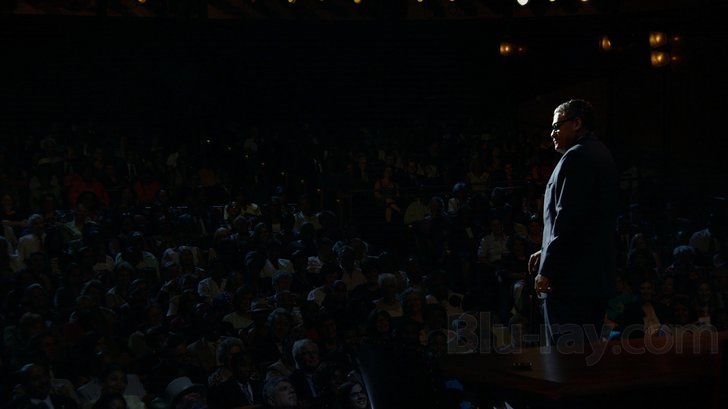
Thurgood was recorded on HD video, and there is little to say about HBO's 1080p, AVC-encoded Blu-ray other than that it faithfully reproduces the clean, grainless and noiseless look of a first-rate HD capture. Blacks are deep, detail is excellent, colors are stable and well-saturated and there is no distortion or artifacting to be seen. This is a first-rate presentation of first-rate source materials.
Thurgood Blu-ray Movie, Audio Quality
The art of mixing sound for a theatrical presentation is different from that for film, but it is no less precise. Thurgood uses subtle distant sounds of city and country to punctuate its protagonist's stories, and it also uses sounds of trains, crowds, chimes and doors closing as transitions from one story to another. Many of these "chapter" dividers pan subtly between left and right. The rear channels in the DTS-HD MA 5.1 track contribute an occasional sense of audience presence through laughter, but mostly these channels are used to convey an expansive sense of the auditorium in which Marshall is speaking, as his voice reaches out to the far corners. There is a jazz-inflected score at the beginning and end, which is credited to Rob Mathes.
Thurgood Blu-ray Movie, Special Features and Extras
No extras have been included.
Thurgood Blu-ray Movie, Overall Score and Recommendation
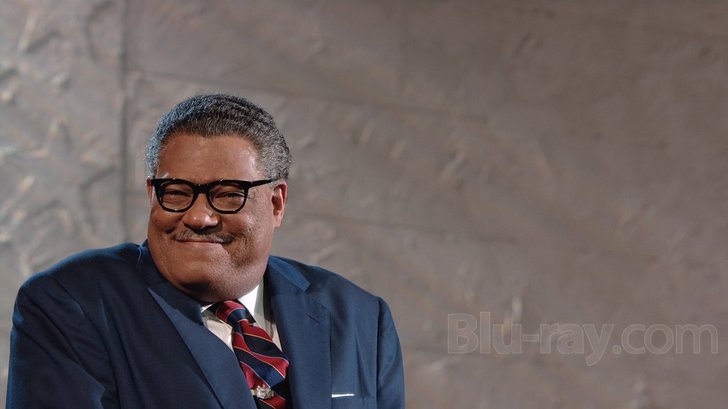
Too many figures of great historical interest resist being made the subject of a biopic because their work is inherently uncinematic. Marshall was a skilled courtroom advocate, but the bulk of his work consisted of reading, writing and thinking, none of which translate effectively to the screen. Thurgood deftly sidesteps this limitation by making the man his own spokesperson. It's a fitting approach for a unique individual who—and this comes through in Thurgood repeatedly—took great pride in always being his own man and being clear-eyed about himself and the world he inhabited. Both the film and the Blu-ray are highly recommended.
Similar titles
Similar titles you might also like
(Still not reliable for this title)

The People vs. Larry Flynt
1996

The Doors 4K
The Final Cut
1991

Bessie
2015

Denial
2016

Judgment at Nuremberg
Limited Edition to 3000 - SOLD OUT
1961

Dark Waters
2019

Amistad
1997

Once Were Brothers: Robbie Robertson and The Band
2019

Mary Queen of Scots 4K
2018

Wolf Hall
Masterpiece
2015

The Mill and the Cross
2011

Mandela: Long Walk to Freedom
2013

Operation Finale
2018

W.
2008

House of Gucci
2021

A Man for All Seasons
Limited Edition to 3000 - SOLD OUT
1966

Cesar Chavez
2014

Inherit the Wind
1960

Pirates of Silicon Valley
1999

Spotlight
2015