Three Secrets Blu-ray Movie
HomeThree Secrets Blu-ray Movie 
Olive Films | 1950 | 98 min | Not rated | Oct 16, 2012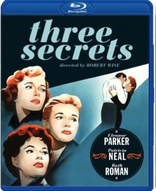

Movie rating
6.8 | / 10 |
Blu-ray rating
| Users |  | 0.0 |
| Reviewer |  | 3.5 |
| Overall | | 3.5 |
Overview
Three Secrets (1950)
A five-year-old boy is the sole survivor of a devastating plane crash in the mountains of California. When the newspapers reveal the boy was adopted and that the crash occurred on his birthday, three women begin to ponder if it's the son each gave up for adoption. As the three await news of his rescue at a mountain cabin, they recall incidents from five years earlier and why they were forced to give up their son.
Starring: Eleanor Parker, Patricia Neal, Ruth Roman, Frank Lovejoy, Larry KeatingDirector: Robert Wise (I)
| Drama | 100% |
Specifications
Video
Video codec: MPEG-4 AVC
Video resolution: 1080p
Aspect ratio: 1.37:1
Original aspect ratio: 1.37:1
Audio
English: DTS-HD Master Audio Mono
Subtitles
None
Discs
25GB Blu-ray Disc
Single disc (1 BD)
Playback
Region A (B, C untested)
Review
Rating summary
| Movie | | 3.5 |
| Video | | 3.5 |
| Audio | | 3.5 |
| Extras | | 0.0 |
| Overall | | 3.5 |
Three Secrets Blu-ray Movie Review
Who's your mommy?
Reviewed by Jeffrey Kauffman October 16, 2012Three Secrets is a fairly standard melodramatic soap opera with a rather impressive pedigree, being one of the early directorial efforts of Robert Wise, and one of the first films in Wise’s directing oeuvre that wasn’t a B or quasi-B feature. Wise, who for most Baby Boomers will forever be associated with West Side Story and The Sound of Music, started his long career as an editor, working on such iconic fare as Citizen Kane. His first directorial efforts were solid if exploitative items like The Curse of the Cat People and The Body Snatcher, but by the time the fifties rolled around, Wise had begun to find his directorial voice and would soon offer the world his first undisputed masterpiece, The Day the Earth Stood Still. One year prior to that release, however, Wise came out with Three Secrets, an uneasy amalgam that combined elements of Joseph L. Mankiewicz’s enormously successful 1949 sudser A Letter to Three Wives with a sort of presaging of another recent Olive Films Blu-ray release, 1956’s The Mountain. As with Three Wives, we have a trio of females around whom a mystery swirls. In the case of Wives, it was which woman’s husband had left her to have an affair with the titular letter writer; in the case of Three Secrets, it’s which woman had a baby whom she gave up for adoption and who is now a five year old stranded on a precarious cliff side after a harrowing airplane crash. Wise weaves together the back stories of the three women alongside the rescue efforts to get the little boy down off the mountain before he perishes.
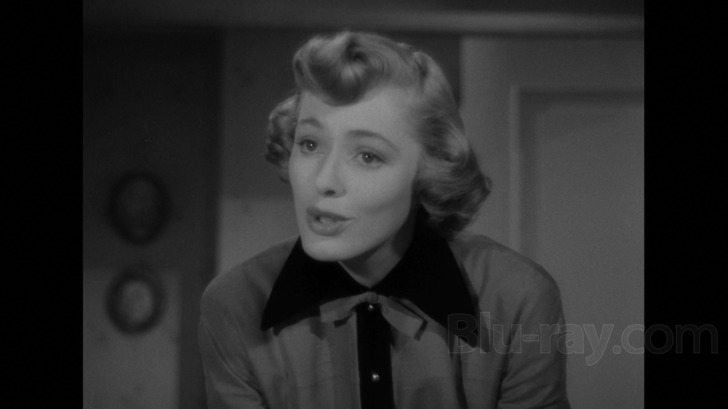
Wise reaches right out and grabs the viewer by the heartstrings even as the film’s credits are rolling by, with a frightening scene consisting simply of an airplane engine sputtering. It roars for a moment, cuts out, and comes back on, only to fail again. We quickly cut inside the craft to see a little boy turning toward the camera to ask his mother when they’ll be getting home, at which point disaster strikes. A rescue aircraft is quickly sent out to locate the wreckage, taking some photographs of the twisted hull of the aircraft perched precariously on a precipitous cliff, and it’s assumed that there could be no survivors. But a quick review of two photos taken seven minutes apart proves that the little boy is alive—or at least was when the pictures were snapped, as he’s moved quite a distance between the two photos.
The rescue of little Johnnie becomes a media sensation (in fact some elements of this film are strangely reminiscent of Billy Wilder’s great Ace in the Hole), and a kind of smarmy journalist quickly discovers that little Johnnie had actually been a foundling who was adopted by the parents who perished in the devastating plane crash. That of course sets the guy off on an attempt to figure out who the real mother is, hoping for a scoop that will play up the human interest angle even more than it already is being. The journalist finds out what facility handled the adoption and goes there, but is rebuffed by the no nonsense administrator, who, after he leaves, confides to her secretary that there were four babies born the day that little Johnnie was and which were entrusted to her facility’s care. One was a little girl and three of them were boys.
With that intriguing premise set before the viewer, the film then starts to revel in a rather nonstop array of bathos as we get to know the three “contestants” who may or may not be little Johnnie’s biological mother. Co-scenarists Martin Rackin and Gina Kaus aren’t especially nuanced in their treatment of the three stories. They start with Susan (Eleanor Parker), a young wife who has married well to an attorney named Bill (Leif Erickson), but who has kept her past indiscretion secret. A visit from her mother and the shocking revelation of Johnnie’s birth date and foundling status set Susan off on the first of what will be several flashbacks scattered throughout the film (replete with wavy imagery and echoing voiceovers saying things like “five years ago, five years ago, five years ago. . .”).
Susan it turns out had been having a romance with a Marine (“five years ago” placing the bulk of the back stories in the film resolutely in World War II territory). The Marine jilts her rather unceremoniously and she doesn’t have the wherewithal to tell him she’s pregnant with his child. (One of the fascinating things about this film is how carefully it skirts even the use of the word “pregnant” or even any outright assertion of illegitimacy or premarital sex.) Susan attempts to commit suicide, but her mother saves her and insists that she give her baby up for adoption. At the adoption agency, we also meet two other women who are signing away their parental rights that day, newspaper writer Phyllis (Patricia Neal) and troubled dance star Ann (Ruth Roman).
Back at the rescue site, Susan bumps into Phyllis (called “Phil” by all her newspaper cronies) again, and we get Phyllis’ back story. She had been a globetrotting war correspondent whose long absences had alienated her from her husband, though she manages to reclaim his affections at least briefly when she promises not to write anymore and instead become a “dutiful” homebody wife. That soon ends when her editor hands her a plumb assignment, at which point her husband walks out on her for good. Of course a few weeks later she discovers she’s pregnant. Also showing up to the rescue site is Ann, whose back story turns out to be quite a bit more dramatic than the other two women. She had been the girlfriend of an extremely wealthy industrialist who attempted to ditch her. When she revealed she was carrying his child, he arranged for a slimy guy to claim the baby was his and that she was a woman of loose morals. Ann snapped and killed her lover, ending up with a five year prison sentence, something she has just been released from.
The rest of the film plays out with the women trying to come to terms with their decisions and also having to decide if they want to know for certain whether Johnnie is theirs or not. Phyllis’ journalistic efforts may in fact solve the mystery, but the film adds a little touch of pathos at the end as one character makes a noble sacrifice in order to better little Johnnie’s lot in life.
There’s no denying the overtly soap operatic elements of Three Secrets, but that really doesn’t diminish the emotional power of the film. All three leads are excellent, even if all three are required to look imploringly into the camera in virtually every scene (try to keep count of the raised eyebrows, hopeful glances and watery eyes—you probably won’t be able to). Neal is especially effective as a gung ho career woman who doesn’t cotton easily to being told what to do or how a “real woman” (an actual quote from her soon to be ex-husband) should behave. The film is unabashedly in the “women’s picture” genre, but it’s still a surprisingly effective little film that shows what a superior director could fashion out of standard (or frankly even substandard) material.
Three Secrets Blu-ray Movie, Video Quality

Three Secrets is presented on Blu-ray courtesy of Olive Films with an AVC encoded 1080p transfer in 1.37:1. The elements here are in generally decent enough shape, though they exhibit some of the more consistent damage of circa fifties catalog releases by Olive. A lot of the film is hobbled by white flecks and specks, as well as scratches and, in the case of some stock footage, hairs in the gate. There are two or three really bad moments (seconds, really) that exhibit horrible print through and fading (note the cutaway to the radio early in the first Eleanor Parker sequence). Otherwise, though, things look nicely sharp and well detailed, with good contrast and a firmly intact grain structure. Some of the process photography is more readily apparent now in this higher resolution, but generally speaking, Three Secrets looks nicely sharp and well detailed.
Three Secrets Blu-ray Movie, Audio Quality
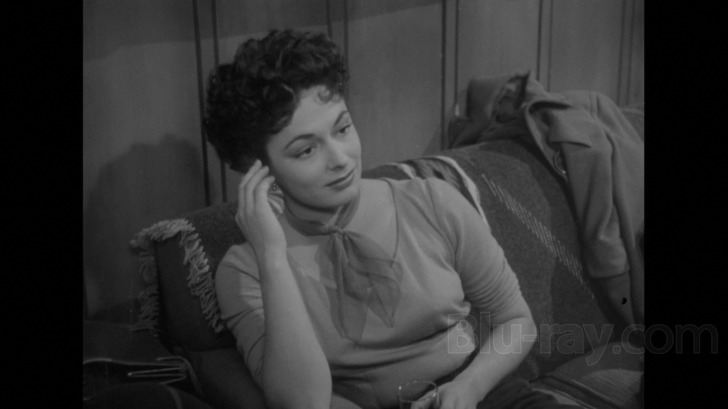
Three Secrets' lossless DTS-HD Master Audio Mono has weathered the ravages of time somewhat better than the image quality has. While this obviously a narrow and shallow audio presentation, fidelity is quite good, and both the dialogue and David Buttolph's string drenched score sound quite fine. There's no egregious damage to report, and aside from the expected tinny quality (especially in the midrange), this track sounds just fine.
Three Secrets Blu-ray Movie, Special Features and Extras
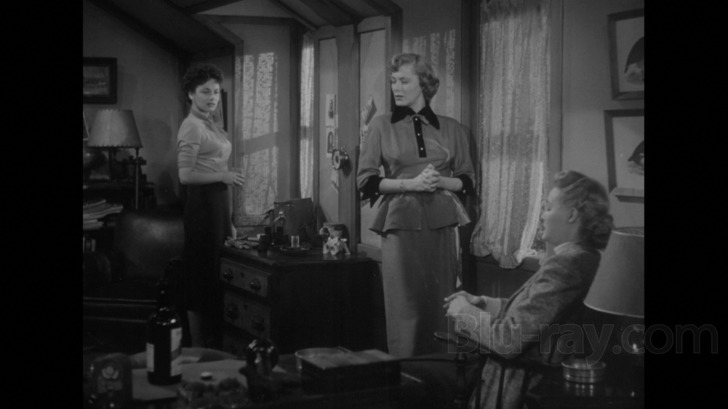
No supplements of any kind are included on this Blu-ray disc.
Three Secrets Blu-ray Movie, Overall Score and Recommendation

Three Secrets is an unabashed tearjerker, a three hankie picture (one for each of the ostensible moms, evidently) that makes no bones about appealing to a distaff audience and tugging on the veritable heartstrings. All three leads are excellent, especially Neal as the tough as nails journalist. Wise may have still been relatively early in his career, but he evinces a lot of mastery here (note his repeated push-ins to the leads at key dramatic moments). This isn't any great lost masterpiece, but it's a surprisingly ingratiating little drama. The video has a few issues that may bother persnickety videophiles, but Three Secrets still comes Recommended.
Similar titles
Similar titles you might also like

The Mortal Storm
Warner Archive Collection
1940

Christopher Strong
Warner Archive Collection
1933

Devil and the Deep
1932
Pinky
1949

Mary Stevens, M.D.
Warner Archive Collection
1933

Rain
90th Anniversary
1932

Lost Horizon
1937

Leave Her to Heaven
1945

The Country Girl
1954

The Importance of Being Earnest
1952

Sherlock Holmes
1922

The Cheat
1931
Man on a Tightrope
1953
The Great Gatsby
1949

Cat on a Hot Tin Roof
Warner Archive Collection
1958

Come Back, Little Sheba
1952

Not Wanted
1949

Diner
1982

The Great Impostor
1961

Trapeze
1956