Thielemann Conducts Faust Blu-ray Movie
HomeThielemann Conducts Faust Blu-ray Movie 
C MAJOR | 2011 | 90 min | Rated G | Oct 25, 2011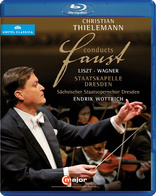

Movie rating
6.5 | / 10 |
Blu-ray rating
| Users |  | 0.0 |
| Reviewer |  | 4.5 |
| Overall | | 4.5 |
Overview
Thielemann Conducts Faust (2011)
Under the musical direction of their chief conductor designate, Christian Thielemann, the Staatskapelle Dresden performed this special concert to celebrate Franz Liszt and his bicentenary. At its home, the prestigious Semperoper in Dresden, the orchestra presented a Faust-themed concert with two works by Wagner and Liszt inspired by Goethe’s drama.
Starring: Christian Thielemann| Music | 100% |
Specifications
Video
Video codec: MPEG-4 AVC
Video resolution: 1080i
Aspect ratio: 1.78:1
Original aspect ratio: 1.78:1
Audio
English: DTS-HD Master Audio 5.1
English: LPCM 2.0
Subtitles
English, French, Spanish, Japanese, German, Korean, Mandarin (Simplified)
Discs
25GB Blu-ray Disc
Single disc (1 BD)
Playback
Region A (B, C untested)
Review
Rating summary
| Movie | | 4.5 |
| Video | | 4.5 |
| Audio |  | 5.0 |
| Extras | | 0.0 |
| Overall | | 4.5 |
Thielemann Conducts Faust Blu-ray Movie Review
Reviewed by Jeffrey Kauffman January 5, 2012The legend of Faust has fascinated a huge number of writers and musicians for hundreds and hundreds of years. The idea of a man willing to sell his soul for any number of promised goods—knowledge, immortality—presents incredible dramatic opportunities. What’s perhaps surprising about at least a couple of the adaptations of the Faust legend that have come down to us is how they eschew (at least for the most) the verbal in favor of a purely musical depiction of the story. The Faust legend has of course inspired countless books, plays, poems, films and other literary and artistic properties, as well as a number of operas which married the subliminal power of music with the opportunities that a libretto provided. But how odd is it that there are also at least a few solely musical depictions of the Faust legend, a legend which perhaps more than most depends on the art of language to fully make its point. After all, it’s hard to “make a deal with the devil” if you’re mute, at least mute in the ordinary understanding of the word. Two of the most iconic 19th century composers, Franz Liszt and Richard Wagner, both were significantly moved by the Johan von Goethe retelling of the Faust legend that they wanted to set it to music. Wagner, like Liszt, evidently initially wanted to write a complete Faust Symphony, though for a number of reasons he soon realized he wouldn’t be able to properly finish the piece and instead decided to rework what he had on hand as a concert overture. Liszt, on the other hand, was able to bring his ideas to fruition, and his Faust Symphony is a really fascinating piece not just with regard to its connection to the Faust tradition, but within the more narrow confines of Liszt’s oeuvre as well. Perhaps tellingly, Liszt comes at the Faust story not from a narrative perspective, but instead with three discrete movements which are meant to offer character sketches of Faust, Gretchen and Mephistopheles. The narrative, such as it is, is therefore extrapolated from the interaction between the motives and ideas that play out in the three movements.
Rather interestingly, Wagner himself may have had the character sketch idea in mind as he began to formulate what would eventually become his A Faust Overture, as he had the conception of his planned symphony’s second movement being fashioned around the character of Gretchen. Another figure of legend and lore, The Flying Dutchman, intervened, and Wagner soon decided a concert overture was the better path for this material. However, there is certainly a considerable similarity in approach between Wagner and Liszt to this iconic material, and what may surprise aficionados of either composer’s work is how rather understated both men cast their musical material. While there is certainly some fiery material to be had here, this is really rather surprisingly contemplative music from both of these typically brash writers, and it’s a really fascinating fact that Faust should have moved them in similar compositional ways.
There’s little doubt actually that Wagner’s conception probably influenced Liszt, and there’s actually a good reason to believe that Liszt was more than just a little acquainted not only with the final version of A Faust Overture, but with its genesis as well. That’s because Liszt himself was the conductor of the first performance of A Faust Overture outside of Dresden (where Wagner himself had conducted the actual premiere). Wagner and Liszt actually engaged in a rather copious discussions and correspondence over the long gestation period Wagner went through with regard to his Faust piece, and how his original conception slowly but surely morphed into an Overture form. And so seeds were no doubt planted in Liszt that ultimately grew to fruition with A Faust Symphony.
Liszt utilizes his preferred technique of thematic evolution throughout the three movements of his A Faust Symphony, introducing a number of themes to depict Faust alone, several of which are subtly altered and transformed to reappear in both the Gretchen and (especially) the Mephistopheles movements. In fact Liszt is in a way presaging the very Wagnerian idea of the leitmotif in his Faust Symphony, albeit in a more condensed and less declamatory style. What may strike some listeners as unexpected is the rush away from tonality at times, as the first movement seems to disintegrate before our very ears, stretching the perfect consonance of a fifth into an augmented approach that soon tumbles away from any recognizable key. While the Gretchen movement is a much needed respite, Liszt is back with a rather peculiar fury in the Mephistopheles movement. While it’s a brisk and fitting portrayal of the ultimate demon, what’s so interesting about Liszt’s musical vocabulary is how subtly playful it is, with lots of string pizzicatos and acerbic commentary from the winds, reeds and brass. This is not just an evil Mephistopheles, it’s a Mephistopheles able to seduce with a sort of wink and dance.
Christian Thielemann expresses some surprise in the liner notes to this release that Liszt isn’t performed more regularly, at least with regard to his symphonic works. Of course the composer is probably best known for his piano masterpieces, but what A Faust Symphony makes abundantly clear is what a cogent orchestral (and vocal, considering the ravishing choral finale with tenor) thinker he was. As he did with his incredible Beethoven cycle last year (which made my personal list for Top 10 Blu-ray releases of 2011), Thielemann never really assaults the classic tradition of interpretation with regard to the piece, but also introduces subtle nuances of phrasing and dynamics which end up giving those long familiar with A Faust Symphony a whole new appreciation for the piece. It’s a fitting tribute that this concert should be by the Staatskapelle Dresden, an orchestra who in its earlier incarnation gave the premiere of Wagner’s A Faust Overture under the baton of its composer. The orchestra, now directed by its “Chief Conductor Designate” Thielemann manages to create a sturdy bridge between history and an exciting new era of enhanced performances further abetted by high definition releases. Hopefully no one had to sell their soul to the devil to make this happen.
Thielemann Conducts Faust Blu-ray Movie, Video Quality
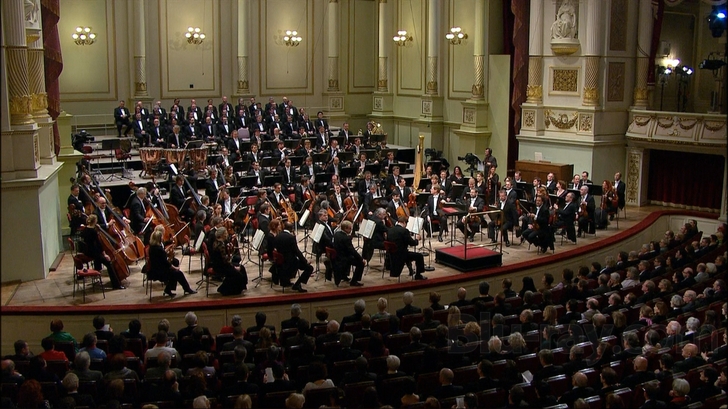
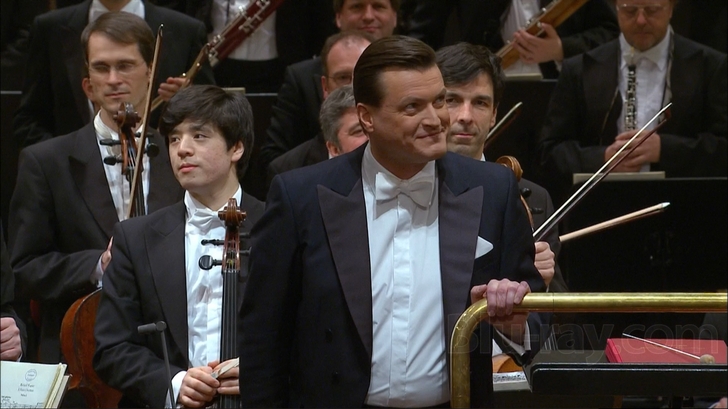
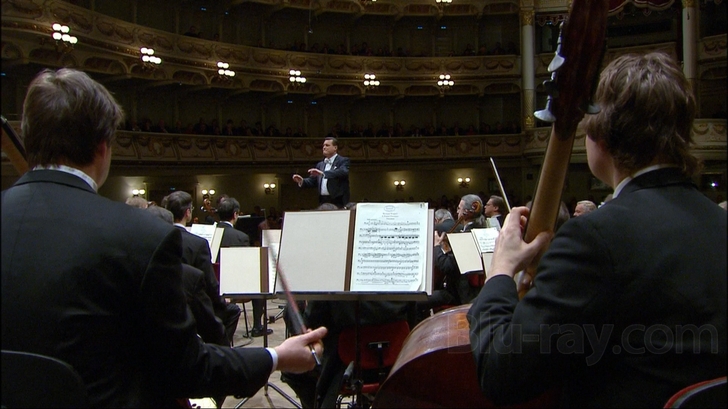
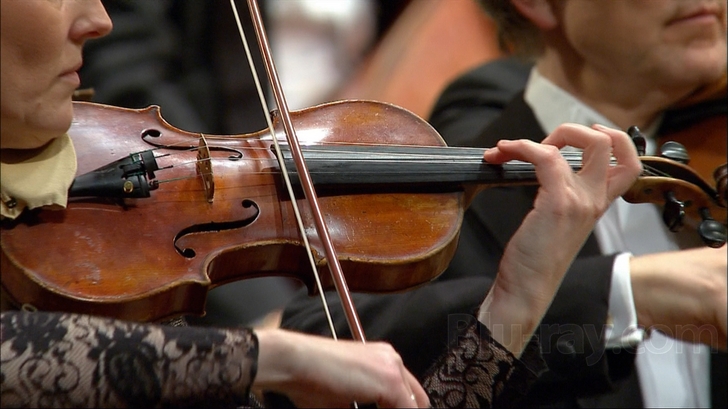
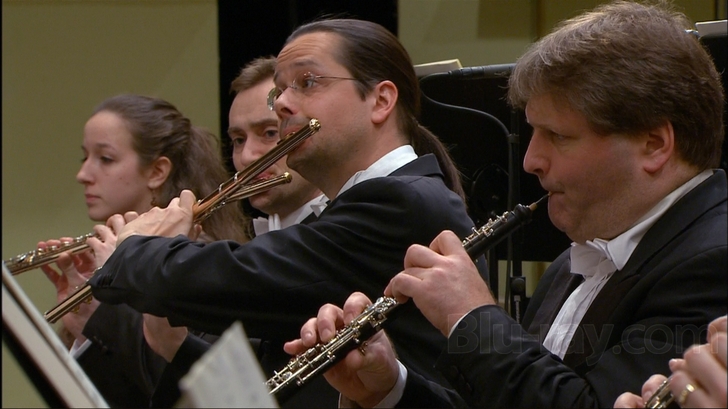
Christian Thielemann Conducts Faust is presented on Blu-ray courtesy of C Major and Unitel Classica with an AVC encoded 1080i transfer in 1.78:1. This is another great looking high definition presentation from the somewhat Baroque looking Dresden Semperoper, in a performance dating from February 2011. As with some of the other Thielemann Blu-ray offerings of late, camera coverage is exceptional, and fine detail is good enough that even dynamic markings and phrasing can easily be made out in pages of score as the camera wends its way through the orchestra. Several close-ups of various players also reveal a wealth of fine detail, and in fact I was kind of surprised at the haggard shape of one of the violins being played (check out screencap 4), though of course it could be a priceless antique. Black levels are exceptional and shadow detail is also excellent: note how Thielemann's very dark blue tuxedo jacket never crushes into the background, and though it's not captured in any of the screenshots uploaded here, there are several camera angles that show music stands against the unlit background, and edges and basic frameworks can always be made out.
Thielemann Conducts Faust Blu-ray Movie, Audio Quality
Christian Thielemann Conducts Faust is presented with two excellent lossless audio options, a DTS-HD Master Audio 5.1 mix and an uncompressed LPCM 2.0 stereo fold down. The DTS track offers incredible spaciousness and superb fidelity, and is especially impressive with regard to dynamic range. The Wagner piece runs the gamut from lyricism to bombast, and while Liszt is perhaps just slightly more restrained, there 's such a wealth of dynamic contrast under Thielemann's baton that the track's ability to effortlessly glide between huge orchestral (and choral) tuttis and quieter soli is really quite remarkable. The orchestral playing here is near perfection, and the choral finale, with an absolutely lustrous tenor solo by Endrik Wottrich, is a highlight, Fidelity is top notch, with gorgeous reproduction through all frequency ranges and a very healthy streaming rate.
Thielemann Conducts Faust Blu-ray Movie, Special Features and Extras
No supplements other than Trailers (which I never count in scoring extras) are included on the Blu-ray disc.
Thielemann Conducts Faust Blu-ray Movie, Overall Score and Recommendation
Christian Thielemann has vaulted to the front rank of my favorite contemporary conductors. I was simply blown away by his Beethoven cycle last year (if you haven't checked it out yet, you really should), and that sense of awe and respect certainly continues unabated with this superior release. These two pieces are not generally as well known as some of either composer's other works, and pairing them makes a lot of sense not just due to their shared source, but also their similar musical vocabularies. This Blu-ray offers brilliant video and spectacular sound and it comes Highly recommended.