The Women's Balcony Blu-ray Movie
HomeThe Women's Balcony Blu-ray Movie 
ישמח חתני / Ismach HataniMenemsha Films | 2016 | 96 min | Not rated | Nov 14, 2017

Price
List price:Listed on Amazon marketplace

Movie rating
6.8 | / 10 |
Blu-ray rating
| Users |  | 0.0 |
| Reviewer |  | 3.5 |
| Overall | | 3.5 |
Overview
The Women's Balcony (2016)
A bar mitzvah mishap causes a major rift in a devout Orthodox community in Jerusalem.
Starring: Evelin Hagoel, Igal Naor| Foreign | Insignificant |
| Drama | Insignificant |
| Comedy | Insignificant |
Specifications
Video
Video codec: MPEG-4 AVC
Video resolution: 1080p
Aspect ratio: 2.39:1
Original aspect ratio: 2.39:1
Audio
Hebrew: Dolby Digital 5.1
Subtitles
English SDH, French, Spanish
Discs
Blu-ray Disc
Single disc (1 BD)
Playback
Region A (B, C untested)
Review
Rating summary
| Movie | | 3.5 |
| Video |  | 4.0 |
| Audio | | 3.5 |
| Extras |  | 0.5 |
| Overall | | 3.5 |
The Women's Balcony Blu-ray Movie Review
You don't have to be Jewish to like 'The Women's Balcony'.
Reviewed by Jeffrey Kauffman October 13, 2017There’s an old adage that states “two Jews, three opinions,” and that proclivity is perhaps nowhere more apparent than in how various Jews choose to observe (or not) their religion, and how they interpret halakha, the many, and often contradictory, religious laws that have accrued over the millennia of Jewish history, and which in and of themselves quite remarkably prove the “two Jews, three opinions” adage. I’m what I jokingly refer to as a “dreaded patrilineal”, meaning my father was Jewish and therefore some in the more orthodox wings of Judaism don’t even consider me a “real” Jew since my mother wasn't (I’ve also joked with some of my more observant relatives that in my estimation my lineage simply gives them plausible deniability in case I do something stupid). I once got into a pretty heated argument online with a Jewish social media group when another “dreaded patrilineal” posted about just having discovered she was Jewish on her Dad’s side, and wondering if that made her Jewish. I told her it was up to her and her own idea of Jewish identity, while a number of orthodox types simply said “no way”. One of them started mentioning halakha in defense of their opinion, to which I responded, “Whose halakha?”, specifically referencing the Jewish group known as the Karaites, who only accept patrilineal descent to define who is Jewish. That rather hilariously (to me, anyway) put an end to that debate, but it’s perhaps indicative of the wide array of opinions that even supposedly similarly observant Jews can have about those very observances. The Women’s Balcony features a group of pretty orthodox Jews worshiping at a Jerusalem synagogue, but even though they’re bound together as a social group and ostensibly as believers sharing the same basic set of tenets, the entire film is an exercise in “two Jews, three opinions”, sometimes slyly comic, but just as often kind of bitterly sardonic and perhaps even rueful. Any non-Jews who have ever attended an orthodox service will probably concur that it’s almost like entering some sort of alien (as in otherwordly) environment, with a strange language and even stranger customs, among them the seemingly archaic emphasis on separating the genders. In most orthodox shuls, the women have their “place”, and that typically is on the balcony above the main floor, the main floor being the exclusive domain of the men. That very separation isn’t even questioned in The Women’s Balcony, perhaps one sign of an almost inherently understood orthodoxy, but when the shul’s balcony collapses during a Bar Mitzvah celebration, seriously injuring the Rabbi’s wife in the process, how the synagogue treats its women congregants and how it chooses to rebuild become the focal point of a charming if perhaps slightly underdeveloped tale that should certainly appeal to any lover of foreign cinema that seeks to examine seemingly quaint customs in other cultures.
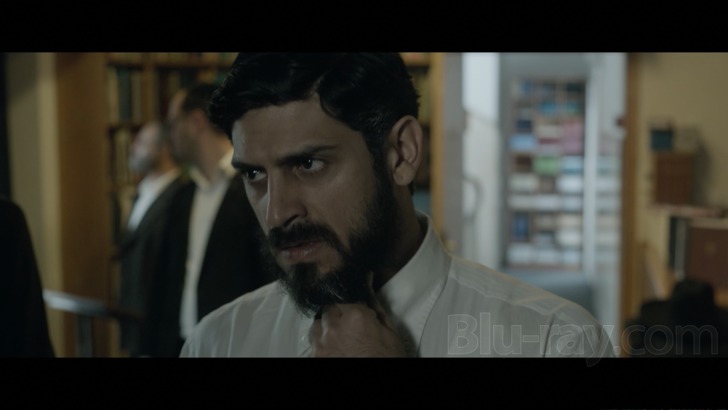
Ettie (Evelin Hagoel) and Zion (Yigal Naor) are among a small group of worshipers who attend a shul run by an elderly rabbi (Avraham Celektar). The Rabbi is obviously beloved by his flock, and returns the favor, stalling during the bar mitzvah of Ettie and Zion’s son until some forgotten candies can be retrieved and brought back to be tossed by the women at the men (and main celebrant) below. Suddenly, though, tragedy intrudes on the festivities when the balcony collapses, sending the rabbi’s wife to the hospital in a coma.
Already The Women’s Balcony would seem to be in pretty perilous territory for even a dramedy (let alone a comedy), but quite surprisingly Shlomit Nehama’s screenplay manages to toe a fairly fine line between at least subtly anarchic humor and some more trenchant dramatic elements. With the shul in shambles, the rabbi in shock over his wife’s predicament, and the men unable to even muster a minyan (the necessary minimum needed to recite group prayers), the future of the congregation is in doubt. In a time honored Israeli tradition, the men accost (male) passers-by to ask them to join the morning prayers to make a minyan, and depending on how one views the subsequent events, they either have the good luck or the misfortune to recruit a young rabbi named David (Aviv Alush), who not only agrees to pray with them, but who brings a coterie of his own students and who also rather generously (it seems, anyway) offers to help rebuild the shul so that it’s ready when the main rabbi is healthy enough to return.
While tonally Nehama’s screenplay is quite consistent, it’s a little bit more uneven in actually doling out coherent, or at least organically developed, plot points. There are some curious elisions throughout the film, including the fact that Rabbi David quickly becomes a Svengali of sorts to many of the men and women in the congregation, insisting (for example) that the women cover their heads, the first sign that Ettie picks up that this particular rabbi may not be her cup of tea. Another issue kind of glossed over is the renovation of the synagogue itself, which ends up not fixing the women’s balcony, forcing them to sit in what one woman describes as an “outhouse”.
Another arguably underdeveloped issue is the fracture that accrues between Ettie and several of her longtime female co-worshipers, an element that is “solved” in a similarly underdeveloped way. That said, the bulk of the low level conflict in this film is between Ettie, who insists the shul has to have a women’s balcony, and Rabbi David, who decides that money that Ettie and her newly united female friends have raised should be better spent getting a new Torah scroll, since that was also destroyed in the collapse of the balcony.
Playing into this are a number of rather sweet if often inconsequential subplots, including Zion’s mentoring of an adorable little boy and the ongoing romantic struggles of Ettie’s niece Yaffa (Yafit Asulin), who, in one of the film’s too predictable plot points, falls for Rabbi David’s assistant, leading to a kind of showdown late in the film. Part of what perhaps undercuts The Wedding Balcony’s attempts to gin up a little suspense is the undeniable sweetness of almost all of the characters. Even Rabbi David, ostensibly the “villain” of the piece, seems to be well intentioned, if awfully single minded, especially when it’s not even his actual congregation he’s dealing with.
While certainly never offering the same kind of visceral impact as Gett: The Trial of Viviane Amsalem did in its examination of the power inequalities between men and women in the more orthodox realms of Israel, there’s some fairly cogent social criticism lurking just beneath the surface of this often charming film. Had just a little bit more time been spent developing the interrelationships of all the characters, as well as more completely documenting the way these relationships falter and then are rebuilt, The Women’s Balcony might have had even more emotional resonance than it does. But as it stands, this is an undeniably agreeable film that features a number of really winning performances and which offers at least a little insight into Jewish observance in its often chaotic forms.
The Women's Balcony Blu-ray Movie, Video Quality
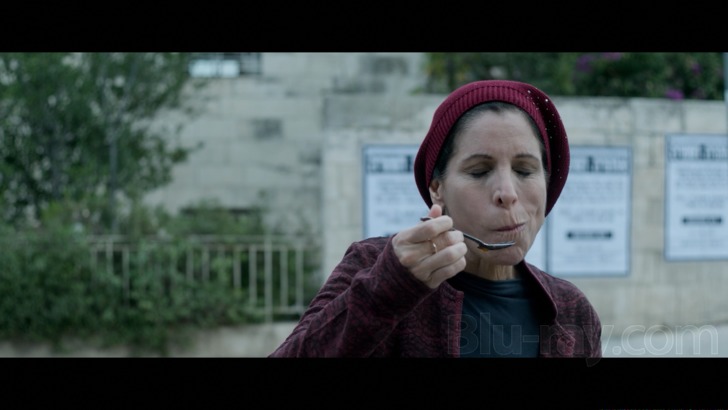
The Women's Balcony is presented on Blu-ray courtesy of Menemsha Films with an AVC encoded 1080p transfer in 2.39:1. I haven't been able to track down any authoritative technical data on the shoot, but this looks digitally captured and while the palette is kind of curiously anemic quite a bit of the time, sharpness and clarity, as well as general detail levels, are first rate. There are a number of excellent examples of well rendered fine detail throughout the film, including elements like roughhewn stone walls in the alleyways of Jerusalem, or even the tzitzit (fringes) on various tallit. Quite a bit of the film takes place outdoors, and good lighting conditions promote excellent detail levels, though the palette looks a bit on the blue side quite a bit of the time. There are no issues with compression artifacts or image instability.
The Women's Balcony Blu-ray Movie, Audio Quality
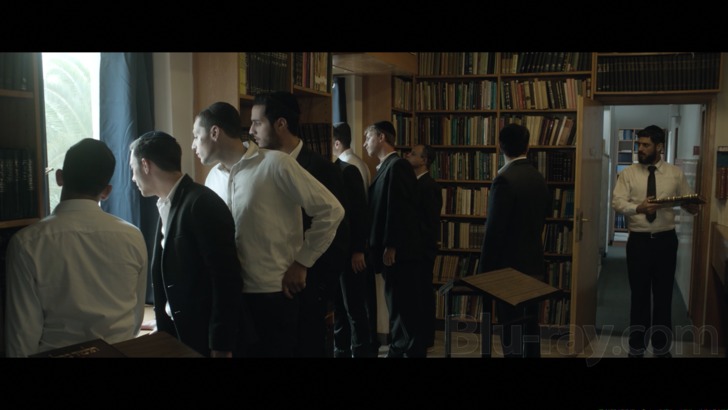
Menemsha Films is relatively new to the Blu-ray game, and so I won't take them to task in the same way I just did Lionsgate for its release of America: Promised Land, which featured only a lossy Dolby Digital 2.0 track. At least The Women's Balcony offers a decently robust surround track delivered via Dolby Digital 5.1, but Meneshma may want to start offering lossless audio to totally win over the high definition consumer. There's quite a bit of exuberant energy running through the track, often courtesy of a winning score by Ahuva Ozeri, but the many outdoor scenes do offer good placement of ambient environmental effects. Dialogue (mostly in Hebrew, but with sporadic outbursts in English) is rendered cleanly and clearly, and there are no problems with distortion, dropouts or other damage.
The Women's Balcony Blu-ray Movie, Special Features and Extras
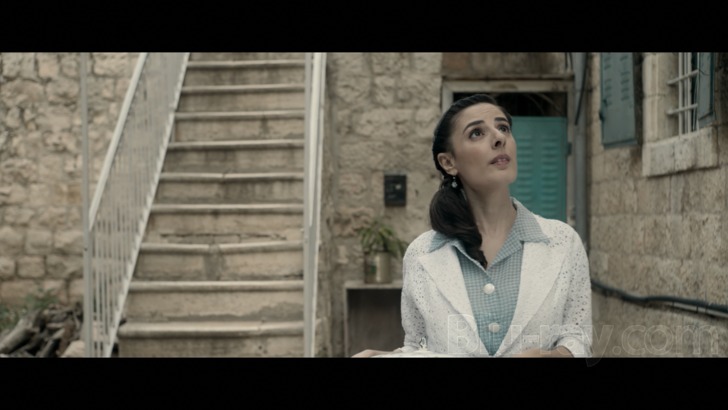
- The Making of "The Women's Balcony" (1080p; 18:13) is an above average EPK with some good behind the scenes footage, especially of preparations for the big balcony collapse.
The Women's Balcony Blu-ray Movie, Overall Score and Recommendation
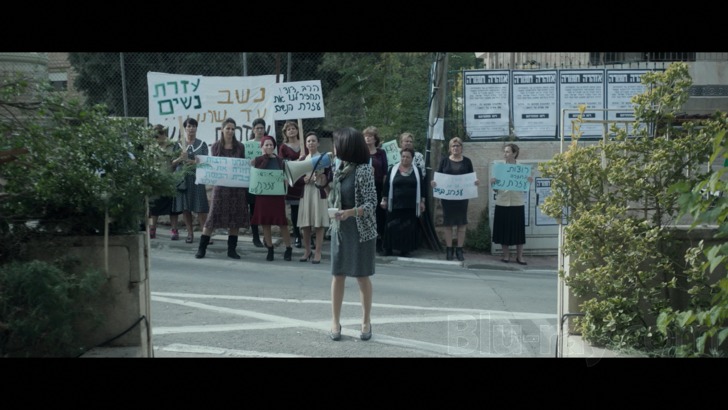
While obviously not germane to any of the issues dealt with in The Women's Balcony, the fact that the women band together in an almost Lysistrata-esque fashion until the men come to their senses rather strangely brought to mind the current scandal involving Harvey Weinstein, where just a relatively few women armed with social media outlets like Twitter were able to speak truth to power and make a significant change (one hopes, anyway). There's a similar subtext of female empowerment in this film, even if it's cloaked in an otherwise overwhelming orthodoxy that, for example, never questions the need to separate the genders during services. Buoyed by a palpable sense of place and featuring several winning performances, The Women's Balcony doesn't have much in the way of supplements or even lossless audio, but with caveats noted, comes Recommended.