The Wizard of Gore / The Gore Gore Girls Blu-ray Movie
HomeThe Wizard of Gore / The Gore Gore Girls Blu-ray Movie 
Image Entertainment | 1970-1972 | 2 Movies | 176 min | Unrated | May 01, 2012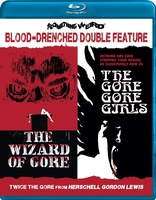
Price
List price:Listed on Amazon marketplace

Movie rating
Movie has not been rated yetBlu-ray rating
| Users |  | 1.0 |
| Reviewer |  | 3.0 |
| Overall |  | 2.3 |
Overview
The Wizard of Gore / The Gore Gore Girls (1970-1972)
See individual titles for synopses.
Specifications
Video
Video codec: MPEG-4 AVC
Video resolution: 1080p
Aspect ratio: 1.78:1
Original aspect ratio: 1.85:1
Audio
English: DTS-HD Master Audio Mono
Subtitles
None
Discs
50GB Blu-ray Disc
Single disc (1 BD)
Playback
Region A (B, C untested)
Review
Rating summary
| Movie |  | 2.0 |
| Video |  | 3.5 |
| Audio | | 2.0 |
| Extras | | 3.5 |
| Overall | | 3.0 |
The Wizard of Gore / The Gore Gore Girls Blu-ray Movie Review
From "a Schmuck with a Camera" to the Godfather of Gore
Reviewed by Michael Reuben April 30, 2012Image Entertainment is following up last year's Blu-ray release of Herschell Gordon Lewis' The Blood Trilogy, which the exploitation auteur made in the Sixties, with a pair of films from his Seventies oeuvre, just before he abandoned the movie business for advertising. As Lewis says on the commentary to The Gore Gore Girls, if only he'd foreseen that the home video revolution would bring him a whole new audience, he might have continued. Lewis would be the first to dispute any claim that he was a cinematic "artist", and even devoted admirers like John Waters and Joe Bob Briggs probably wouldn't go that far. In his commentary for The Gore Gore Girls, he says (and he's not being facetious) that the first two requirements of a "good" film are that the picture should be in focus and the sound should be in sync. For Lewis, it was more important to be professional than artistic. As Dan Krogh, his assistant on these two films, would later say: "You must understand that for Herschell, professionalism has as much to do with bringing a picture in at or below budget and making money at the box office as it does with artistry. That these films always turned a profit was what he was most proud of." (John McCarty, Splatter Movies: Breaking the Last Taboo of the Screen (St. Martin's Press 1984), p. 52.) Still, there are many roads to originality, and a key to Lewis' financial success was offering movie audiences something they couldn't get elsewhere. He started with nudie pictures, but when the major studios began taking bigger chances with sexual content, Lewis looked elsewhere and hit on the notion of explicit gore. He used a chainsaw long before Tobe Hooper created Leatherface; he gleefully tossed around guts and viscera before Ridley Scott gave us the chestburster and George A. Romero let loose his zombies; and he was piercing and shredding bodies long before Jason began carving up campers. In a line that became so famous it appears whenever Lewis is discussed, the director who once was an English professor compared one of his films to a Walt Whitman poem: "It's no good, but it's the first of its type and therefore it deserves a certain position."

Montag the Magnificent
In his review of The Blood Trilogy, my colleague Casey Broadwater neatly summed up the Herschell Gordon Lewis style in terms on which I doubt I could improve:
The acting is awful, the camerawork and editing is sloppy, the scripts only serve to get us from one kill to the next; Lewis basically applied a porno aesthetic and work ethic to the drive-in horror film, spattering it all with crayon-red viscera.The same aesthetic is fully on display here. The Wizard of Gore (1970) concerns Montag the Magnificent, a stage magician whose remarkable powers include hypnosis, zombification and wooden acting. Montag is played by Lewis regular Ray Sager, who stepped in on ten minutes' notice, after the actor originally cast for the part stormed off the set following an argument with one of the producers. In campy arch-villain tones, Montag asks his audience how they can distinguish between illusion and reality, dreaming and wakefulness, then solicits a female volunteer from the audience. The volunteer is then cut in half with a chainsaw, punched through the abdomen with a metal press, has her skull pierced from ear to ear with a steel bolt, etc. All this happens in full view of the placid audience members who see nothing except a magician's trick that they wildly applaud. Meanwhile, the camera shows close-ups of flesh and viscera being mangled, as Montag kills the screaming victim. Nevertheless, at the end of the "trick", the victim appears to rise and return to her seat, as if in a trance. When the show is over, she leaves the theater with the other spectators. An hour after the show, she's found dead somewhere, with the same graphic injuries that Montag appeared to inflict on her. (Insert screams.) The plot device that keeps bringing us back to Montag is a local TV reporter, Sherry Carson (Judy Cler), who wants to put this startling new magic act on the air and keeps dragging her sportswriter boyfriend, Jack (Wayne Ratay), to the theater for the next mystifying illusion. But when Sherry and Jack see the headlines about the bizarre murders and realize that someone is targeting Montag's "volunteers", they become investigators as well. Eventually Montag does appear on Sherry's program with a "special" illusion designed just for TV—and, as Mike Vraney of Something Weird Video notes on the commentary track, the concept of involving everyone watching the program in an evil scheme is essentially the plot of Halloween III: Season of the Witch (1982). Jack and Sherry foil Montag just in time. Or do they? The end of The Wizard of Gore is one of those "snake swallowing its own tail" conundrums that have become a staple of modern horror films. Notable examples include Phantasm and the original A Nightmare on Elm Street. One has to acknowledge, though, that, despite Lewis' schlock style, his ending does logically flow from elements clearly laid out at the beginning of the film. (Although the credited screenwriter is Allen Kahn, Lewis was the real writer.) The Gore Gore Girls (1972) was Lewis' last film before turning to advertising, and the title card still bears the original title "Blood Orgy". It has the distinction of being the only film Lewis ever submitted to the MPAA for a rating. He expected to get an R, based on the kinds of films that were receiving R's at that point, but he hadn't reckoned with the clout that studios have when negotiating with the ratings board (a subject explored in depth in the documentary This Film Is Not Yet Rated). Gore Gore Girls was instantly slapped with an X, and Lewis released it unrated. Gore Gore Girls also has the rare distinction of being a Lewis film with a recognizable face: the late Henny Youngman, King of the One-Liners, who shot all his scenes in one day as club owner Marzdone Mobilie, whose strippers are being murdered and mutilated by a serial killer. (On the commentary track, Lewis relates the series of relationships that led to Youngman's appearance.) The excuse for a plot is to follow conceited master detective Abraham Gentry (Frank Kress), who's been hired by a reporter, Nancy Weston (Amy Farrell), in return for the exclusive on the story when Gentry cracks the case. The investigation is just a pretext, because the film's raison d'etre is mutilation—most of it, thankfully, post mortem—in the most disgusting ways possible: with bludgeon, scissors, iron, meat tenderizer, frying oil on a stove, etc. Even though the effects are obviously fake, the whole affair is still plenty nauseating. Lewis considers it his masterpiece. The film even has a Psycho-like ending in which Gentry explains the killer's motivation; to his credit, Lewis winds things up quicker than Hitchcock did.
The Wizard of Gore / The Gore Gore Girls Blu-ray Movie, Video Quality
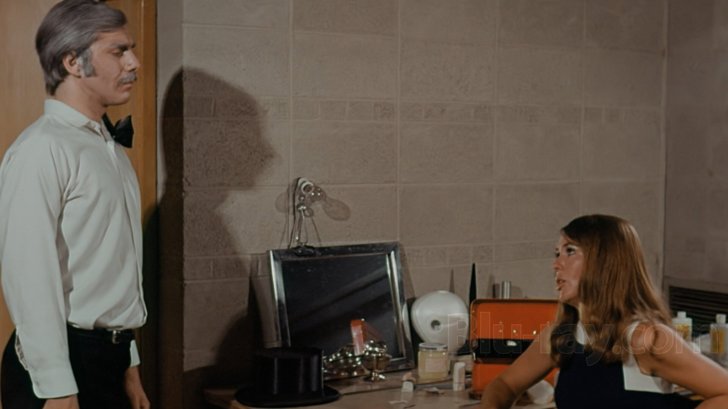
Both The Wizard of Gore and The Gore Gore Girls offer video quality on a par with The Blood Trilogy on Image's 1080p, AVC-encoded Blu-ray. As with the prior Lewis offerings, no obvious restoration work has been attempted, and the sources retain all their spots, speckles, scratches and, occasionally, a missing frame or two. The Gore Gore Girls is in substantially worse shape, with long vertical scratches that continue for a minute or more during large portions of the running time. Then again, the original photography for that film is superior to that of The Wizard of Gore, where nearly every outdoor shot seems to have been out of focus (thereby violating one of Lewis' own principles for what constitutes a good film). Sharpness is remarkable, given the source, and black levels are surprisingly good, which is important for Wizard because of Montag's black stage garb. The colors have been brought out with exceptional vividness, which is effectively nauseating for the copious amounts of stage blood, and equally so for the atrocious late Sixties fashions worn by all and sundry. I have no idea what kind of digital processing was necessary to clean up the source, but it was obviously done with care and restraint, because the grain texture on both films looks about as natural as can be expected from this weak source material. To my shock and amazement, Image has splurged for a BD-50 for these two films.
The Wizard of Gore / The Gore Gore Girls Blu-ray Movie, Audio Quality

Both films have their mono soundtracks presented as DTS-HD MA 2.0. The lossless encoding is nice to have, but it doesn't provide much benefit. There's a constant background hiss throughout each track, which is much louder on The Wizard of Gore, and neither track has any dynamic range to speak of. Neither track can be played at reference volume without hurting one's ears, because the upper end is so brittle and shrill; here, again, Wizard is by far the worse of the two. As for the lower end, there isn't any. Dialogue is reasonably clear in both films, but that's partly because almost every actor delivers his or her lines woodenly as if speaking in quotation marks. The sole exception is Henny Youngman, who makes the mistake of trying to give an actual performance, which is the wrong style for a Herschell Gordon Lewis film. It was the only time I wanted subtitles. The scores for both films could have accompanied an old-style porno (and probably did at some point).
The Wizard of Gore / The Gore Gore Girls Blu-ray Movie, Special Features and Extras
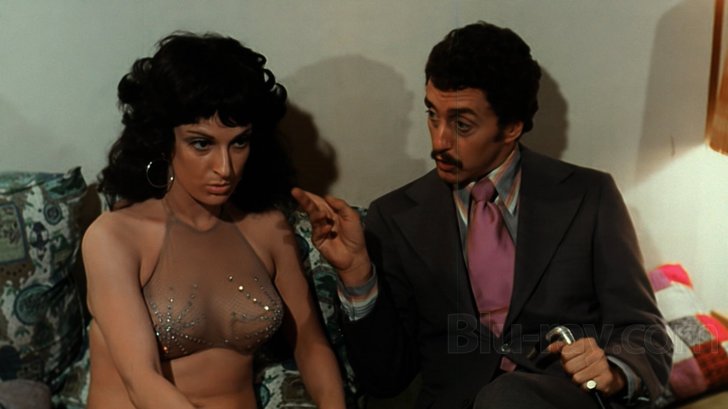
The extras have been ported over from Image's 2000 DVD releases of the two features, each of which contained a commentary and the "exploitation art" gallery. The trailer collection comes from the 2004 Herschel Gordon Lewis Collection.
- Commentaries by Director/Producer Herschel Gordon Lewis: Interviewed by Mike Vraney, founder of Something Weird Video (joined by Jimmy Maslin for The Gore Gore Girls), Lewis provides a wealth of detail about both his career in general and the production of each film in particular. Lewis is a terrific raconteur: fast-talking, full of vivid details, down-to-earth in his approach to filmmaking. Asked about charges that The Wizard of Gore exploits women, he replies: "I will exploit whatever gender people will pay to see exploited." Recalling questions he's been asked about the meaning of a particular scene, he says: "Why are you looking for significance in any film that I've ever made? It's simply part of the overall impression of unrealism (rather than surrealism)." Some of Lewis' comments are surprising. For example, he says that Wizard is one of his least favorite films and the one he'd most like to do over, largely because he wasn't able to stage the extreme ending he'd originally envisioned. But the film was also one of his most successful, and the character of Montag has become a fan favorite. Lewis also downplays his nickname, the Godfather of Gore. As Lewis notes, those nicknames come later. At the time he was making the films, he was just, he says, a schmuck with a camera.
- Trailer Gallery: Many of the trailers appear to be sourced from videotape, and the quality is appropriately weak. A "play all" feature is included. Except where otherwise indicated, all trailers are 480i, 1.33:1 and pillarboxed:
- Blood Feast (1080p)
- Two Thousand Maniacs
- Color Me Blood Red (1080p; 1.78:1)
- The Godfather of Gore (1080i; 1.78:1)
- The Alley Tramp
- Goldilocks & The Three Bares
- The Gruesome Twosome (1.78:1, non-enhanced)
- She-Devils on Wheels
- Something Weird
- The Wizard of Gore
- Gallery of Herschell Gordon Lewis Exploitation Art: (SD; various; 2:31): An album of promotional materials, much of it intended for distribution to "to the trade".
The Wizard of Gore / The Gore Gore Girls Blu-ray Movie, Overall Score and Recommendation
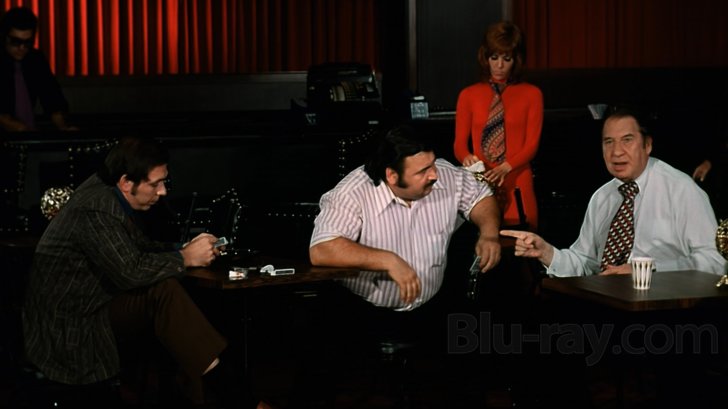
The very fact that I own a copy of McCarty's book Splatter Movies should tell you that I once was fascinated by Lewis and his ilk, but that was a long time ago. I quickly became more interested in filmmakers who took Lewis' boundary-busting exploitation efforts and incorporated them into more interesting explorations of the psychological: directors like Wes Craven, David Cronenberg, Brian DePalma and George A. Romero. (I could appreciate John Waters' "bad taste for its own sake" aesthetic in the abstract, but I never warmed to it.) Reviewing this Blu-ray was like opening an old photo album of bygone days, except that someone has obviously gone to great care to dust off the pictures and mount them in a fresh setting. Highly recommended for fans of the genre. Everyone else will go, "Huh??"