The Trials of Oscar Wilde Blu-ray Movie
HomeThe Trials of Oscar Wilde Blu-ray Movie 
Kino Lorber | 1960 | 123 min | Not rated | Aug 09, 2022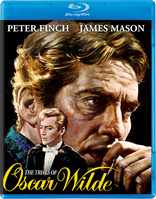
Price
List price:Listed on Amazon marketplace

Movie rating
6.9 | / 10 |
Blu-ray rating
| Users |  | 0.0 |
| Reviewer |  | 3.5 |
| Overall | | 3.5 |
Overview
The Trials of Oscar Wilde (1960)
A chronicle of Oscar Wilde's libel suit against the Marquis of Queensberry and the tragic turn his life takes because of it.
Starring: Peter Finch, Yvonne Mitchell, James Mason (I), James Mason (I), Nigel PatrickDirector: Ken Hughes
| Drama | Insignificant |
| Biography | Insignificant |
Specifications
Video
Video codec: MPEG-4 AVC
Video resolution: 1080p
Aspect ratio: 2.35:1
Original aspect ratio: 2.35:1
Audio
English: DTS-HD Master Audio 2.0 Mono (48kHz, 24-bit)
1608 kbps
Subtitles
English SDH
Discs
Blu-ray Disc
Single disc (1 BD)
Playback
Region A (B, C untested)
Review
Rating summary
| Movie |  | 4.0 |
| Video |  | 3.0 |
| Audio | | 4.0 |
| Extras |  | 0.5 |
| Overall | | 3.5 |
The Trials of Oscar Wilde Blu-ray Movie Review
Reviewed by Dr. Stephen Larson August 14, 2022"[T]he rivals are at each other’s throats in a way seldom seen in movie history." This is how Jack Bentley of the London-based Sunday Pictorial (sister paper of the Daily Mirror) described the "Battle of the Oscars," a race between production firms Vantage Films and Warwick Films to make and release a movie about Oscar Wilde. The lower-budgeted Vantage feature (simply titled Oscar Wilde) and the $350,000 Warwick production known as The Trials of Oscar Wilde were released a week apart in the UK and a little over a week apart in America. In the spring of 1960, each company sent spies to the opposing camp to inform on what was happening at the other's production! Collie Knox, The Philadelphia Inquirer's London film correspondent, reported that Warwick Films filed an injunction against Vantage in an attempt to restrain them from producing a Wilde film. But Warwick lost its plea and Vantage went ahead with its Wilde story, which later showed in the West End. According to author Trader Faulkner in his 1979 book, Peter Finch, a Biography, British filmmaker Ken Hughes wrote a script for Trials in a week, "with a shuttle service of cars picking up the pages as they came off the typewriter." The Evening Standard reported that Trials went into production on Monday, March 28, 1960. Filming lasted for six weeks. London-based Shepherds Bush Gazette and Hammersmith Post led its review of Trials with the revelation that the film was rushed into general release a mere two weeks after principal photography wrapped. But Oscar Wilde won the release race as it was screened first in both the UK and US.
Both films cover roughly the same territory about Wilde in late-Victorian England of the early 1890s. But there are some important differences. Oscar Wilde was shot in black and white using the Academy Ratio. The Trials of Oscar Wilde was filmed in Technicolor and Technirama, the era's cinematographic alternative to CinemaScope. Each are adapted from different plays. Oscar Wilde lead Robert Morley performed the title role on stage. Ken Hughes adapted John Furnell's 1955 play, The Stringed Lute (published simultaneously in London and New York by Rider and Co.). (Interestingly, the subtitle of the play is An Evocation in Dialogue of Oscar Wilde.) Hughes also relied on H. Montgomery Hyde's transcripts of the trials. These consist of Wilde's libel suit brought against Lord Queensberry in London's Marlborough Street Police Court, as well as the trials of Wilde and Alfred Taylor, which were held in the Central Criminal Court of London. Director Gregory Ratoff's film Oscar Wilde also quotes verbatim from the trial transcript.
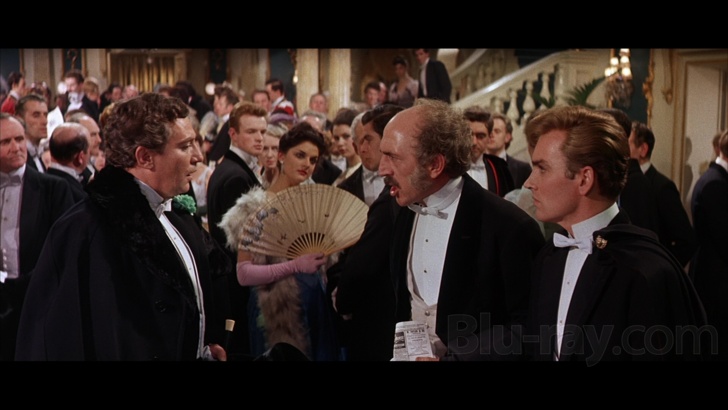
The Marquis stands between Oscar and his son.
Both movies open inside the St James Theatre at the premiere of Wilde's play, Lady Windermere’s Fan. Hughes's film has a more extended opening, though, compared to the rather hurried pace of Ratoff's film. In Trials, Oscar Wilde (Peter Finch) has become a celebrated playwright beloved seemingly by everyone at the theater except for one individual: the Marquis of Queensberry (Lionel Jeffries). Lord Alfred Douglas (nicknamed “Bosie” and played by John Fraser), one of the Marquis's sons, has become a good friend to Oscar. Their burgeoning relationship causes much consternation and resentment from Bosie's father. As portrayed by Lionel Jeffries, the Marquis always always appears morbid and with a scowl on his face. The animosity he directs at Oscar is developed considerably more than it is by Ratoff and actor Edward Chapman in Oscar Wilde. Oscar is married to Constance Wilde (Yvonne Mitchell), who he shares two sons with. (He's seen reading The Happy Prince to them before bedtime.)
Robert Morley and John Neville (who plays Bosie in the Vantage production) are too old for their parts. That isn't the case for Peter Finch and John Fraser. Finch was only a few years older when he was cast than Wilde was at his trials. Fraser retains some of Bosie's boyish attributes. Bosie is the spoiled son of an aristocrat who self-indulges and abuses his friendship with Oscar by using him to get money.
Each film takes divergent routes in dealing with Wilde's homosexuality. When Finch's Wilde receives a disparaging note from the Marquis, who calls him a "sodomite," the film only specifies that it's because of the playwright's alleged "improper conduct." The Marquis tells Wilde he "looks it" (read: acts in a gay manner). The word "gay" isn't mentioned once in Trials but is uttered twice by the titular character in Oscar Wilde!
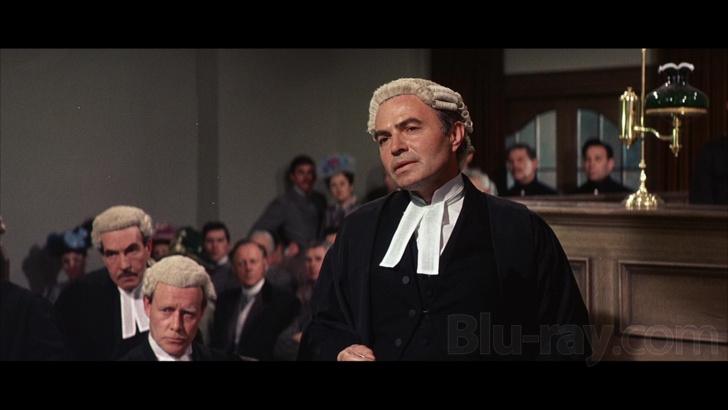
The only section that Oscar Wilde has a leg up on Trials is in the courtroom scenes. James Mason is very good as Sir Edward Carson, the Irish barrister who's defending the Marquis. But Sir Ralph Richardson is one level above Mason playing the same counselor for the defendant in the Ratoff work. Richardson's tough questioning of Morley never becomes too over-the-top or overwrought. I also prefer the filming style here in Oscar Wilde over Trials. In the former, cinematographer Georges Périnal effectively alternates between medium close-ups and close shots of the faces. Because director of photography Ted Moore was framing in one of the widest ratios, he tends to favor primarily medium and long shots that cover most of the courtroom space.
The Trials of Oscar Wilde and Peter Finch's performance received mostly splendid reviews from critics in the early '60s. Both the San Francisco Chronicle's Paine Knickerbocker and Newsday's Entertainment editor Ben Kubasik lauded Ken Hughes's film as "masterful." The Boston Herald's Elinor Hughes had specific accolades for the main star: "Peter Finch is an exceptional actor, and his Oscar Wilde is one of his very best performances." An anonymous film correspondent for The Daily Telegraph and Morning Post was one of the few lone dissenters: "Peter Finch plays Wilde rather colourlessly, and he did not make me feel at any time that he was the author of the witticisms he has to speak...In his shot at portraying a literary genius Mr. Finch is well wide of the mark."
The Trials of Oscar Wilde Blu-ray Movie, Video Quality
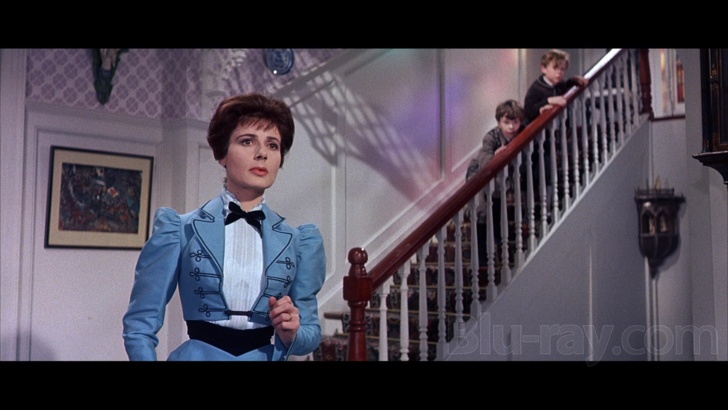
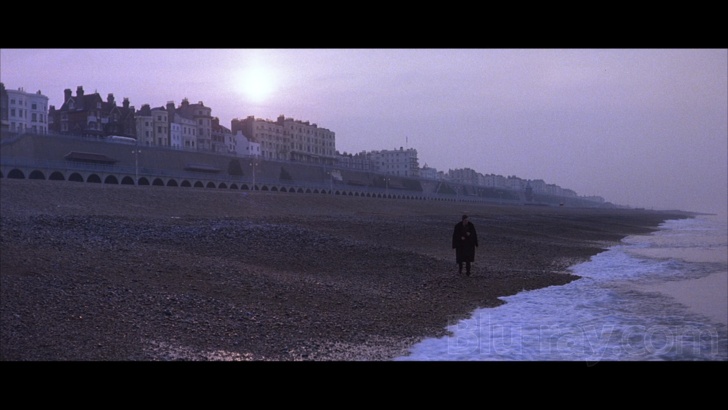
Kino Lorber Studio Classics has given The Trials of Oscar Wilde its global premiere on Blu-ray. The MPEG-4 AVC-encoded BD-50 carries a maxed-out video bitrate averaging 38940 kbps. The Technicolor hues radiate nicely on this transfer. Philip K. Scheuer of the Los Angeles Times remarked in a 1960 review that the Technicolor recreates the 1890s London "on a fuller scale [than 1960's Oscar Wilde] and in lavish but tasteful hues." While the Technirama widescreen boasts a sharp image, the transfer's lingering problem is that it's sourced from an older master that hasn't been fully restored. So it definitely shows its age. Beginning with the main title cards (see Screenshot #19), white speckles and other fairly minor blemishes mar the picture from time to time. Fortunately, the specks aren't present in every shot but they reappear with semi-frequency. On the walls in capture #4, you'll spot tiny specks to James Mason's right shoulder. When the camera is positioned on his character in two different shots, there are two relatively small blotches that creep in the top left and top right area of the frame. Image stability is okay but the jittery grain make the frame wobble very slightly in the center on occasion.
There is no individual popup option for chapters in the main menu. While the feature plays, you can skip around to eight different chapters by hitting "Display" or a similar button on your remote.
The Trials of Oscar Wilde Blu-ray Movie, Audio Quality
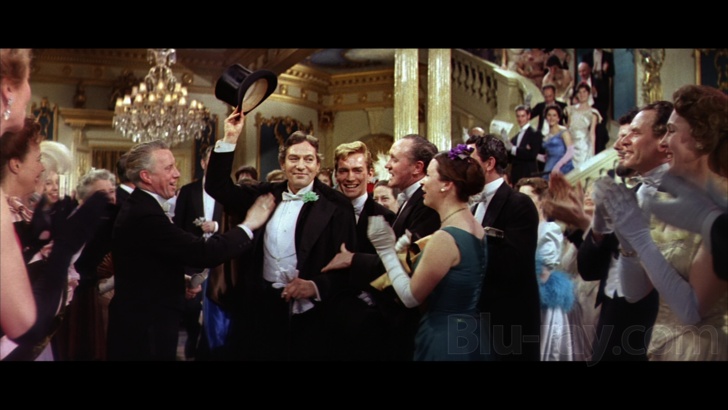
Kino has supplied a DTS-HD Master Audio Dual Mono (1608 kbps, 24-bit). It's a pleasant surprise that Kino has used a bit depth of 24 instead of 16. The sound track is audibly clean with no distracting hiss, scratches, or dropouts. After the first reel or so, I switched from a monaural sound field to a stereo one to bring out more of the front sounds on the sides. The British and Irish accents are comprehensible to my ears. Kino has included optional English SDH (see Screenshot #20).
Trader Faulkner wrote in his Peter Finch biography that composer Ron Goodwin wrote music for scenes prior to them being shot. He would go to Ken Hughes's home each evening where the director would telegraph the scene in the same way it later was to be filmed. Goodwin would spot and time it using a stopwatch before writing the music. Next day, Hughes would photograph the scene.
Goodwin's score is a fine but unexceptional complement to the film. He wrote cues that reflect both the characters' internal states and their external temperaments. The music does get melodramatic at times, though.
The Trials of Oscar Wilde Blu-ray Movie, Special Features and Extras
- Theatrical Trailer (3:45, upconverted to 1080p) - trailer for the US-titled The Man with the Green Carnation. Presented in 2.35:1 anamorphic widescreen, this unrestored trailer sports various film artifacts and a very bright image.
- KLSC Trailers - trailers for additional "vintage" Kino titles including Room at the Top, The Chalk Garden, Isadora, He Who Must Die, The Queen of Spades, Murder by Decree, and The Internecine Project.
The Trials of Oscar Wilde Blu-ray Movie, Overall Score and Recommendation
The Trials of Oscar Wilde was doubtlessly a daring film for its time that exposed a miscarriage of justice against a literary giant who was also a benevolent gentleman. Peter Finch's performance carries more expressive nuances than does Robert Morley's take on the character. Oscar Wilde is still worth seeking out as I did via Prime's Instant Video where it's available to stream in a restored print (albeit only in 480i). I consider that restoration superior to the one Kino undertook for Trials. Ratoff's film was a Fox property so I hope it reaches physical HD sometime soon. If you're new to Ken Hughes (1967's Casino Royale and Chitty Chitty Bang Bang the following year), this feature is a solid starting point. A 2001 obituary for Hughes named The Trials of Oscar Wilde his favorite among the films he directed. The movie is DEFINITELY RECOMMENDED but since the transfer hasn't been completely cleaned up, Kino's disc comes with some qualifiers.
Similar titles
Similar titles you might also like
(Still not reliable for this title)

Wander Darkly
2020

Houdini
2014

London
2006

Red Joan
2018
Special Dead
2006

Humans: 1.0
Uncut UK Edition
2015

Rob the Mob
2014

Home of the Brave
1949

Voyagers 4K
2021

Best Man Down
2013

Plenty
1985

Gorillas in the Mist: The Adventure of Dian Fossey
1988
About Cherry
2012

The Newsroom: The Complete Second Season
2013

Cave-In!
1983

Walking Out
2017

Outcasts: Season One
2011
Never Cry Wolf
1983
The Night the Bridge Fell Down
1983

The Bear
25th Anniversary Collector's Edition
1988