The Three Colours Trilogy Blu-ray Movie
HomeThe Three Colours Trilogy Blu-ray Movie 
Blue / White / RedArtificial Eye | 1993-1994 | 3 Movies | 289 min | Rated BBFC: 15 | Nov 21, 2011

Price
List price:Listed on Amazon marketplace

Movie rating
Movie has not been rated yetBlu-ray rating
| Users |  | 5.0 |
| Reviewer |  | 4.5 |
| Overall | | 4.6 |
Overview
The Three Colours Trilogy (1993-1994)
This boldly cinematic trio of stories about love and loss from Krzysztof Kieślowski was a defining event of the art-house boom of the 1990s. The films were named for the colors of the French flag and stand for the tenets of the French Revolution—liberty, equality, and fraternity—but this hardly begins to explain their enigmatic beauty and rich humanity. Set in Paris, Warsaw, and Geneva, and ranging from tragedy to comedy, Blue, White, and Red (Kieślowski’s final film) examine with artistic clarity a group of ambiguously interconnected people experiencing profound personal disruptions. Marked by intoxicating cinematography and stirring performances by such actors as Juliette Binoche, Julie Delpy, Irène Jacob, and Jean-Louis Trintignant, Kieślowski’s Three Colors is a benchmark of contemporary cinema.
| Drama | 100% |
| Foreign | 81% |
| Romance | 22% |
| Mystery | 16% |
| Music | 6% |
| Comedy | Insignificant |
Specifications
Video
Video codec: MPEG-4 AVC
Video resolution: 1080p
Aspect ratio: 1.86:1
Original aspect ratio: 1.85:1
Audio
French: DTS-HD Master Audio 5.0
French: LPCM 2.0 (48kHz, 24-bit)
Subtitles
English
Discs
50GB Blu-ray Disc
Three-disc set (3 BDs)
Playback
Region free
Review
Rating summary
| Movie | | 5.0 |
| Video |  | 4.0 |
| Audio | | 5.0 |
| Extras | | 4.0 |
| Overall | | 4.5 |
The Three Colours Trilogy Blu-ray Movie Review
Reviewed by Dr. Svet Atanasov December 5, 2011Krzysztof Kieslowski's Three Colors (1993-1994) trilogy arrives on Blu-ray courtesy of British distributors Artificial Eye. The supplemental features in this 3-disc box set include original theatrical trailers; interviews with actors Juliette Binoche, Julie Delpy and Irene Jacob, producer Marin Karmitz, and editor Jacques Witta; segments from director Krzysztof Kieslowski's masterclass series; and making of featurettes. In French and Polish, with optional English subtitles for the main features. Region-Free.

In a quiet place
Blue
During a horrific car accident somewhere in the French countryside, Julie (Juliette Binoche) loses her husband, an acclaimed European composer, and young daughter. She is found unconscious and quickly transported to a Parisian hospital. In the days after the accident, her wounds begin to heal but her soul hurts so bad that she attempts to commit suicide -- and fails.
Immediately after she is released from the hospital, Julie begins erasing her past. First, she sells her house, then she burns the scores of her husband's unfinished composition. She also makes love to one of his best friends (Benoit Regent) -- to make sure that she is still alive and has retained the ability to feel -- and rents a small apartment in downtown Paris. Around the same time, she is approached by one of her neighbors (Charlotte Very), a single young woman making ends meet in a sex club on Place Pigalle, who wants to be friends with her.
In the months after the accident Julie begins to forget. Her mind and heart insist that she spends all of her time alone, but occasionally she visits a nearby cafe and listens to the sounds of the world moving around her. After one of these trips to the cafe, her neighbor phones and asks for help. At the club, where the two meet, while looking at a TV monitor running a report about her husband's unfinished composition, she accidentally discovers that he had a mistress (Florence Pernel).
A few days later, Julie and her husband's mistress meet and quickly conclude that both were genuinely loved by the same man. They also concede that their lives have been permanently scarred, but because of their loss, both have learned to appreciate them even more. After the two part ways, Julie finally regains her freedom.
The first of the three films in Krzysztof Kieślowski's brilliant Three Colors trilogy, Blue, captures the essence of loss like no other contemporary film does. The focus of attention, however, is not on its dramatic and often destructive effects, but on the transition period where one slowly moves away from it.
The film is quiet, elegant, and often indescribably beautiful, but incredibly cruel as well. However, despite its tremendous intensity, it is completely free of melodrama. Julie does everything a devastated person would and gradually comes to realize that the man she loved and lost was a stranger. It is a disappointing, painful realization but a liberating one as well.
Blue, one of the three colors of the French national flag, has a prominent role throughout the entire film as it is directly linked to Julie's efforts to regain her liberty. (Liberté, égalité, fraternité is the national motto of France). However, the film does not attempt to define or politicize liberty. It simply suggests that liberty is elusive, perhaps even mythical.
White
Karol Karol (Zbigniew Zamachowski) is a Polish immigrant living in Paris. He is extremely poor, possibly impotent, and without papers. His beautiful French wife, Dominique (Julie Delpy), wants a divorce because, among many other reasons, their marriage was "never consummated".
But Karol refuses to divorce Dominique, so to punish him she sets her beauty salon ablaze and sends the police after him. While hiding in the subway, Karol then meets another Polish immigrant (Janusz Gajos), a jaded professional poker player that has made enough and is getting ready to retire, who offers to help him go back home.
In Warsaw, Karol begins working in his brother's hair salon. Soon after, a happy client suggests that if Karol wants to earn more he should start working as a bodyguard for her brother, a cocky young man who owns a currency exchange bureau. A few days later, Karol is given a gas pistol and instructed how to walk and talk so that he looks like a real bodyguard.
Not only does the new job prove as good as advertised, but it quickly awakens Karol's business instincts and he decides to take advantage of a seemingly perfect opportunity to make a big chunk of money quickly. After he reconnects with the man from the subway, the two become business partners and begin importing and exporting anything that they can get for a good price, from frozen bananas to Chinese knock-off merchandise.
Eventually, Karol puts together a brilliant revenge plan. With the assistance of his business partner, he manages to bring his wife to Poland, frame her just as she did him in Pairs, and have her arrested by the local authorities. However, her misery makes him realize that he is still madly in love with her.
Like Blue, White tells a multi-layered story about a unique transition. After the fall of the Iron Curtain, Poland has regained its freedom but Poles have discovered that they do not know what to do with it. Unsurprisingly, the mafia has taken over the country, started reshaping it, and forced many Poles to look for a better life abroad.
Karol has ended up in France, a free and prosperous country, a true democracy. But he has quickly realized that the people living there are not all equal, and those like him, the poor immigrants, are possibly even not allowed to be equal. This is why he returns home, where he could give his wife a dose of the same inequality he has endured thanks to her.
As was the case with Blue, a single color permeates the entire film. Here it is white, which symbolizes equality, the second of the three French national symbols. A stunning score by Zbigniew Preisner again complements the visuals.
Red
In the third and final film in Krzysztof Kieslowski's Three Colors trilogy, Valentine (Irene Jacob), a beautiful model living in Geneva, ends up in the home of a retired judge (Jean-Louis Trintignant) after her car accidentally strikes his dog. His indifference towards the dog irritates her but his hobby -- spying on his neighbor and recording his phone calls -- fascinates her.
After the dog recovers at her place, Valentine visits the judge again, and much to her surprise, he reveals why he wiretaps his neighbor. Valentine learns that the judge's neighbor is a middle-aged man, wealthy and married, most of the time looking incredibly happy. But she also learns that he has many secrets, some dangerous, some sad. The man's wife does not know about them, but his daughter does.
While struggling to decide whether to confront the man and save his family, Valentine begins a most unusual relationship with the judge that forces her to reexamine how she defines right and wrong. She discovers that it is easier to be good when you do not know enough, but very difficult to do the right thing when you know everything.
While Valentine's relationship with the judge evolves, the camera becomes interested in the progression of a second relationship between two young lovers, Auguste (Jean-Pierre Lorit) and Karin (Frederique Feder). Even though the two are committed to each other, eventually fate separates them and arranges that Auguste meets Valentine.
Red is a marvelous puzzle of a film about the cosmic force that determines how people meet, how they fall in love, how they live, and how they die. It tells two great stories, but it is the thoughts and feelings it evokes that captivate the viewer's imagination. Anyone could recognize a familiar piece in the puzzle and reflect on its meaning.
The consensus among critics and fans of the Three Colors trilogy is that Red is the most elegant film. In it, light, shadow, and color are united in a truly special way by cinematographer Piotr Sobocinski. Like Blue and White, Red greatly benefits from another remarkable score composed by Zbigniew Preisner.
Red was Kieslowski's final film. In 1996, two years after Red premiered at the Cannes Film Festival, the director passed away at the age of fifty-five.
The Three Colours Trilogy Blu-ray Movie, Video Quality
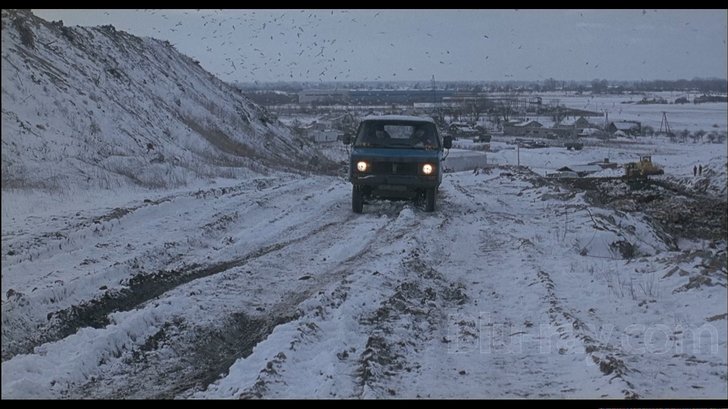
Presented in an aspect ratio of 1.86:1, encoded with MPEG-4 AVC and granted 1080p transfers, Krzysztof Kieslowski's Blue, White and Red arrive on Blu-ray courtesy of British distributors Artificial Eye.
Artificial Eye's high-definition transfers appear to have been sourced from the same MK2 masters Criterion had access to when they prepared their Blu-ray release of Krzysztof Kieslowski's Three Colors trilogy. Unsurprisingly, the two releases have nearly identical technical characteristics.
I did my best to match a couple of screenshots from each film, but there might be small discrepancies as I did not use time codes. Regardless, I believe that the screenshots we have included with the review could give one a fairly good idea how the Artificial Eye release compares to Criterion's release.
Blue
As I noted in our review for the Criterion release, detail and color reproduction are dramatically improved, while the darker sequences are free of the macroblocking patterns that plagued the R1 DVD release. Detail and facial textures in particular are very pleasing, while contrast levels have been successfully stabilized. I was curious to see whether there might be some discrepancies in the color-scheme of the UK release (because back in the days of DVD the UK and U.S. DVD releases had very different color-schemes), but it appears that the prominent blues and browns seen throughout the film look identical on both releases. Finally, the same extremely light noise that is visible on the Criterion release is also present on the Artificial Eye release (compare screenshot #6 with screenshot #1 from our review of the Criterion release). Additional degraining has not been performed and there are no serious stability issues to report in this review).
White
I can only echo the comments from our review of the Criterion release - White's transition to high-definition is the most impressive one. Not only are detail and clarity substantially better, but the coarse sharpening and color bleeding that plagued the R1 DVD release have been effectively eliminated. Unsurprisingly, now the film's light and airy look does not appear compromised (see screenshot #11). This being said, I noticed the same tiny artifacts occasionally popping up here that I noticed on the Criterion release (see the sequence with the garbage field in Poland, where Karol is greeted by his countrymen). Nevertheless, the film looks wonderful, the best it ever has.
Red
Predictably, Red has the strongest high-definition transfer. As it was the case with the Criterion release, close-ups convey wonderful depth, while light and light reflections are handled tremendously well. The color-scheme is also practically identical to that of the Criterion release - the prominent reds and browns are similarly saturated and only during a few selected scenes the Criterion release has slightly stronger greens (compare screenshot #20 with the corresponding screenshot from our review of the Criterion release). All in all, the presentation is of exceptionally high-quality.
(Note: The three Blu-ray discs in the Three Colors Trilogy are Region-Free. Therefore, you will be able to play them on your PS3 or SA regardless of your geographical location. For the record, there is no problematic PAL or 1080/50i content preceding their menus).
The Three Colours Trilogy Blu-ray Movie, Audio Quality
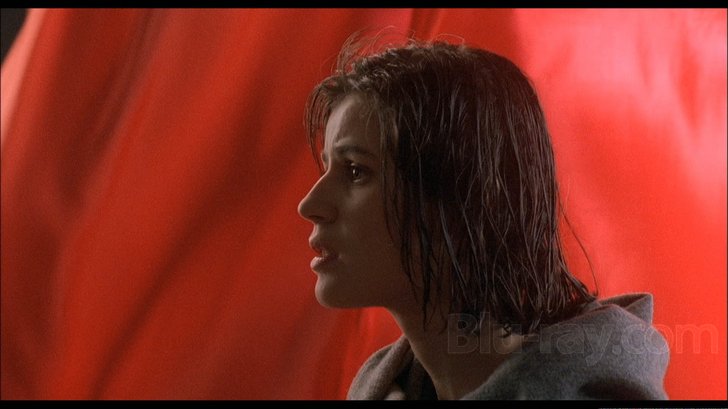
Each of the three films in Three Colors trilogy arrives with French LPCM 2.0 and French DTS-HD Master Audio 5.0 tracks (with large portions of Polish in White), as well as optional English subtitles.
Clearly, it would have been a lot better if Criterion had these two exact same audio options on their Blu-ray box set (obviously, having LPCM 2.0 or DTS-HD Master Audio 2.0 tracks is the same thing). This way some of the confusion that followed up their release would have been avoided.
The depth and clarity of the LPCM 2.0 tracks matches that of the DTS-HD Master Audio 2.0 tracks from the Criterion release (the crispness of the strings and sharp trumpet solo in Blue, for instance, sound identical to me). In Red, Zbigniew Preisner's score also sounds equally rich and vibrant. Now, unlike the Criterion release the Artificial Eye release has DTS-HD Master Audio 5.0 tracks that handle the Pro-Logic surround material. I personally do not find the surrounds to be overly effective, but the fact remains that this is the more flexible option for a number of people who bistream and have experienced some issues with the Criterion Blu-ray box set.
The Three Colours Trilogy Blu-ray Movie, Special Features and Extras
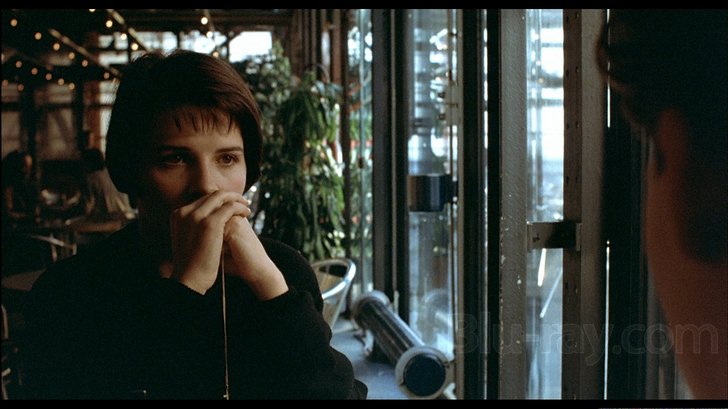
Note: Please note that some of the supplemental features included in this box set are encoded in PAL. Therefore, if you reside in North America where PAL is not supported, you need to have a Region-Free player capable of converting PAL to NTSC in order to view them.
Blue
- Trailers - original theatrical trailers for Blue, White and Red. In French and Polish, with optional English subtitles. (PAL).
- Interviews -
-- Juliette Binoche - the French actress comments on specific scenes from the film. (The comments are part of an audio commentary recorded in 2004). This interview also appears on the Criterion release. In French, with optional English subtitles. (24 min, PAL).
-- Jacques Witta - in this video interview, Jacques Witta, editor of Blue and Red, discusses his collaboration with director Krzysztof Kieslowski, as well as the unique cinematography in each of the three films in the trilogy. In French, with optional English subtitles. (14 min, PAL)
-- Marin Karmitz - a very informative video interview with producer Marin Karmitz, who discusses his first encounter with director Krzysztof Kieslowski, his directing methods, the production history of the three films, etc. This interview is not identical to the one included on the Criterion release. In French, with optional English subtitles. (17 min, PAL).
- Krzysztof Kieslowski's Masterclass - in this segment from 1994, Krzysztof Kieslowski discusses the significance of a specific sequence from Blue, as well as the importance of the sugar cube scene in the Parisian cafe. This feature also appears on the Criterion release. In Polish, with optional English subtitles. (8 min, PAL)
- Trailers - original theatrical trailers for Blue, White and Red. In French and Polish, with optional English subtitles. (PAL).
- The Making of - in this behind-the-scenes featurette, director Krzysztof Kieslowski discusses the production history of White, its unique color scheme, the strange relationship between comedy and drama the film nurtures, etc. In Polish, with imposed French and optional English subtitles.(18 min, PAL).
- Interviews -
-- Julie Delpy - in this long and very informative interview, the French actress recalls her first encounter with director Krzysztof Kieslowski and her work in White, and discusses her character and specific scenes from the film. This interview does not appear in its entirety on the Criterion release. In French, with optional English subtitles. (22 min, PAL).
-- Marin Karmitz - producer Marin Karmitz discusses the production history of White. In French, with optional English subtitles. (6 min, PAL).
- Krzysztof Kieslowski's Masterclass - in this segment from 1994, the Polish director discusses the opening scene from White. This feature also appears on the Criterion release. In Polish, with optional English subtitles. (11 min, PAL).
- Trailers - original theatrical trailers for Blue, White and Red. In French and Polish, with optional English subtitles. (PAL).
- Kieslowski, Cannes 1994 - a short documentary shot during Red's premiere at the Cannes Film Festival. The documentary features interviews with director Krzysztof Kieslowski and actors Irene Jacob and Jean-Louis Trintignant. This feature also appears on the Criterion release. In Polish and French, with optional English subtitles. (16 min, PAL).
- The Making of - raw footage from the shooting of Red, with Krzysztof Kieslowski directing key scenes. In French and English, with optional English subtitles where necessary. This feature also appears on the Criterion release. (24 min, PAL).
- Interviews -
-- Irene Jacob - a long and very informative interview with Irene Jacob, who discusses her work with director Krzysztof Kieslowski on Red, the character she plays (Valentine), the narrative, etc. This interview does not appear on the Criterion release. In French, with optional English subtitles. (19 min, PAL).
-- Jacques Witta - in this video interview, Jacques Witta, editor of Blue and Red, discusses selected sequences from Red as well as the unique framing, use of light, Piotr Sobocinski's cinematography, etc. This interview is not identical to the one found on the Criterion release of Red. In French, with optional English subtitles. (16 min, PAL).
-- Marin Karmitz - in this video interview, producer Marin Karmitz discusses Krzysztof Kieslowski's directing methods, the different teams that assisted the Polish director during the shooting of Red (French, Polish, Swiss-German), the film's premiere at the Cannes Film Festival, the controversy surrounding its "nationality", etc. This interview is not identical to the one found on the Criterion release of Red. In French, with optional English subtitles. (11 min, PAL).
- Krzysztof Kieslowski's Masterclass - in this segment from 1994, the Polish director discusses a key scene from Red (where Rita, the dog, runs away). This feature also appears on the Criterion release. In Polish, with optional English subtitles. (11 min, PAL).
The Three Colours Trilogy Blu-ray Movie, Overall Score and Recommendation

British distributors Artificial Eye's release of Krzysztof Kieslowski's legendary Three Colors trilogy is an excellent alternative for people residing outside of the United States who could not take advantage of Criterion's release. The three films in the box set have been sourced from the same masters Criterion had access to and predictably look just as good. The audio options on the Artificial Eye release are, in my opinion, more flexible, and therefore preferable. As far as supplemental features are concerned, the Criterion release clearly has a better selection. All in all, the Three Colors trilogy's appearance on Blu-ray is undoubtedly a cause for celebration. VERY HIGHLY RECOMMENDED.